Bergmann 1896 and 1897 · Volume 9
Making One: From Parts, From Scratch, and the Law of a New Bergmann
Why there is no parts-kit route, what rebarrelling an original does to its legal status, a from-scratch lab plan for the 1896 and the 1897, barrel blanks that happen to fit the old bores, and a federal replica clause that is open for these cartridges where it was closed for the Borchardt
9.1 Three paths
The hub treats every firearm by three routes: buying an original, building from parts, and building from scratch. For the Bergmanns the first is a collector’s purchase (Volume 8), the second barely exists, and the third is the interesting one, because the 1896 in particular is a simple machine made of flat slabs and a rectangular bolt.
9.2 Path A: an original
An original 1896 costs, on the auction record of the last fifteen years, about $4,500 to $11,000; an 1897 about $11,500 to $24,000 (Volume 8). It is the only route to a real Bergmann. The identification checklist is in Volume 5, the law in Volume 8, and the case against firing an original casually in Volume 7.
9.3 Path B: from parts
There is no parts kit. No reproduction parts, no demilitarised surplus, no new-made frames or barrels for either pistol were found (Volume 6). The only “from parts” Bergmann is an incomplete original completed with parts from other originals, which is what the auction record’s mismatched magazines and replaced grips are.12 That is restoration, not a build, and it lowers value: a completed gun sells as a gun with replaced parts.
A non-firing display replica, the route the hub’s prop dives use for other pistols, would also be a from-parts project; none for the Bergmann 1896 or 1897 was found on sale.
9.4 What rebarrelling does to an original
One tempting project is to make an original shootable by rebarrelling or rechambering it for a cartridge that can be bought, a 7.8 mm 1897 to 7.63 Mauser for example. Mechanically, that asks a pistol of unknown steel and a weak-spring history to run at modern 7.63 Mauser pressure (the C.I.P. maximum is 2,250 bar; the 7.8 mm’s original pressure is unknown).3 Legally, it may change what the pistol is:
- Federally, the GCA’s antique definition turns on the date of manufacture, and the text does not say that a new barrel changes it. No ATF ruling on a rebarrelled pre-1899 cartridge pistol was found.
- Under the NFA and in Michigan, the antique definitions turn on ammunition that is not available. A Bergmann that has been made to fire a commercial cartridge no longer meets that test on any reading. A stocked 1897, or the carbine, would lose the § 5845(g) route out of the NFA described in Volume 8, and a Michigan pistol would lose its antique exemption from licensing.45
On the text, rebarrelling an original to a commercial cartridge is the one change that most clearly costs it its antique status where it matters. It also destroys most of its value. This dive does not recommend it.
9.5 Path C: from scratch, the engineering
Making a Bergmann from bar stock is a realistic lab project. The pistols were made by hand-fitting in the 1890s with the machine tools of the day; a modern shop with a CNC mill, a lathe and a heat-treating oven is better equipped than Schilling was. What it does not have is a drawing.
9.6 Which pistol to make
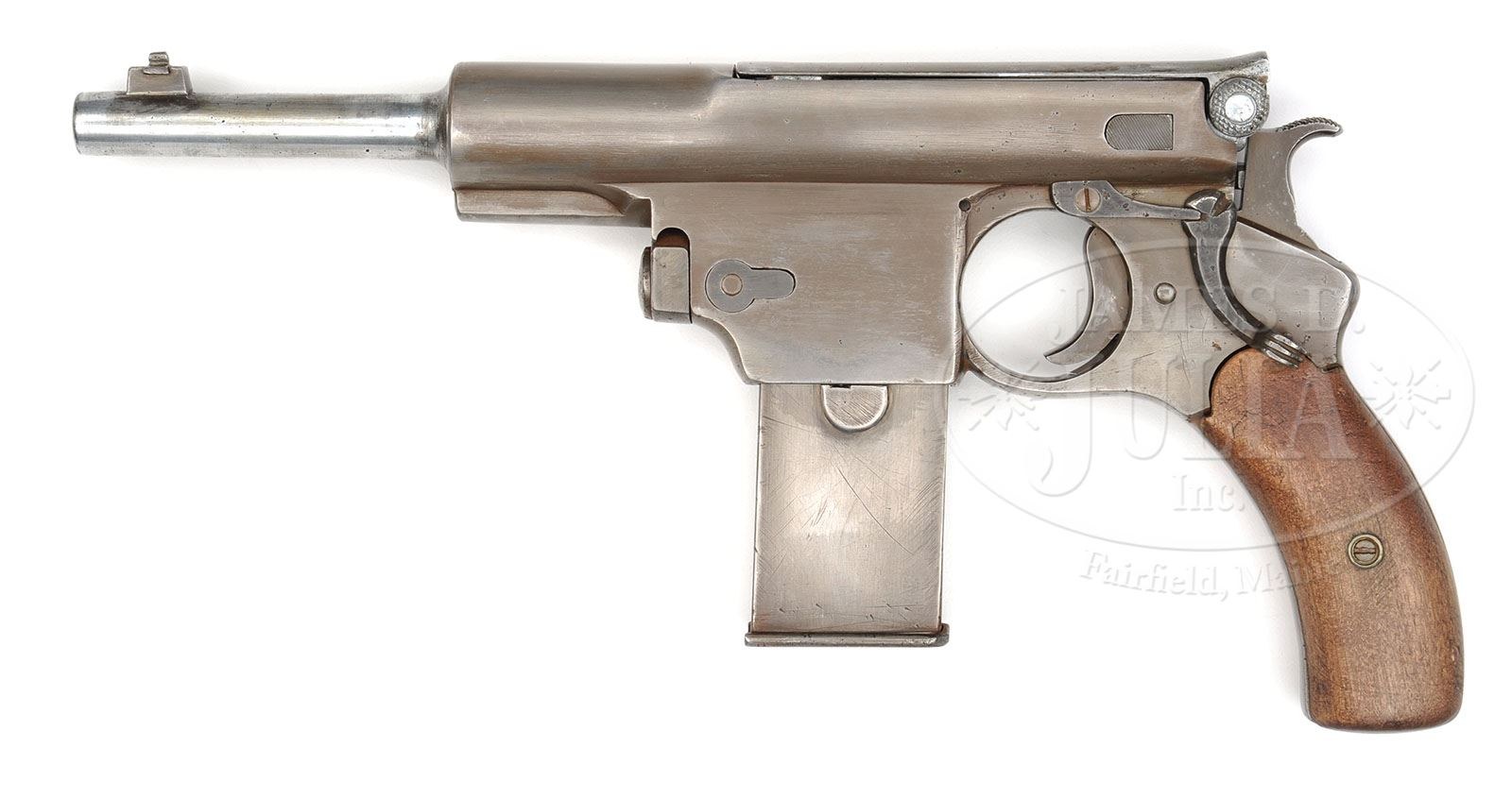
- The 1896 is the simpler and the more forgiving: a one-piece frame that is essentially a profiled plate with a deep magazine housing, a rectangular bolt, an exposed hammer and simple lockwork. Its weakness is the one Volume 1 describes: as a blowback, it is safe only with a weak cartridge, so it must be built for one of the original rounds or a modern cartridge of similar power, and its bolt mass must be right.
- The 1897 is the more interesting and the more demanding: the lateral lock puts the locking surfaces, the cam and a flat spring in a small space; the barrel and extension must slide in a shroud; and the detachable double-column magazine has to feed reliably. Five of the five Sturgess 1897s described had weak recoil springs, which suggests the design runs close to the limit of what its spring can do.6
For a first build the 1896 No. 3 in 6.5 mm or the No. 2 in 5 mm is the sensible choice; the 1897 is a second project.
9.7 Getting the dimensions
No factory drawings, no dimensioned patent drawings and no published measurements beyond overall and barrel lengths were found (Volume 2). The sources of dimensions, in order of quality:
- An original in the hand, measured with the owner’s permission. Nothing else gives chamber, bore, lock and spring dimensions.
- A chamber cast from an original, which also settles the cartridge question in Volume 7.
- The patent drawings of US 547,454 for proportions of the 1894-type mechanism (spring and rod under the barrel, which the 1896 dropped), and the German, Swiss and British patents of 1897 for the lock, which were not read for this dive.7
- Photographs to scale, using a known dimension (the barrel or overall length) as a reference. Good enough for external shape; not good enough for anything that locks, feeds or holds pressure.
9.8 Barrels: blanks that fit the old bores
The measured bullet diameters in Volume 7 sit, by coincidence, close to modern standard calibres, which matters because rifling a barrel is the hardest single job in a small shop.
Table 1 — Barrels: blanks that fit the old bores
| Bergmann | Measured bullet | Nearest modern bore and bullet | Comment |
|---|---|---|---|
| 5 mm | 5.13 mm (0.202 in) | .20 calibre, .204 in bullets | Original is a little under the modern size; slug an original’s bore before choosing |
| 6.5 mm | 6.61 mm (0.260 in) | .264 in (6.5 mm) | Modern 6.5 mm bullets are about 0.1 mm larger; a .260 in groove barrel would need to be made or bullets swaged |
| 7.8 mm | 7.81 mm (0.3075 in) | .308 in (.30 Mauser) | A close match; .30 Mauser barrel blanks and bullets fit |
| 8 mm | 7.96 mm (0.313 in) | .312–.313 in (.32 calibre) | Close |
Bullet diameters from municion.org’s measured specimens; the comparisons are this dive’s.8 Bore and groove of any original were not found, so each figure is a starting point for a slug, not a specification.
9.9 Frame, bolt and lock
- Frame (1896). One piece, in a medium-carbon or alloy steel, machined from plate: the profile, the bolt way along the top, the magazine housing ahead of the trigger, the pockets for hammer, sear and trigger in the rear. On a CNC mill it is a multi-setup part with no compound angles. The hinged magazine sideplate is a separate plate on a pivot screw.
- Bolt (1896). A rectangular block with a bore for the firing pin and a slot for the recoil spring and its cross pin (Volume 4). Its mass is the design’s safety margin and must be settled by calculation for the cartridge chosen, then tested; the original mass is not published.
- Barrel extension, bolt and cam (1897). The two locking lugs are about 3 mm deep and the unlocking travel about 6 mm, by Forgotten Weapons’ account.9 Everything else (lug width and spacing, cam angle, the flat spring’s rate) has to come from an original. These are the parts where an error is dangerous: a lock that unlocks early is a blowback pistol firing a locked-breech cartridge.
- Magazine (1897). A double-column, double-feed box with witness holes. Feed lips and follower are the usual source of trouble in any new-made magazine; plan to make several.
- Hammer interrupter (1897). The part that “keeps the hammer from falling until the bolt is fully forward” is a safety device and must be made and fitted, not omitted.10
9.10 Springs, heat treatment and proof
- Coil springs (recoil, hammer, follower) can be wound in music wire or bought from spring makers to dimension. The recoil spring should be made to give the bolt full closure with margin; the original’s weakness is a warning, not a pattern.
- The 1897’s flat spring must be spring steel, hardened and tempered to a spring temper, and checked for set after cycling.
- Bolt, lugs, extension recesses and cam need a hard wearing surface over a tough core: case-hardening of a low-carbon steel, or through-hardening and tempering of an alloy steel, chosen and specified before machining. The original heat treatment is unknown.
- Proof. The United States has no proof house. A new pistol should be fired first remotely, with a measured load and an over-pressure test cartridge loaded by someone who knows how, and inspected before it is fired by hand. Without published load data (Volume 7), that work starts from nothing and is the riskiest step in the project.
9.11 Path C: the law
A new pistol made from scratch is not an antique by date, and the question is whether it is a “firearm” at all.
The GCA’s replica clause. 18 U.S.C. § 921(a)(16)(B) makes an antique of “any replica of any firearm” made in or before 1898 if the replica “(i) is not designed or redesigned for using rimfire or conventional centerfire fixed ammunition, or (ii) uses rimfire or conventional centerfire fixed ammunition which is no longer manufactured in the United States and which is not readily available in the ordinary channels of commercial trade”.11 For a replica Borchardt C-93 that clause fails, because the 7.63 Mauser cartridge chambers in it and is on sale; the Borchardt dive’s Volume 9 works that through.12 For a faithful replica of an 1896 or an 1897, chambered for an original Bergmann cartridge, the text of (B)(ii) appears to be met: none of the Bergmann cartridges is made in the United States or available in commerce (Volume 7). On that reading, such a replica would be a GCA antique.
Three cautions keep that from being an answer:
- It is this dive’s reading of the text. No ATF ruling on a Bergmann replica was found, and ATF’s classification branch can be asked for a written determination on a sample. For anything to be sold or carried across state lines, that letter is the prudent step.
- A replica chambered for any commercial cartridge, or one that can be “readily” converted to one, is a firearm.
- The replica clause is in the GCA only. The NFA’s antique definition has no replica limb for cartridge guns, so a new Bergmann fitted with a shoulder stock, or a new carbine, is a short-barrelled rifle under the NFA whatever its GCA status: approval and registration first, at a $0 tax under Public Law 119-21.413
If it is a firearm. Making a firearm for personal use needs no licence, in ATF’s own words: “No, a license is not required to make a firearm solely for personal use”, with the exceptions the Borchardt dive quotes.12 The regulated part is the frame or receiver as defined in 27 CFR 478.12, which for a single-piece pistol is the part that houses the fire-control components; on both Bergmanns the hammer, sear and trigger sit in the one-piece frame, so on this dive’s reading the frame is the receiver. Marking is required of licensees, not of a private maker, but marking a home-made pistol with a maker’s name and a serial costs nothing and helps if it is ever transferred.
9.12 Michigan and a home-made pistol
Michigan’s antique definition has no replica limb for a cartridge gun: its limb (ii) speaks of “a firearm using fixed ammunition manufactured in or before 1898”, which a new pistol is not on the ordinary reading.5 So a new-made Bergmann is a pistol in Michigan, even if it were a federal antique, and the state’s pistol licensing law applies. The Borchardt dive works through the problem that the Michigan scheme assumes a seller and a purchaser and has no step for a self-made pistol, and notes that a concealed pistol licence holder is exempt from the licence requirement; that analysis applies here unchanged, and it recommends a written question to the State Police before the pistol is made.12
9.13 What could not be established
- Any factory drawing or dimension beyond lengths; bore and groove diameters; bolt masses; spring rates; heat treatment.
- The texts of the 1897 patents.
- Any ATF ruling on a rebarrelled antique Bergmann or on a Bergmann replica under § 921(a)(16)(B)(ii).
- Any Michigan State Police position on a home-made pistol or on a replica.
- Any current non-firing replica.
References
Footnotes
-
James D. Julia, Inc., Spring 2014, lot 3029, https://jamesdjulia.com/item/3029-358 (accessed 2026-10-19). ↩
-
James D. Julia, Inc., Fall 2010, lot 1075, https://jamesdjulia.com/?p=469478 (accessed 2026-10-19). ↩
-
C.I.P., TAB. IV, “7,63 Mauser”, third-party copy https://www.tiropratico.com/CIP/Commission%20Internationale%20Permanente/763mauser.pdf (accessed 2026-10-19). ↩
-
26 U.S.C. § 5845(a), (g), Cornell LII, https://www.law.cornell.edu/uscode/text/26/5845 (consulted 2026-10-18). ↩ ↩2
-
MCL 750.231a, https://legislature.mi.gov/Laws/MCL?objectName=mcl-750-231a (accessed 2026-10-19). ↩ ↩2
-
James D. Julia, Inc., Fall 2013, lot 3192A, https://jamesdjulia.com/item/lot-3192a-bergmann-m1897-no-5-presentation-with-matching-shoulder-stock-52046/ (accessed 2026-10-19); and lots 3191, 3192, 3029, 3030 (Volume 4). ↩
-
Louis Schmeisser, US Patent 547,454, 8 October 1895, https://patentimages.storage.googleapis.com/pdfs/US547454.pdf (accessed 2026-10-19). ↩
-
municion.org (Jordi Camerón), Bergmann cartridge pages and drawings, via Internet Archive captures of http://www.municion.org/bergmann/ (accessed 2026-10-19). ↩
-
Ian McCollum, “Bergmann No.5 / 1897 Pistol”, Forgotten Weapons, 15 November 2013, https://www.forgottenweapons.com/bergmann-no-5-1897-pistol/ (accessed 2026-10-19). ↩
-
James D. Julia, Inc., Fall 2013, lot 3192, https://jamesdjulia.com/?p=484810 (accessed 2026-10-19). ↩
-
18 U.S.C. § 921(a)(16), Cornell LII, https://www.law.cornell.edu/uscode/text/18/921 (text consulted 2026-10-18; quoted in the Borchardt dive’s research notes). ↩
-
Borchardt C-93 dive, Volume 9, /actual-firearms/pistols/borchardt-c93/vol-9/, quoting ATF, “Does an individual need a license to make a firearm for personal use?” and the Michigan statutes. ↩ ↩2 ↩3
-
Suppressor law dive, Volume 3, /suppressors/suppressor-law/vol-3/. ↩
Comments (0)