Bergmann 1896 and 1897 · Volume 4
How They Work: An Unlocked Bolt and a Bolt That Steps Aside
The 1896 cycle from the patent and the field-strip descriptions, the clip magazine, the lockwork and its disconnector, and the 1897's laterally locked short recoil, part by part, with what the sources leave undescribed marked as such
4.1 What is known and what is not
No factory manual for either pistol was found for this dive, in English or German, and no armourer’s drawing. What follows is built from four kinds of evidence: Louis Schmeisser’s US patent of 1895, which describes the 1894 and therefore the principle of the 1896; the descriptions of Forgotten Weapons, Ed Buffaloe and the auction cataloguers at James D. Julia and Rock Island, who had the guns in hand; the photographs in this dive; and engineering reasoning, which is labelled where it is used. The two diagrams are schematics drawn from those descriptions, not reconstructions of the factory drawings.
4.2 The 1896: parts that matter
Table 1 — The 1896: parts that matter
| Part | What it does | Source |
|---|---|---|
| Frame | One piece carrying the barrel, the magazine in front of the trigger and the grip; open on top for the bolt and ejection | patent; photographs |
| Barrel | Fixed to the frame by a screw and lug (early) or screwed in (later) | Forgotten Weapons |
| Bolt | Rectangular block sliding straight back in the top of the frame; knurled knob at the rear for cocking by hand | patent; photographs |
| Recoil spring | Inside the rear of the bolt (moved there from under the barrel in 1896) | Forgotten Weapons |
| Cross pin | Rectangular pin through the bolt, retaining the recoil spring | Buffaloe |
| Firing pin | In the bolt, retained by a screw at the rear right of the bolt; no firing-pin spring in the 1894 patent | Buffaloe; patent |
| Dust cover | On the No. 3 and No. 4, a cover over the ejection port that moves with the bolt | Forgotten Weapons |
| Hammer | Exposed, behind the bolt; cocked by the bolt as it recoils | patent; photographs |
| Magazine | Fixed; a hinged sideplate on the right swings open to take a five-round clip; a spring-loaded follower raises the rounds | Forgotten Weapons; Julia; Buffaloe |
| Safety | A lever at the left rear of the frame, above the grip | photographs; Julia |
Sources: US 547,454; Forgotten Weapons; Buffaloe; Julia.12345
4.3 The 1896 cycle, step by step
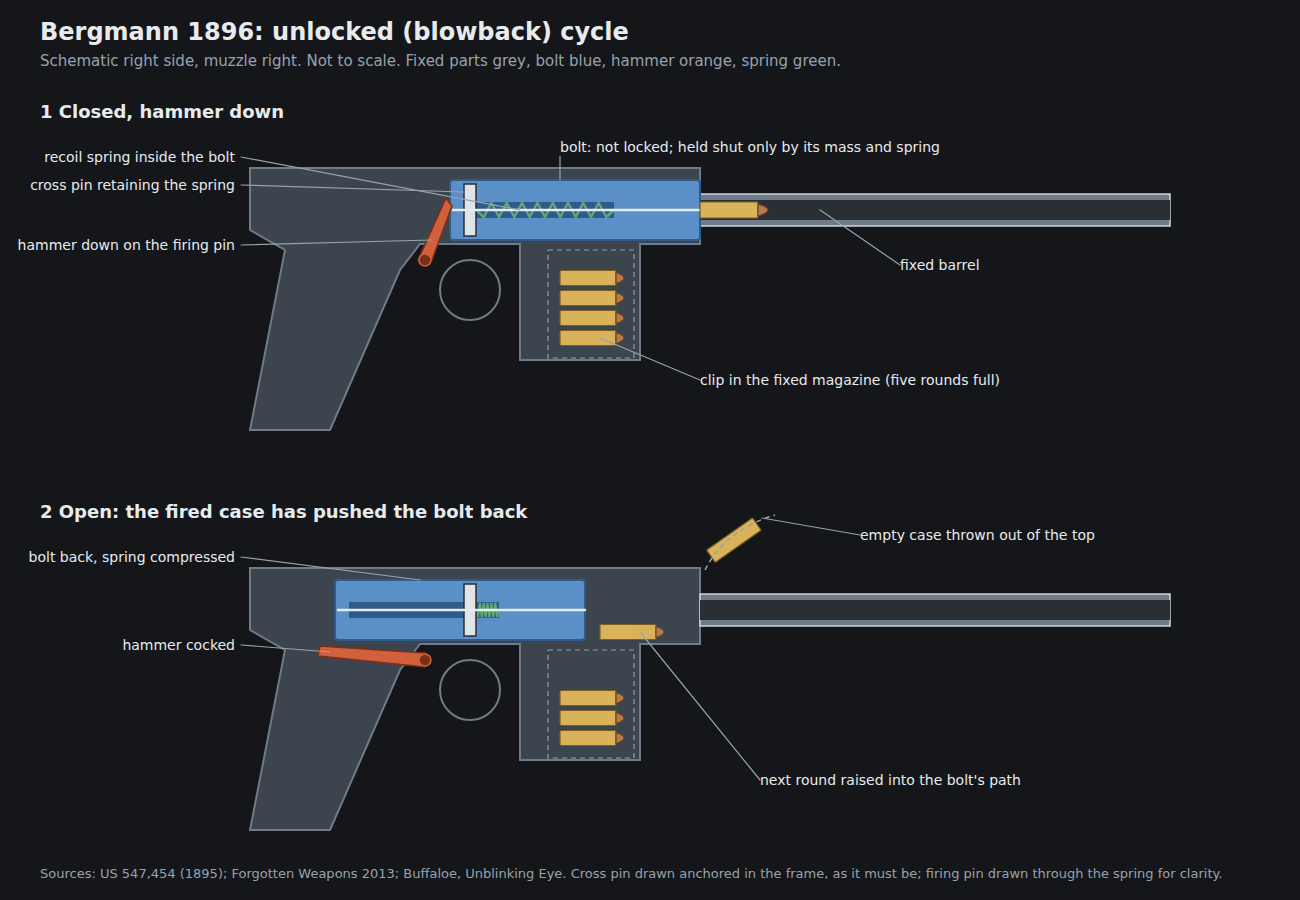
- Fire. The hammer falls on the firing pin and the cartridge fires. Nothing locks the bolt; it is held against the breech only by its mass and by the recoil spring.
- Bolt recoils. The patent’s principle applies: pressure acts equally on bullet and case head, but the bolt, “the weight of which is a certain multiple of that of the projectile”, starts slowly, so that by the time the bullet leaves the barrel the bolt “has been driven back only a short way”. The case, pressed against the bolt face, seals the breech meanwhile.1
- Case out. Residual pressure keeps driving the case and bolt back together. On early guns with no extractor, that pressure is the only thing pulling the case from the chamber; later guns add an extractor (below).
- Ejection. The case is thrown out of the top of the action (Forgotten Weapons describes ejection as “vertical”).2
- Cocking. The rear of the bolt rides over the hammer and rocks it back to full cock; the recoil spring in the bolt is compressed against its cross pin.
- Feeding. With the bolt clear, the follower pushes the next cartridge up into the bolt’s path.
- Return. The spring drives the bolt forward; it pushes the round into the chamber and comes to rest against the breech, ready to fire.
The figure draws the cross pin anchored in the frame, with the spring between it and the bolt. That is how such a pin must work if the spring is to return the bolt, and it is drawn so for clarity; no drawing of the 1896’s spring and pin was found.
4.4 Loading the 1896
The 1896 is loaded through the side. Julia’s cataloguer puts it plainly: all the Nos. 2, 3 and 4 “had an integral magazine that was loaded by rotating down the magazine sideplate and inserting a clip of cartridges from the side”.5 The sideplate, with its two angled slots, pivots on the large screw at the front of the magazine housing on the right. Forgotten Weapons adds that a follower finger is rotated aside while the clip goes in and then pushes the cartridges up, and that when the last round has been fed the empty clip falls out through the bottom of the magazine; Buffaloe adds that a spring arm puts tension on the cartridges as the cover is closed.24 The clips hold five rounds and are specific to each calibre.3
Loading without a clip was possible on the 1894, according to R. K. Wilson, but made the pistol “fairly prone to misfeeding”.6 Whether the same holds for the 1896 was not found.
4.5 Extraction and ejection
The early 1896 had no extractor, as the 1894 had none, and fired cartridges with no groove and no rim (DWM 416 and 413). Schmeisser then added an extractor and the cartridges gained a groove (416A and 413A); when that happened is disputed (Volume 2).23
How the case was thrown clear is described two ways. The 1893 patent has an “ejection-bar” at the rear wall of the frame, which the case strikes “in the well-known manner” as it comes back.1 The English Wikipedia article, citing Dougherty, says the spent case of the 1896 “bounced off the next round in the magazine”, a fault removed in later designs.7 The two are not exclusive (a patent drawing and a production gun can differ), and the sources do not settle which the production 1896 used.
4.6 The lockwork
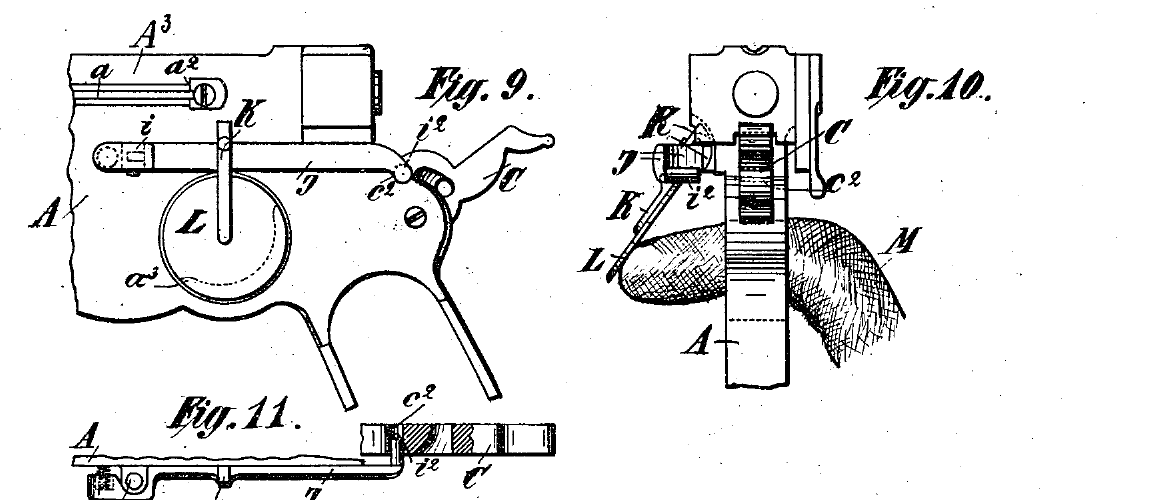
The 1896 is single action, with an exposed hammer. The patent explains a problem every self-loader of the period had to solve, and Schmeisser’s answer. “In auto-loading firearms the hammer is cocked so soon after the explosion that the finger cannot let the trigger go back quickly enough”, so the sear might not catch the hammer at full cock and the gun could fire again or follow the bolt down. The patent’s cure is an “intermediate piece” between trigger and sear: it lifts the sear when the trigger is pulled, then slides off the sear’s tooth so that the sear can catch the recocked hammer even while the finger still holds the trigger back, and resets only when the trigger is released.1 That is a disconnector, and the patent of 1893 is an early statement of it.
The production 1896’s safety is the lever at the left rear of the frame, above the grip, visible in every 1896 photographed for this dive and called a “flip safety” by Julia.8 What it blocks (hammer, sear or trigger) is not described in any source consulted.
The patent also describes a “trigger-safety” that has not been seen on any production gun: a lever on the back of the frame holds the hammer cocked until a finger, entering the trigger guard, pushes aside a small disc and releases it.1
4.7 The 1897: parts that matter
Table 2 — The 1897: parts that matter
| Part | What it does | Source |
|---|---|---|
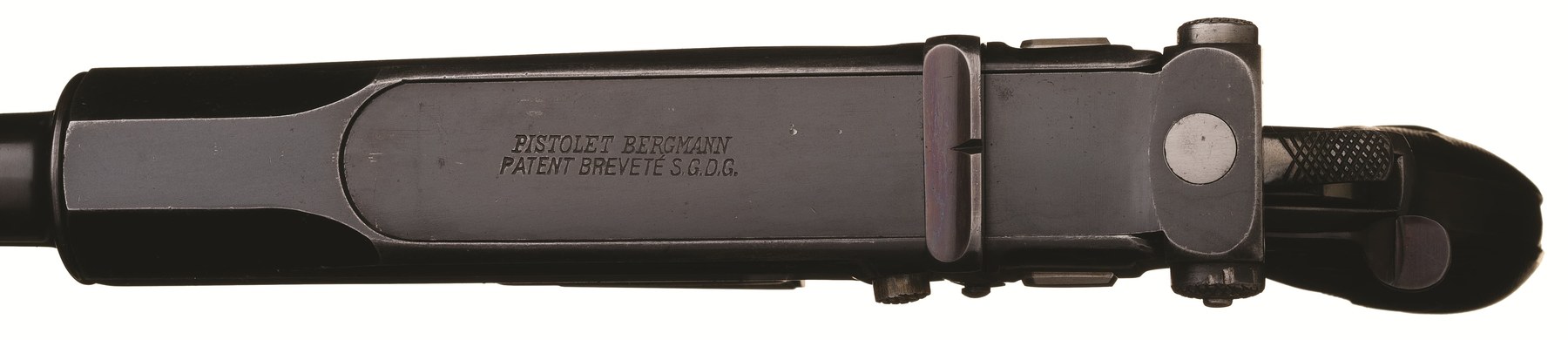
| Barrel and extension | Slide back together inside a fixed shroud; the extension carries the recesses the bolt locks into | Rock Island; Forgotten Weapons |
| Shroud and lock lever | Fixed outer casing; a lever at its rear holds it to the frame for takedown | Julia; Rock Island |
| Bolt | Locks to the barrel extension with two lugs on its left side, about 3 mm deep | Forgotten Weapons |
| Flat spring | On the right of the bolt, holding the bolt over to the left, into the recesses | Forgotten Weapons |
| Cam | Fixed surface that meets the rear lug after about 6 mm of travel and drives the bolt to the right | Forgotten Weapons |
| Recoil spring | Returns the bolt; described as sluggish on most surviving guns (below) | Julia |
| Extractor | On the right of the frame, fire-blued; the serial is stamped near it | Julia |
| Hammer interrupter | On the right of the frame; “keeps the hammer from falling until the bolt is fully forward” | Julia |
| Hold-open latch | Holds the bolt open | Rock Island |
| Gas port | On the left of the receiver, to vent a ruptured case | Rock Island |
| Magazine | Detachable double-column box, normally ten rounds, with witness holes; released by a catch; can be charged from a stripper clip through the top | Forgotten Weapons; Julia |
| Safety | Lever at the left rear, with a separate “safety stop” | Julia; photographs |
4.8 The 1897 cycle, step by step
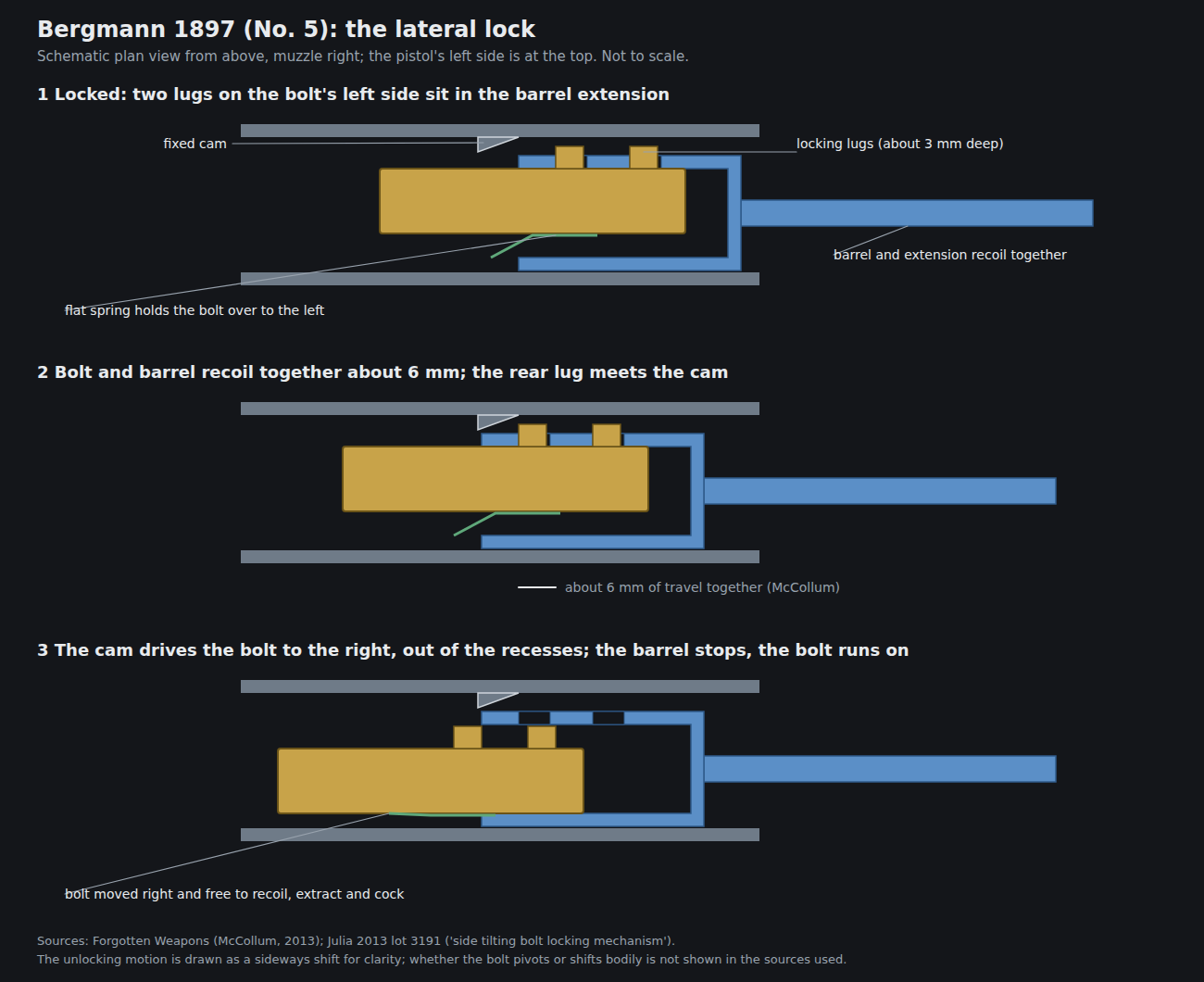
- Fire, locked. At the shot the bolt is locked to the barrel extension by its two left-side lugs, held there by the flat spring on its right.9
- Recoil together. Barrel, extension and bolt move back together inside the shroud, “about 6mm” in Forgotten Weapons’ figure and “about 6 mm” in Rock Island’s.910 The bullet has left the barrel during this travel; the sources give no timing, and that sequence is the one any short-recoil lock relies on.
- Unlock. A camming surface on the rear lug meets a fixed surface and pushes the bolt to the right, out of the recesses.9 Julia calls this a “side tilting” bolt; Forgotten Weapons and Wikipedia describe the bolt as swung or moved sideways.147 Whether it pivots or shifts bodily is not described closely enough to draw, and the diagram shows a shift for clarity.
- Barrel stops. The barrel and extension stop and return forward. What returns them (a separate barrel spring or the bolt on its way home) is not described in the sources found.
- Extract, eject, cock. The bolt runs on alone, drawing the case out on the extractor, ejecting it, cocking the hammer and compressing the recoil spring.
- Feed and lock. The spring returns the bolt, which strips the top round from the double-column magazine, chambers it and re-enters the extension, where the flat spring pushes it back to the left into the recesses.
- Hammer released. Only when the bolt is fully home does the interrupter on the right of the frame let the hammer fall.12 After the last round, the hold-open latch catches the bolt.10
4.9 Why the lateral lock is unusual
Most locked-breech pistols of the period, and nearly all since, unlock by moving something up or down: the Borchardt’s toggle breaks upward, the Mauser C96’s locking block drops, a Browning barrel tilts. The 1897’s bolt moves sideways. Forgotten Weapons calls the arrangement one of the few of its kind ever made, and it did not last even at Bergmann: the Mars of 1903 replaced it with a block that moves vertically, which the Bergmann-Bayard kept.94 The Borchardt C-93 and Mauser C96 dives describe their own locks in detail.
4.10 The weak point the auction record shows
Julia’s cataloguer described five 1897s from the Sturgess collection in 2013 and 2014, and his condition notes repeat one phrase. Serial 117: “The bolt return spring is sluggish, requiring an assist for full closure.” Serial 156: “the bolt return spring is sluggish”. Serial 96: “the bolt return spring is sluggish”. The carbine, serial 493: “The bolt return spring is sluggish, requiring an assist for full closure.” The prototype: “Bolt return is sluggish, with full closure requiring a manual prompt.”1112131514 All five. The pistols catalogued from other collections (serials 260, 475, 544, 570) carry no such note. The cause is not stated: original springs over a century old, a design that asked a lot of one spring, or both. It is the most consistent mechanical fact in the record, and it bears directly on the Swiss judgement that the pistol was “too fragile or temperamental for service use” and on anyone thinking of firing one (Volume 6).9
4.11 Carrying: a free firing pin
The 1893 patent says the firing pin “is not worked by a spring” and “can slightly move axially in the bolt”, and Antaris says the same of the 1894.116 An exposed hammer resting on a free firing pin over a loaded chamber is the arrangement single-action revolvers are not carried with, and the same reasoning applies here. Whether the production 1896 and 1897 kept the springless pin is not stated in the sources consulted (Rock Island mentions only “the thin, lightweight firing pin” of a late No. 4).17 The safe reading, and this dive’s, is not to carry either pistol with the hammer down on a loaded chamber.
4.12 What could not be established
- A factory or armourer’s description of either mechanism.
- How the 1896’s safety works, and what the 1897’s “safety stop” does.
- Whether the production 1896 ejects on a fixed ejector, on the next cartridge, or both.
- Whether the 1897’s bolt pivots or shifts; what returns its barrel; where its recoil spring sits.
- Whether the production pistols have a firing-pin spring.
References
Footnotes
-
Louis Schmeisser, assignor to Theodor Bergmann, US Patent 547,454, “Recoil Operated Firearm”, 8 October 1895, https://patentimages.storage.googleapis.com/pdfs/US547454.pdf (accessed 2026-10-19). ↩ ↩2 ↩3 ↩4 ↩5 ↩6
-
Ian McCollum, “Bergmann No. 2 / 1896 Pistol”, Forgotten Weapons, 8 November 2013, https://www.forgottenweapons.com/bergmann-no-2-1896-pistol/ (accessed 2026-10-19). ↩ ↩2 ↩3 ↩4
-
Ian McCollum, “Bergmann No. 3 / 1896 Pistol”, Forgotten Weapons, 12 November 2013, https://www.forgottenweapons.com/bergmann-no-3-1896-pistol/ (accessed 2026-10-19). ↩ ↩2 ↩3
-
Ed Buffaloe, “The Bergmann Pistols”, Unblinking Eye, https://unblinkingeye.com/Guns/Berg/berg.html (accessed 2026-10-19). ↩ ↩2 ↩3
-
James D. Julia, Inc., April 2017, lot 1522, Bergmann M1896 No. 3 target, serial 898, https://jamesdjulia.com/item/1522-396/ (accessed 2026-10-19). ↩ ↩2
-
Ian McCollum, “Bergmann 1894 – No.1 Pistol”, Forgotten Weapons, https://www.forgottenweapons.com/early-automatic-pistols/bergmann-no1-1894/ (accessed 2026-10-19). ↩
-
“Bergmann 1896”, English Wikipedia, https://en.wikipedia.org/wiki/Bergmann_1896 (accessed 2026-10-19); cites Dougherty (2014). ↩ ↩2
-
James D. Julia, Inc., Fall 2012, lot 2472, Bergmann Model 1896 No. 3, serial 479, https://jamesdjulia.com/item/lot-2472-bergmann-model-1896-no-3-semi-automatic-pistol-46957/ (accessed 2026-10-19). ↩
-
Ian McCollum, “Bergmann No.5 / 1897 Pistol”, Forgotten Weapons, 15 November 2013, https://www.forgottenweapons.com/bergmann-no-5-1897-pistol/ (accessed 2026-10-19). ↩ ↩2 ↩3 ↩4 ↩5 ↩6
-
Rock Island Auction Company, 5 December 2020, lot 1558, M1897 serial 260, https://www.rockislandauction.com/detail/81/1558/bergmann-model-1897-semi-automatic-pistol-with-holsterstock (accessed 2026-10-19). ↩ ↩2 ↩3
-
James D. Julia, Inc., Fall 2013, lot 3192A, M1897 serial 117, https://jamesdjulia.com/item/lot-3192a-bergmann-m1897-no-5-presentation-with-matching-shoulder-stock-52046/ (accessed 2026-10-19). ↩ ↩2
-
James D. Julia, Inc., Fall 2013, lot 3192, M1897 serial 156, https://jamesdjulia.com/?p=484810 (accessed 2026-10-19). ↩ ↩2 ↩3
-
James D. Julia, Inc., Spring 2014, lot 3030, M1897 serial 96, https://jamesdjulia.com/item/3030-358 (accessed 2026-10-19). ↩ ↩2
-
James D. Julia, Inc., Fall 2013, lot 3191, M1897 prototype, https://jamesdjulia.com/?p=484809 (accessed 2026-10-19). ↩ ↩2
-
James D. Julia, Inc., Spring 2014, lot 3029, M1897 carbine serial 493, https://jamesdjulia.com/item/3029-358 (accessed 2026-10-19). ↩
-
Leonardo M. Antaris, “Bergmann’s Extraordinary Pistols”, American Rifleman, 18 October 2021, https://americanrifleman.org/content/bergmann-s-extraordinary-pistols (accessed 2026-10-19). ↩
-
Rock Island Auction Company, 11 September 2016, lot 3300, 1896 No. 4 serial 2429, https://www.rockislandauction.com/detail/68/3300/bergmann-theodor-1896-pistol-8-mm (accessed 2026-10-19). ↩
Comments (0)