Bergmann 1896 and 1897 · Volume 3
The 1897 No. 5: A Locked Breech, Two Armies and the Line to the Bayard
Prototypes on the No. 4 frame, three patents in a year, a presentation pistol for the man who wrote the book on Bergmann's recoil loaders, Swiss and British refusals, the carbine, and the successors told briefly
3.1 Why a locked breech
By 1897 the 1896 had found its market and lost the one Bergmann wanted. Forgotten Weapons sums up the problem with the No. 4: its 8 mm cartridge “was still too weak to interest military commissions”, and “when it became apparent that the design would not meet military requirements, development proceeded on to the No.5 design, which would introduce a locked breech to allow a significantly stronger cartridge.”1 Volume 1 sets out why: an unlocked bolt has to grow with the cartridge, and the 1896’s frame could not.
The cartridge Bergmann chose was a direct answer to the Mauser C96, which had appeared in 1896. Forgotten Weapons describes the 7.8 mm Bergmann as using “the exact same size bullet as the 7.63mm Mauser”, an 85-grain bullet at about 1,300 ft/s (400 m/s), in a bottlenecked case whose longer neck keeps the two rounds from being interchangeable.2 Volume 7 tests that claim against the dimensions and finds it holds. The Mauser C96 dive owns the Mauser cartridge.
3.2 Prototypes
Julia’s sale of Geoffrey Sturgess’s collection in 2013 included an unnumbered 1897 prototype in the white, and its catalogue is the best description of how the No. 5 began: “Prior to initiating production of the M1897, Bergmann made a number of prototypes. Most were based on the M1896, No.4, scaled up for the 7.8mm cartridge modified to use a detachable magazine and incorporating the Bergmann side tilting bolt locking mechanism that characterises the M1897 No 5 pistols.”3
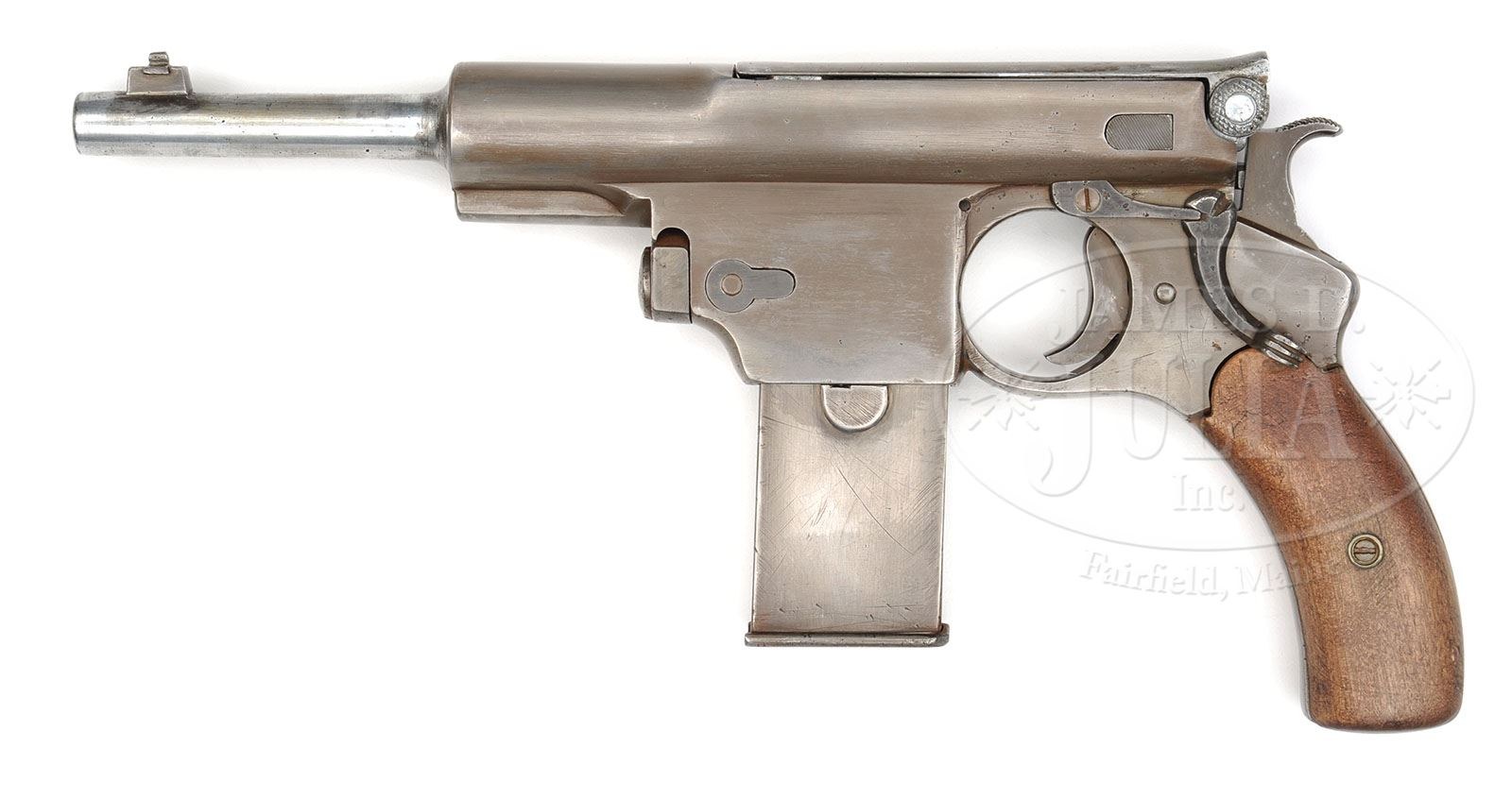
That pistol, which Julia says has Swiss provenance, has a quick-detachable 5.25-inch barrel without a shroud and with sights like the No. 3 and No. 4’s; a heavier receiver than the blowback guns; a different ejector and a “pivoting hammer blocking safety lever” on the right; a single-column detachable magazine released by a push button on the right; four indicator holes in the magazine well, three of them matching holes in the magazine; and no serial or proof marks. Its only marking is the early bare miner logo, without Schilling’s letters, on a sideplate that still has the “thick staple used for the No. 3/No.4 shoulder stock”.3 Julia notes that it closely resembles Swiss Patent 14,716 of 18 July 1897.3
Forgotten Weapons shows two further early guns: a Swiss trial pistol, from Reinhart and am Rhyn, with a full-length barrel shroud and a tangent rear sight whose blade is missing, and a Sturgess prototype with no serial, “a spring-loaded pivoting bar on the upper receiver”, a single-stack magazine, no adjustable sight and a single Bergmanns Industriewerke marking.2 Whether that is the pistol Julia sold as lot 3191 is not stated; the descriptions overlap but are not identical.
3.3 Three patents in 1897
The locking system was patented in at least three countries within the year. None of the three documents was read for this dive; they are listed with their sources so that they can be found.
Table 1 — Three patents in 1897
| Country | Number | Date | Reported by |
|---|---|---|---|
| Germany | 98,318 | 10 March 1897 | Buffaloe4 |
| Switzerland | 14,716 | 18 July 1897 | Julia (prototype description)3 |
| Great Britain | 17,251 | 9 October 1897 | Forgotten Weapons2 |
The German date is earlier than any trial and earlier than the C96’s Swiss debut of early 1897, which is consistent with the locked Bergmann having been designed against the Mauser cartridge as soon as that cartridge existed.
3.4 The production pistol
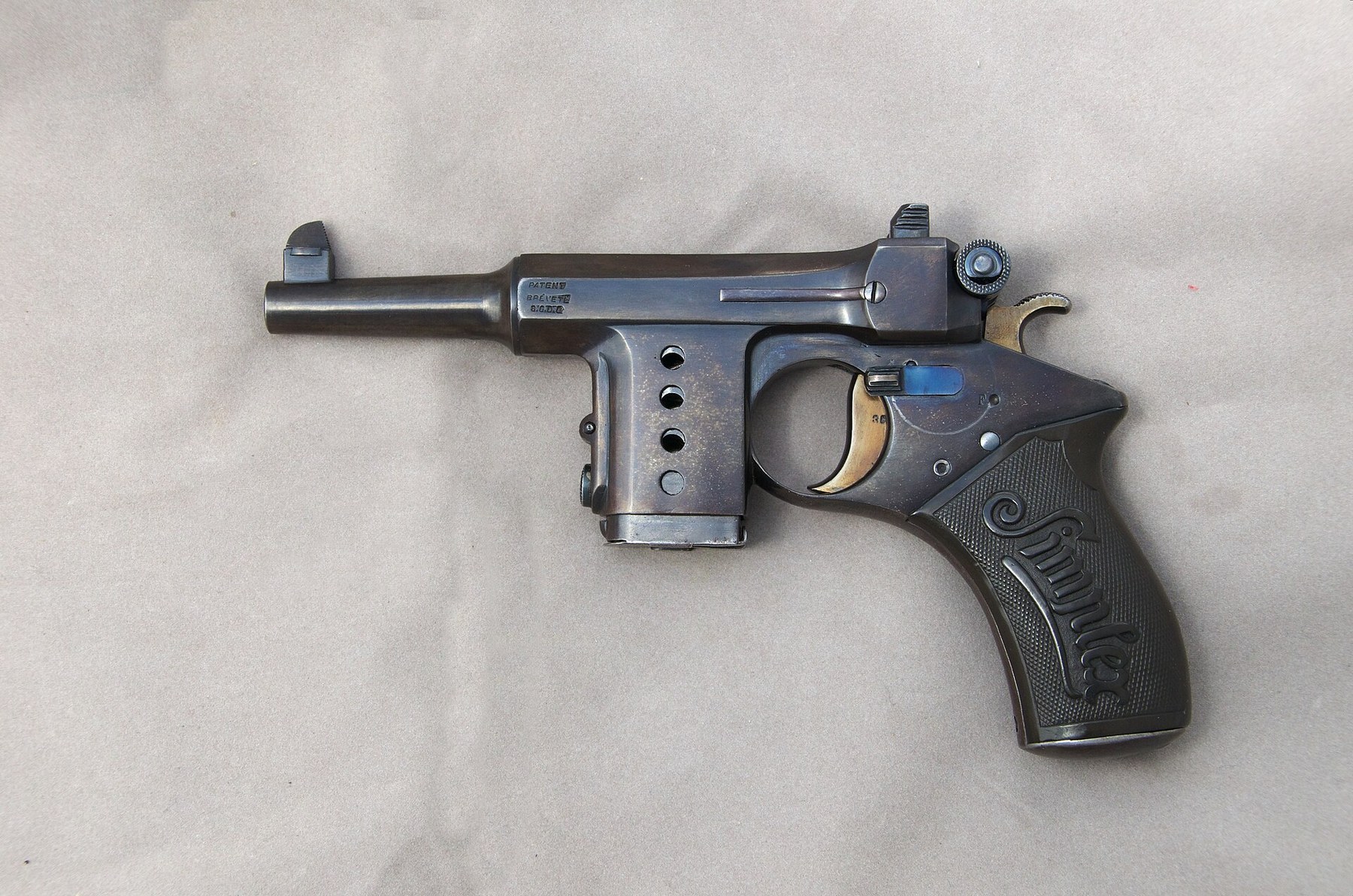
The production No. 5 keeps the 1896’s rear half (grip, exposed hammer, single-action lockwork, sliding cover over the bolt and the manual safety at the left rear of the frame) and replaces everything forward of the trigger guard.25
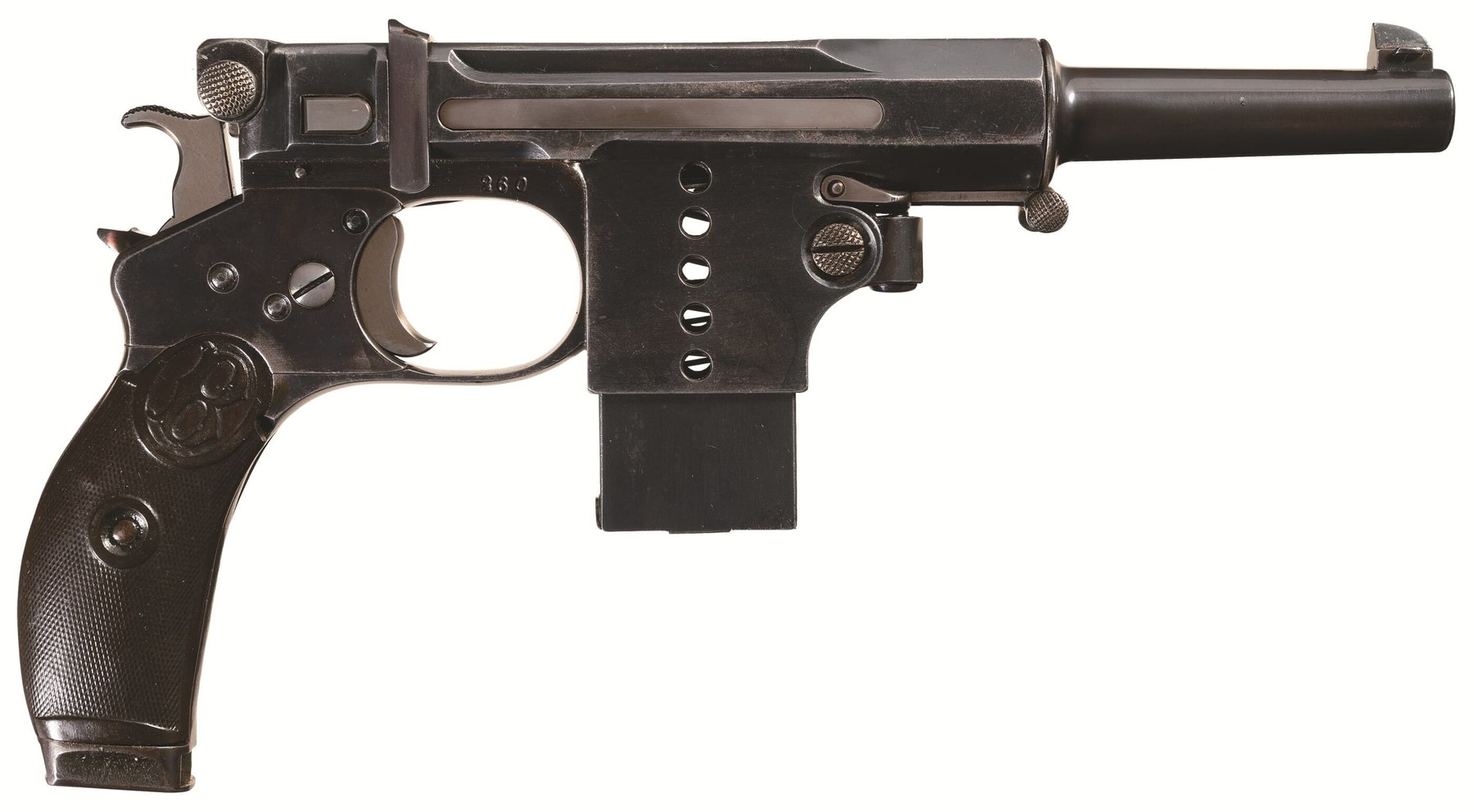
The parts that are new, as the descriptions give them:
- A barrel inside a shroud. Rock Island describes “an outer barrel casing with an internal sliding barrel that is directly in line the breechblock”, which recoils “about 6 mm to unlock the breech”.6 The shroud is held by a lever, strawed on the guns Julia catalogued as the “bbl shroud stop lever” or “shroud locking lever”.75
- The lateral lock. Two locking lugs about 3 mm deep on the left of the bolt, a flat spring on the right holding the bolt into the barrel extension, and a cam that swings the bolt to the right after about 6 mm of travel (Volume 4).2
- A detachable magazine. A double-column, double-feed box, normally of ten rounds, with witness holes on each side matched by holes in the magazine well, loadable from a stripper clip in the pistol or replaced whole.2 The well has four holes on some guns and five on others (Volume 5).58
- A long-range sight. A rear sight on the frame graduated from 100 to 1,000 metres, marked “1,3,5,7,9,1000” in Julia’s reading, with a spring-loaded button so that it does not move under recoil.52
- A hammer interrupter. On serial 156, “attached to the right frame is a hammer block/interrupter that keeps the hammer from falling until the bolt is fully forward”.8
- A hold-open and a gas vent. Rock Island mentions “a bolt hold-open latch (both patented features)” and “a gas port on the left side of the receiver to avoid any over pressure in the event there was a ruptured cartridge”.6
- A stock slot. Forgotten Weapons believes every 1897 has the slot for a stock in the grip, where 1896s were slotted only if sold with one; the Julia and Rock Island guns all show it.289
The top of the bolt cover is marked “PISTOLET BERGMANN / PATENT BREVETÉ S.G.D.G.”, in French, which a photograph of serial 260 confirms; the carbine’s cover reads “KARABINER BERGMANN, PATENT BREVETE S.G.D.G.”.610 The proof is a crown over crown over U on the left of the frame and on the back of the bolt, and the serial is on the right of the frame.78
3.5 How many, and in what order
The production figure is given three ways:
Table 2 — The production figure is given three ways
| Figure | Source |
|---|---|
| ”about 800” | Forgotten Weapons; Ezell, via Wikipedia; Julia catalogues of 2008–201221112 |
| ”approximately 1,000” | Julia catalogues of 2013–2014 (Sturgess collection)510 |
| “only a few hundred” | Rock Island, 20206 |
Antaris gives the serial range for “all 1897 variations” as 1 to 1000.13 The highest serial in the auction record consulted is 570.14 A range of 1 to 1,000 and a total of about 800 are not in conflict if numbers were skipped or the last block was not filled, but no source explains the gap.
Julia’s 2013 cataloguer says that “during its production there ensued a number of variations, largely directed to the milling pattern of the right frame”, and his predecessors in 2010 and 2012 called serial 475 “the 2nd type” for its “hook end bolt locking spring, screw and plate for ejector”.512 The descriptions are not enough to draw a type table, and none is attempted here.
3.6 Barrel lengths and the carbine
No two descriptions agree on the standard barrel, which suggests that more than one length was sold.
Table 3 — Barrel lengths and the carbine
| Barrel | Pistols | Source |
|---|---|---|
| 3 in | serials 96, 117, 156 | Julia 2013–2014758 |
| 4 in | serial 544 | Julia 20099 |
| 4-1/4 in | serials 475, 570 | Julia 2010, 20121214 |
| 4-5/8 in | serial 260 | Rock Island 20206 |
| 3.5 to 5.25 in, “typically” | — | Forgotten Weapons2 |
| 13.5 in, “standard length” carbine | serial 493 | Julia 201410 |
| about 12 in (30 cm), “a few” | — | Wikipedia11 |
The 3-inch figures sit oddly with the photographs, in which serials 117 and 156 look no shorter in the barrel than serial 260; they may be measured to the shroud rather than to the breech. That is an inference from the photographs, not a measurement, and the table keeps the figures as published.
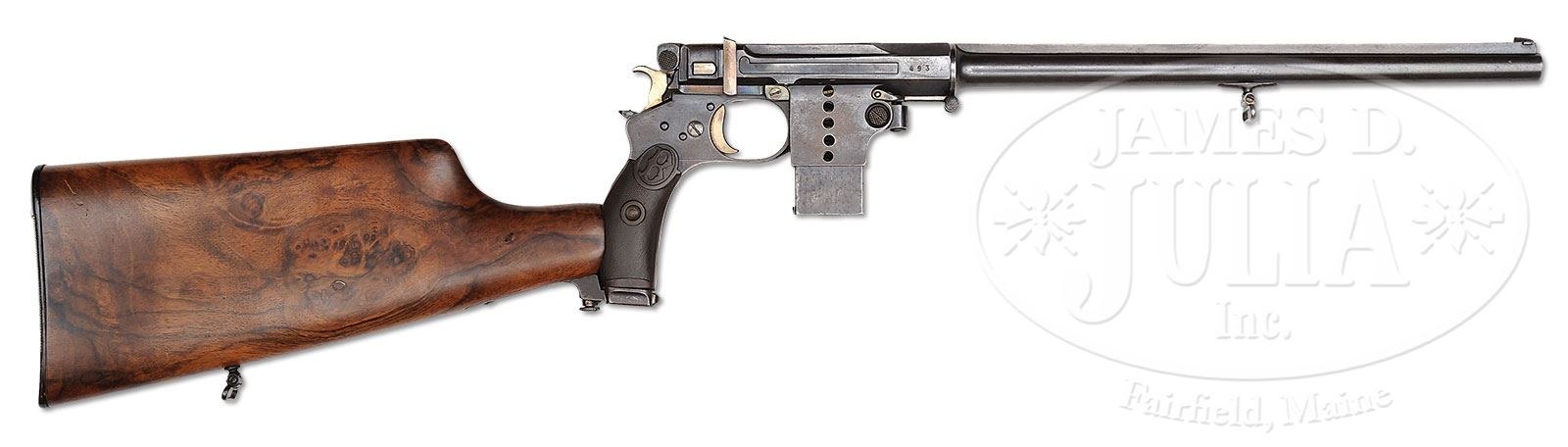
Julia’s catalogue distinguishes the carbine from a pistol with a stock: “Although most M1897s were sold with a leather covered shoulder stock, the true long barrel pistol carbines were equipped with a solid butt stock that attached to the frame using a standard lug.”10 A carbine with its stock attached is, in American law, a rifle with a barrel under 16 inches, which is one of the questions in Volume 8.
3.7 The holster-stock
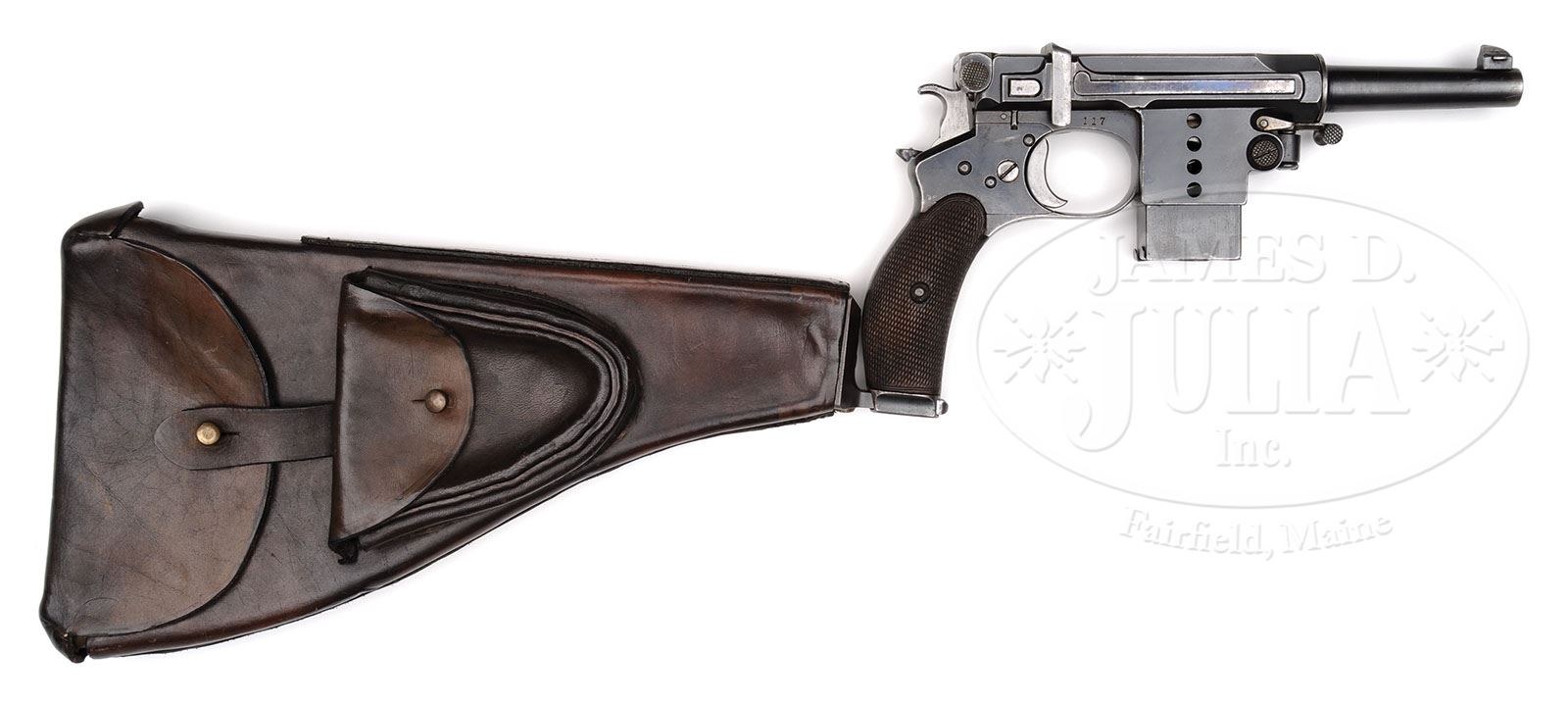
Most 1897s were sold with a combination holster and shoulder stock, which Julia’s cataloguer says was “often ‘lost’ over the years”.5 Rock Island describes it as “a lightweight metal frame with a leather outer cover and a small pouch on the front”; Julia’s descriptions add a spare-magazine pouch, a belt loop on the back, a provision for a cleaning rod along the spine, a lid closed by a brass stud, and an iron lug, numbered to the pistol and held by two screws, that slides into the grip.6512 The frame inside the leather is “steel” in two descriptions and “aluminum” in two others, all from the same two houses; both readings are recorded.1561214
3.8 Switzerland, and Dr Günther’s pistol
The Swiss are the one army known to have looked closely at the No. 5, and the record is thin. Forgotten Weapons describes the Swiss testing of 1897 and 1898 as informal and says they “appear to have found the gun too fragile or temperamental for service use”; Antaris dates the Swiss test to 1898; Wikipedia, citing a 2018 work by Grant, says the No. 5 was eliminated from trials running from October 1897 to late 1899 for failing minimum standards, along with the Mauser C96.21311 The broader Swiss story, in which the Borchardt-Luger won and became the Ordonnanzpistole 1900, is in the Borchardt dive.
One pistol ties the No. 5 to the Swiss trials by name. Serial 117, sold by Julia in 2013 from the Sturgess collection, has its bolt cover engraved “DEM ERKENNER DER BERGMANN-PISTOLE / DR. REINH. GÜNTHER VON THEOD. BERGMANN”: to the connoisseur of the Bergmann pistol, Dr Reinhold Günther, from Theodor Bergmann.5
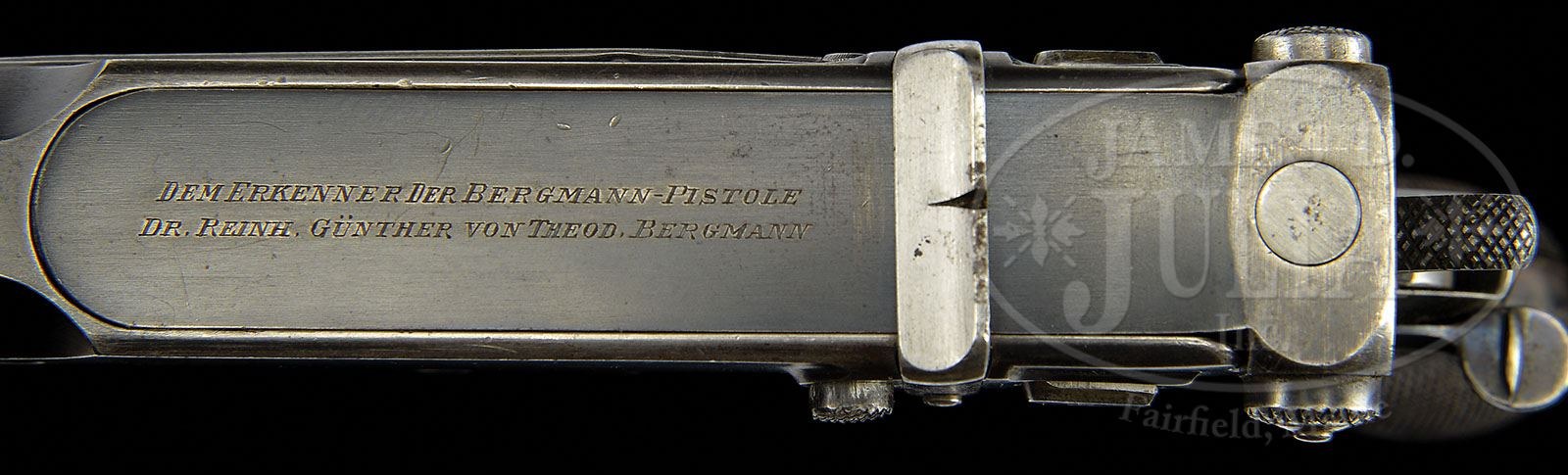
According to the consignor, as Julia reported it, Günther was Bergmann’s agent in Switzerland, promoting the pistol in the Swiss trials.5 A second source fills in who he was. Reinhold Günther’s own Allgemeine Geschichte der Handfeuerwaffen of 1909 lists among its sources “Reinhold Günther: Bergmanns Rückstoßlader. Berlin 1900”, a monograph on Bergmann’s recoil-loaders by the author himself.16 The man on the pistol and the author of the monograph share a name, a title and a subject; that they are the same man is this dive’s inference, and a strong one. “Erkenner” fits a writer better than a salesman. The 1900 monograph was not found online and is high on the list of sources owed.
3.9 The United States, 1901, and Britain, 1902
- United States. Buffaloe records that the US Army tested a No. 5 in 1901 and bought none.4 The Ordnance report was not found. The Army’s better-documented encounter with Bergmann came in 1907, with the later .45-calibre design (below).
- Britain. Forgotten Weapons says the British tested the No. 5 in 1902, saw potential, and wanted a heavier bullet, roughly equal to the .455 Webley.2 Wikipedia, citing Kinard, says Bergmann “built a special 10mm model” for the British trials and that it was rejected.11 The two accounts may describe one episode, with the 10 mm gun as Bergmann’s response to the British request, but neither source says so, and the British report was not found.
Antaris’s summary is the safest: tested by the Swiss and the British, adopted by neither.13 The pistols were sold commercially instead, which is why Forgotten Weapons can say they were “mostly sold commercially” and why so many survive with civilian stocks and cases.2
3.10 What came next: Simplex, Mars, Bayard
The No. 5 was the end of Schmeisser’s 1890s line and the start of the next one. The successors are outside this dive and are sketched only so that the 1897 can be placed.
- The Simplex (from about 1897, sold from 1901) went back to blowback in a small 8 mm pistol with a detachable magazine. Buffaloe gives about 4,000 made through 1903, the early ones by Schilling and later ones in Belgium, firing the 8 mm cartridge DWM 488.4
- The No. 6 prototypes of the same years were chambered for an 8 mm, a 7.5 mm and a 7.65 mm cartridge (DWM 460, 460A and KK 475, in Buffaloe’s list).4 The 7.5 mm round here is one of four different things called “7.5 mm Bergmann” (Volume 7).
- The Mars of 1903 replaced the sideways bolt with a block that rises and falls, derived from a machine-gun lock Bergmann patented in 1901, and held six rounds. Spain ordered 3,000 in 9 mm on 5 September 1905, but Schilling’s contract was cancelled after Krieghoff bought the firm, and Bergmanns Industriewerke made fewer than 1,000 Mars pistols itself.4 Bergmann’s US Patent 710,411, filed in October 1901, covers a “brake” for the breech of an automatic firearm, a wedge that resists the bolt under a heavy charge; it belongs to this period of work.17
- The Bergmann-Bayard. Bergmann licensed the design to Anciens Etablissements Pieper of Herstal in 1907. AEP filled the Spanish order as the Model 1908, delivered in 1909, and Denmark bought 4,840 Model 1910s, delivered from 1911.134 Its 9 mm cartridge, the 9 mm Largo, outlived the pistol by decades.
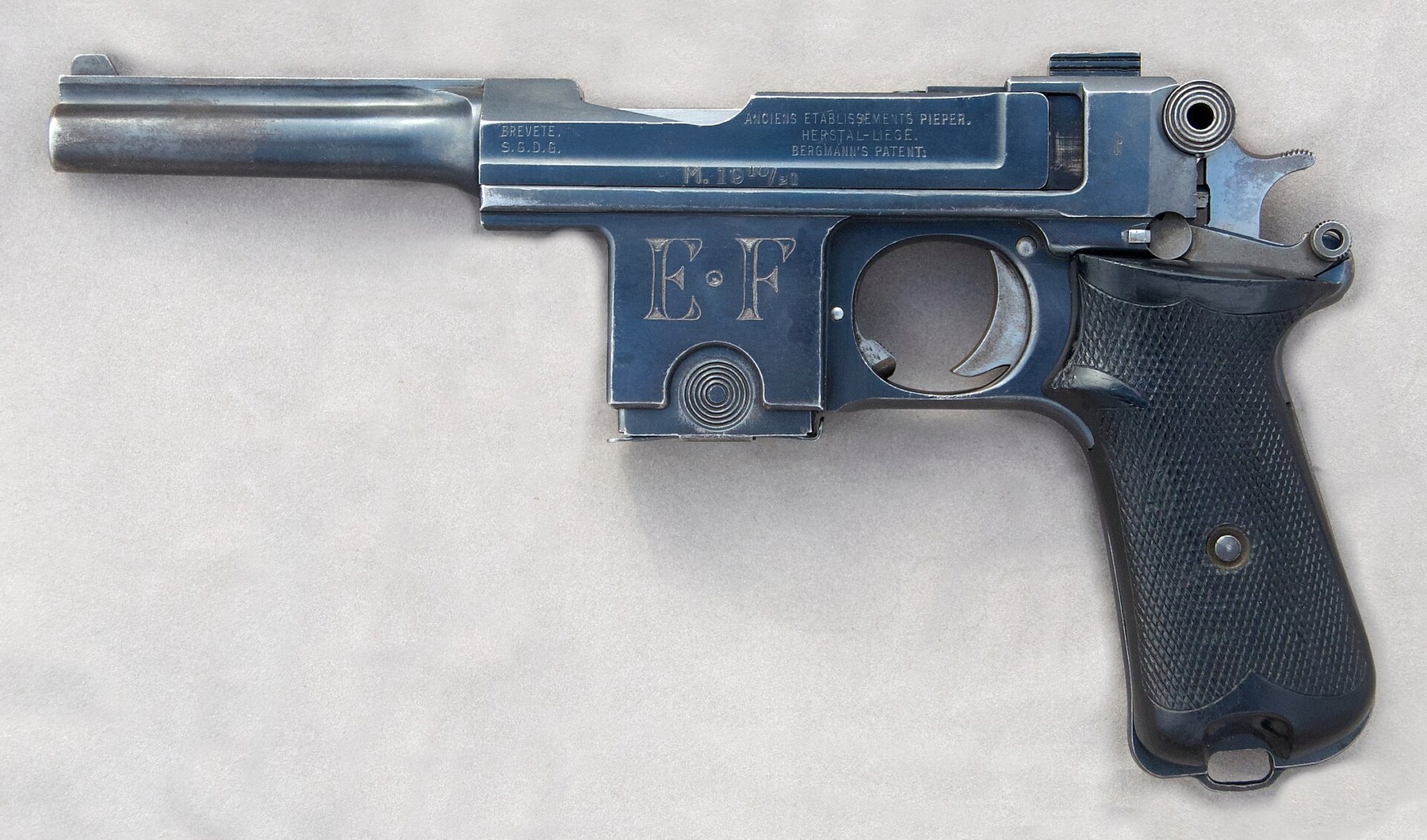
The US Army tested a Bergmann in .45 in 1907, the Mars-pattern design, and the board’s report survives. An expert from Springfield Armory stripped it in 2 minutes 2 seconds; it had 40 parts; and when the board tried to fire 20 rounds, “the blow of the hammer was not sufficient to discharge the cartridges, and the test was discontinued”. The board added that the magazine forward of the trigger “gives a heavy muzzle preponderance”, and concluded: “The design of the arm is not favored by the board.”18 Buffaloe explains the misfires as a mismatch with the Frankford Arsenal primers.4
3.11 From Bergmann’s pistols to the MP 18
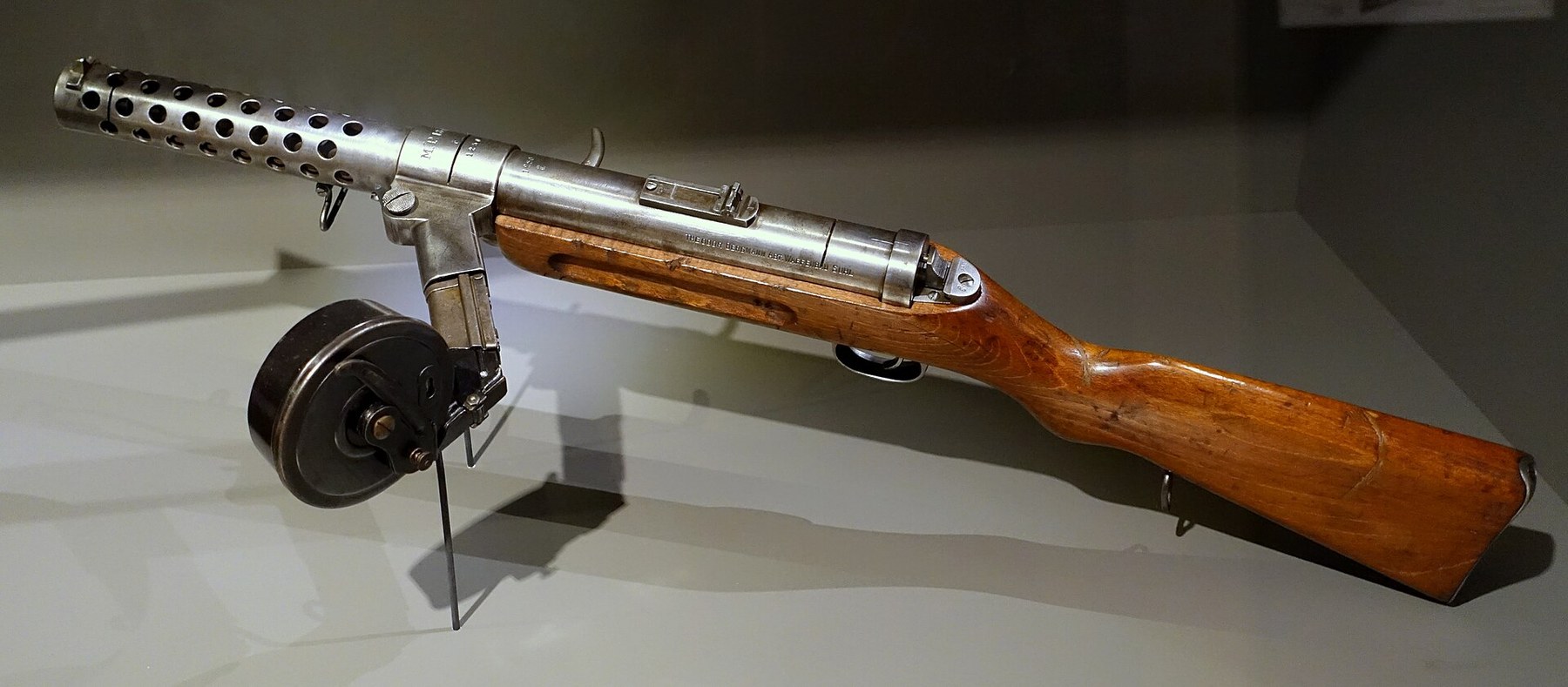
The Bergmann name stayed on German arms into the twentieth century; the MP 18 in the Braunschweig museum, below, is labelled as made by Theodor Bergmann at Suhl. Louis Schmeisser’s son Hugo, who trained there, designed the MP 18, the first mass-produced submachine gun; its successors, and the long misattribution of the MP 40 to the Schmeisser name, are told in the MP 40 dive. The current ATF curio and relic list, read for Volume 8, still carries the family’s later guns side by side: the Bergmann MP-34 and MP-35/1 and the “Schmeisser, MP-28/II”.19 The 1897 sits two decades upstream of all of them.
3.12 What could not be established
- The texts of DRP 98,318, Swiss 14,716 and GB 17,251, and therefore the patent’s own account of the lock.
- The production total (800, 1,000 or “a few hundred”) and how the serial range 1 to 1,000 relates to it.
- A type table for the variations “directed to the milling pattern of the right frame”.
- The standard barrel length or lengths, and how Julia’s “3 inch” was measured.
- Whether the stock frame was steel or aluminium (perhaps both, at different times).
- The Swiss trial reports for the No. 5, the 1901 US test report, and the 1902 British report; whether the British “special 10 mm model” existed as a No. 5 variant.
- Dr Reinhold Günther’s role: agent (the consignor’s account), writer (his 1909 bibliography), or both. Bergmanns Rückstoßlader (Berlin, 1900) was not seen.
References
Footnotes
-
Ian McCollum, “Bergmann No. 4 / 1896 Pistol”, Forgotten Weapons, 13 November 2013, https://www.forgottenweapons.com/bergmann-no-4-1896-pistol/ (accessed 2026-10-19). ↩
-
Ian McCollum, “Bergmann No.5 / 1897 Pistol”, Forgotten Weapons, 15 November 2013, https://www.forgottenweapons.com/bergmann-no-5-1897-pistol/ (accessed 2026-10-19); cites Ezell (1981), Reinhart and am Rhyn, R. K. Wilson (1934). ↩ ↩2 ↩3 ↩4 ↩5 ↩6 ↩7 ↩8 ↩9 ↩10 ↩11 ↩12 ↩13
-
James D. Julia, Inc., Firearms, Fall 2013, lot 3191, Bergmann M1897 No. 5 prototype in the white, https://jamesdjulia.com/?p=484809 (accessed 2026-10-19). ↩ ↩2 ↩3 ↩4
-
Ed Buffaloe, “The Bergmann Pistols”, Unblinking Eye, https://unblinkingeye.com/Guns/Berg/berg.html (accessed 2026-10-19). ↩ ↩2 ↩3 ↩4 ↩5 ↩6 ↩7
-
James D. Julia, Inc., Firearms, Fall 2013, lot 3192A, Bergmann M1897 No. 5 presentation pistol, serial 117, https://jamesdjulia.com/item/lot-3192a-bergmann-m1897-no-5-presentation-with-matching-shoulder-stock-52046/ (accessed 2026-10-19). Result $23,000 including premium. ↩ ↩2 ↩3 ↩4 ↩5 ↩6 ↩7 ↩8 ↩9 ↩10 ↩11
-
Rock Island Auction Company, 5 December 2020, lot 1558, Bergmann Model 1897 with holster/stock, serial 260, https://www.rockislandauction.com/detail/81/1558/bergmann-model-1897-semi-automatic-pistol-with-holsterstock (accessed 2026-10-19). ↩ ↩2 ↩3 ↩4 ↩5 ↩6 ↩7
-
James D. Julia, Inc., Firearms, Spring 2014, lot 3030, Bergmann M1897, serial 96, https://jamesdjulia.com/item/3030-358 (accessed 2026-10-19). ↩ ↩2 ↩3
-
James D. Julia, Inc., Firearms, Fall 2013, lot 3192, Bergmann M1897, serial 156, https://jamesdjulia.com/?p=484810 (accessed 2026-10-19). ↩ ↩2 ↩3 ↩4 ↩5
-
James D. Julia, Inc., Firearms, Spring 2009, lot 1155, Bergmann Model 1897 No. 5 with stock, serial 544, https://jamesdjulia.com/item/lot-1155-extremely-rare-bergmann-model-1897-no-5-semi-auto-pistol-with-shoulder-stock-37698/ (accessed 2026-10-19). ↩ ↩2
-
James D. Julia, Inc., Firearms, Spring 2014, lot 3029, Bergmann M1897 carbine, serial 493, https://jamesdjulia.com/item/3029-358 (accessed 2026-10-19). ↩ ↩2 ↩3 ↩4
-
“Bergmann 1896”, English Wikipedia, https://en.wikipedia.org/wiki/Bergmann_1896 (accessed 2026-10-19); cites Ezell (1993), Kinard (2003), Grant (2018). ↩ ↩2 ↩3 ↩4
-
James D. Julia, Inc., Firearms, Fall 2012, lot 2474, Bergmann Model 1897 No. 5 with stock, serial 475, https://jamesdjulia.com/?p=479395 (accessed 2026-10-19); same text as Spring 2010 lot 1074, https://jamesdjulia.com/?p=467386. ↩ ↩2 ↩3 ↩4 ↩5
-
Leonardo M. Antaris, “Bergmann’s Extraordinary Pistols”, American Rifleman, 18 October 2021, https://americanrifleman.org/content/bergmann-s-extraordinary-pistols (accessed 2026-10-19). ↩ ↩2 ↩3 ↩4
-
James D. Julia, Inc., Firearms, Fall 2010, lot 1075, Bergmann Model 1897 No. 5, serial 570, https://jamesdjulia.com/?p=469478 (accessed 2026-10-19). ↩ ↩2 ↩3
-
James D. Julia, Inc., Firearms, Fall 2008, lot 1142, Model 1897 No. 5 with stock, serial 260, https://jamesdjulia.com/?p=460505 (accessed 2026-10-19). ↩
-
Reinhold Günther, Allgemeine Geschichte der Handfeuerwaffen (Leipzig, 1909), Literaturverzeichnis, Internet Archive item reinhold-guenther-allgemeine-geschichte-der-handfeuerwaffen-1909-86-doppels.-scan, https://archive.org/details/reinhold-guenther-allgemeine-geschichte-der-handfeuerwaffen-1909-86-doppels.-scan (accessed 2026-10-19). ↩
-
Theodor Bergmann, US Patent 710,411, “Firearm”, filed 15 October 1901, issued 7 October 1902, https://patentimages.storage.googleapis.com/pdfs/US710411.pdf (accessed 2026-10-19). ↩
-
US Army, Report of Board on Tests of Revolvers and Automatic Pistols (1907), “Test of Bergmann Automatic Pistol, Caliber .45”, Internet Archive item 1907pistoltrials, https://archive.org/details/1907pistoltrials (accessed 2026-10-19). ↩
-
ATF, Firearms Curios or Relics List, January 1972 through April 2025 (ATF P 5300.11), Section IV, read from the Internet Archive copy https://web.archive.org/web/20260426215034if_/https://www.atf.gov/media/19856/download (accessed 2026-10-19). ↩
Comments (0)