Bergmann 1896 and 1897 · Volume 6
Field Strip, Detail Strip, Care and Repair
The one published 1896 takedown, what a correct 1897 procedure must allow for when no manual is found, cleaning and lubrication for a pistol whose maker left no schedule, the recurring weak spring, and where parts come from
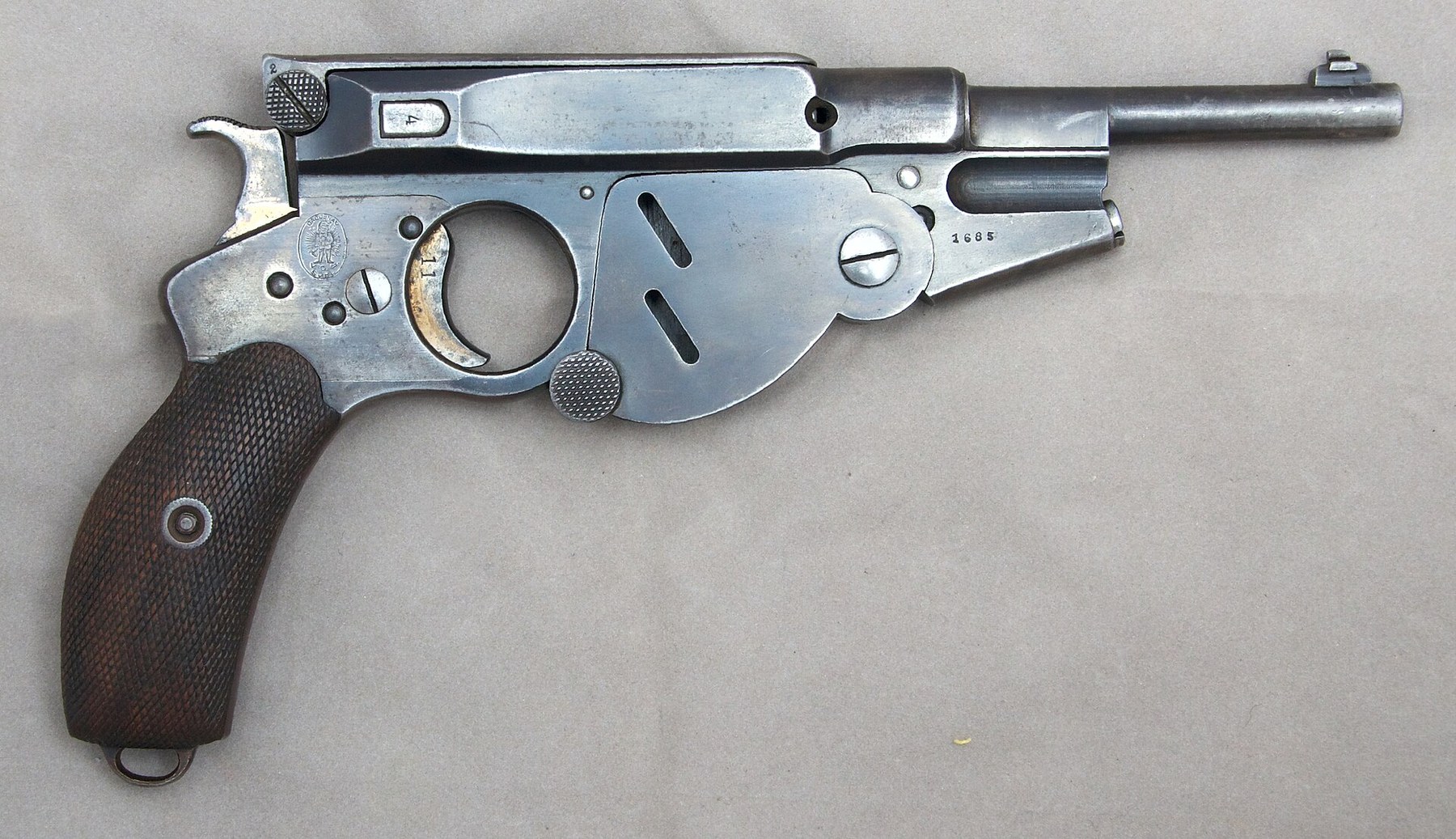
6.1 Before anything else
These are antiques worth thousands of dollars, made in small numbers by hand-fitting, and no replacement parts are made for them. Every screw is original and has been turned by somebody for a hundred and twenty years. The rules are the ordinary ones for any antique arm, and they matter more here than usual:
- Clear it first. Open the action and look into the chamber; on an 1897, remove the magazine first.
- Use screwdrivers ground to fit each slot, and stop if a screw resists.
- Do not drive pins until you know which way they come out. Nothing in the published record says which pins on these pistols are tapered or staked.
- Photograph each step before you take it.
6.2 Sources for this volume
No factory manual for the 1896 or the 1897 was found, in English or German, and no armourer’s instruction. One field-stripping procedure for the 1896 is published, by Ed Buffaloe, and Forgotten Weapons describes how the barrel comes out; both are quoted. For the 1897 there is no published sequence in any source consulted, and none is made up here. Instead the 1897 section sets out what a correct procedure must account for, from the parts that are described. That is the hub’s rule for a gun without a manual.123
6.3 The 1896: field strip
Buffaloe’s procedure, in his own words:1
- “Make sure the chamber is empty.”
- “Remove the screw at the rear of the bolt on the right side.”
- “Cock the hammer and tip the gun backward—the firing pin should fall out.”
- “Remove the rectangular pin through the bolt (to either side) and catch the recoil spring”
- “Remove the bolt.”
- “Remove the bolt cover by lifting at the rear.”
Reassembly is the reverse. Three notes, from the mechanism as Volume 4 describes it:
- Step 3 works because the firing pin is free in the bolt once its retaining screw is out; the patent of 1893 says the pin “is not worked by a spring” and is retained by a pin and screw.4 Keep the pistol over a padded surface; a firing pin dropped on a hard floor can lose its tip.
- Step 4 frees the recoil spring under compression. “Catch the recoil spring” means it will jump: hold a finger or a rag over the bolt as the pin comes out.
- Step 6 applies to the No. 3 and No. 4, which have the cover that moves with the bolt. Forgotten Weapons says the No. 2 has none (Volume 2).32
6.4 The 1896: barrel removal
The barrel is not part of a routine field strip, but it can come out, and the method changed during production. On early guns the barrel is held by a screw above the trigger and a lug: remove the screw and “rotate the barrel 90 degrees”, in Forgotten Weapons’ description, and draw it out. On later guns the barrel is fully threaded: remove the screw and unscrew the barrel.23 Which kind a given pistol has is not marked; if the barrel will not turn a quarter turn with the screw out, do not force it, because it may be a threaded barrel that has not been moved in a century. Taking it off for anything short of real need is not recommended.
6.5 The 1896: what is not published
No source describes taking out the magazine follower and its spring, the sideplate, the extractor, the hammer, sear, trigger and disconnector, or the safety. These are detail-strip steps, and on a pistol with no parts supply they are a gunsmith’s work (below). What can be seen from outside is that the sideplate pivots on its large front screw and that the lockwork lives behind side screws in the rear of the frame.
6.6 The 1897: what a correct procedure must account for
Forgotten Weapons says the 1897 kept “overall layout, disassembly” from the 1896 and 1894, which suggests the same idea (bolt out the rear, after the spring and firing pin are freed), but adds no steps.5 What the published descriptions do establish is the list of parts any procedure must handle in order:
- Magazine out. The 1897’s box magazine is detachable; it comes out first, and the chamber is checked after it.5
- The hold-open. Rock Island describes a bolt hold-open latch.6 Whether the bolt is held open while the magazine comes out, as on the 1907 Mars-pattern pistol the US Army tested, is not described; the board’s complaint about that gun was that the hold-open made the magazine hard to remove without drawing the bolt back by hand.7
- The shroud and its lever. Julia’s cataloguer calls the strawed lever at the rear of the shroud the “take-down lever” on one gun and the “bbl shroud stop lever” on another.89 So the shroud, and with it access to the barrel and extension, is released by that lever.
- Barrel and extension. They recoil together inside the shroud, so they must come out of it as a unit or be separated inside it; what retains them, and what returns them after unlocking, is not described.
- Bolt, lugs and flat spring. The bolt has two lugs on its left and a flat spring on its right that holds it into the extension.5 The flat spring must not be lost or bent, and the bolt cannot come straight back while it is locked; it has to be moved to the right, as the action itself moves it, before it is free.
- Recoil spring and firing pin. As on the 1896, both must be secured before the bolt comes out. Julia’s notes that the recoil spring on five Sturgess pistols is “sluggish” mean it may be weak, but it is still under load.10981112
- Interrupter and extractor. Both are on the right of the frame and are separate parts, the extractor fire-blued.98 Neither needs to come off for cleaning.
The sensible course for an 1897 is not to go beyond removing the magazine and wiping the bore from the muzzle until a manual, a disassembly film by a qualified source, or an experienced collector is to hand. Forgotten Weapons has filmed an 1897; its published article, which was read, gives no takedown sequence.5
6.7 Cleaning
No maker’s cleaning instruction survives in any source consulted. The general practice for an antique self-loader applies, and is stated as practice, not as Bergmann’s instruction:
- Bore and chamber. Clean from the breech where the action allows it (the 1896 with its bolt out), otherwise from the muzzle with a rod guide to protect the crown. The 1896 No. 2’s 5 mm bore is small (bullet about 5.1 mm; Volume 7) and needs a fine rod.
- After firing, assume corrosive priming. Period ammunition, and any reloaded with old components, may have corrosive or mercuric primers; no source states what DWM loaded these cartridges with. Clean the same day with a water-based solvent, then dry and oil.
- Clips and magazines. The 1896’s clips and the 1897’s magazines are thin sheet steel; clean and oil them, and do not leave cartridges in them for storage.
- Leather. The 1897’s holster-stock is leather over a metal frame. Keep it dry and conditioned, and do not store the pistol in it; leather holds moisture against steel.
6.8 Lubrication
The places that need oil follow from the mechanism (Volume 4): the bolt’s sliding surfaces and its rails in the frame; on the 1897, the barrel extension inside the shroud, the locking lugs, their recesses and the cam; the hammer and sear pivots; the trigger and disconnector; the 1896’s follower and its pivot. A light oil sparingly, wiped back to a film, is the safe choice for a mechanism whose clearances were set by hand and whose maker’s preference is unknown.
6.9 Inspection
Before any firing, and as a habit:
- Bolt face and firing-pin hole. Look for erosion and a firing-pin tip that protrudes with the pin pushed forward but does not stick out when it is pulled back; the pin is free (Volume 4).
- Locking surfaces (1897). The lugs, the recesses in the extension and the cam surface should be clean-edged, without battering or set-back. Any peening there is a reason not to fire the pistol.
- Recoil spring. Note whether the bolt closes fully on its own. If it does not, it will not chamber reliably and may leave the 1897 out of battery for the interrupter to deal with.
- Extractor and its spring. A tired extractor gives failures to extract that look like blowback problems.
- Bore. Original 1890s bores are often frosted or pitted; Julia’s notes range from “Bright bore with sharp rifling” to “mild-moderate corrosion”.912
- Matching numbers and finish. Not mechanical, but part of an inspection (Volume 5).
6.10 What fails, and what to do about it
There is no maker’s or armourer’s table of malfunctions for these pistols. The table below is the auction record’s evidence and the mechanism’s logic, labelled accordingly.
Table 1 — What fails, and what to do about it
| Symptom | Likely cause | Evidence | Bench response |
|---|---|---|---|
| Bolt will not close fully on its own | Weak recoil spring | Julia, on all five Sturgess 1897s described | Have a spring made to the original’s dimensions; do not stretch the original |
| Case not extracted (late 1896, 1897) | Worn or weak extractor; wrong (grooveless) cartridge | mechanism; cartridges (Volume 7) | Check the cartridge first; then the extractor and spring |
| Case stuck or torn (early, extractor-less 1896) | Rough chamber, wrong cartridge, low pressure | mechanism | Do not fire; polish nothing without a gunsmith |
| Misfeed from the clip | Clip bent; follower spring weak; loaded without a clip | Wilson via Forgotten Weapons (1894) | Use a sound clip of the right calibre |
| Hammer follows the bolt | Worn sear or disconnector | patent explains the disconnector | Stop; gunsmith |
| Misfire | Weak hammer spring; hard primers | the 1907 Mars-pattern test failed on hammer blow with Frankford primers | Check primer type before suspecting the gun |
| Out-of-battery behaviour (1897) | Bolt not fully home | interrupter exists to prevent firing | Never override the interrupter |
6.11 Bench work and gunsmith work
The line between the two is set by the fact that no part can be bought.
- Owner’s bench: field strip of the 1896 as above; cleaning; magazine and clip care; leather care.
- Gunsmith with antique experience: any detail strip; springs (made new to sample, never by stretching); extractor work; anything touching the 1897’s lugs, recesses or cam; any barrel removal that resists; any refinishing. Refinishing destroys value (Volume 5) and should not be done to an original.
- Not at all: welding, re-heat-treating or restamping. The auction record shows restamping is already common enough to make buyers wary.
6.12 Parts
No manufacturer of reproduction parts for either pistol was found, and the main US surplus-parts dealers’ catalogues did not show any in the searches made for this dive. Parts come, in practice, from other guns: the auction record’s mismatched magazines and replaced grips are the trace of that.1114 Springs and screws are the parts most often needed, and both can be made by a competent gunsmith to a sample, which is the realistic route.
6.13 A function check
This sequence is derived from the mechanism in Volume 4. It is not a factory procedure.
- Unloaded, with the magazine or clip out, draw the bolt back by its knob and let it run forward. It should close fully on its own.
- The hammer should be cocked by the bolt and stay cocked.
- With the safety applied, pull the trigger; the hammer should not fall. Release the safety.
- Pull the trigger and hold it; the hammer should fall. Still holding the trigger, cycle the bolt by hand; the hammer should be cocked and stay cocked (the disconnector). Release the trigger; it should reset.
- On an 1897, hold the bolt slightly short of fully closed and pull the trigger; the interrupter should stop the hammer from falling.
- With an empty magazine fitted (1897), cycle the bolt; it should be held open if the hold-open works with the magazine in.
Any failure at any step is a reason not to fire the pistol until it has been seen to.
6.14 What could not be established
- Any factory or armourer’s disassembly instruction for either pistol.
- The 1897’s takedown sequence.
- What the 1896’s safety acts on, and how the follower comes out.
- Whether the 1897’s hold-open works with the magazine removed.
- The original primer type and whether it was corrosive.
- Any current source of reproduction parts.
References
Footnotes
-
Ed Buffaloe, “The Bergmann Pistols”, Unblinking Eye, https://unblinkingeye.com/Guns/Berg/berg.html (accessed 2026-10-19). The field-strip steps are quoted from this page. ↩ ↩2
-
Ian McCollum, “Bergmann No. 2 / 1896 Pistol”, Forgotten Weapons, 8 November 2013, https://www.forgottenweapons.com/bergmann-no-2-1896-pistol/ (accessed 2026-10-19). ↩ ↩2 ↩3
-
Ian McCollum, “Bergmann No. 3 / 1896 Pistol”, Forgotten Weapons, 12 November 2013, https://www.forgottenweapons.com/bergmann-no-3-1896-pistol/ (accessed 2026-10-19). ↩ ↩2 ↩3
-
Louis Schmeisser, US Patent 547,454, 8 October 1895, https://patentimages.storage.googleapis.com/pdfs/US547454.pdf (accessed 2026-10-19). ↩ ↩2
-
Ian McCollum, “Bergmann No.5 / 1897 Pistol”, Forgotten Weapons, 15 November 2013, https://www.forgottenweapons.com/bergmann-no-5-1897-pistol/ (accessed 2026-10-19). ↩ ↩2 ↩3 ↩4
-
Rock Island Auction Company, 5 December 2020, lot 1558, M1897 serial 260, https://www.rockislandauction.com/detail/81/1558/bergmann-model-1897-semi-automatic-pistol-with-holsterstock (accessed 2026-10-19). ↩
-
US Army, Report of Board on Tests of Revolvers and Automatic Pistols (1907), Internet Archive item 1907pistoltrials, https://archive.org/details/1907pistoltrials (accessed 2026-10-19). ↩ ↩2
-
James D. Julia, Inc., Spring 2014, lot 3030, M1897 serial 96, https://jamesdjulia.com/item/3030-358 (accessed 2026-10-19). ↩ ↩2 ↩3
-
James D. Julia, Inc., Fall 2013, lot 3192, M1897 serial 156, https://jamesdjulia.com/?p=484810 (accessed 2026-10-19). ↩ ↩2 ↩3 ↩4 ↩5
-
James D. Julia, Inc., Fall 2013, lot 3192A, M1897 serial 117, https://jamesdjulia.com/item/lot-3192a-bergmann-m1897-no-5-presentation-with-matching-shoulder-stock-52046/ (accessed 2026-10-19). ↩ ↩2
-
James D. Julia, Inc., Spring 2014, lot 3029, M1897 carbine serial 493, https://jamesdjulia.com/item/3029-358 (accessed 2026-10-19). ↩ ↩2
-
James D. Julia, Inc., Fall 2013, lot 3191, M1897 prototype, https://jamesdjulia.com/?p=484809 (accessed 2026-10-19). ↩ ↩2
-
Ian McCollum, “Bergmann 1894 – No.1 Pistol”, Forgotten Weapons, https://www.forgottenweapons.com/early-automatic-pistols/bergmann-no1-1894/ (accessed 2026-10-19). ↩
-
James D. Julia, Inc., Fall 2010, lot 1075, M1897 serial 570, https://jamesdjulia.com/?p=469478 (accessed 2026-10-19). ↩
Comments (0)