Bergmann 1896 and 1897 · Volume 1
Bergmann, Schmeisser and the First Gaggenau Pistols
An ironworks owner who sold air guns, a Mannheim gunmaker whose patents carried his employer's name, the 1892 Swiss prototype, and the 1893 patent that set out the unlocked principle every Bergmann of the 1890s used until the 1897
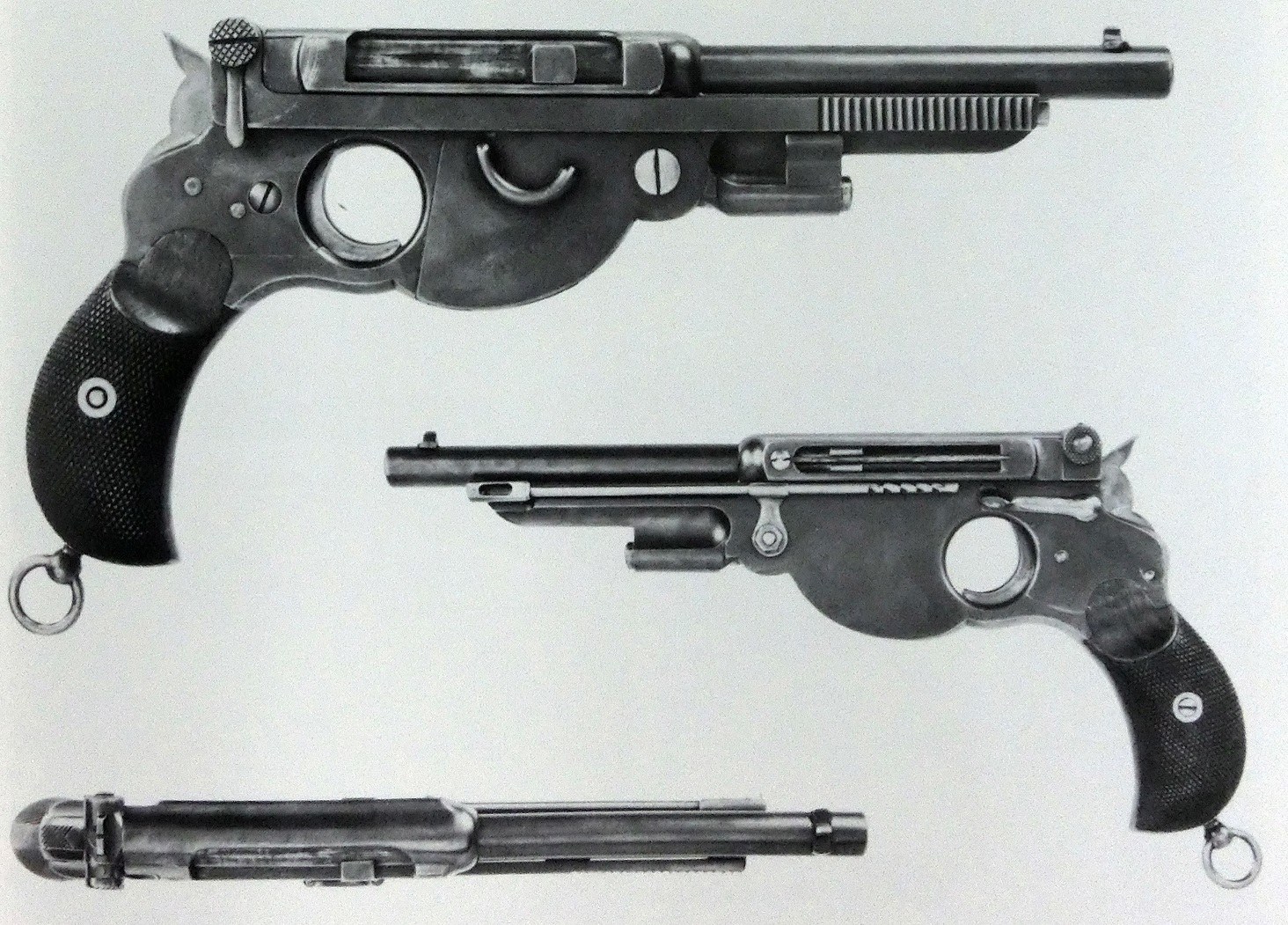
1.1 What this dive covers
This dive is about the self-loading pistols sold by Theodor Bergmann of Gaggenau in the 1890s and designed for him by Louis Schmeisser. Two families matter. The 1896 pattern is an unlocked blowback pistol with a fixed magazine loaded by a five-round clip through a hinged sideplate, made in three calibres and numbered by them: No. 2 in 5 mm, No. 3 in 6.5 mm and No. 4 in 8 mm. The 1897 pattern, No. 5, is a different gun under a similar skin: a locked-breech, short-recoil pistol in 7.8 mm with a detachable box magazine. Its bolt locks by moving sideways, an arrangement almost nobody else has used. The 1894 pistol that came before both, and the Simplex, Mars and Bergmann-Bayard that came after, appear where they explain the two main models, and their own stories are left for other work.
The volumes run: this one on the men and the first patent; Volume 2 on the 1896 in production; Volume 3 on the 1897, its trials and its successors; Volume 4 on how both work; Volume 5 on telling the models apart; Volume 6 on taking them down and keeping them working; Volume 7 on the five cartridges; Volume 8 on the market and the law, including which pistols are antiques; and Volume 9 on making one.
Two hub dives sit beside this one. The Borchardt C-93 was the other German self-loader of 1893, the locked-breech gun the Bergmanns competed with, and its Volume 3 tells the Swiss trials of 1897 in which a Bergmann took part. The Mauser C96 is the pistol whose cartridge the 1897 Bergmann was designed to match. And the MP 40 dive tells the later story of the Bergmann works, where Louis Schmeisser’s son Hugo designed the MP 18.
1.2 The two models in one paragraph
The 1896 sold. By the estimates collectors repeat, from Edward Ezell’s Handguns of the World, about 2,000 No. 2s, about 4,000 to 4,400 No. 3s and a few hundred No. 4s were made, which makes it, in Leonardo Antaris’s phrase in American Rifleman, “arguably the first commercially successful semi-automatic pistol”, at a time when the Borchardt had sold in the hundreds.12 It sold as a civilian pocket and belt pistol, because its cartridges were too weak for any army. The 1897 was Bergmann’s attempt to fix that. It took a cartridge as strong as the Mauser’s, a locked breech to hold it and a removable magazine, and it was tried by Switzerland and Britain and refused by both. About 800 were made, or about 1,000; both figures are in print.34 Its locking idea, refined, became the Mars of 1903 and the Bergmann-Bayard, which Spain and Denmark adopted.
1.3 Theodor Bergmann and Gaggenau
Theodor Bergmann (1850–1931) was an industrialist, not a gunsmith. Ed Buffaloe’s history of the Bergmann pistols, the most complete free account and the one this volume leans on for the company’s early years, records that he became a managing partner of the Eisenwerke Gaggenau, an ironworks in Baden, in 1879 at the age of 29.5 The works had been bought in 1873 by Michael Flürscheim (1844–1912; Buffaloe spells him Flörscheim), who took out a German patent for an air pistol in 1878, two improvement patents in 1879 and more airgun patents through the 1880s; Buffaloe notes that the Flürscheim air pistol closely copied a design patented in the United States by Haviland and Gunn in 1872, and that in 1884 Bergmann licensed an airgun patent held by Henry Quackenbush.5
By 1891, on Buffaloe’s account, Gaggenau was making rifles, gun barrels, reloading tools, air guns, pellets and darts.5 A company booklet of that year, authored by Bergmann, survives and is on Wikimedia Commons.
Bergmann’s own firearms business, Bergmanns Industriewerke, was founded at some point between 1893 and 1895; Buffaloe gives the range rather than a date, and no primary record of the founding was found for this dive.5 Its trademark, a bearded miner with a pick, appears on the pistols (Volume 5): Bergmann is German for miner. Bergmann filed a pistol patent roughly every year from 1893 to 1901, and the designs are credited to Louis Schmeisser even where the patents name Bergmann.5
1.4 Louis Schmeisser
Louis Schmeisser (1848–1917) is described in the English Wikipedia article on his son as “one of the best-known weapons designers in Europe”; that sentence carries no citation.6 What can be said from a primary document is narrower and more useful. On his US patent of 1895 he is “Louis Schmeisser, gun maker, a citizen of Germany, residing at Mannheim, in the Grand Duchy of Baden”, and the patent is assigned “to Theodor Bergmann, of Gaggenau, Germany”.7 So in January 1894, when the American application was filed, Schmeisser was a working gunmaker in Mannheim whose inventions belonged to Bergmann by contract.
His son Hugo Schmeisser, born in Jena in 1884, “received his fundamental training in weapons technology at Bergmann”, and in 1917 designed the MP 18 at the Bergmann works.6 That later chapter, and the long confusion of the Schmeisser name with the MP 40, are in the MP 40 dive. It is enough here that one family’s work runs from the first Bergmann pistol of 1893 to the first mass-produced submachine gun.
1.5 Brauswetter and the 1892 pistol
The Bergmann story has a prologue that the usual accounts compress. Buffaloe records a Swiss patent of 6 April 1892 issued jointly to Otto Brauswetter and the Eisenwerke Gaggenau for a self-loading pistol, and a prototype “Model of 1892” tested by the Swiss against their Model 1882 revolver, chambered for the Swiss 7.5 mm revolver cartridge; no example is known to survive.5 Antaris, writing in American Rifleman in 2021, puts it differently: in 1893 Bergmann “bought Otto Brauswetter’s patent” and gave the plans to Schmeisser, whose first change was to simplify its delayed-blowback action to a plain blowback.1 The two accounts agree on Brauswetter and on a delayed system that Schmeisser abandoned. They disagree on the date and on whether Gaggenau already held the patent jointly in 1892. A joint 1892 patent and an 1893 purchase of Brauswetter’s remaining interest are not incompatible, but no source consulted says so, and the Swiss patent itself was not read.
The Swiss record gives the 1892 gun a date from the other side. The 2021 history of the Swiss trials by Markus Käser of the Stiftung Historisches Armeematerial, summarised in the Borchardt dive, says the Swiss had been looking at self-loading pistols “since about 1892, beginning with a Bergmann”.8
1.6 The 1893 patents
Schmeisser’s design was patented across Europe in 1893 and 1894 and in the United States in 1895, as US 547,454, “Recoil Operated Firearm”, dated 8 October 1895 on an application filed 20 January 1894. The American patent lists its foreign predecessors, which makes it the most convenient record of how widely the design was protected. The list below is copied from the specification; the Swiss number is printed partly illegibly in the scan and is given as it most probably reads.7
Table 1 — The 1893 patents
| Country | Number | Date |
|---|---|---|
| France | 230,689 | 8 June 1893 |
| Germany | 78,500 | 10 June 1893 |
| England | 11,509 | 12 June 1893 |
| Italy | 34,238 | 30 June 1893 |
| Belgium | 106,826 | 31 October 1893 |
| Switzerland | 7,201 (scan unclear) | 6 December 1893 |
| Germany | 78,881 | 13 February 1894 |
| Belgium | 109,829 | 15 May 1894 |
| Austria | 44/2,000 | 31 May 1894 |
| Hungary | 678 | 26 June 1894 |
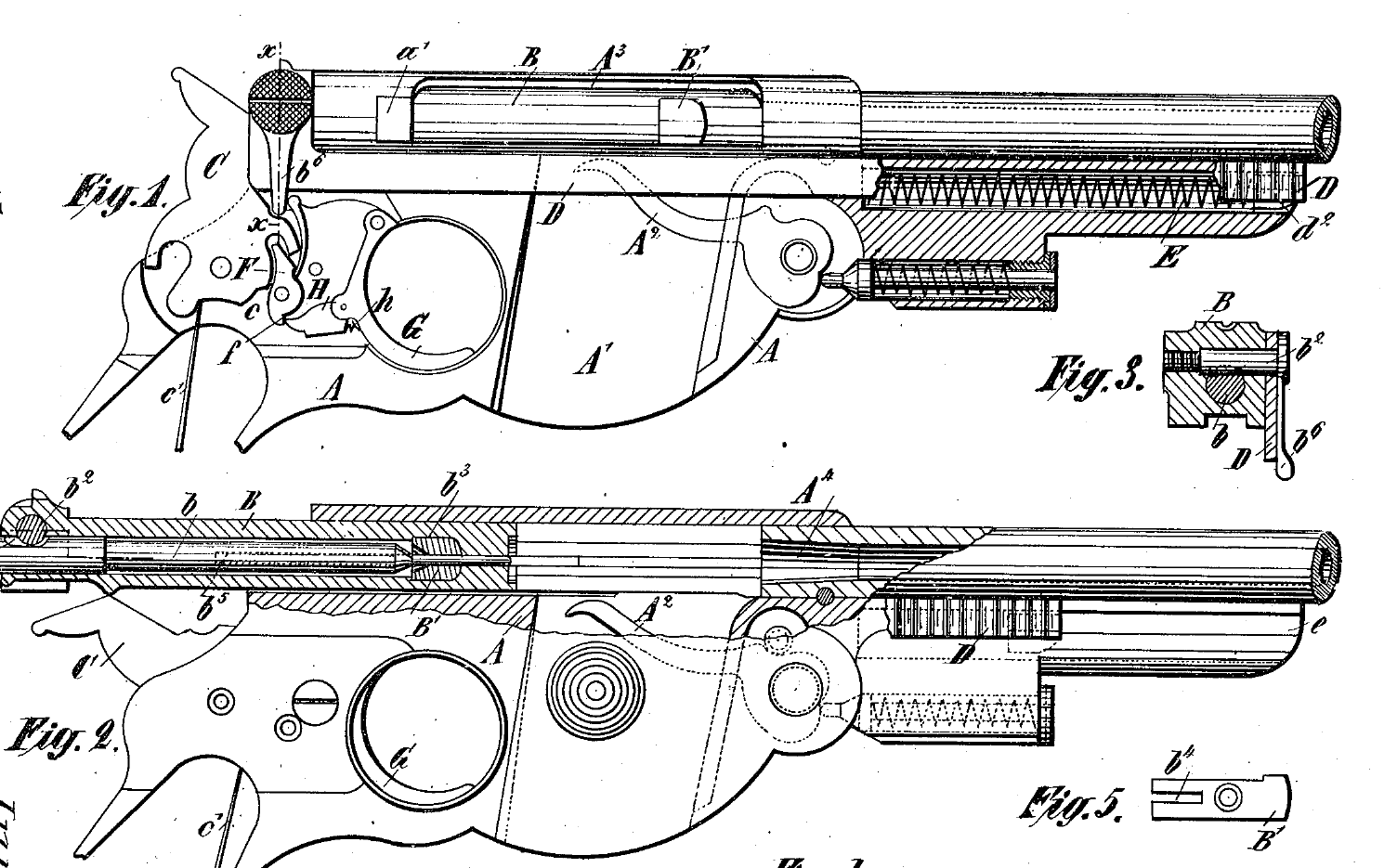
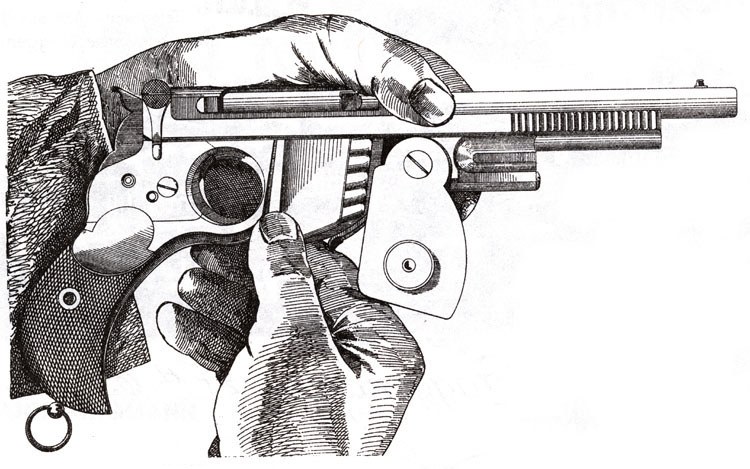
The drawings show a pistol recognisably like the trial gun in the photograph at the head of this volume. The bolt slides straight back in a frame cut away on top and on the right for loading and ejection. A magazine in front of the trigger takes cartridges “one by one or by means of a loading-box”, a spring lever pushing them up. An ejection bar at the rear of the frame strikes the case as it comes back. The closing spring lives under the barrel, and the rod that joins it to the bolt runs outside the frame, with a roughened surface that “gives a better hold for the hand when it is required to keep the cylinder in the open position”: the rod is the charging handle.7
Three smaller features in the patent turn up later. The firing pin “is not worked by a spring”, a detail Antaris also gives for the 1894 pistol.71 A small version of the arm, Fig. 7, has a trigger that is “pushed forward” and folds “for the sake of carrying the arm conveniently”, the folding trigger of the first No. 2 pistols (Volume 2).7 And Figs. 9 to 11 show a “trigger-safety”: a lever on the back of the frame holds the hammer cocked, and only a finger entering the trigger guard, pushing aside a small disc, releases it.7 No production pistol photographed for this dive shows that device, and nothing here suggests it was ever fitted.
1.7 What the patent claims: a bolt that is simply heavier than the bullet
The specification states its principle plainly, and the words matter because a common modern summary calls the early Bergmann “delayed” blowback. It is not. “It has been usual heretofore,” the patent says, “to oppose a resistance as strong as possible to the pressure of the gases from the rear or closing parts”; in this system “this resistance is made away with entirely”. The explosion presses equally on the bullet and on the case head; the bolt behind the case, “the weight of which is a certain multiple of that of the projectile”, is set moving more slowly than the bullet, so that “up to the time that said projectile leaves the barrel the breech-bolt has been driven back only a short way”, while the case pressed against the bolt keeps the breech gas-tight. The rest of the bolt’s travel reloads the arm and compresses the spring that closes it again.7
That is straight blowback: nothing holds the bolt but its own mass and its spring. Where a source speaks of a delayed action, it is describing Brauswetter’s earlier design, which Schmeisser dropped, not the pistol that went into production.19
1.8 The 1894 pistol, later called No. 1
The first Bergmann sold to the public is the model of 1894. Bergmann numbered his pistols by calibre only from 1896, and the 1894 was retroactively called “No. 1”, as Ezell records; the prototype of 1893 had no number.29 It carried its spring under the barrel, as the patent shows, and had no extractor: the case was blown out by the residual pressure in the chamber and struck the ejector on its way back.29 It had an exposed hammer and a single-action trigger, and fed from a five-round clip pushed down into the magazine with a Mannlicher-type follower; the empty clip dropped out through the bottom. R. K. Wilson, writing in 1934, adds that the magazine could be loaded without the clip, though the pistol was then “fairly prone to misfeeding”.91
Its calibre is the first of several contested points. Antaris says 5 mm and 8 mm, most of them 8 mm; Buffaloe reports that the British author Stewart gives 8 mm only and others 5 mm; Forgotten Weapons lists the Swiss trial pistols in 7.5 mm, “probably” the Swiss revolver cartridge, plus 5 mm and possibly 6.5 and 8 mm.159 The English Wikipedia article, following Kinard, says the 1893 design was “chambered for a rimless 8mm cartridge”.2 These are not averaged here. What they share is a pistol made in small numbers and in more than one calibre, and that much is enough for the identification and legal volumes.
Forgotten Weapons gives figures for two surviving 1894s, which show how far apart the type could be:
Table 2 — Forgotten Weapons gives figures for two surviving 1894s, which show how far apart the type could be
| Swiss trial model | Unnumbered toolroom pistol | |
|---|---|---|
| Calibre | 7.5 mm (Swiss revolver, probably) | 5 mm |
| Overall length | 280 mm (11 in) | 140 mm (5.5 in) |
| Barrel | 136 mm (5.35 in) | 70 mm (2.75 in) |
| Weight | 1.03 kg (36.3 oz) | 240 g (8.5 oz) |
| Trigger | conventional | folding |
Source: Forgotten Weapons, “Bergmann 1894 No. 1”.9
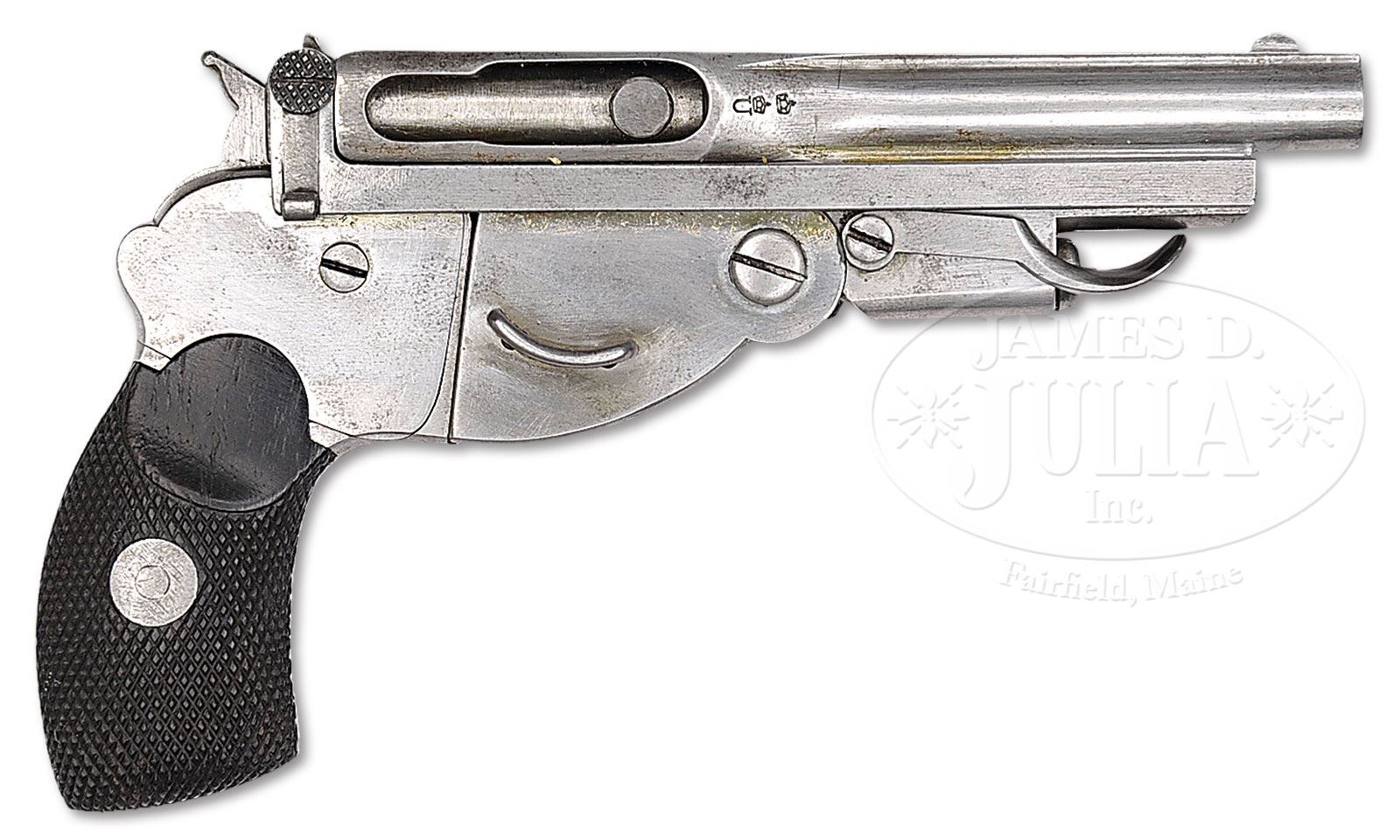
The Swiss tried the 1894 in 1894 and 1895, according to Forgotten Weapons citing Reinhart and am Rhyn’s history of Swiss handguns, and those trials are what Forgotten Weapons connects to the changes of 1896.9 Wikipedia adds, citing Ezell and Antaris, that the 1893 and 1894 pistols were tried and rejected in Swiss, German and Belgian trials.2 A reader of Forgotten Weapons has suggested that Bergmann had a dozen or so prototypes made by Mauser around 1895, on the evidence of Württemberg crown proofs on one example. It is a reader’s comment, not a finding, and is recorded only so that it is not lost.9
1.9 Why the blowback was a dead end for military sales
The principle in the patent sets its own limit. A blowback bolt has to be heavy enough, or its spring strong enough, that the case does not leave the chamber while the pressure is still high, and both grow with the power of the cartridge. Schmeisser’s bolt was heavy for what it held, and every cartridge Bergmann made for it was weak. Ezell compares even the 8 mm to the .32 ACP, and Forgotten Weapons judges the No. 4’s cartridge “still too weak to interest military commissions”.210 When the armies would not buy, the choice was between a heavier gun and a locked one, and Bergmann chose the lock. That is the 1897, and Volume 3.
1.10 What could not be established
- The date Bergmanns Industriewerke was founded (Buffaloe: between 1893 and 1895).
- Whether Gaggenau held Brauswetter’s Swiss patent from 1892 or bought it in 1893; the Swiss patent itself was not read.
- The 1894’s calibres: 5, 6.5, 7.5 and 8 mm are all reported, by different authors.
- How many 1894s were made; every source says “small numbers” or “very few”.
- Louis Schmeisser’s career before 1893.
References
Footnotes
-
Leonardo M. Antaris, “Bergmann’s Extraordinary Pistols”, American Rifleman, 18 October 2021, https://americanrifleman.org/content/bergmann-s-extraordinary-pistols (accessed 2026-10-19). ↩ ↩2 ↩3 ↩4 ↩5 ↩6
-
“Bergmann 1896”, English Wikipedia, https://en.wikipedia.org/wiki/Bergmann_1896 (accessed 2026-10-19); cites Ezell, Handguns of the World (1993), pp. 366–369; Kinard (2003); Walter (2001, 2008); Antaris (2017). ↩ ↩2 ↩3 ↩4 ↩5 ↩6
-
Ian McCollum, “Bergmann No.5 / 1897 Pistol”, Forgotten Weapons, 15 November 2013, https://www.forgottenweapons.com/bergmann-no-5-1897-pistol/ (accessed 2026-10-19). ↩
-
James D. Julia, Inc., Firearms, Fall 2013, lot 3192A, Bergmann M1897 No. 5 serial 117, https://jamesdjulia.com/item/lot-3192a-bergmann-m1897-no-5-presentation-with-matching-shoulder-stock-52046/ (accessed 2026-10-19). ↩
-
Ed Buffaloe, “The Bergmann Pistols”, Unblinking Eye, https://unblinkingeye.com/Guns/Berg/berg.html (accessed 2026-10-19). Company history, Brauswetter’s 1892 Swiss patent and prototype, the 1894 calibre dispute. ↩ ↩2 ↩3 ↩4 ↩5 ↩6 ↩7
-
“Hugo Schmeisser”, English Wikipedia, https://en.wikipedia.org/wiki/Hugo_Schmeisser (accessed 2026-10-19); cites Willbanks, Machine Guns (2004), pp. 79–82. ↩ ↩2
-
Louis Schmeisser, assignor to Theodor Bergmann, US Patent 547,454, “Recoil Operated Firearm”, filed 20 January 1894, issued 8 October 1895, https://patentimages.storage.googleapis.com/pdfs/US547454.pdf (accessed 2026-10-19). ↩ ↩2 ↩3 ↩4 ↩5 ↩6 ↩7
-
Borchardt C-93 dive, Volume 3, /actual-firearms/pistols/borchardt-c93/vol-3/, drawing on Markus Käser, Stiftung Historisches Armeematerial, 2021. ↩
-
Ian McCollum, “Bergmann 1894 – No.1 Pistol”, Forgotten Weapons, https://www.forgottenweapons.com/early-automatic-pistols/bergmann-no1-1894/ (accessed 2026-10-19); cites Reinhart and am Rhyn, Faustfeuerwaffen II; R. K. Wilson, Textbook of Automatic Pistols (1934); Ezell (1981). ↩ ↩2 ↩3 ↩4 ↩5 ↩6 ↩7 ↩8
-
Ian McCollum, “Bergmann No. 4 / 1896 Pistol”, Forgotten Weapons, 13 November 2013, https://www.forgottenweapons.com/bergmann-no-4-1896-pistol/ (accessed 2026-10-19). ↩
Comments (0)