Bergmann 1896 and 1897 · Volume 7
The Cartridges: 5, 6.5, 7.5, 7.8 and 8 mm Bergmann
Seven cases measured and drawn to scale, four different things called 7.5 mm Bergmann, why the 7.8 mm is a .30 calibre round that a 7.63 Mauser will not fit, the grooveless first cartridges, and what can be bought or made in 2026
7.1 The family in one table
Bergmann’s pistols used their own cartridges, made for him by the German ammunition makers and catalogued by Deutsche Waffen- und Munitionsfabriken under its own numbers. The dimensions below are from the Spanish collectors’ reference municion.org, which publishes a measured drawing for each; they are measurements of individual specimens, not a specification, and no C.I.P. or SAAMI sheet exists for any of them.1
Table 1 — The family in one table
| Cartridge | Pistol | DWM no. | Bullet dia. | Mouth | Head | Rim | Case length | Overall | Form |
|---|---|---|---|---|---|---|---|---|---|
| 5 mm Bergmann, grooveless | early No. 2 | 416 | 5.18 | 5.89 | 7.01 | none | 14.95 | 22.28 | tapered, no rim or groove |
| 5 mm Bergmann | No. 2 | 416A | 5.13 | 5.85 | 6.89 | 6.96 | 15.03 | 21.49 | tapered, grooved |
| 6.5 mm Bergmann, grooveless | early No. 3 | 413 | 6.75 | 7.25 | 9.46 | none | 21.80 | 31.30 | bottleneck, no rim or groove |
| 6.5 mm Bergmann | No. 3 | 413A | 6.61 | 7.25 | 9.34 | 9.45 | 21.78 | 31.17 | bottleneck, grooved |
| 7.5 mm Bergmann No. 4A | No. 4 variant | 451A | 7.76 | 8.41 | 9.40 | 9.36 | 22.06 | 30.30 | tapered, grooved |
| 8 mm Bergmann | No. 4 | 451 | 7.96 | 8.62 | 9.40 | 9.44 | 22.07 | 30.57 | tapered, grooved |
| 7.8 mm Bergmann | 1897 No. 5 | 461 | 7.81 | 8.38 | 9.88 | 9.92 | 24.97 | 33.94 | bottleneck, grooved |
All dimensions in millimetres, from municion.org.1 The 6.5 mm 413A’s bullet is drawn with a flat point of 3.00 mm.
7.2 Drawn to scale
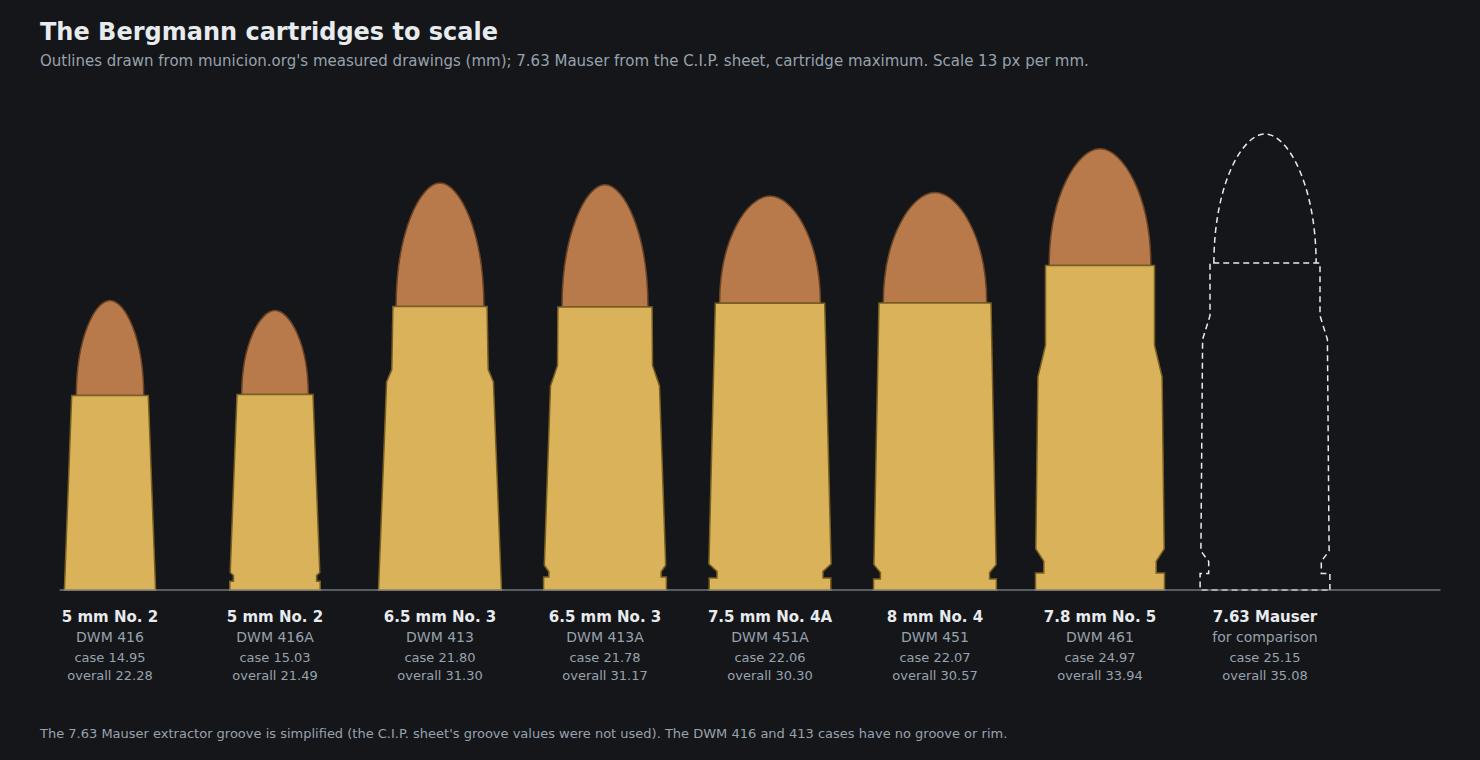
The drawing makes three things plain. The 5 mm is tiny: 21.5 mm overall. The 6.5 mm and the 7.8 mm are bottlenecked; the 5 mm and both 8 mm-class rounds are straight but steeply tapered. The Wikipedia article on the 6.5 mm says that case “is bottle-necked and steeply conical, and headspaces on the conical case walls”; the same is likely of the tapered 5 mm and 8 mm, which have no rim to stop on, but no source says so.2 And the 7.8 mm is the same size as the 7.63 Mauser in every dimension but one, which is the subject of a section below.
7.3 The grooveless first cartridges
The first 5 mm and 6.5 mm cartridges had no extractor groove and no rim, which is why the pistols that fired them had no extractor: there was nothing to grip, and the case was blown out of the chamber by its own residual pressure (Volume 4). municion.org dates both grooveless cases to 1894 and calls the design “no resultó práctico”, not practical, replaced by grooved versions identical except for the groove: 416A and 413A.1 Forgotten Weapons adds that the early 5 mm had a cannelured bullet and a full crimp and the later one a three-point stab crimp.3
The practical consequence for an owner runs one way. A grooved cartridge will chamber and fire in an early extractor-less pistol, because the groove does not touch anything. A grooveless cartridge in a pistol with an extractor has nothing for the extractor to hold. Which case a given pistol was made for follows from whether it has an extractor (Volume 5).
7.4 What they did: published ballistics
Table 2 — What they did: published ballistics
| Cartridge | Bullet | Velocity | Source |
|---|---|---|---|
| 5 mm | 35 gr FMJ | 580 ft/s (177 m/s) | Forgotten Weapons3 |
| 6.5 mm | 65 gr | 722 ft/s (220 m/s) | DWM, via Wilson, via Forgotten Weapons4 |
| 6.5 mm | 81.7 gr | 775 ft/s (236 m/s) | same4 |
| 6.5 mm | 76 gr FMJ | 710 ft/s (220 m/s) | Wikipedia “6.5mm Bergmann” infobox, citing Wilson2 |
| 6.5 mm | — | 380 m/s | Wikipedia “Bergmann 1896” infobox, uncited5 |
| 8 mm | not found | not found | Forgotten Weapons: “roughly equal to .32 ACP” is the author’s supposition6 |
| 7.8 mm | 85 gr | about 1,300 ft/s (400 m/s) | Forgotten Weapons7 |
The two 6.5 mm velocity figures are a long way apart (about 230 against 380 m/s) and are not reconciled. The lower comes, through Wilson, from DWM; the higher has no source. Forgotten Weapons notes that the 5 mm gave about half the velocity of the contemporary 5 mm Clement and that its energy was about 60 percent of a .22 Short’s.3 Wilson thought the 6.5 mm had “appreciable stopping power” and rated it above the .25 ACP, which did not appear until 1905.4
7.5 Four things called “7.5 mm Bergmann”
A reader looking for “7.5 mm Bergmann” ammunition or a “7.5 mm Bergmann” pistol can mean any of four different things, and the sources use the name for all of them.
- The Swiss revolver round in the 1894 trial pistols. Forgotten Weapons says the 1894s sent to Switzerland “were in 7.5mm”, probably the standard Swiss revolver cartridge, and Buffaloe says the Swiss-tested 1892 prototype was chambered for “the 7.5mm M1882 Swiss revolver cartridge”.89 That is a Swiss service cartridge, not a Bergmann one.
- The 7.5x22 Bergmann No. 4A, DWM 451A. municion.org lists it as a variant of the 8 mm No. 4 so close that “the differences in the dimensions of the two cartridges could well be manufacturing tolerances”, made in much smaller quantities; its measured bullet is 7.76 mm against the 8 mm’s 7.96.1
- The 7.5 mm No. 7A, DWM 460A, one of three calibres in which Buffaloe records the No. 6 prototypes of about 1897 to 1901.9
- The 7.8 mm No. 5 itself. municion.org lists “7.5 Bergmann 97” among the 7.8 mm round’s names, along with “7.82 Bergmann 1897”, “7.64 Bergmann Pistol Carbine 1897” and “7.65 Bergmann”.1 ATF’s curio and relic list calls the 1897’s calibre “7.65mm (7.8mm)” (Volume 8).10
The way through is the DWM number when there is one, and the pistol when there is not.
7.6 The 7.8 mm is a .30, and a 7.63 Mauser will not fit
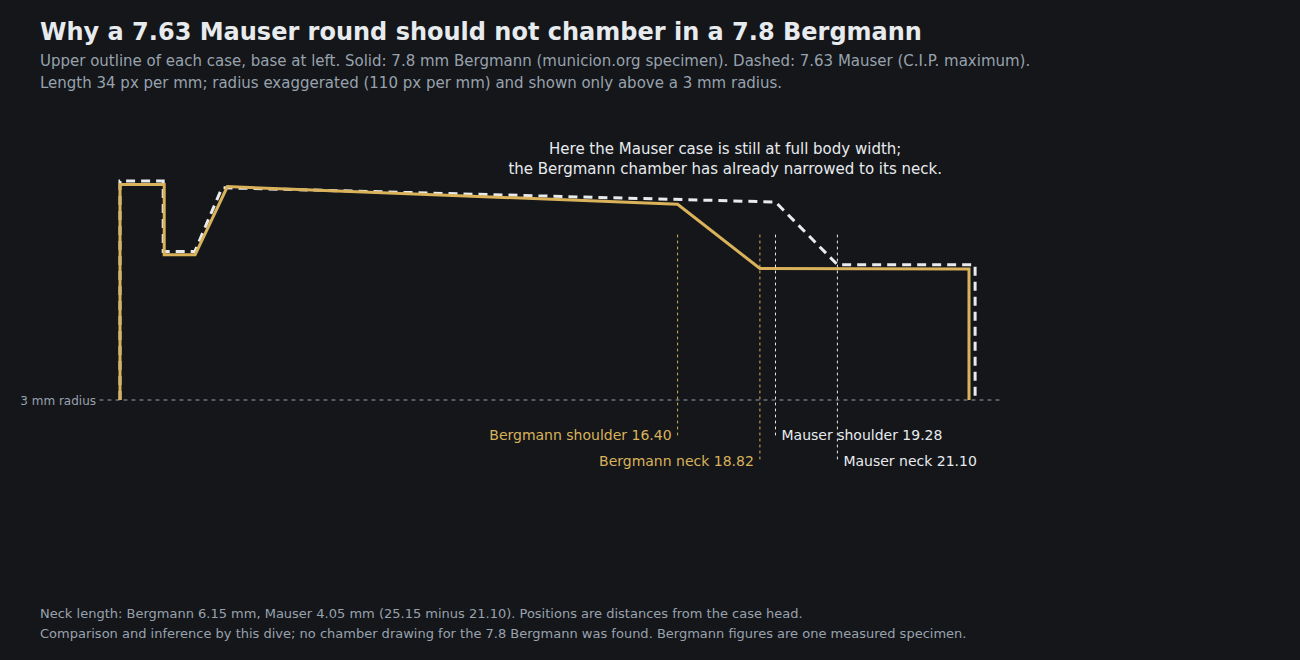
Forgotten Weapons states that the 7.8 mm Bergmann “actually used the exact same size bullet as the 7.63mm Mauser” and that “the Bergmann case has a longer neck”, which keeps the two from being interchangeable.7 The measurements bear both halves out. Set side by side with the C.I.P.’s maximum cartridge dimensions for the 7,63 Mauser:111
Table 3 — The 7.8 mm is a .30, and a 7.63 Mauser will not fit
| 7.8 mm Bergmann (specimen) | 7.63 Mauser (C.I.P. max) | |
|---|---|---|
| Bullet diameter | 7.81 | 7.86 |
| Neck diameter | 8.39 | 8.46 |
| Shoulder diameter | 9.56 | 9.60 |
| Head diameter | 9.88 | 9.86 |
| Rim diameter | 9.92 | 9.98 |
| Case length | 24.97 | 25.15 |
| Shoulder begins, from the head | 16.40 | 19.28 |
| Neck begins, from the head | 18.82 (24.97 minus a 6.15 neck) | 21.10 |
| Neck length | 6.15 | 4.05 |
| Overall length | 33.94 | 35.08 |
The bullet is the same .30 calibre: 7.81 against 7.86 mm, within the scatter of a single measured specimen. The heads, rims and bodies are the same within a few hundredths of a millimetre. The difference is where the shoulder is. The Bergmann’s shoulder begins at 16.40 mm from the head and its neck at 18.82; the Mauser’s shoulder begins at 19.28 and its neck at 21.10. A 7.63 Mauser round therefore carries its full body diameter about 2.9 mm further forward than a 7.8 mm Bergmann chamber allows, and should not enter the chamber. Run the other way, a 7.8 mm Bergmann round in a C96 would headspace, if at all, on a shoulder nearly 3 mm short of the chamber’s, and must never be tried.
That conclusion is this dive’s, from one measured specimen of the Bergmann and the Mauser’s specification; no chamber drawing for the 7.8 mm was found. A chamber cast from the pistol in hand is the check.
7.7 Who made them
The headstamps municion.org illustrates name the makers: Deutsche Metallpatronenfabrik of Karlsruhe (“D.M. K”), which became part of DWM; DWM itself, with its catalogue numbers in the headstamp (“DWM K K 413A”, “461”); the Rheinische Metallwarenfabrik of Sömmerda (“R M S”); and, for the 7.8 mm, Hirtenberger of Austria (“H K&C”) and the Société Française des Munitions of Paris.1 Forgotten Weapons, citing Wilson, adds Eley for the 6.5 mm.4 A box of 6.5 mm from the Karlsruhe works, labelled for Bergmanns Industriewerke, is illustrated on the municion.org page.1 municion.org also notes that the 6.5 mm was used by the Hamilton pistol of 1901, and that the 8 mm No. 4 cartridge was dropped from the catalogues “around 1910”.1
7.8 Ammunition today
No loaded ammunition for any Bergmann pistol cartridge was found on sale in October 2026. Buffalo Arms, the largest American supplier of components for obsolete calibres, returned on a search for “bergmann” only one item for these pistols: a CH4D “6.5 Bergmann 4D Die Set”, item 4D6.5BERG, at $130.09, listed as out of stock and available on back order.12 Original cartridges survive as collectors’ pieces, and Julia’s cataloguer wrote in 2010 that he could not “recall having ever encountered American made ammunition” for the 1897 and that none “has been available in ordinary commerce in Europe for many years”.13 The legal weight of that absence is in Volume 8.
7.9 Making cases
The cases have to be formed or made. What follows is dimensional reasoning from the table above, offered as starting points to check, not as a tested procedure; no published case-forming instructions for any Bergmann cartridge were found.
- 7.8 mm. The obvious parent is the .30 Mauser (7.63 x 25) case, which is in production (Starline brass, $28.79 per 100 at Graf & Sons on 18 October 2026, as recorded in the Borchardt dive). Head, rim, body and neck diameters match; the case is 0.18 mm long; and the shoulder must be set back about 2.9 mm. That is a sizing-die job in a die made to a 7.8 mm Bergmann chamber, followed by trimming. No off-the-shelf 7.8 mm die was found.
- 6.5 mm. CH4D makes the die set Buffalo Arms lists. The parent case it is meant for is not stated on the listing, and none of the common cases has a 9.34 mm head with a 21.8 mm length; ask the die maker.
- 5 mm. By dimension the nearest common case is the .25 ACP, whose head is about 7 mm against the Bergmann’s 6.89 and whose length is a little longer; the steep taper to a 5.85 mm mouth would need a full-length forming die. No .25 ACP dimensions are tabled here from a primary sheet, so check them before cutting anything.
- 8 mm and 7.5 mm No. 4A. No common parent case with a 9.4 mm head and a 22 mm length was identified.
- Turned cases. A lathe can make a case from brass bar. A cartridge case is a pressure vessel whose softness at the mouth and hardness at the head are what make it safe, and a turned case has neither unless it is annealed and work-hardened in the right places. The hub’s reloading dives cover case metallurgy; turned cases are not recommended for an original pistol.
7.10 Bullets, and the load-data gap
Jacketed .308-inch bullets for the .30 Mauser suit the 7.8 mm (the measured bullet is 7.81 mm, 0.3075 inch); slug the bore before buying, because no published bore or groove dimension for the 1897 was found. For the 6.5 mm (6.61 mm, about 0.260 inch), the 5 mm (about 0.202 inch) and the 8 mm (about 0.313 inch), bullets have to be chosen to a slugged bore and in a weight near the original, which is published only for the 5, 6.5 and 7.8 mm (above).
No load data for any Bergmann pistol cartridge was found in any source consulted, and no powder charge appears in this dive. That is deliberate. The 1896 is an unlocked blowback whose safety depends on its cartridge being weak; a charge chosen by guesswork that is too strong drives the case back while the pressure is high, and a charge too weak leaves an extractor-less pistol with a case stuck in its chamber. Either way the test is made on an irreplaceable antique.
7.11 Should an original be fired?
That is an owner’s decision, and this dive’s view is narrow. The pistols are rare, valuable and without spare parts (Volume 6); five of the five Sturgess 1897s described had weak recoil springs (Volume 4); there is no factory ammunition and no published load data; and the Borchardt dive reached the same position on the C-93 for similar reasons. A Bergmann that is to be shot should be examined by a gunsmith, fired with ammunition made by someone who has measured its chamber, and fired gently. Most owners do not shoot them.
7.12 What could not be established
- An official dimension sheet for any Bergmann cartridge; the table above is of measured specimens.
- Bore and groove diameters for any of the pistols.
- Any original powder or charge.
- Published velocity for the 8 mm; a source for Wikipedia’s 380 m/s for the 6.5 mm.
- The parent case for CH4D’s 6.5 mm Bergmann dies; any die for the 5, 7.8 or 8 mm.
- Whether the No. 4A (7.5 mm) and No. 4 (8 mm) were chambered differently, or are one pistol with two loadings.
References
Footnotes
-
municion.org (Jordi Camerón), pages “5x15 Bergmann Nº2 Grooveless”, “5x15 Bergmann nº 2 1896”, “6.5x22 Bergmann Nº 3 1894”, “6.5x22 Bergmann Nº 3 1896”, “8x22 Bergmann Nº4”, “7.5x22 - 7.5 Bergman nº 4” and “7.8x25 Bergmann Nº 5”, with their dimensional drawings, read from Internet Archive captures of http://www.municion.org/bergmann/ and http://www.municion.org/7_5x22/ (accessed 2026-10-19). ↩ ↩2 ↩3 ↩4 ↩5 ↩6 ↩7 ↩8 ↩9
-
“6.5mm Bergmann”, English Wikipedia, https://en.wikipedia.org/wiki/6.5mm_Bergmann (accessed 2026-10-19). ↩ ↩2
-
Ian McCollum, “Bergmann No. 2 / 1896 Pistol”, Forgotten Weapons, 8 November 2013, https://www.forgottenweapons.com/bergmann-no-2-1896-pistol/ (accessed 2026-10-19). ↩ ↩2 ↩3
-
Ian McCollum, “Bergmann No. 3 / 1896 Pistol”, Forgotten Weapons, 12 November 2013, https://www.forgottenweapons.com/bergmann-no-3-1896-pistol/ (accessed 2026-10-19); cites R. K. Wilson, Textbook of Automatic Pistols (1934). ↩ ↩2 ↩3 ↩4
-
“Bergmann 1896”, English Wikipedia, https://en.wikipedia.org/wiki/Bergmann_1896 (accessed 2026-10-19). ↩
-
Ian McCollum, “Bergmann No. 4 / 1896 Pistol”, Forgotten Weapons, 13 November 2013, https://www.forgottenweapons.com/bergmann-no-4-1896-pistol/ (accessed 2026-10-19). ↩
-
Ian McCollum, “Bergmann No.5 / 1897 Pistol”, Forgotten Weapons, 15 November 2013, https://www.forgottenweapons.com/bergmann-no-5-1897-pistol/ (accessed 2026-10-19). ↩ ↩2
-
Ian McCollum, “Bergmann 1894 – No.1 Pistol”, Forgotten Weapons, https://www.forgottenweapons.com/early-automatic-pistols/bergmann-no1-1894/ (accessed 2026-10-19). ↩
-
Ed Buffaloe, “The Bergmann Pistols”, Unblinking Eye, https://unblinkingeye.com/Guns/Berg/berg.html (accessed 2026-10-19). ↩ ↩2
-
ATF, Firearms Curios or Relics List, January 1972 through April 2025, Section IIIA, via https://web.archive.org/web/20260426215034if_/https://www.atf.gov/media/19856/download (accessed 2026-10-19). ↩
-
C.I.P., TAB. IV, “7,63 Mauser” (dated 84-06-14, revised 06-09-19), read from a third-party copy at https://www.tiropratico.com/CIP/Commission%20Internationale%20Permanente/763mauser.pdf (accessed 2026-10-19). ↩
-
Buffalo Arms Co., “6.5 Bergmann 4D Die Set”, item 4D6.5BERG, https://www.buffaloarms.com/6-5-bergmann-4d-die-set-4d6-5berg.html, and site search for “bergmann” (both accessed 2026-10-19). ↩
-
James D. Julia, Inc., Spring 2010 lot 1074 and Fall 2012 lot 2474, Bergmann Model 1897 No. 5, serial 475, https://jamesdjulia.com/?p=467386 and https://jamesdjulia.com/?p=479395 (accessed 2026-10-19). ↩
Comments (0)