Bergmann 1896 and 1897 · Volume 2
The 1896 in Production: No. 2, No. 3 and No. 4
Schilling of Suhl, three calibres sharing one serial series, a folding trigger that lasted less than a year, the extractor added in mid-run, and production figures that the sources give two ways
2.1 From 1894 to 1896
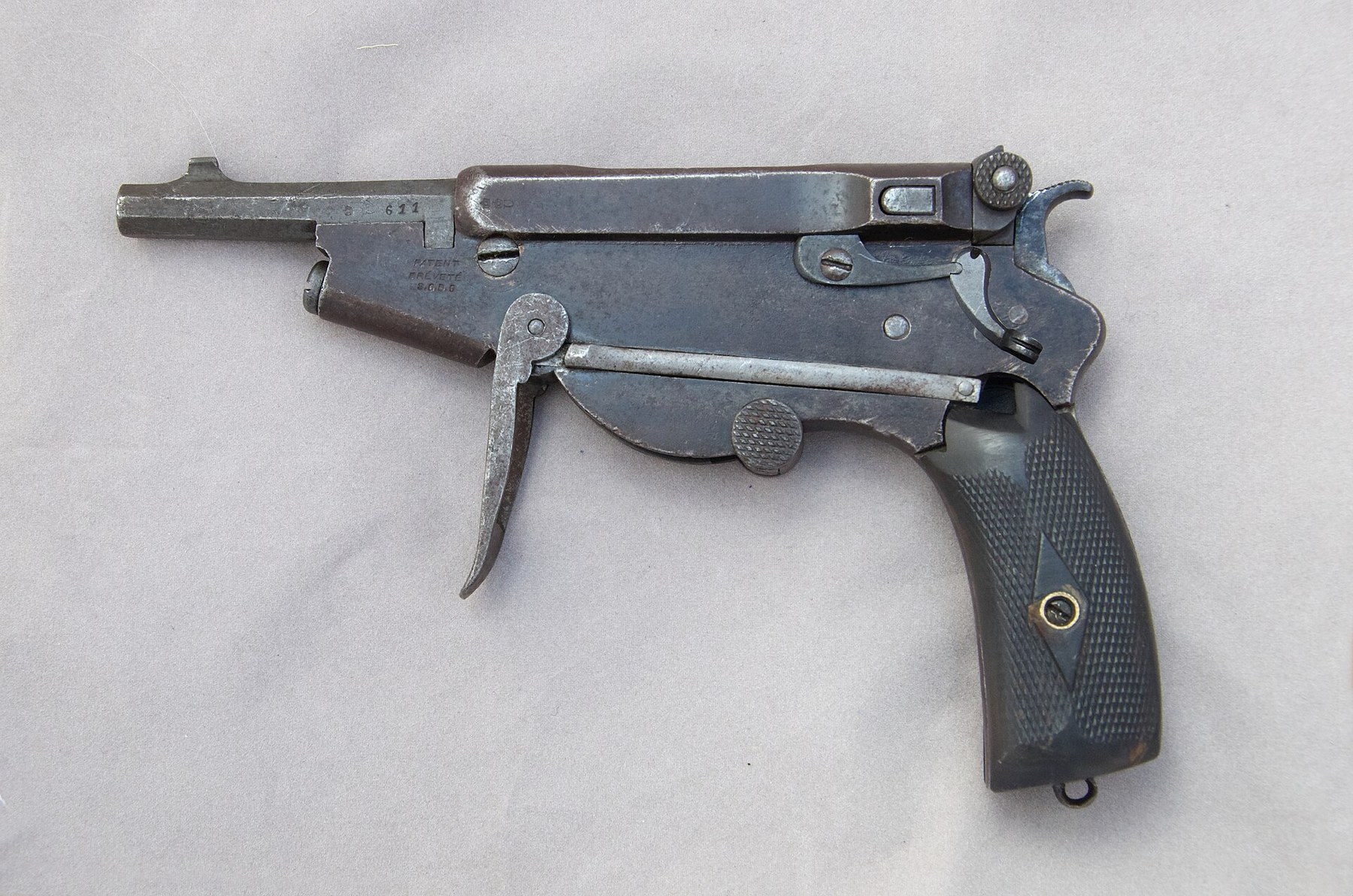
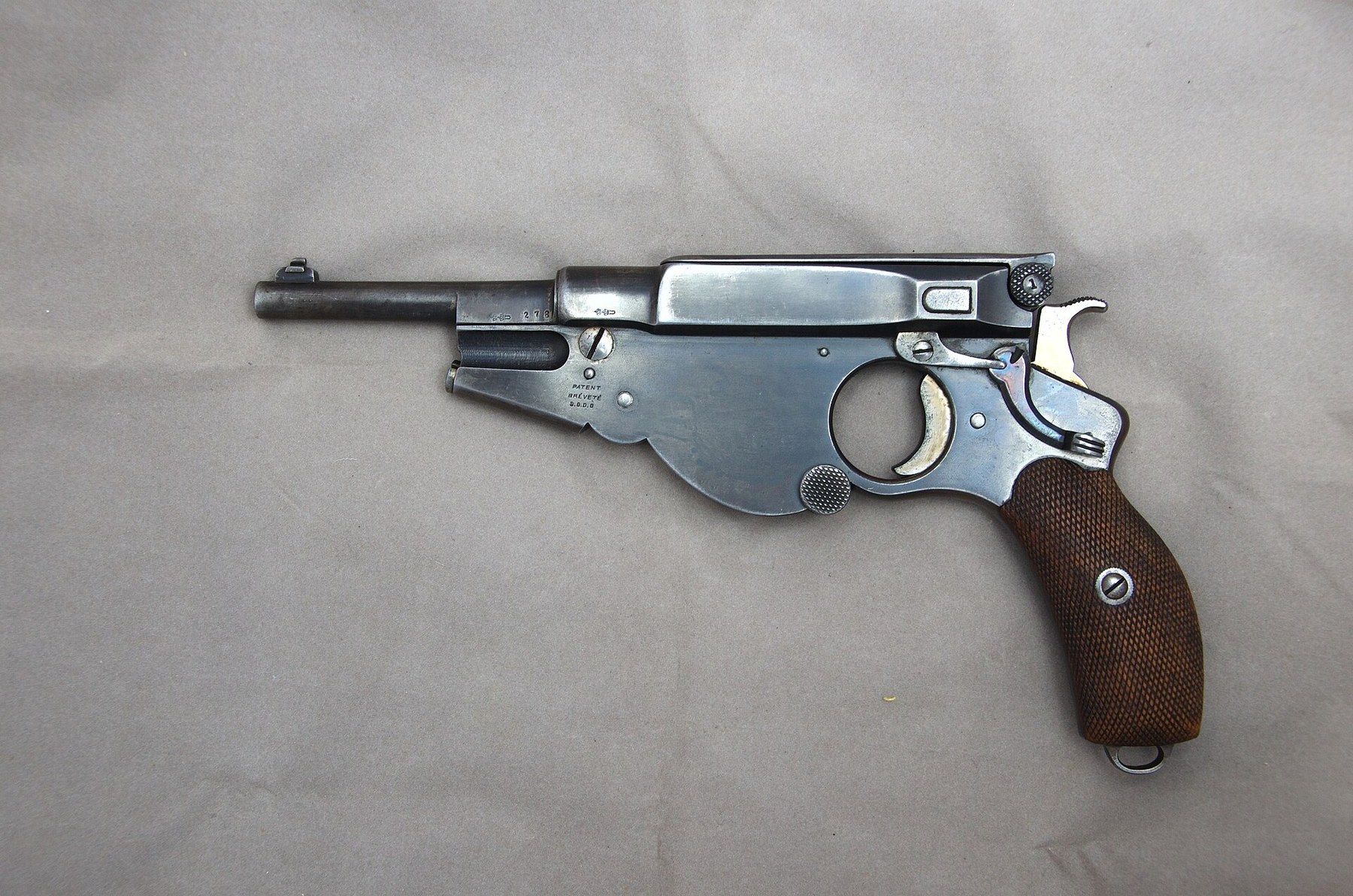
The 1896 is the 1894 tidied up, not a new mechanism. Its bolt is still unlocked and its magazine still takes a five-round clip through a hinged plate on the right. The visible change is underneath the barrel: Forgotten Weapons records that the 1896 “moved the recoil spring into the back of the bolt assembly, removing the housing under the barrel”.1 With the spring tube gone, the frame in front of the trigger guard became a plain, deep slab carrying the magazine, which is the 1896’s silhouette.
Buffaloe records that the patents for the new pattern were filed late in 1895, and Wikipedia, citing John Walter, says the pistol was commercially available in the autumn of that year, which is why the “1896” name runs a little behind the guns.23 From this model on Bergmann numbered by calibre: No. 2 for 5 mm, No. 3 for 6.5 mm and No. 4 for 8 mm. The 1894 was then called No. 1 after the fact.13
2.2 Who made them: V. Charles Schilling of Suhl
Bergmann did not make the 1896 himself. The pistols were made under contract by V. Charles Schilling of Suhl, the old arms town in Thuringia, and Schilling’s guns say so: the miner trademark on the frame is surrounded by “GAGGENAU” above and “V.C.S. SUHL” below.452 The James D. Julia catalogue for a No. 3 target pistol spells it out: “V.S.C were the initials for V. Charles Schilling, who made the pistols for Bergmann, with Suhl being the location.”5 Pistols with the miner alone in the oval, without the Schilling letters, are taken by Forgotten Weapons to be Bergmanns Industriewerke’s own, and it judges the quality the same.4
Buffaloe dates Schilling’s work to “the later M1896 guns … starting in 1896”.2 The auction record suggests Schilling was there from close to the start: Rock Island catalogued folding-trigger No. 2s with serials 19 and 386 as made by Schilling “in 1896” and “c. 1896-1897”, Forgotten Weapons shows a No. 3 with serial 106 and “a prominent V.C. Schilling inscription”, and Julia’s No. 3 serial 479 carries the full Schilling stamp.6748 Which serials, if any, came from Gaggenau rather than Suhl is not settled by anything consulted here.
Schilling’s later history matters for the end-date question in Volume 8. Buffaloe records that Heinrich Krieghoff bought Schilling in 1904 and that Schilling’s manufacturing agreement with Bergmann was cancelled early in 1905.2 A reader of Forgotten Weapons adds that Krieghoff made the last thousand or so 1896s; no source for that was found, and it is treated here as unconfirmed.4
2.3 Three calibres, three numbers
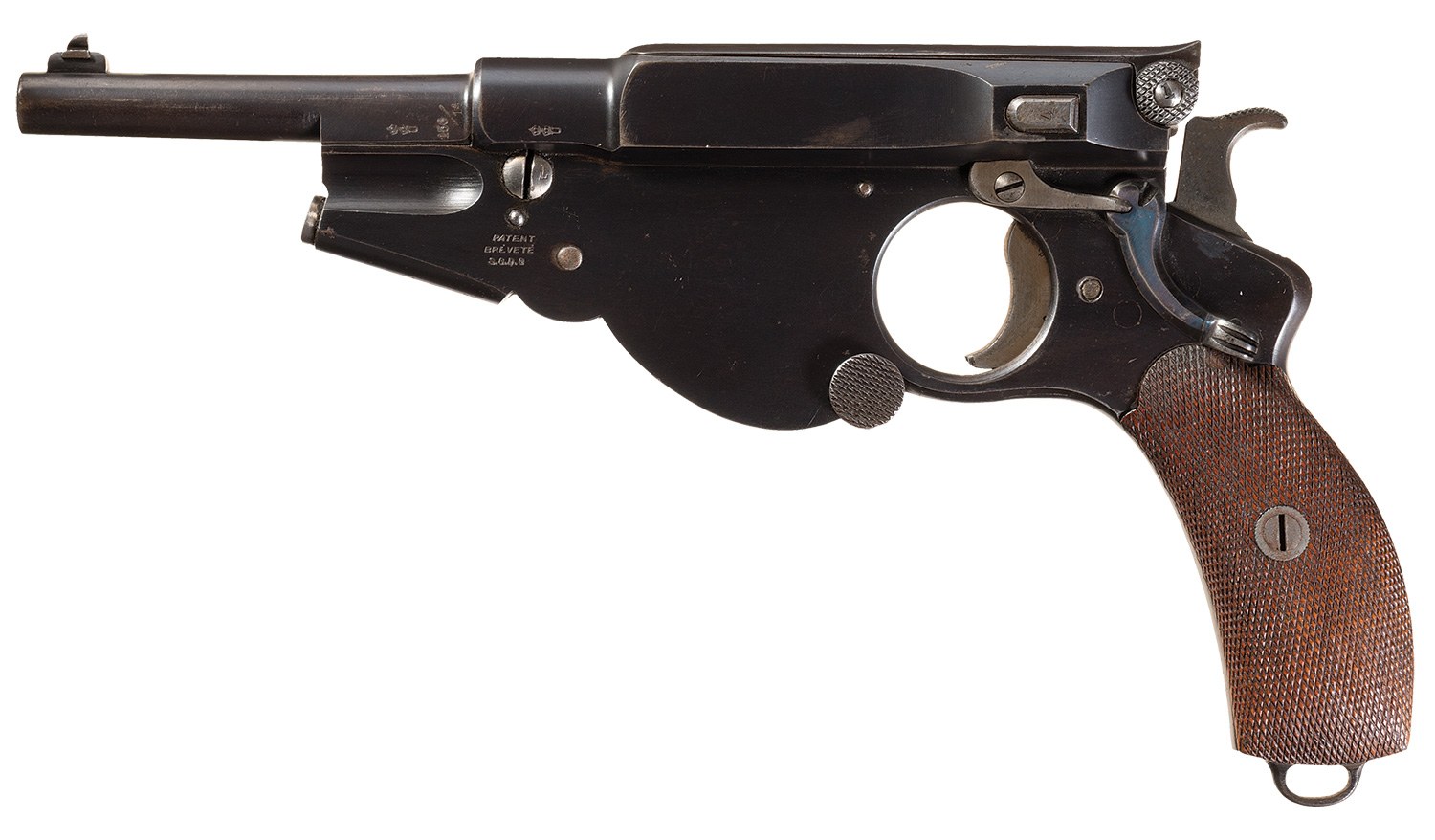
Every 1896 barrel carries a number on its left side, ahead of the frame, that is not a serial. Forgotten Weapons found “611” on every No. 2 it photographed and “278” on “roughly 75%” of No. 3s; both No. 4 barrels it photographed are marked “156/14”, and it did not know what the numbers meant.149 Antaris calls them “Bergmann’s marked calibers”.10 Julia’s cataloguer is more specific, writing that a No. 3’s barrel “is marked 278 (bore gauge)”.5 The serial itself is on the right of the frame, in front of the magazine.1
Table 1 — Three calibres, three numbers
| Model | Calibre | Barrel code (left side) | Clip | DWM cartridge numbers |
|---|---|---|---|---|
| No. 2 | 5 mm Bergmann | 611 | 5 rounds | 416, later 416A |
| No. 3 | 6.5 mm Bergmann | 278 | 5 rounds | 413, later 413A |
| No. 4 | 8 mm Bergmann | 156/14 | 5 rounds | 451 |
Sources: Forgotten Weapons; Antaris; Julia; municion.org for the DWM numbers.14910511 The clips were not interchangeable between calibres.4 The cartridges are the subject of Volume 7.
2.4 How many were made
The production figures in print come from two or three authors and do not agree exactly. They are set side by side here.
Table 2 — How many were made
| Model | Ezell, via Wikipedia | Ezell and Schroeder, via Antaris | Forgotten Weapons |
|---|---|---|---|
| No. 2 (5 mm) | about 2,000 | about 2,000 | 1,500 to 2,000 |
| No. 3 (6.5 mm) | about 4,400 | about 4,000 | about 4,000 |
| No. 4 (8 mm) | “two or three hundred” | 200 to 300 | ”one or two hundred” |
A fourth figure stands apart. Rock Island’s catalogue for a No. 4 says “approximately 1000-1500 total were produced between 1897 and mid 1898”.12 It does not say whether it means all 1896s or only the late “New Model” it was selling, and it cites no source; it is recorded, not used.
The serials explain why exact counts are hard. Forgotten Weapons states that the No. 2 and No. 3 “share a single block of serial numbers”, and that the No. 4 shares the No. 3’s series, which makes “an exact count impossible”.19 Buffaloe places the No. 4 at about serials 2300 to 3000, made around 1897, and the auction record agrees well enough: No. 4 serials 2370, 2429, 2437 and 2512 have been described, and Forgotten Weapons notes a reference to 3125.291210 A No. 2 at serial 2273 and another at 2172 show that 5 mm pistols were still being numbered in the same range.1314
2.5 The folding trigger
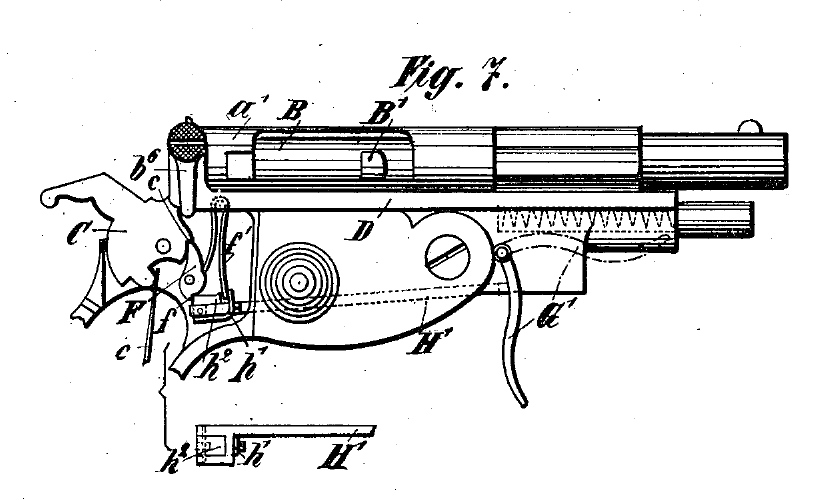
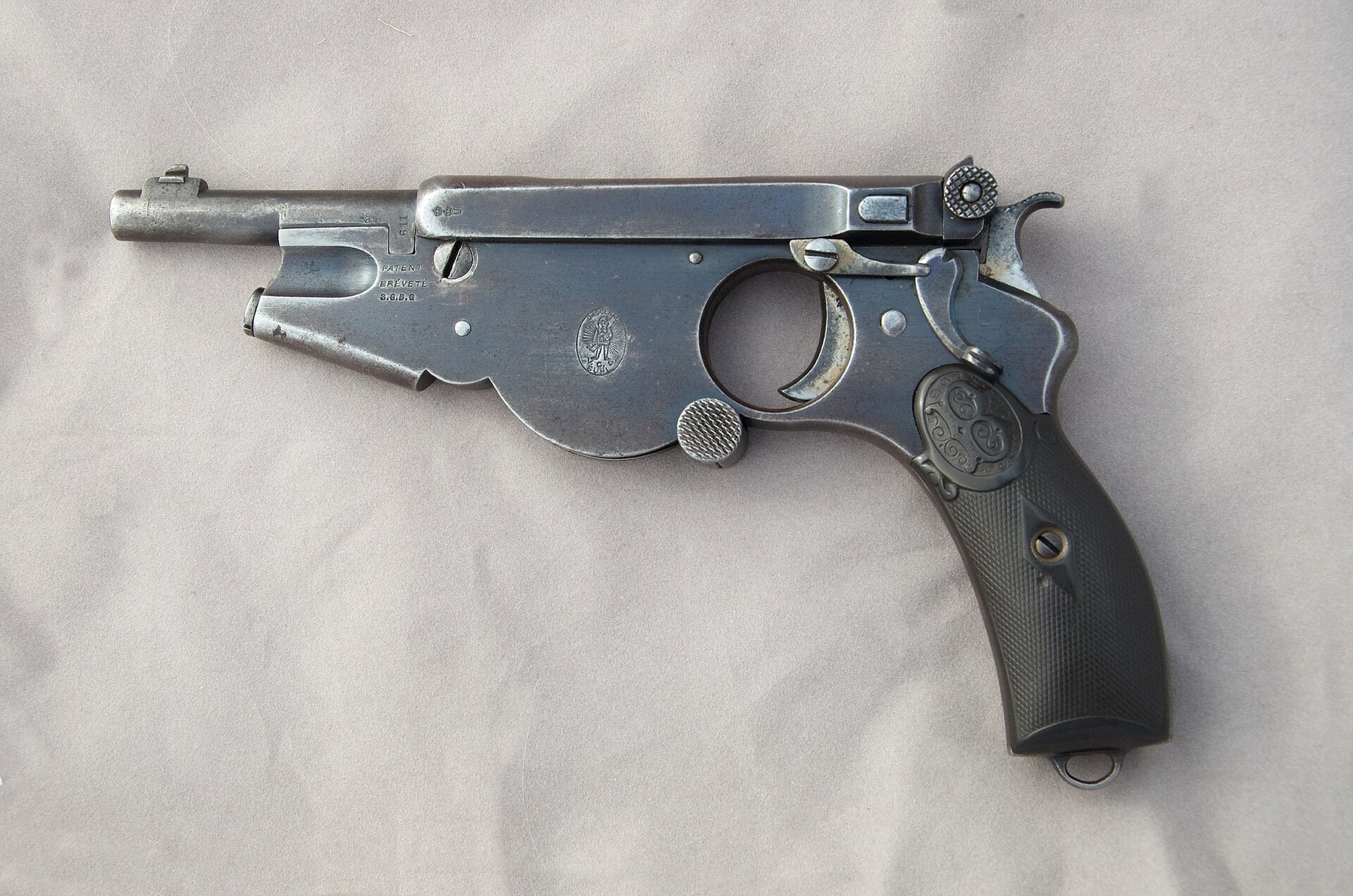
The first No. 2s had the trigger the patent drew for “small firearms” (Volume 1): a blade hinged at the front of the frame, ahead of the magazine, that folds forward against the frame for the pocket and swings down to fire, with “a long transfer bar connecting it to the rest of the mechanism”, in Rock Island’s description.615 The long bar is plain to see on the left of the gun.
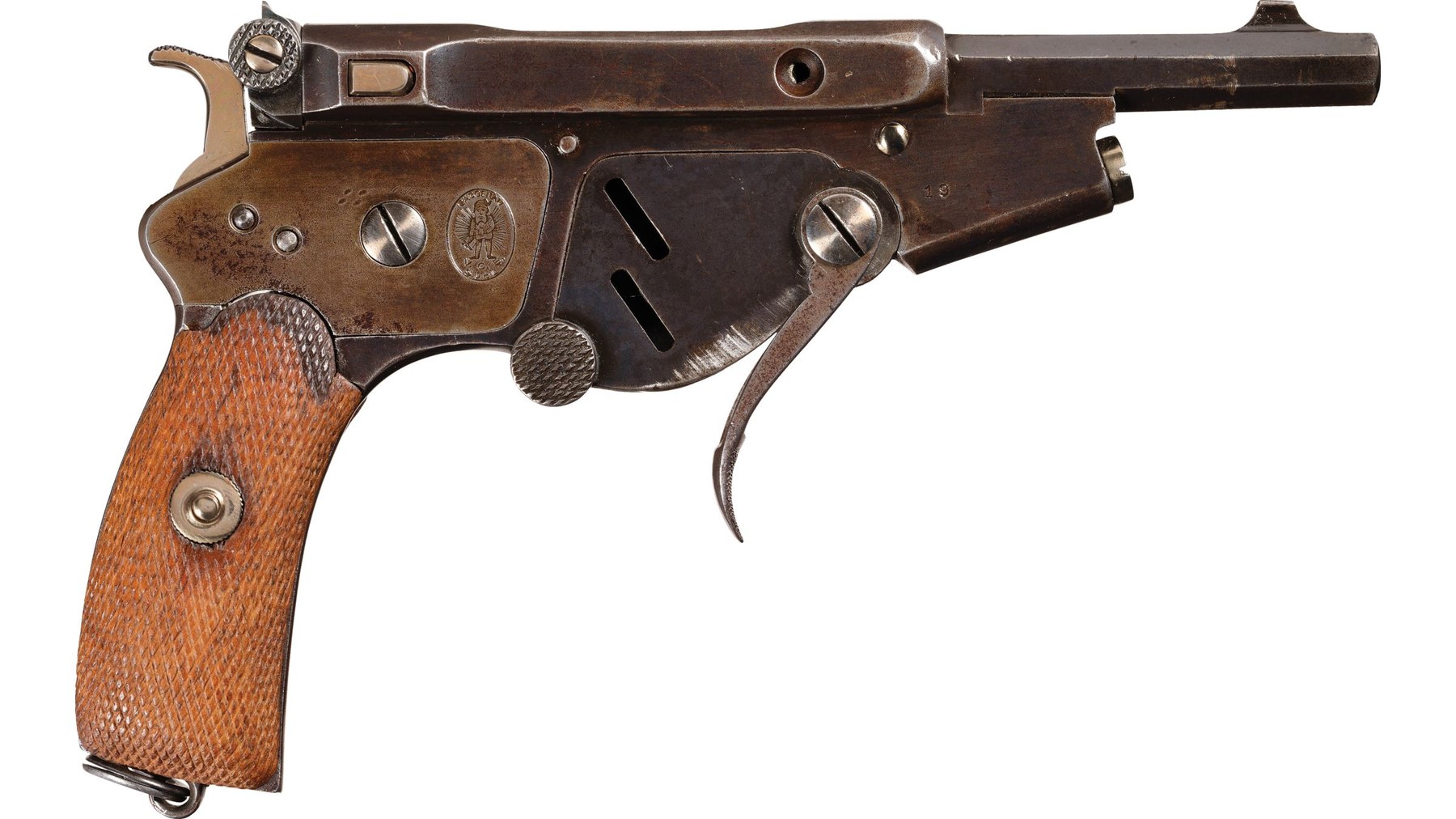
It did not last. Wikipedia, citing Walter, says the folding trigger was “accident-prone” and that a revised No. 2 with a conventional trigger appeared in the summer of 1896; Rock Island says the first iteration proved “accident prone and unpopular on the commercial market” and was replaced “less than a year later”, and that fewer than 500 were made; Antaris says it was discarded “by about Serial No. 500”.3710 Three different ways of saying the same thing, and consistent: a few hundred folding-trigger pistols, all in the first months of production.
2.6 The extractor arrives
The 1894 had no extractor, and neither did the first 1896s: the fired case was blown out of the chamber by its own residual pressure. That needs a case with no rim to catch and nothing to grip, and the first 5 mm and 6.5 mm cartridges, DWM 416 and 413, have neither rim nor groove. When Schmeisser added an extractor, the cartridges gained a groove and new numbers, 416A and 413A.111
When it happened is given three ways, and the three are not easily reconciled:
- “approximately the first thousand guns made maintained the extractor-less design of the No. 1” (Forgotten Weapons, No. 2 article, of both calibres);1
- “the first several hundred No.3 pistols were made without extractors” (Forgotten Weapons, No. 3 article);4
- an extractor “perhaps” added to the No. 3 about the time of the revised No. 2, in the summer of 1896 (Walter, via Wikipedia).3
The physical record agrees with the broad picture without fixing the number. Julia’s No. 3 serial 414 is “early, no extractor”, and Forgotten Weapons’ serial 2485 has one.4 A later grooved cartridge will chamber in an early pistol, but an early grooveless cartridge cannot be extracted by a pistol that expects a groove; the practical consequence is in Volume 7.
2.7 Barrels, covers and the small changes
Several smaller changes ran through production. Forgotten Weapons describes them; none is dated to a serial.
- Barrel retention. Early guns hold the barrel with a screw above the trigger and a lug; to remove it, the screw comes out and the barrel turns 90 degrees. Later guns have a fully threaded barrel that unscrews once the screw is out.14 Julia’s No. 3 target pistol has a “screw-in bbl”.5
- Dust cover. The No. 3 has a cover over the ejection port that moves with the bolt; Forgotten Weapons says the No. 2 does not.41 The photographs used in this dive are not sharp enough on that point to confirm or contradict it.
- Bolt and frame. Rock Island’s description of a late No. 4 picks out “the distinctive flat top bolt and top cover with the thin, lightweight firing pin” and “the two angled cuts on the right side of the frame”, which are the angled slots in the magazine sideplate visible on every 1896 photographed here.12
2.8 Dimensions, as published
No factory specification sheet was found. The figures below are from named sources and individual pistols, and they disagree in ways that are partly explained by the different barrel lengths that were sold.
Table 3 — Dimensions, as published
| Source | Overall length | Barrel | Weight | |
|---|---|---|---|---|
| No. 2 | Julia, serial 1195 | ”about 7-1/2 in” (190 mm) | 2-1/2 in, tapered round | — |
| No. 2 | Rock Island, serial 19 (folding trigger) | — | 3 in, octagonal | — |
| No. 2 | Forgotten Weapons, “typical” | — | 3 to 3.5 in (75–90 mm) | — |
| No. 3 | Forgotten Weapons | 255 mm (10.0 in) | 114 mm (4.5 in) | 885 g (31.2 oz) |
| No. 3 | Wikipedia infobox, uncited | 254 mm | 102 mm | 1.13 kg |
| No. 3 | Julia, serials 479 and 1685 | — | “Four inch” | — |
| No. 3 target | Julia, serial 898 | — | 7.25 in, octagonal | — |
| No. 4 | Forgotten Weapons | 255 mm (10.0 in) | 114 mm (4.5 in) | 950 g (33.5 oz) |
| No. 4 | Rock Island, serial 2429 | — | 4-3/8 in, round | — |
Sources.16614385912 Forgotten Weapons’ specification box for the No. 2 gives 280 mm and 1.03 kg, the same figures it gives for the 1894 Swiss trial pistol; they look carried over, and they are not used here.117
2.9 Target pistols, stocks, cases and export marks
- Target model. Julia states that “Bergmann made very few target pistols, all in 6.5mm Bergmann”. Its serial 898 has a 7.25-inch octagonal barrel, fully adjustable sights, a finger rest, a trigger stop and a set trigger whose “auxiliary cocking catch in the front of the trigger guard … must be pushed forward to cock the set trigger mechanism”.5
- Stocks. Holster-stocks were a factory option for the No. 3 and are “very rare”; Forgotten Weapons notes that 1896s were slotted for a stock only when sold with one, and illustrates a No. 4 whose backstrap is slotted.4189 A stocked 1896 is a legal question as well as a rarity (Volume 8).
- Cased sets. Julia sold a No. 3, serial 1685, in a black leather maker’s case with “Bergmann Pistole” in the lid, two loaded clips, a cleaning rod and an oil bottle.19 It is the same pistol, by serial and by its stamps, as the CC0 photographs at the head of this volume.
- Export marks. Forgotten Weapons illustrates a No. 3, serial 2485, with Siamese markings.4 Who bought pistols for Siam, and how many, was not found.
2.10 Trials and buyers
No army adopted the 1896. A Bergmann was among the four pistols the Swiss commission tested in June 1897, with the Mannlicher, the Mauser and the Borchardt, and a “Bergmann” was one of the pistols a US Army board examined in November 1898 before deciding that self-loaders were not yet ready to replace the revolver; both episodes are told in the Borchardt dive’s Volume 3.20 Which Bergmann either body saw is not stated in the passages quoted there. By 1897 the No. 5 existed, and Antaris says the Swiss tested the No. 5 in 1898 (Volume 3); the 1897 Swiss Bergmann could have been either.10
The 1896 sold instead to civilians and officers buying privately, which is why it survives in some numbers. Wikipedia, citing Barker, adds that it was “over-engineered” and that some officers carried it only for show.3 Antaris, citing Geoffrey Sturgess, compares its several thousand sales with the C-93’s hundreds.10
2.11 When production ended
Nothing consulted gives a last serial or a last year with a primary citation. Rock Island describes its No. 4, serial 2429, as made “right at the end of production” and puts the end in “mid 1898”, without a source.12 Against that stand the unconfirmed claim that Krieghoff, who bought Schilling in 1904, made the last thousand or so, and the fact that cartridges for the 1896 stayed in catalogues long after: municion.org says the 8 mm was dropped “around 1910”.4211 Ammunition outliving a pistol is normal, so that last point proves nothing about the guns. Volume 8 explains why the end date matters, and how to handle a pistol whose year cannot be shown.
2.12 A museum label corrected
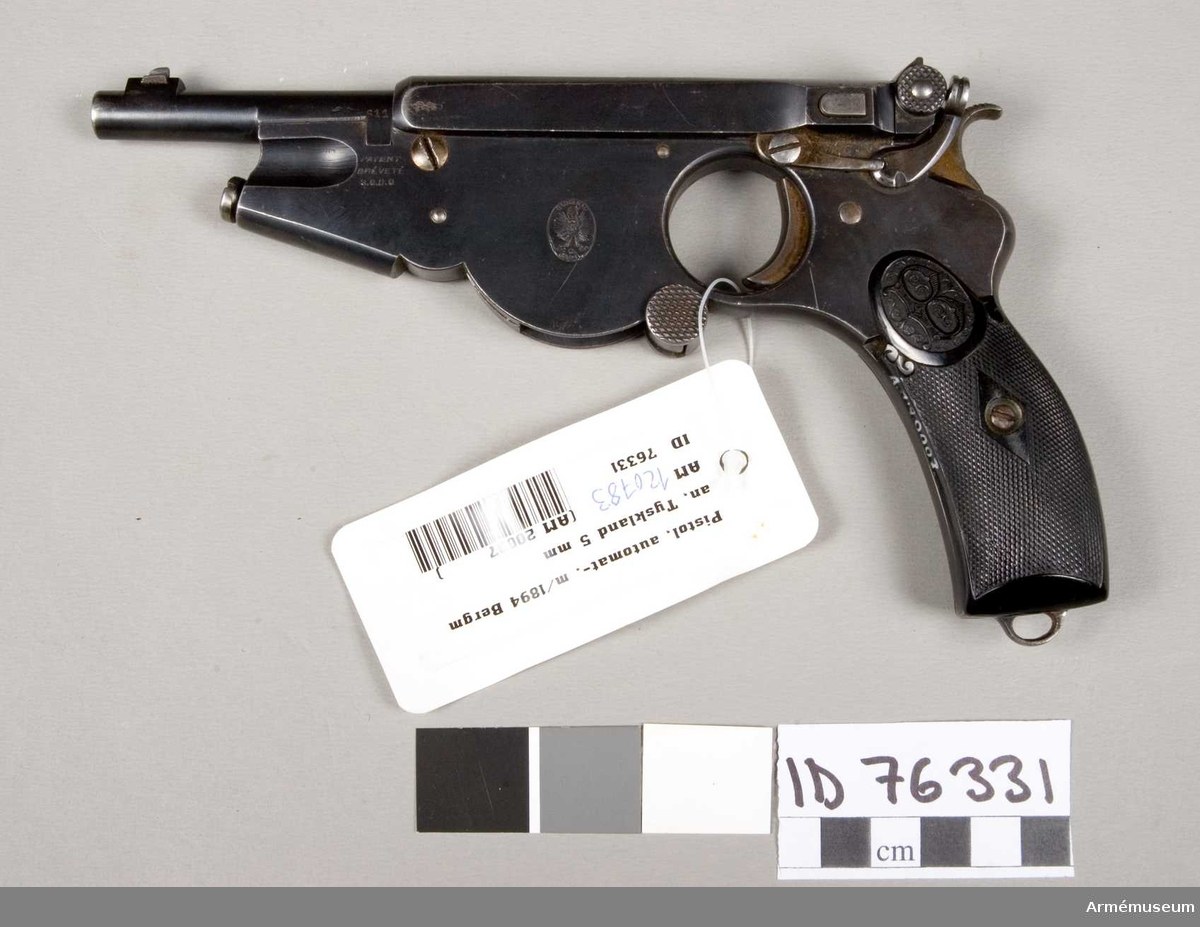
The Swedish Army Museum (Armémuseum) has two of these pistols online, both catalogued as “Pistol m/1894”, citing Automatic Weapons for the model year.14 Both are 1896-pattern guns. The 5 mm example has a conventional trigger in a ring guard and no spring tube under the barrel, the two features that separate the 1896 from the 1894 (Volume 5). Its catalogue entry also reads the barrel’s “611” as the “tillverkningsnummer”, the serial, while noting a different number, 2172, on the front of the frame. On the evidence of every other No. 2, 611 is the calibre code, and 2172 is the serial.141
2.13 What could not be established
- Which 1896s, if any, Bergmanns Industriewerke made itself rather than Schilling.
- The serial at which the extractor was introduced (three incompatible statements above).
- The meaning of the barrel codes 611, 278 and 156/14 beyond their association with calibre; Julia’s “bore gauge” is one cataloguer’s reading.
- The last serial and the last year of manufacture, and whether Krieghoff completed any.
- Who bought the Siamese-marked pistols.
- Whether the No. 2 really lacked the No. 3’s dust cover.
References
Footnotes
-
Ian McCollum, “Bergmann No. 2 / 1896 Pistol”, Forgotten Weapons, 8 November 2013, https://www.forgottenweapons.com/bergmann-no-2-1896-pistol/ (accessed 2026-10-19). ↩ ↩2 ↩3 ↩4 ↩5 ↩6 ↩7 ↩8 ↩9 ↩10 ↩11 ↩12 ↩13 ↩14
-
Ed Buffaloe, “The Bergmann Pistols”, Unblinking Eye, https://unblinkingeye.com/Guns/Berg/berg.html (accessed 2026-10-19). ↩ ↩2 ↩3 ↩4 ↩5 ↩6
-
“Bergmann 1896”, English Wikipedia, https://en.wikipedia.org/wiki/Bergmann_1896 (accessed 2026-10-19); cites Ezell (1993), Walter (2008), Barker (1979), Antaris (2017). ↩ ↩2 ↩3 ↩4 ↩5 ↩6 ↩7
-
Ian McCollum, “Bergmann No. 3 / 1896 Pistol”, Forgotten Weapons, 12 November 2013, https://www.forgottenweapons.com/bergmann-no-3-1896-pistol/ (accessed 2026-10-19), with reader comments. ↩ ↩2 ↩3 ↩4 ↩5 ↩6 ↩7 ↩8 ↩9 ↩10 ↩11 ↩12 ↩13 ↩14 ↩15 ↩16
-
James D. Julia, Inc., Firearms, April 2017, lot 1522, Bergmann M1896 No. 3 target pistol, serial 898, https://jamesdjulia.com/item/1522-396/ (accessed 2026-10-19). ↩ ↩2 ↩3 ↩4 ↩5 ↩6 ↩7
-
Rock Island Auction Company, 22 August 2026, lot 1338, Bergmann 1896 No. 2 folding trigger, serial 19, https://www.rockislandauction.com/detail/4098/1338/very-scarce-german-bergmann-1896-no-2-folding-trigger-pistol (accessed 2026-10-19). ↩ ↩2 ↩3
-
Rock Island Auction Company, 16 August 2025, lot 1394, Bergmann 1896 No. 2 folding trigger, serial 386, https://www.rockislandauction.com/detail/4095/1394/v-c-schilling-bergmann-model-1896-no-2-folding-trigger-pistol (accessed 2026-10-19). ↩ ↩2
-
James D. Julia, Inc., Firearms, Fall 2012, lot 2472, Bergmann Model 1896 No. 3, serial 479, https://jamesdjulia.com/item/lot-2472-bergmann-model-1896-no-3-semi-automatic-pistol-46957/ (accessed 2026-10-19). ↩ ↩2
-
Ian McCollum, “Bergmann No. 4 / 1896 Pistol”, Forgotten Weapons, 13 November 2013, https://www.forgottenweapons.com/bergmann-no-4-1896-pistol/ (accessed 2026-10-19). ↩ ↩2 ↩3 ↩4 ↩5 ↩6 ↩7
-
Leonardo M. Antaris, “Bergmann’s Extraordinary Pistols”, American Rifleman, 18 October 2021, https://americanrifleman.org/content/bergmann-s-extraordinary-pistols (accessed 2026-10-19). ↩ ↩2 ↩3 ↩4 ↩5 ↩6 ↩7
-
municion.org (Jordi Camerón), pages for the 5x15, 6.5x22, 8x22 Nº4 and 7.5x22 Bergmann, read from Internet Archive captures of http://www.municion.org/bergmann/ (accessed 2026-10-19). ↩ ↩2 ↩3
-
Rock Island Auction Company, 11 September 2016, lot 3300, Bergmann 1896 No. 4, serial 2429, https://www.rockislandauction.com/detail/68/3300/bergmann-theodor-1896-pistol-8-mm (accessed 2026-10-19). ↩ ↩2 ↩3 ↩4 ↩5
-
File:Bergmann 1896 No 2 5mm Bergmann Sn 2273 L DSC 1177.jpg, Self Loader, Wikimedia Commons (accessed 2026-10-19). ↩
-
Armémuseum, Stockholm, “Pistol m/1894”, object IDs 76331 and 76415, https://digitaltmuseum.se/011024400550/pistol-m-1894 and https://digitaltmuseum.se/011024400548/pistol-m-1894, catalogue text as carried on Wikimedia Commons (accessed 2026-10-19). ↩ ↩2 ↩3
-
Louis Schmeisser, US Patent 547,454, 8 October 1895, https://patentimages.storage.googleapis.com/pdfs/US547454.pdf (accessed 2026-10-19). ↩
-
James D. Julia, Inc., Firearms, Fall 2010, lot 1074, Bergmann Model 1896 No. 2, serial 1195, https://jamesdjulia.com/item/lot-1074-rare-bergmann-model-1896-no-2-semi-auto-pistol-40592/ (accessed 2026-10-19). ↩
-
Ian McCollum, “Bergmann 1894 – No.1 Pistol”, Forgotten Weapons, https://www.forgottenweapons.com/early-automatic-pistols/bergmann-no1-1894/ (accessed 2026-10-19). ↩
-
Ian McCollum, “Bergmann No.5 / 1897 Pistol”, Forgotten Weapons, 15 November 2013, https://www.forgottenweapons.com/bergmann-no-5-1897-pistol/ (accessed 2026-10-19). ↩
-
James D. Julia, Inc., Firearms, Fall 2012, lot 2473, Bergmann Model 1896 No. 3 in maker’s case, serial 1685, https://jamesdjulia.com/item/lot-2473-bergmann-model-1896-no-3-semi-auto-pistol-in-ultra-rare-maker-s-case-46989/ (accessed 2026-10-19). ↩
-
Borchardt C-93 dive, Volume 3, /actual-firearms/pistols/borchardt-c93/vol-3/. ↩
Comments (0)