.300 Blackout AR Pistol · Volume 5
Suppressor Host — The Cartridge That Exists Because Cans Do
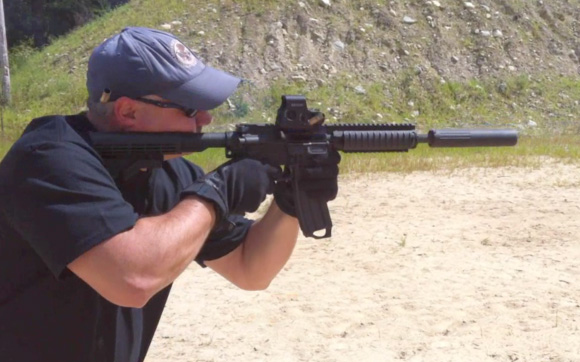
Every other cartridge in a collection acquires a suppressor as an accessory. .300 Blackout acquired the suppressor first and the cartridge was designed around it. That inversion is why this volume exists, and it is why an 8-inch braced .300 Blackout pistol is, properly understood, a suppressor host that happens to also work without one.
This series does not re-derive suppressor theory. Three companion dives own that material and are cross-referenced rather than repeated:
- How Suppressors Work — the mechanism, baffles, backpressure, threading and failure modes.
- Suppressors by Caliber — which can for which host, and the arithmetic of how many.
- Suppressor Law — the NFA process, the 2026 changes, and Michigan.
What follows is only what is specific to this cartridge on this host.
5.1 Why This Cartridge and Not Another
The Suppressors by Caliber dive reduces the whole question to a single table, and .300 Blackout is the only centerfire rifle row in it that reads “Yes — designed for it” under subsonic availability and “Quiet, and with real energy” under suppressed result.
The reasoning is short. A suppressor cannot do anything about the sonic crack of a supersonic bullet, so genuine quiet requires subsonic ammunition. Subsonic ammunition is only useful if the bullet is heavy enough to carry energy at around 1,000 fps. A heavy enough bullet requires a large enough diameter. And a large enough diameter, in a package that still runs in an AR-15 with unmodified magazines and an unmodified bolt, is exactly the problem .300 Blackout was invented to solve.
5.56 fails at step two and can never pass it. .308 can produce subsonic loads but they are expensive, specialist, and stability in common twist rates is genuinely unresolved. 9mm subsonic is easy but carries substantially less energy than a 220-grain .30-calibre bullet at the same velocity. .300 Blackout is the only common cartridge that clears every step, and the fact that it does so is not luck.
5.2 The Developer’s Own Number
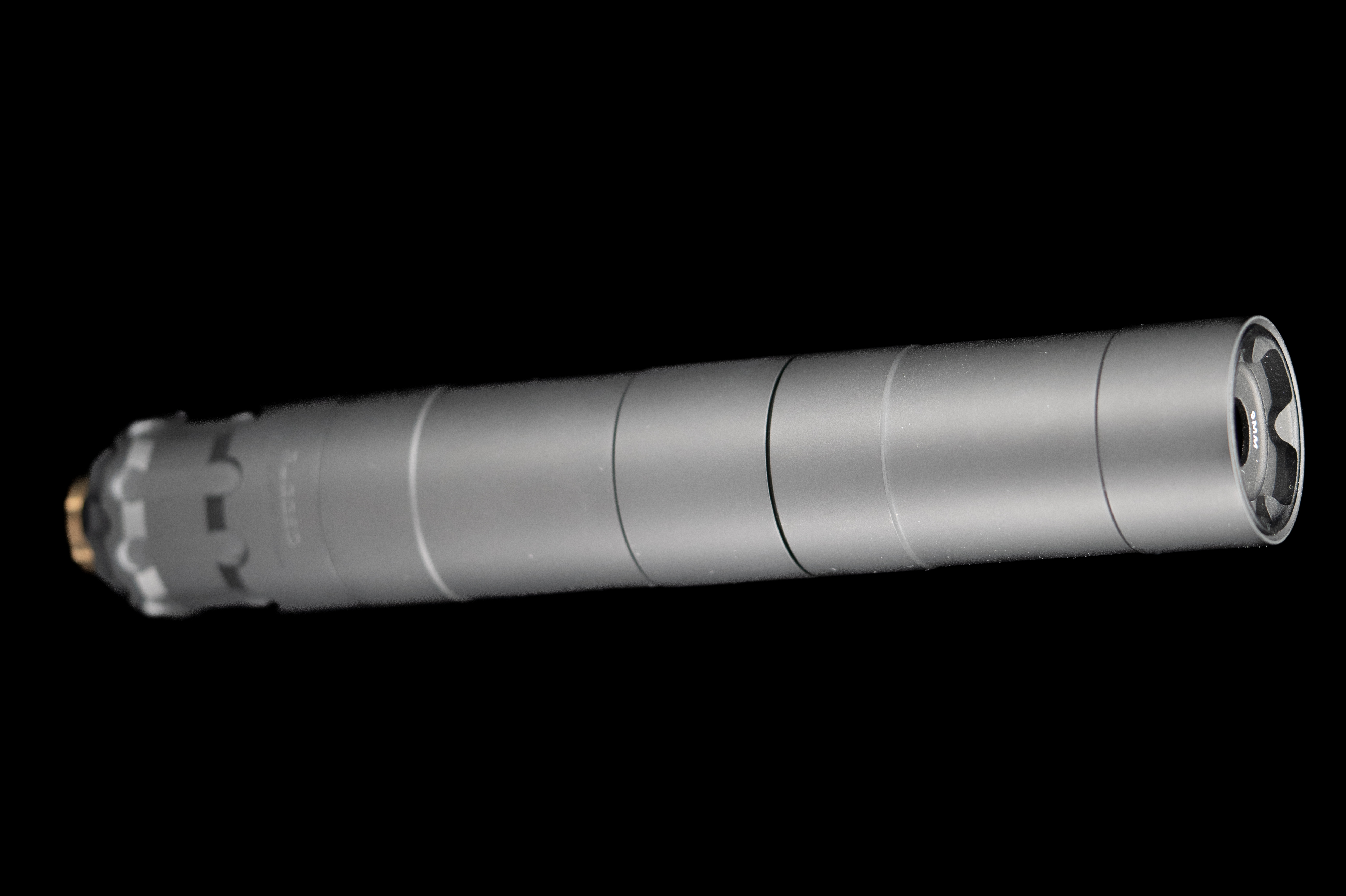
AAC specified a companion suppressor for its 300 BLK upper and published a figure for it:1
“The recommended sound suppressor is the AAC 762-SDN-6. This has been tested to provide a good balance between sound level, weight, accuracy, and reliable function. Suppressed SPL with AAC subsonic ammunition is approximately 126 dB both using MIL-STD measurements and at the shooter’s ear.”
⚠ That figure is the manufacturer’s own, for its own can and its own ammunition, and it is quoted as such. The Suppressors by Caliber dive’s standing rule applies with full force here: a decibel number from one manufacturer cannot be compared with a decibel number from another, because the labs, meters, distances, positions and weightings differ, on a logarithmic scale. The 126 dB figure is useful for what it says about the category, not as a benchmark to shop against.
What it says about the category is worth knowing. Roughly 126 dB is in the region where a centerfire rifle stops being a hearing-damage event on every shot and starts being something a person can stand beside. That is a qualitative change, not an incremental one, and it is available on no other cartridge that runs in this rifle.
⭐ The comparison AAC chose to make is the revealing one. The same manual compares its 9-inch .300 Blackout against the MP5-SD — the purpose-built integrally suppressed submachine gun — claiming “more accuracy, more penetration, and 165% the energy at 200 meters.”1 Whether or not one accepts the figure, the fact that a barrel-swap on a standard AR was being pitched against a dedicated suppressed weapon system says what the cartridge was for.
5.3 🔴 The Rating Question, Which Is a Materials Question
This is the single most consequential suppressor decision for this host, and it is routinely skipped.
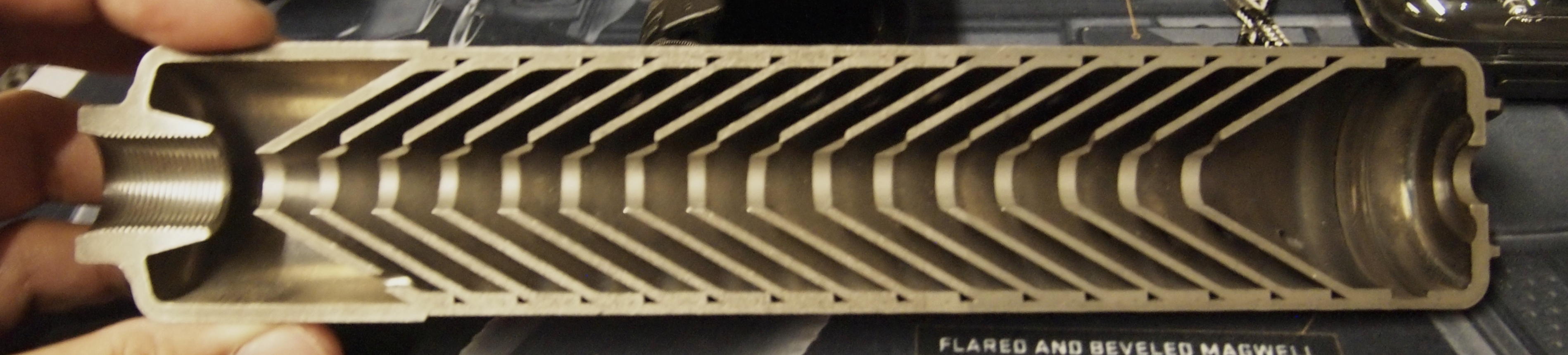
An 8-inch barrel is a far more hostile environment for a suppressor than a 16-inch barrel firing the same cartridge. The bullet exits sooner, at higher residual pressure, with more unburnt propellant still travelling behind it. All of that energy arrives in the blast chamber — the first volume behind the entry aperture — and it arrives as heat and as erosive high-velocity gas.
Two things follow, and they are not symmetrical:
Subsonic .300 Blackout is gentle. Low pressure, low velocity, modest gas volume. A subsonic-only diet is among the easiest duty cycles a centerfire rifle can gives a suppressor.
🔴 Supersonic .300 Blackout out of 8 inches is not gentle at all. This is the load that will eat a can, and it is the load people fire casually because it is cheaper and because the rifle came with it.
Therefore: any suppressor fitted to a barrel this short must be explicitly rated by its maker for a short-barrelled .300 Blackout host. That rating is a statement about materials — a superalloy or 17-4 stainless blast baffle rather than bare titanium throughout — and not a marketing claim. How Suppressors Work Volume 4 covers what the materials actually do and why the blast baffle is the part the argument is about.
Threading. .300 Blackout barrels are conventionally 5/8×24, the same as .308. This is deliberate and it is a safety feature: a 5.56 barrel is 1/2×28, so a .30-calibre can will not thread onto a 5.56 muzzle and a 5.56-bore can will not thread onto a .300 Blackout muzzle. The threads do not prevent every mistake — but they prevent this one.
5.4 What Changes on the Gun When the Can Goes On
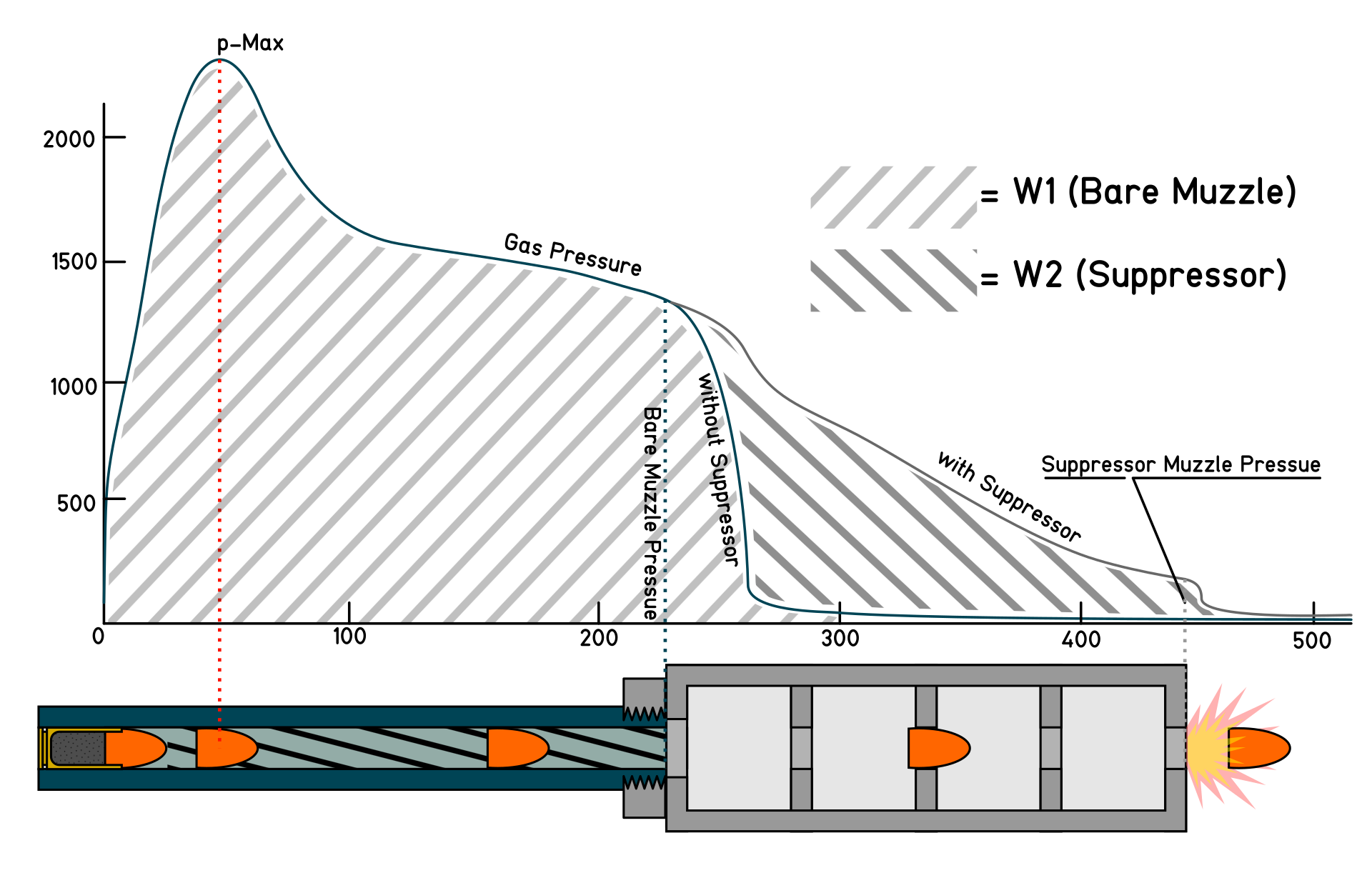
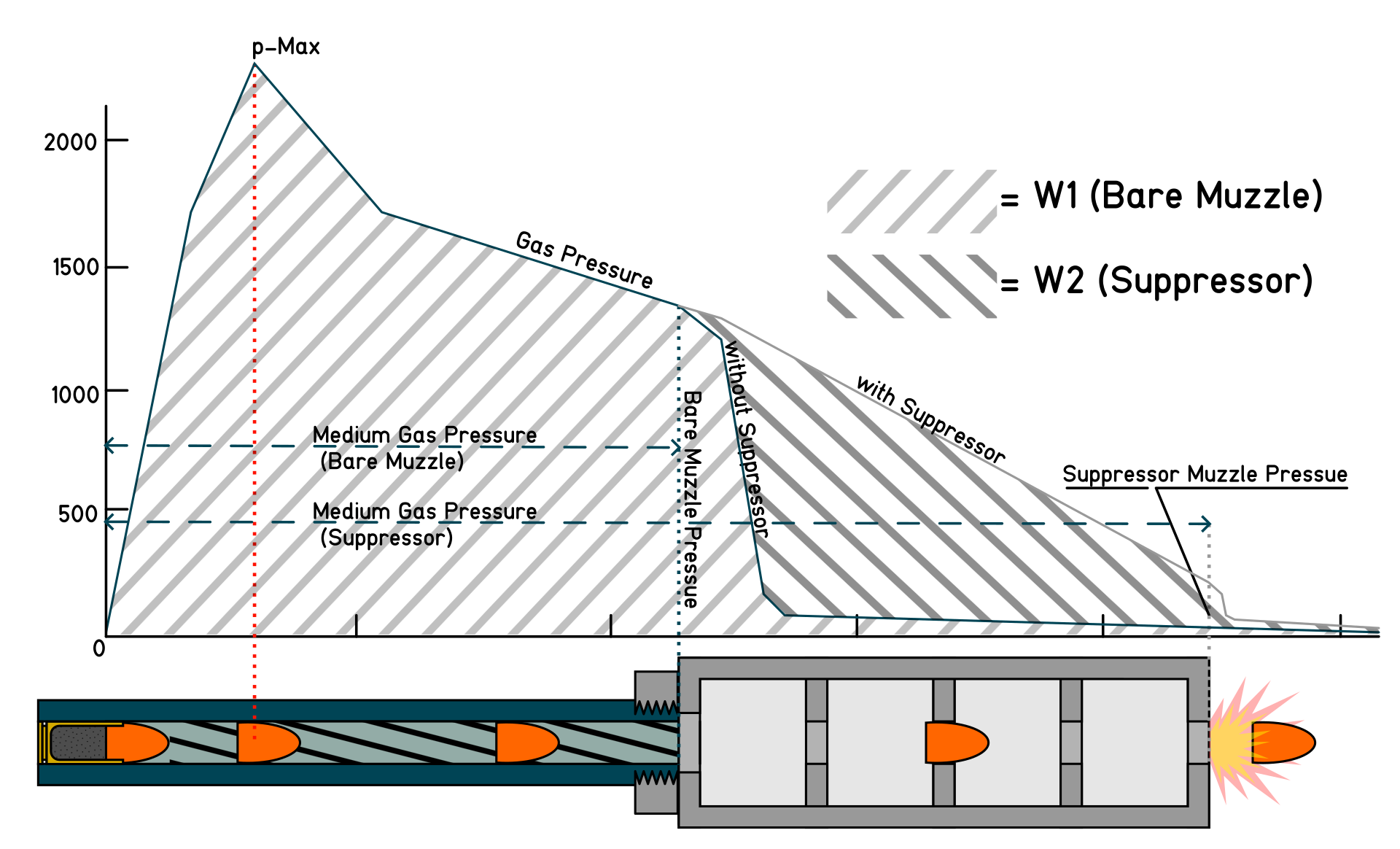
A suppressor is not a neutral addition to a gas-operated rifle. It changes the pressure environment the gas system sees, and on a short-barrelled AR it changes it a great deal.
Back-pressure rises. The suppressor holds gas at the muzzle for longer, which raises the pressure the gas port sees and keeps it up longer. The direct consequence on a direct-impingement AR is more gas driven back down the tube into the receiver — and the receiver is beside the shooter’s face. This is why suppressed AR shooters come home sooty, and the mechanism and the fixes are the subject of How Suppressors Work Volume 8.
The rifle cycles harder and faster. More gas means a carrier moving faster and further, earlier extraction, and more violent ejection. On a rifle already tuned to the edge, this is the change that turns a marginal setup into a malfunctioning one — in the opposite direction from the failures in Volume 3.
🔴 And this is where Volume 3’s tuning problem becomes a four-way problem rather than a two-way one. The rifle must work across:
Table 1 — 🔴 And this is where Volume 3's tuning problem becomes a four-way problem rather than a two-way one. The rifle must work across
| Unsuppressed | Suppressed | |
|---|---|---|
| Subsonic | 🔴 Hardest case — least gas available | Easier — the can helps |
| Supersonic | Normal | ⚠ Over-gassed — hardest on parts and on the can |
The two diagonal corners pull in opposite directions. A gas setting that makes the top-left corner work will over-gas the bottom-right one; a setting tuned for the bottom-right will not cycle the top-left. This is the strongest practical argument for an adjustable gas block on a suppressed .300 Blackout pistol, notwithstanding AAC’s reasoned preference against one for its own factory-matched combination (Volume 3 §3.5).
Point of impact shifts. Fitting or removing a suppressor moves the group, reliably and repeatably for a given can and mount, but by an amount that must be measured rather than predicted. On a rifle already carrying a large supersonic-to-subsonic offset (Volume 3 §3.3), this is a third zero to keep track of.
⭐ Which argues for leaving the can on. A pistol whose entire purpose is short, quiet and subsonic has no strong reason to be fired without its suppressor. Treating the can as part of the weapon rather than as an accessory removes one whole axis of the zeroing problem — and direct-thread mounting, which is the most repeatable interface available, becomes the obvious choice once the can stops moving between hosts. How Suppressors Work Volume 7 §7.3 covers why direct thread beats a quick-detach mount for concentricity and return-to-zero.
5.5 The Length Arithmetic, Which Is the Best Trade in the Collection
The number that makes this configuration compelling is not a decibel figure. It is a length.
Table 2 — 5.5 The Length Arithmetic, Which Is the Best Trade in the Collection
| Component | Length |
|---|---|
| Barrel | 8 in |
| Typical rifle suppressor | 6–7 in |
| Barrel-equivalent with the can fitted | ≈ 14–15 in |
A bare M4 carbine has a 16-inch barrel. So an 8-inch .300 Blackout pistol wearing a suppressor is, in muzzle-forward terms, shorter than an ordinary carbine — while being quiet and while delivering, per Volume 2, more muzzle energy from those 8 inches than a 5.56 carbine delivers from 14.5.
That is the trade in one line, and nothing else in a mixed collection comes close to it. The Suppressors by Caliber dive reaches the same conclusion from the other direction and calls it the best size-to-capability trade in that series.
5.6 Which Can, in One Paragraph
The companion dive owns this decision and works it through properly. The short version as it applies here: one .30-calibre rifle can, rated to .300 Win Mag, on a 1.375×24 HUB mount, with a superalloy blast baffle and interchangeable end caps, covers .300 Blackout, 7.62×39, .308, 6.5 Creedmoor and 5.56 with an over-bore penalty. It is the single highest-leverage purchase in the whole suppressor category, and a .300 Blackout pistol is one of the hosts that makes it worth buying. See Suppressors by Caliber Volumes 5 and 10.
What this host adds to that specification is only the short-barrel rating from §5.3, and it is not optional.
5.7 The Legal Position, Briefly
Suppressors are NFA items. The process, the wait and the 2026 changes belong to Suppressor Law, and Volume 4 of this series covers what the 2026 tax change means for the brace-versus-SBR decision.
The three points that matter here:
- The making and transfer tax on a suppressor is $0 as of 1 January 2026. Everything else — registration, fingerprints, background check, approval before possession — is unchanged.
- Michigan permits suppressor ownership with no state permit beyond the federal process, and permits suppressed hunting for all game and all seasons. Suppressor Law Volume 7 owns the Michigan treatment.
- 🔴 A suppressor and a braced pistol are separate legal questions. Fitting a can to a braced pistol does not change the brace analysis in Volume 4, and the vacatur of the brace rule does not touch the NFA status of the suppressor. Two registrations’ worth of thinking, or one and a legal argument.
⚠ What could not be established for this volume: any independently measured sound-pressure figure for a suppressed 8-inch .300 Blackout, subsonic or supersonic, from a source using a consistent methodology. PEW Science publishes host-specific suppression ratings and is the right place to look for comparable numbers, but a rating for this specific barrel length and cartridge combination was not located. No decibel figure is published in this series except AAC’s own, attributed to AAC.
5.8 Bibliography
Companion dives, which own the material cross-referenced above and are not re-derived here:
- How Suppressors Work — Volume 4 (materials and the blast baffle), Volume 7 §7.3 (threading and mounting, direct thread versus QD), Volume 8 (backpressure).
- Suppressors by Caliber — Volume 1 (the subsonic-availability table and the decibel-comparison rule), Volume 5 §5.2 (.300 Blackout as the cartridge designed around the can) and §5.2.2 (nine inches as the design point), Volume 10 (the three-can set).
- Suppressor Law — Volume 3 (what changed on 1 January 2026), Volume 7 (Michigan, including hunting and vehicle transport).
Footnotes
-
Advanced Armament Corp., 300 AAC BLACKOUT Owner’s Manual Supplement (© 2010). Source of the quoted AAC 762-SDN-6 recommendation and the approximately 126 dB figure with AAC subsonic ammunition, stated as both a MIL-STD measurement and at the shooter’s ear; and of the MP5-SD comparison claiming more accuracy, more penetration and 165% the energy at 200 metres. https://advanced-armament.com/wp-content/uploads/300BLK-AAC-Upper.pdf ↩ ↩2
Comments (0)