.300 Blackout AR Pistol · Volume 3
Supersonic and Subsonic — Twist, Gas, and Cycling Both
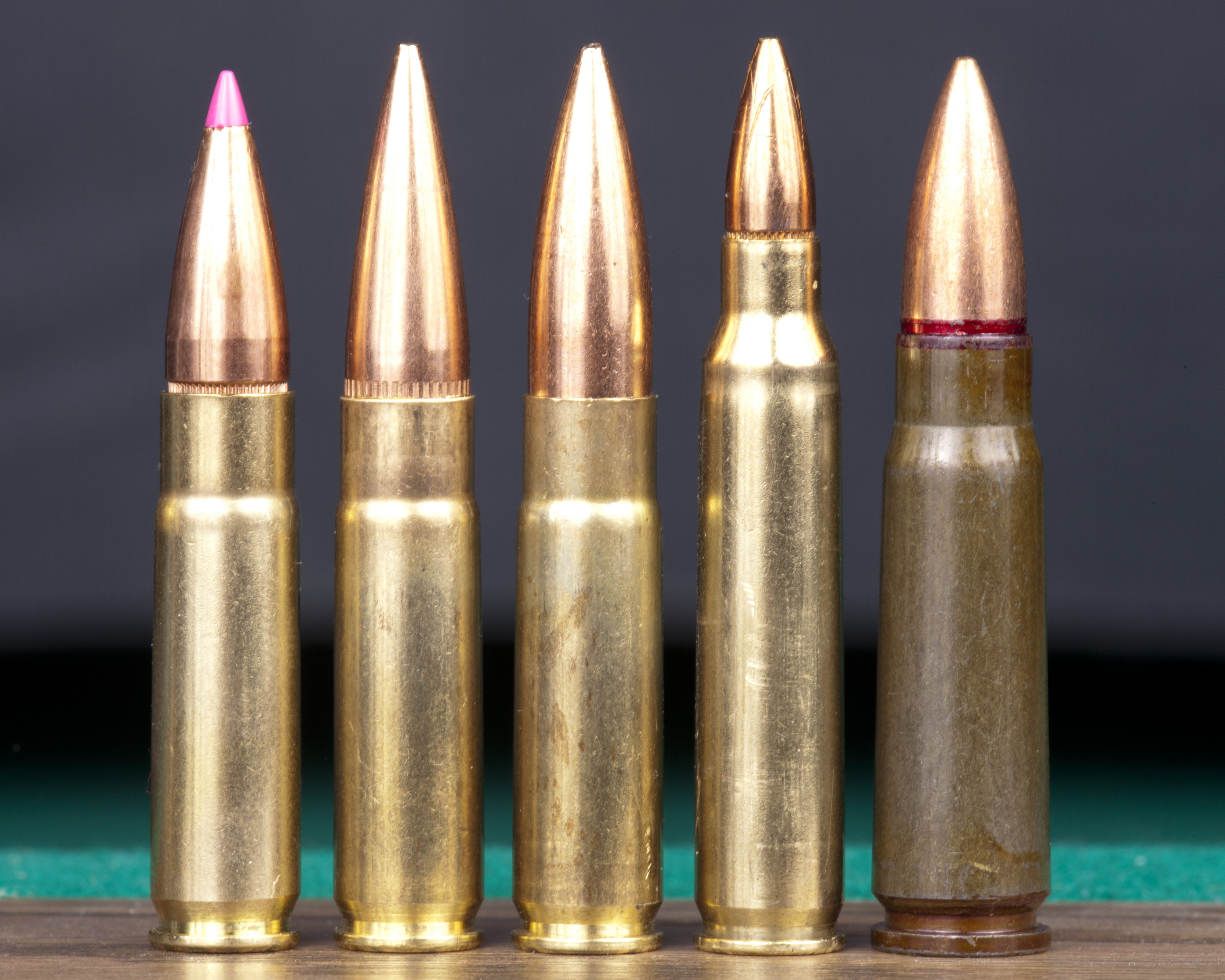
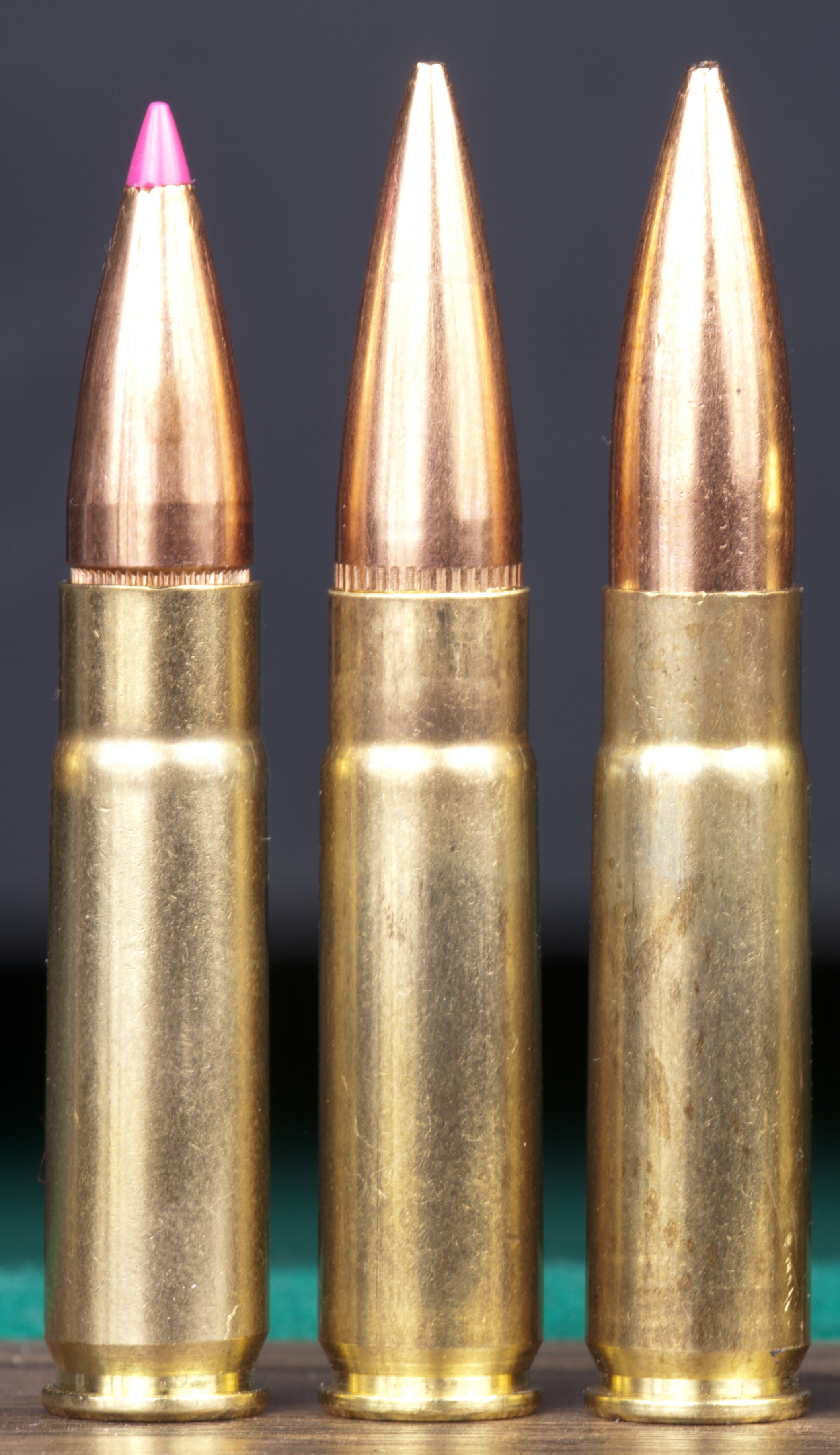
.300 Blackout is routinely described as a cartridge that shoots two kinds of ammunition. That is true and it understates the case. It is two cartridges that happen to share a case head, a chamber and a magazine, and almost nothing else. The difference between a 110-grain bullet at 2,050 fps and a 220-grain bullet at 1,030 fps is not a variation within a cartridge. It is a doubling of bullet weight and a halving of velocity.
Everything difficult about owning one of these traces back to that.
3.1 The Span, Stated Numerically
Taking the extremes from the measured data in Volume 2, from a 7.5-inch barrel:1
Table 1 — 3.1 The Span, Stated Numerically
| Light supersonic | Heavy subsonic | Ratio | |
|---|---|---|---|
| Bullet weight | 110 gr | 208–220 gr | ~1.9× |
| Muzzle velocity | 2,055 fps | ~1,047 fps | ~0.51× |
| Muzzle energy | 1,032 ft·lbf | 506 ft·lbf | ~0.49× |
| Momentum (relative) | 1.00 | ~0.97 | ~equal |
The last row is the interesting one and it is not a coincidence. The two loads carry nearly identical momentum while carrying half the energy — which is exactly why one gas system can be made to cycle both, and exactly why doing so is delicate. Momentum is what drives a recoil-operated mechanism; the AR is gas-operated, but the bolt carrier’s behaviour once it is unlocked is governed by momentum, and this near-equality is the reason the problem is soluble at all.
3.2 Twist Rate, and Why It Is Not a Compromise
SAAMI specifies a 1:8 right-hand twist in the velocity-and-pressure test barrel for this cartridge, with five grooves of .146-inch width.2 That is the industry reference, and the developer’s own 9-inch barrel assembly was likewise 1:8.3
The reason is the heavy end. Stabilising a 220-grain .308-inch bullet — a very long projectile — requires a fast twist. The usual rule of thumb is that longer bullets need faster twists, and 220 grains in .30 calibre is long by any standard. 1:8 covers the entire subsonic range including 220 grain, which means a single barrel specification serves the heaviest ammunition the cartridge is made for.
This is unusual and it is worth appreciating. In most cartridges, choosing a twist means choosing which end of the bullet-weight range to serve well. In .300 Blackout, 1:8 serves the end that matters and the industry standardised on it, so there is no twist decision to agonise over when buying a barrel. A faster twist — 1:7 — is also common and is what two of the three barrels in the Lucky Gunner test used.1
What the fast twist costs is at the light end, and it is real. A short, light supersonic bullet spun at 1:7 or 1:8 is being spun a great deal faster than it needs. One experienced handloader building a custom .300 Blackout put the consequence plainly: the fast twist needed for the heavy bullets “means you are spinning the lighter loads way too fast,” and that this “can lead to poor accuracy from lighter loads.”4
His own load-development results across 125, 135, 175 and 220-grain Sierra MatchKings from a 1:7 Bartlein barrel bear it out, and the spread is startling:4
- Best five-shot group: 0.334 MOA.
- Worst five-shot group: 3.787 MOA.
- The 220-grain MatchKings — the heavy end the twist was chosen for — grouped 1.082 to 1.477 MOA, consistently but not spectacularly.
⚠ That is a single rifle, a single barrel and one handloader’s results, and it is a bolt gun rather than an AR. It is quoted because it is one of very few published datasets in which the same barrel was tested across the full bullet-weight range, and because the direction of the finding — inconsistency at the light end, consistency at the heavy end — matches what the twist theory predicts.
The same source notes something worth knowing before anyone tries to “fix” this: shooters chasing accuracy with light bullets sometimes specify a slower twist and a shorter throat, at which point, as he puts it, they no longer have a .300 Blackout. A slow-twist .300 Blackout is a different cartridge wearing the same name, and it will not stabilise the ammunition the cartridge exists for.
3.3 Zero: Two Cartridges Means Two Zeroes
This is the most commonly underestimated practical consequence, and it is not subtle.
A reviewer firing an AAC 16-inch 1:7 upper with three Remington factory loads measured, with a carbine buffer:5
Table 2 — 3.3 Zero: Two Cartridges Means Two Zeroes
| Load | Velocity |
|---|---|
| Remington 125 gr OTM | 2,213 fps |
| Remington 125 gr AccuTip | 2,308 fps |
| Remington 220 gr OTM | 1,090 fps |
His point-of-impact observation is the part to remember: at 50 yards, the two 125-grain loads printed together, while the 220-grain load hit 2 inches right and 3 inches below them.5
Three inches of drop at fifty yards. At 100 yards the divergence is far larger, and at 200 it is measured in feet — the subsonic bullet is travelling at roughly half the speed with a trajectory to match.
The practical rules that follow:
- Zero for the load that will actually be fired most. For a suppressed pistol, that is usually the subsonic load.
- Record the offset for the other load and treat it as a known dope entry rather than something to rediscover.
- Do not switch loads casually mid-string. The rifle is not zeroed for both and cannot be.
- ⭐ A red-dot sight makes this worse, not better, because a dot offers no reticle subtensions to hold with. A shooter with an offset in mind has nothing to hold on. Volume 6 covers optics for this reason.
3.4 The Gas System — Why Pistol-Length Is Standard
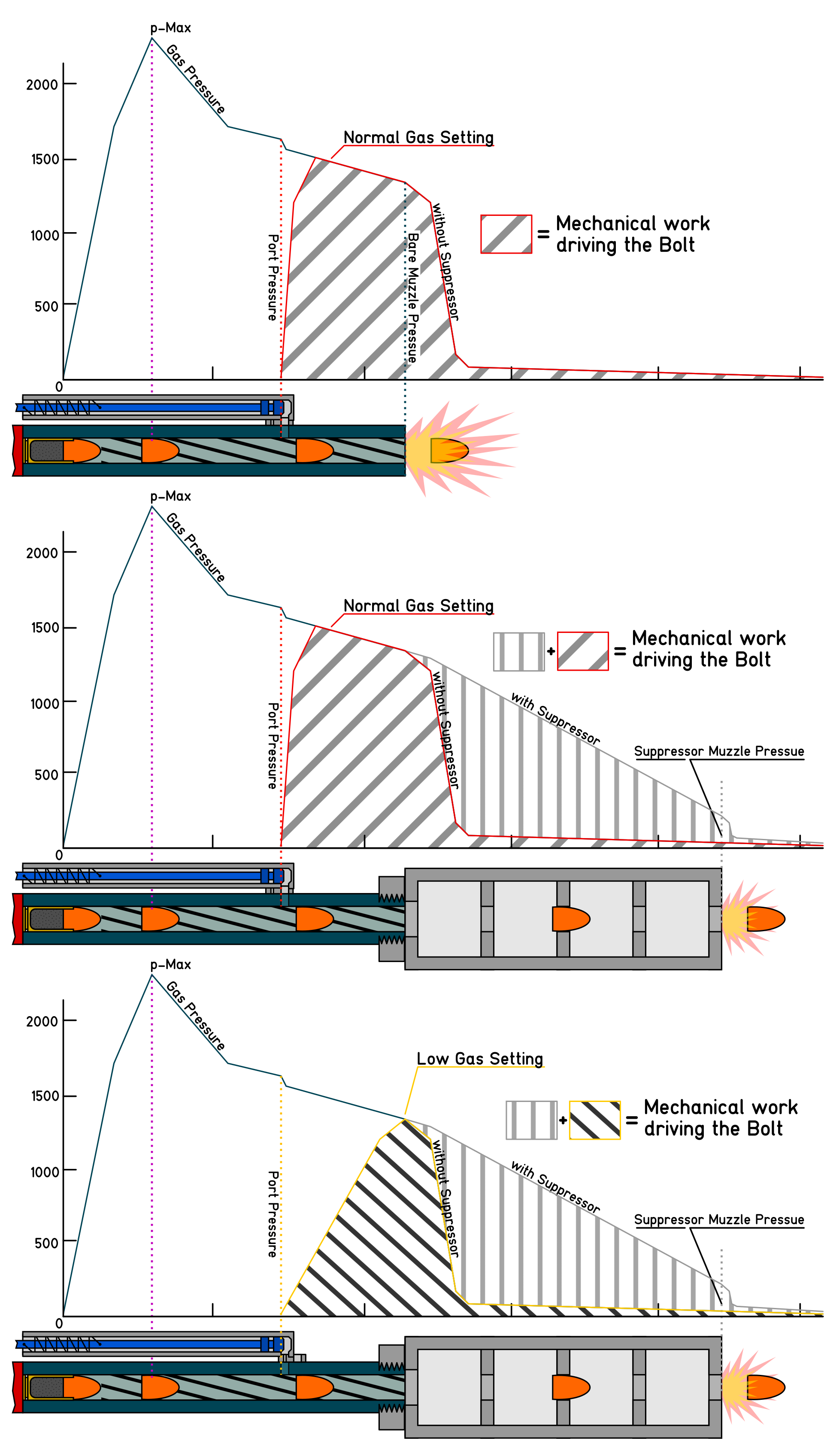
The AR’s gas system taps bore pressure through a port in the barrel and pipes it back to the carrier. Two things determine whether the mechanism cycles: how much pressure is available at the port, and how long the bullet stays in the barrel past the port — the dwell time during which gas continues to flow.
A subsonic load is a low-pressure event. There is simply less gas, at lower pressure, to work with. Shortening the distance between the chamber and the gas port raises the pressure the port sees, because it taps the pressure curve earlier while it is still high.
Hence pistol-length gas on short .300 Blackout barrels, essentially universally. It is not a concession to the short barrel; it is what makes subsonic cycling possible at all.
3.5 The Tuning Problem, and the Developer’s Own Answer
Making one rifle cycle both loads reliably is the central mechanical difficulty of the platform, and AAC addressed it directly in the manual that shipped with its uppers. The guidance is worth reproducing closely because it is specific, it comes from the people who designed the cartridge, and it contradicts a good deal of what circulates online.3
On gas ports — a direct warning against the most popular amateur fix:
“We do not recommend you enlarge your gas-port to aid subsonic function because then supersonic ammunition will hyper-cycle the upper which will reduce the reliability and part life durability of the system.”
AAC’s position was that a correctly specified port plus correctly specified ammunition cycles both without an adjustable gas block, and that the port diameter on its uppers “was selected after thousands of rounds of function testing and high-speed video analysis.”3
🔴 This is the correction the volume is built around. The common advice — open the gas port until the subsonic load cycles — buys subsonic function at the direct cost of over-gassing every supersonic round the rifle will ever fire. It moves the problem rather than solving it, and it damages parts. If a subsonic load will not cycle, the developer’s recommended fix is to change the ammunition, not the barrel: “If your subsonic ammunition is not cycling the upper, consider using a powder which generates more gas-port pressure. AA1680 seems ideal for this use.”3
On buffers and springs, AAC is unusually specific:
Table 3 — On buffers and springs, AAC is unusually specific:
| Component | AAC recommendation |
|---|---|
| Action spring | Standard USGI M4, or HK416 |
| Buffer, general | H2, 4.6 oz (130 g), or an HK416 buffer |
| Buffer, if not shooting subsonic unsuppressed | H3, 5.5 oz (155 g) “may be a good choice” |
| 🔴 Never | A solid 9mm buffer — “may cause bolt bounce” |
On handloading for subsonic, the constraints are tighter than most published data acknowledges. AAC’s warning is pointed: many existing subsonic loads “were developed for Thompson Center single-shot pistols, or for ARs by people not aware of the magazine limitations,” pay “no attention to automatic rifle function,” and “should not be used.”3
Its own criterion is a cycling rate rather than a velocity: look for a load producing a cyclic rate of 700 rpm or more. And its published starting point:3
R-P 300 AAC BLACKOUT brass · Remington 7.5 primers · 11.2 grains of AA 1680 · Sierra 220 MK loaded to 2.089-inch overall length — “this length is optimal for reliable feeding from USGI magazines.”
⚠ That load is quoted as published by the developer in 2010 and is not a recommendation from this series. Any handload must be worked up from current published data in the actual rifle. It is reproduced because the overall length figure is the interesting part: 2.089 inches is a feeding specification, not a pressure one, and it shows how tightly the magazine constrains subsonic load development.
For supersonic loads AAC recommended Hodgdon H110 and Lil’Gun — both magnum pistol powders, which is the clearest possible signal of what kind of pressure curve this cartridge is built around.3
3.6 The Failure Mode Nobody Warns About: Short-Stroking
The characteristic subsonic malfunction is not a failure to fire. It is a failure to lock back, and it is the leading edge of a rifle that is about to stop working.
The same reviewer who measured the velocities above recorded exactly this: the 220-grain subsonic load “did not lock back the bolt with either buffer,” while the supersonic loads did — and this was from a 16-inch barrel with a factory-specified gas system, firing factory subsonic ammunition, unsuppressed.5
That single observation carries most of what an owner needs to understand:
- Unsuppressed subsonic is the hardest case the rifle faces. There is the least gas available and no suppressor raising back-pressure to help.
- Failure to lock back on the last round is the warning sign. It means the carrier is travelling far enough to extract and eject but not far enough to engage the bolt catch — the margin is nearly gone. The next failure will be a failure to feed.
- 🔴 A rifle tuned so that subsonic barely cycles unsuppressed will be over-gassed when the suppressor goes on, because a suppressor raises muzzle pressure and therefore raises the gas the port sees. Volume 5 covers this.
The honest conclusion: a .300 Blackout AR that reliably cycles subsonic ammunition unsuppressed, supersonic ammunition unsuppressed, and both again with a can fitted, is a rifle that has been deliberately tuned. It is not the default state of a rifle assembled from parts.
3.7 What Configuration Actually Resolves This
There are three coherent answers, and choosing one is better than half-doing all three.
One: accept an adjustable gas block. This contradicts AAC’s stated preference, and AAC’s reasoning was sound for its own tested combination of barrel, port and ammunition. For a home build using someone else’s barrel and arbitrary factory ammunition, the certainty AAC was relying on does not exist. An adjustable block moves the tuning decision to a set screw the owner controls. The cost is a part that can shift, and a setting that must be documented rather than remembered.
Two: tune the buffer for the job and leave the gas alone. The H2 buffer AAC recommends is the general-purpose answer. A heavier H3 biases toward supersonic and unsuppressed use; a lighter carbine buffer biases toward subsonic and suppressed. This is the cheapest and most reversible adjustment available, and it is the right first thing to try.
Three: decide the rifle has one job. A pistol built for suppressed subsonic use, gassed and buffered for that, is a simpler and more reliable object than one asked to do everything. It will still fire supersonic ammunition; it will simply be over-gassed doing it. For a weapon whose entire purpose is to be short and quiet, this is a more defensible choice than it first appears.
⚠ What could not be established for this volume: any published, independently measured gas-port diameter specification for an 8-inch .300 Blackout barrel. Port diameters are barrel-maker-specific, are frequently not published at all, and vary between makers for the same nominal length. No figure is printed here, because a wrong gas-port dimension would be worse than none. The practical route is to ask the specific barrel’s maker.
3.8 Bibliography
Footnotes
-
Chris Baker, “300 Blackout Ballistics by Barrel Length: What the Data Told Us,” Lucky Gunner Lounge, 25 August 2026. Source of the 7.5-inch velocity and energy figures used in §3.1 and of the 1:7 and 1:6 twist rates of the test barrels. https://www.luckygunner.com/lounge/300-blackout-ballistics/ ↩ ↩2
-
SAAMI, ANSI/SAAMI Z299.4 (2025 edition). Source of the 1:8 right-hand twist, five grooves and .146-inch groove width in the 300 AAC Blackout velocity-and-pressure test barrel drawing (issued 01/20/2011, revised 07/05/2023). https://saami.org/technical-information/ansi-saami-standards/ ↩
-
Advanced Armament Corp., 300 AAC BLACKOUT Owner’s Manual Supplement (© 2010). Source, quoted verbatim where marked, of: the warning against enlarging the gas port; the statement that the port diameter was selected after thousands of rounds of function testing and high-speed video analysis; the recommendation of AA1680 for subsonic; the 700 rpm cyclic-rate criterion; the criticism of subsonic load data developed for single-shot pistols; the published subsonic load and its 2.089-inch overall length as a magazine-feeding specification; the buffer and action-spring table including the solid-9mm-buffer warning; the H110 and Lil’Gun supersonic powder recommendations; and the 9-inch 1:8 barrel assembly. https://advanced-armament.com/wp-content/uploads/300BLK-AAC-Upper.pdf ↩ ↩2 ↩3 ↩4 ↩5 ↩6 ↩7
-
“300 BLK load development: 125, 135, 175 and 220 SMK with H110 and IMR 4227,” rifleshooter.com, June 2016. Source of the observation that SAAMI specifies 1:8; the fast-twist-versus-light-bullet accuracy problem; the 0.334 MOA best and 3.787 MOA worst five-shot groups; the 1.082–1.477 MOA range for the 220-grain MatchKings from a 1:7 Bartlein barrel; and the point that a slow-twist short-throat chamber is no longer a .300 Blackout. https://rifleshooter.com/2016/06/300-blk-load-development-125-135-175-and-220-smk-with-h110-and-imr-4227/ ↩ ↩2
-
“300 AAC Blackout review,” rifleshooter.com, September 2012. Source of the measured velocities for Remington 125 gr OTM, 125 gr AccuTip and 220 gr OTM with both heavy and standard carbine buffers from an AAC 16-inch 1:7 upper; the 50-yard point-of-impact offset of the 220-grain load (2 inches right, 3 inches below the 125-grain loads); and the finding that the 220-grain subsonic load did not lock the bolt back with either buffer. https://rifleshooter.com/2012/09/300-aac-blackout-review/ ↩ ↩2 ↩3
Comments (0)