.300 Blackout AR Pistol · Volume 1
Why .300 Blackout Exists — The Design Brief, and the Constraint That Shaped It
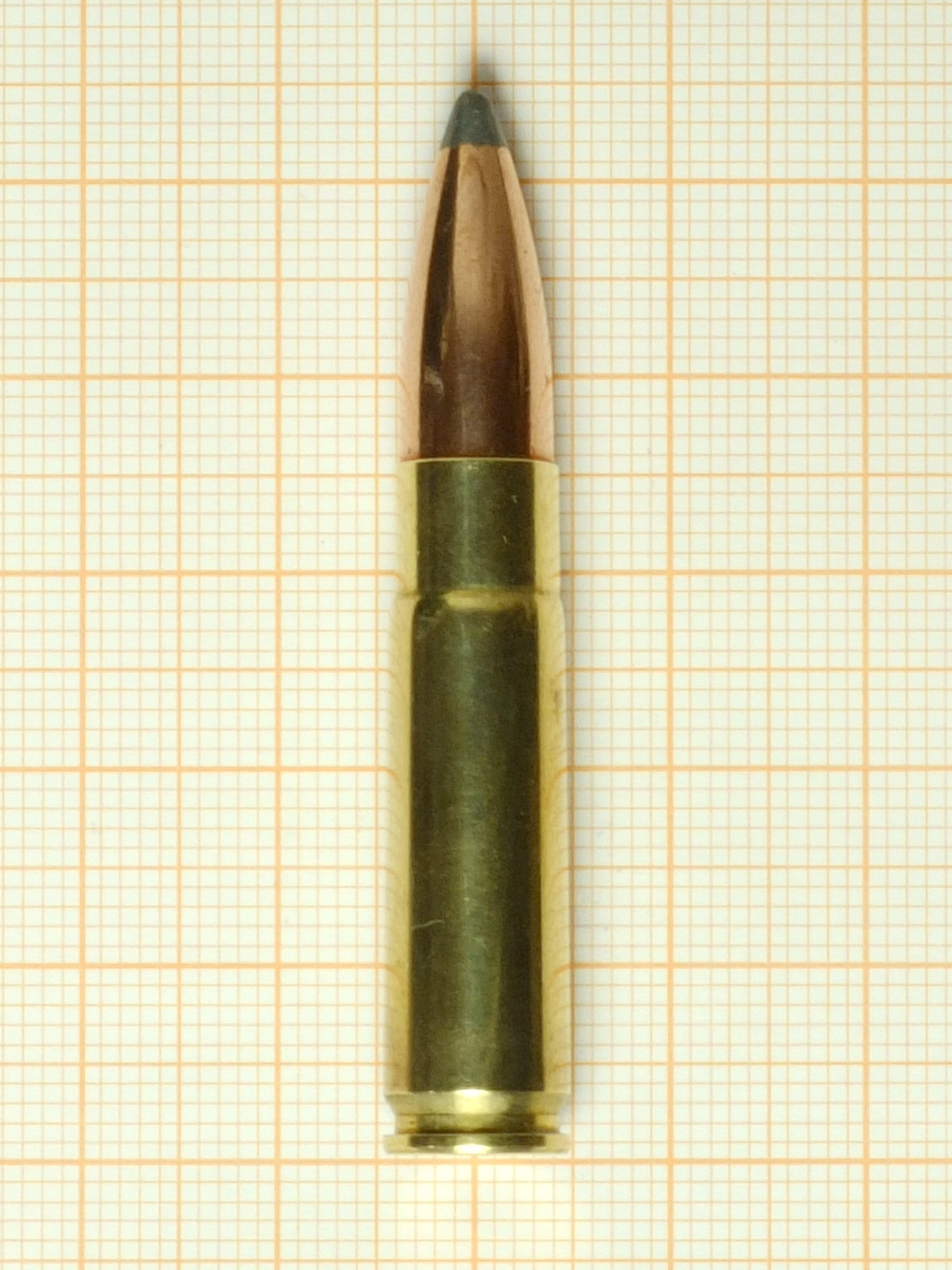
Most cartridges are designed to do something better. .300 AAC Blackout was designed to do something inside a constraint — and the constraint, not the ballistics, is the reason it exists and the reason it looks the way it does.
The constraint was this: whatever the new cartridge turned out to be, it had to run in an unmodified AR-15 that had been given nothing but a new barrel. Same lower. Same bolt. Same bolt carrier. Same magazines, at full capacity, with no follower change and no loss of rounds. A shooter or an armourer was to be able to convert a rifle in the time it takes to change a barrel, and to convert it back just as quickly.
That is an unusually severe brief, and almost every interesting property of the cartridge is a consequence of satisfying it.
1.1 The Problem the Cartridge Was Built to Solve
The requirement being answered was for a weapon that was short and quiet, and that still hit with useful authority.
5.56×45mm cannot be that weapon, and the reason is not a matter of degree. It is structural, and it has two halves.
5.56 cannot be made subsonic in any useful form. A suppressor removes muzzle blast. It does nothing whatever about the sonic boom a supersonic bullet drags behind it down the whole of its flight. To make a rifle genuinely quiet rather than merely comfortable, the bullet has to stay below roughly 1,100 feet per second — and a .224-inch bullet slowed to that speed carries almost nothing. To carry useful energy at 1,050 fps a bullet has to be heavy, and a .224 bullet heavy enough to matter becomes so long that it will neither stabilise reliably nor fit in the magazine ahead of the case. The bullet was designed to be fast. Removing its speed removes its reason to exist.
5.56 also bleeds badly in a short barrel. It is a high-pressure cartridge with a relatively large powder charge behind a light bullet, and a great deal of that charge is still burning as the bullet leaves a 7- or 9-inch muzzle. The energy goes into noise, flash and recoil rather than into the bullet. Volume 2 quantifies this precisely, because it is the technical heart of the whole case for the cartridge.
So the requirement pointed at a bigger, heavier, slower bullet. Bigger bullets mean a bigger case head, and a bigger case head means a different bolt, a different magazine, and — at that point — a different rifle. Which the brief forbade.
.300 Blackout is the answer to that trap. It changes the bullet diameter and the case neck, and nothing else.
1.2 What the Cartridge Actually Is
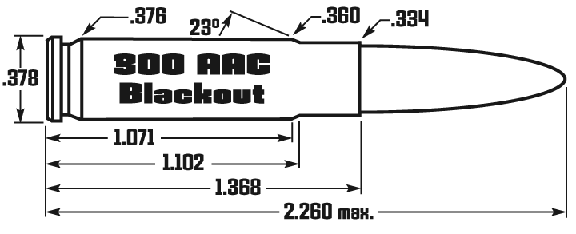
Dimensionally it is a 5.56×45mm case shortened and necked up to take a .308-inch bullet. The figures below are taken from the SAAMI cartridge and chamber drawing, which was issued 17 January 2011 and last revised 20 May 2022.1
Table 1 — 1.2 What the Cartridge Actually Is
| Official SAAMI name | 300 AAC Blackout |
| Accepted abbreviation | 300 BLK |
| Also accepted | 7.62×35mm |
| Bullet diameter | .309 − .003 in (7.85 mm) |
| Bore / groove diameter | .300 in (7.62 mm) / .308 in (7.82 mm) |
| Case length | 1.368 − .020 in (34.75 mm) |
| Cartridge overall length | 1.780 in (45.21 mm) min – 2.260 in (57.40 mm) max |
| Rim diameter | .378 − .010 in (9.60 mm) — identical to 5.56 |
| Shoulder angle | 23° |
| Maximum average pressure | 55,000 psi |
| Rifling twist (V&P test barrel) | 1:8 right hand, 5 grooves |
| SAAMI velocity-and-pressure test barrel | 16.000 inches |
Two rows in that table do more work than the rest.
The rim diameter is unchanged. That is the whole compatibility story in one dimension. The bolt face does not change, so the bolt does not change, so the bolt carrier group does not change. The extractor and ejector see the same case head they always did.
The case is only 1.368 inches long. Short cases are usually a compromise; here the shortness is the point. It leaves room inside a magazine of fixed length for a very long, very heavy .30-calibre bullet to be seated deep into the case and still produce a cartridge that feeds. A 220-grain match bullet is a long object. In a full-length 5.56 case it would be unusable; in a case shortened by nearly half an inch it fits, and it fits from standard USGI or Magpul PMAG magazines at full capacity.2
1.3 The Ancestry, and Why It Is Not a Quibble
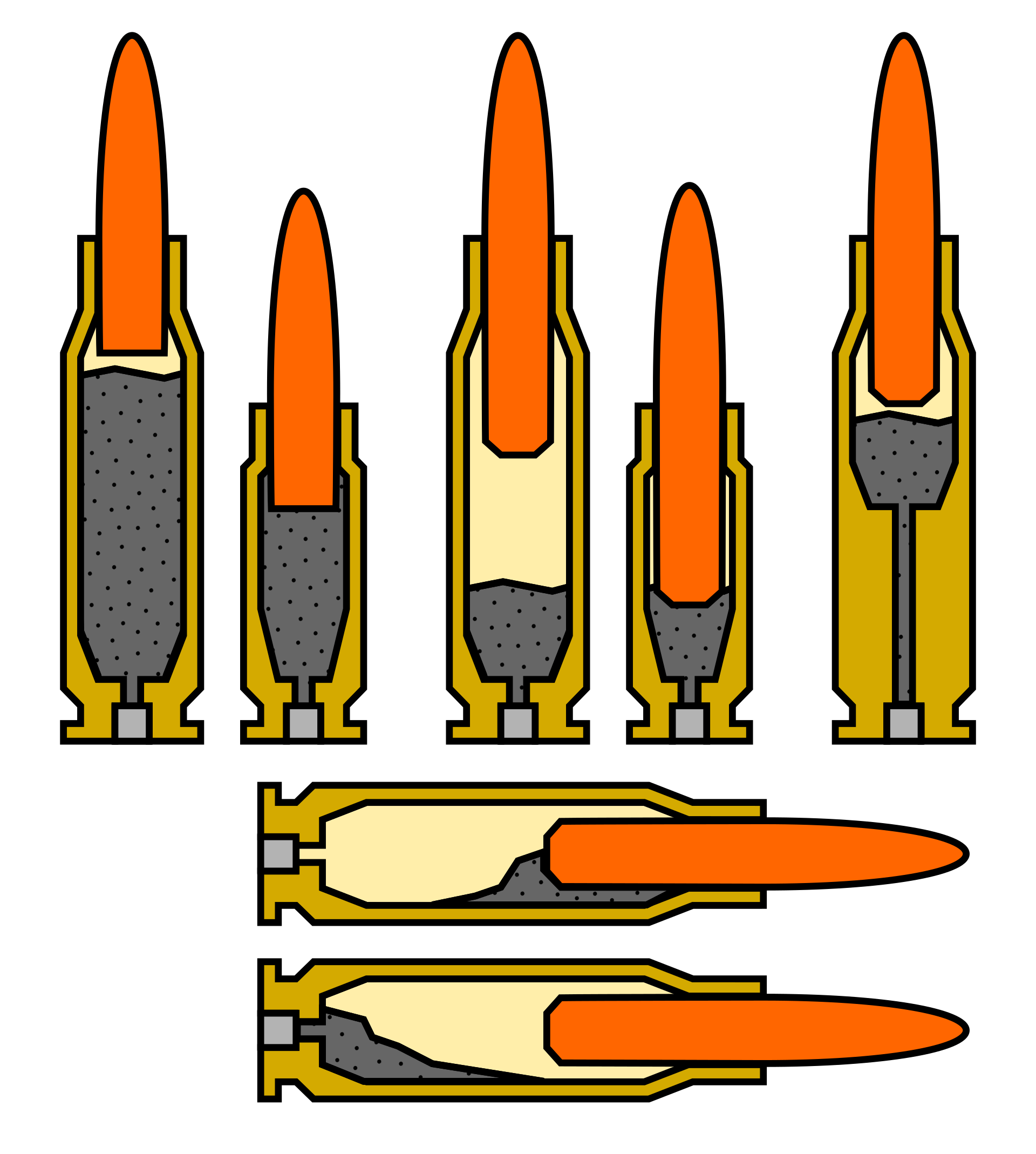
.300 Blackout did not appear from nothing. Its immediate ancestor is the .300 Whisper, a wildcat developed around the same concept — a shortened .221/.223-family case necked to .30 calibre, loaded to be subsonic and suppressed.
The relationship is not folklore. SAAMI documents it in its own advisory on interchangeability, which lists the only cartridge and chamber combinations the institute regards as generally acceptable alternates. The entire list is short, and .300 Blackout is on it:3
Table 2 — 1.3 The Ancestry, and Why It Is Not a Quibble
| Firearms chambered in | May generally safely shoot |
|---|---|
| 22 Long Rifle | 22 Short, 22 Long, 22 LR Shot |
| 22 Winchester Magnum Rimfire | 22 Winchester Rimfire |
| 280 Ackley Improved | 280 Remington |
| 300 AAC Blackout | 300 Whisper |
| 300 Whisper | 300 AAC Blackout |
That is the complete list. Four entries, one of which is this cartridge.
The distinction that matters for a buyer is that the Whisper was a wildcat — a proprietary chambering without an industry standard behind it, with the variation in chamber and throat dimensions that implies. .300 Blackout is a SAAMI-standardised cartridge with a published drawing, a published maximum average pressure and a published proof regime. What AAC contributed was not the idea. It was the standardisation, and standardisation is what produces factory ammunition from a dozen manufacturers and barrels that all chamber the same.
1.4 The Design Brief, in the Developer’s Own Words
The clearest statement of intent is in Advanced Armament Corp’s own owner’s manual supplement for the 300 BLK upper receiver, a document that opens with the case for the cartridge:2
“The 300 AAC BLACKOUT (300 BLK) cartridge is highly efficient and outperforms 5.56mm when used in a short barrel rifle and comes very close to the energy of 6.8 SPC but with less powder and resulting blast.”
The same document publishes the comparison AAC was making, all three cartridges from a 9-inch barrel:
Table 3 — The same document publishes the comparison AAC was making, all three cartridges from a 9-inch barrel
| At the muzzle, 9-inch barrel | Velocity | Energy |
|---|---|---|
| 5.56mm, M855 | 2,570 fps | 909 ft·lbf |
| .300 BLK, 110 gr V-MAX | 2,150 fps | 1,129 ft·lbf (24% over 5.56) |
| 6.8 SPC, SSA 115 SMK | 2,173 fps | 1,206 ft·lbf (7% over .300 BLK) |
Table 4 — 1.4 The Design Brief, in the Developer's Own Words
| At 300 yards, 9-inch barrel | Velocity | Energy |
|---|---|---|
| 5.56mm, M855 | 1,873 fps | 483 ft·lbf |
| .300 BLK, 110 gr V-MAX | 1,437 fps | 504 ft·lbf (4.3% over 5.56) |
| 6.8 SPC, SSA 115 SMK | 1,146 fps | 534 ft·lbf |
| .300 BLK, 155 SMK | 1,329 fps | 601 ft·lbf |
⚠ These are the developer’s own figures, published to sell the developer’s own product, and they are reported here as such. They are useful because they show what AAC was optimising for and what it was prepared to be measured against — not because they are independent. Volume 2 is built on independently measured data instead, and the independent numbers are in broad agreement with the shape of the claim even where they differ in detail.
What the table shows is that the cartridge was never pitched as a better rifle round. It was pitched as a better short-barrel round, and the comparison it invited was against 6.8 SPC — a cartridge that requires a different bolt and different magazines.
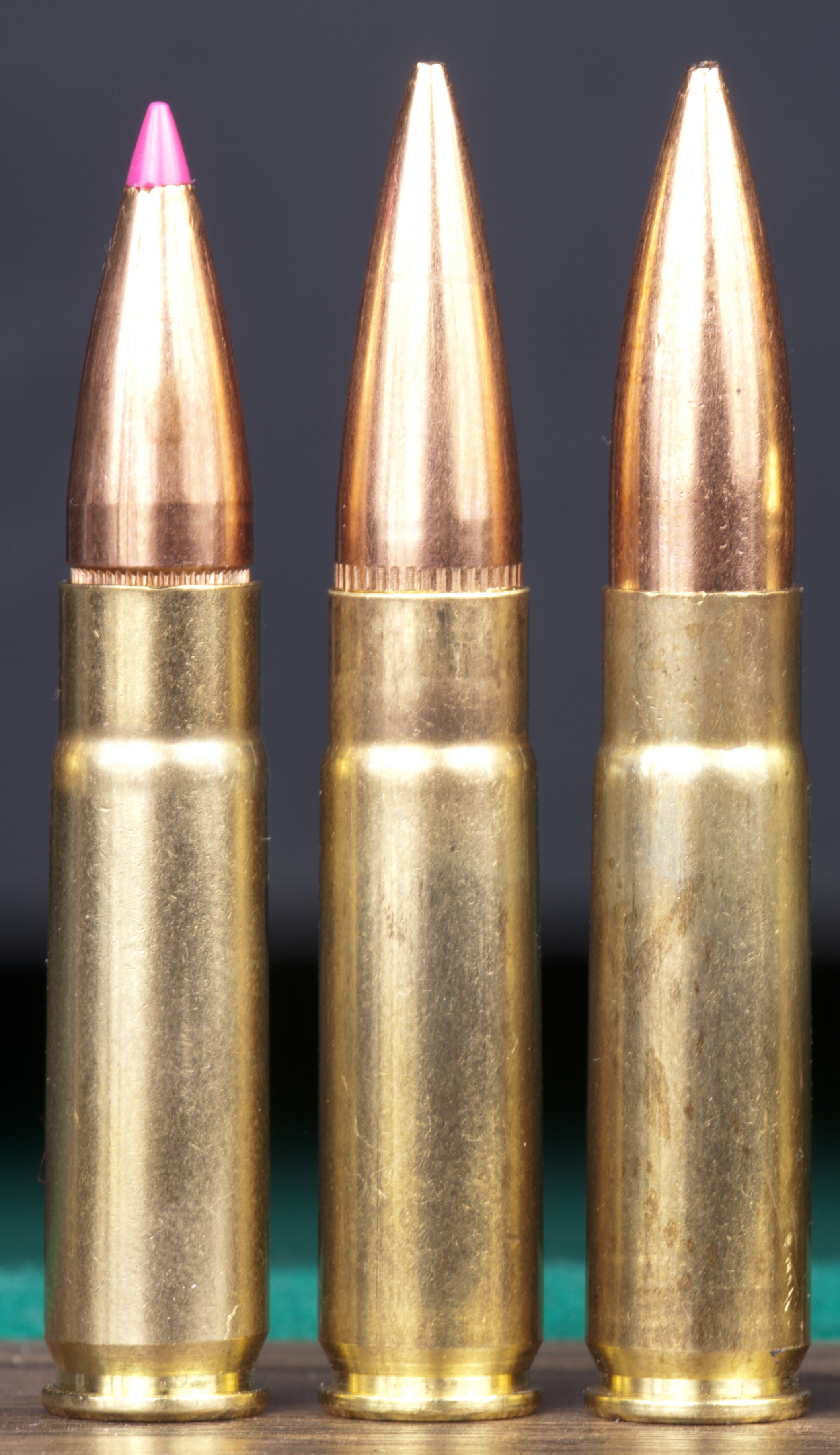
1.5 The Two Cartridges in One Case
The property that makes .300 Blackout unlike anything else in common use is that one chamber digests two entirely different cartridges.
Supersonic, roughly 110 to 150 grains at 1,700 to 2,400 fps. This is a short-range hunting and general-purpose load. Its trajectory is closer to 7.62×39 or .30-30 than to anything in the .223 family, and it sheds velocity quickly. Inside about 150 yards it is capable; past that it falls away fast.
Subsonic, roughly 190 to 220 grains at around 1,000 to 1,100 fps. This is the load the cartridge was invented for. A 220-grain bullet at 1,050 fps carries meaningfully more energy than a 147-grain 9mm at the same velocity, and — because it never goes supersonic — a suppressor can actually make it quiet rather than merely tolerable.
The consequences are real and they are not all pleasant:
- Zero, trajectory and point of impact differ enormously between the two. They are not interchangeable in any practical sense. A rifle zeroed for 125-grain supersonic is not zeroed for 220-grain subsonic, and the difference at 100 yards is measured in feet, not inches.
- Twist rate must serve the heavy end. 1:8 is the SAAMI specification, and it is what the heavy subsonic bullets need. Volume 3 covers what that costs at the light end.
- Cycling both reliably from one gas system is a genuine engineering problem, and Volume 3 covers it in full.
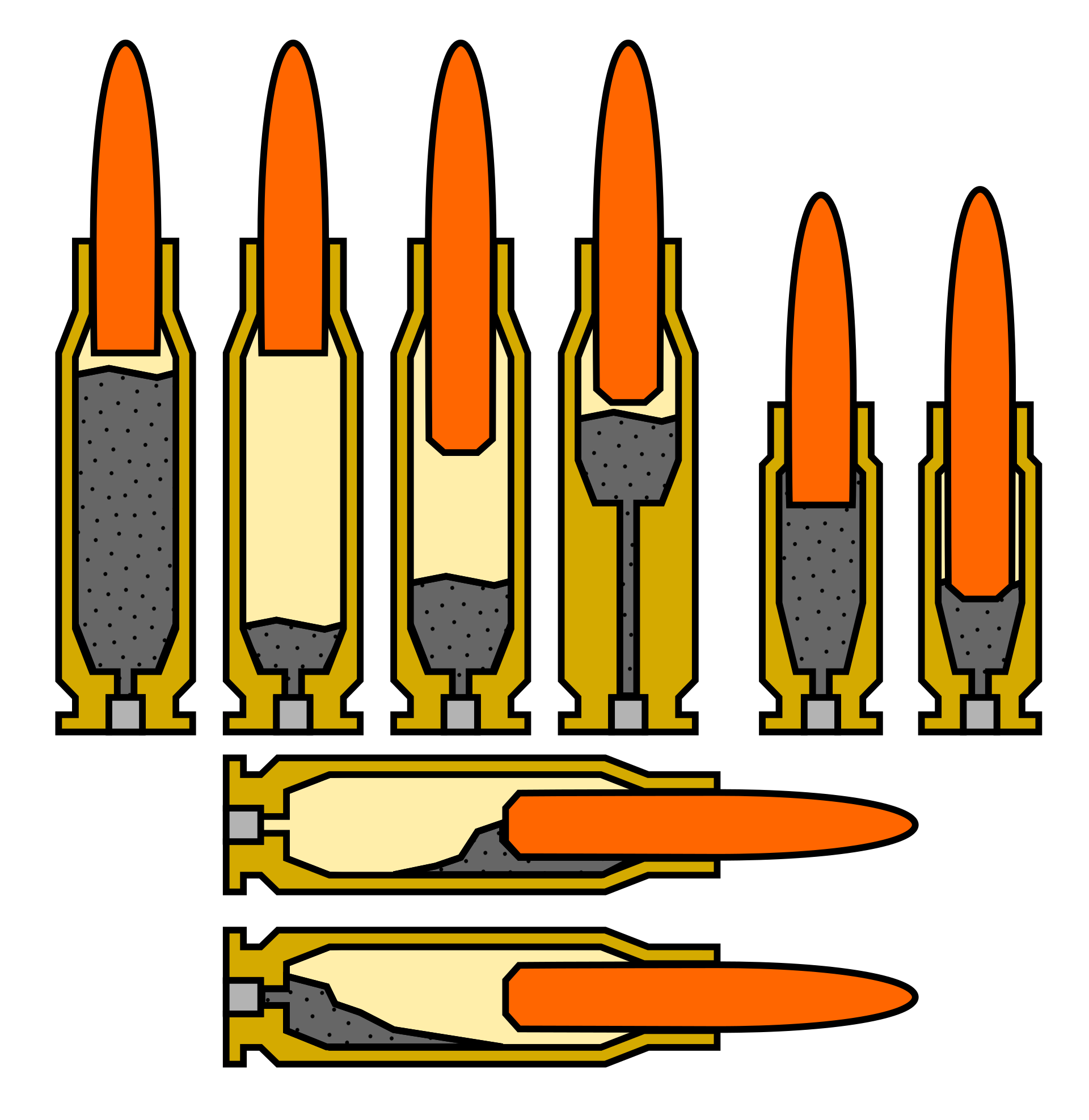
1.6 What the Cartridge Is Not
The published enthusiasm for .300 Blackout has consistently oversold it in three directions, and correcting them early makes the rest of the series easier to read honestly.
It is not a long-range cartridge, and it was never claimed to be. Even supersonic, velocity falls off quickly and the trajectory is steep. Other intermediate cartridges — 6.5 Grendel, 6mm ARC — outperform it substantially in both external and terminal ballistics past short range.4 The advantage of .300 Blackout is flexibility inside about 150 yards, not reach.
It is not a 5.56 replacement. At 16 inches of barrel, 5.56 does most general-purpose rifle work better and does it more cheaply. The case for .300 Blackout is specifically a case about short barrels and suppressors. Take those away and the argument largely evaporates.
It is not inherently quiet. Supersonic .300 Blackout through a suppressor is exactly as loud in flight as any other supersonic round, because the crack is the bullet, not the muzzle. Only the subsonic loads deliver the quiet the cartridge is famous for, and only through a suppressor.
And it is not automatically a hunting upgrade. It is a capable short-range deer cartridge with the right bullet, and Volume 7 treats that properly, including the Michigan regulatory position — which changed materially in 2026 and is covered in Volume 4.
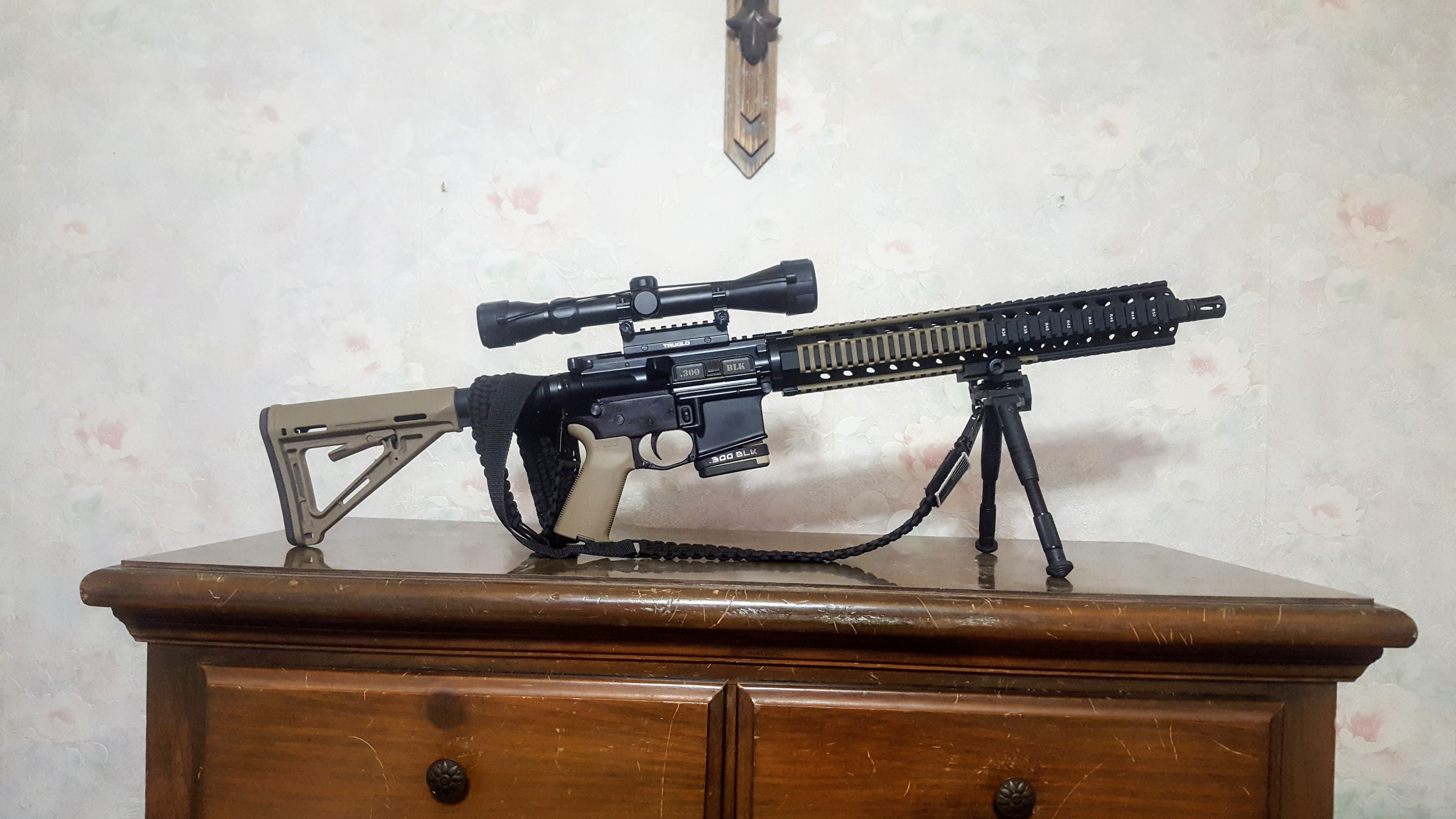
1.7 The Compatibility, Precisely Stated
Because “it uses all the same parts” is repeated so loosely, it is worth being exact about what does and does not carry over.
Unchanged: the lower receiver and everything in it; the upper receiver; the bolt; the bolt carrier; the charging handle; the magazines, at full capacity, standard USGI or PMAG; the buffer tube; the takedown pins.
Changed: the barrel. That is the entire required change.
Often changed, and usually worth changing: the gas system length (pistol-length is standard on short .300 BLK barrels, for reasons Volume 3 explains); the buffer weight and action spring, which AAC gives specific guidance on; and the muzzle thread, which on .300 Blackout is conventionally 5/8×24 rather than the 1/2×28 of a 5.56 barrel.
🔴 And one thing that does not carry over in the direction people assume. A .300 Blackout cartridge will physically chamber in a 5.56 barrel. It will not fire safely. This is the single most dangerous property of the cartridge, it has destroyed a great many rifles, and it is treated in full in Volume 6 §6.7 — including what SAAMI itself says about the general principle, which is quotable and unambiguous.
1.8 The Configuration Documented Here
This series is built around a specific configuration: AR-style pistols in .300 AAC Blackout, home-built on Black Rain Ordnance lower receivers, with 8-inch barrels, stabilising braces, collapsible receiver extensions, Magpul B.A.D. Levers on the bolt catch, and Feyachi RS-28 reflex sights.
Three things about that specification are worth flagging now, because they set the agenda for the volumes that follow.
Eight inches is shorter than AAC’s own design point. AAC’s barrel assembly for this cartridge was 9 inches, 1:8 twist, with its gas system.2 Eight inches is not a mistake and not a meaningful sacrifice, but it is a deliberate step past the developer’s specification, and Volume 2 works out exactly what that step costs — with measured data rather than assertion.
The brace is the legal centre of gravity of the whole series. A braced pistol and a short-barrelled rifle are different things in federal law, they have been the subject of a rulemaking, extensive litigation and a second rulemaking, and the position as of this writing is genuinely unusual. Volume 4 is the legal volume and it is tracked to primary sources throughout, because this is the single most misreported area in American firearms commentary.
This is a suppressor host before it is anything else. The cartridge exists because suppressors exist. Volume 5 covers what changes when a can goes on, and cross-references the dedicated suppressor series rather than re-deriving it.
1.9 How the Series Is Arranged
Table 5 — 1.9 How the Series Is Arranged
| Vol | Subject |
|---|---|
| 1 | Why .300 Blackout exists — the design brief and the constraint that shaped it |
| 2 | Barrel length is the whole point — velocity against length, measured |
| 3 | Supersonic and subsonic — twist, gas, and cycling both |
| 4 | The legal volume — braces, SBRs, the rulemakings, and Michigan |
| 5 | Suppressor host — the canonical suppressed cartridge |
| 6 | Building and running one — controls, tuning, optics, and the 5.56 danger |
| 7 | Owning one — maintenance, ammunition, and what it is actually for |
1.10 Bibliography
Footnotes
-
SAAMI, ANSI/SAAMI Z299.4, Voluntary Industry Performance Standards for Pressure and Velocity of Centerfire Rifle Sporting Ammunition for the Use of Commercial Manufacturers (2025 edition, approved 10 February 2025). Source of every dimensional figure in §1.2: the 300 AAC BLACKOUT cartridge and chamber drawing (issued 01/17/2011, revised 05/20/2022); the maximum average pressure of 55,000 psi; the velocity-and-pressure test barrel drawing (issued 01/20/2011, revised 07/05/2023) giving 5 grooves, .146-inch groove width and a 8.00-inch right-hand twist; and the test-barrel length exception list, which sets 300 AAC Blackout at 16.000 inches against the 24-inch default. https://saami.org/technical-information/ansi-saami-standards/ ↩
-
Advanced Armament Corp., 300 AAC BLACKOUT Owner’s Manual Supplement (© 2010). Source of the quoted design statement, the muzzle and 300-yard comparison tables against 5.56mm M855 and 6.8 SPC, the magazine compatibility statement (standard USGI or Magpul PMAG), and the 9-inch 1:8 barrel assembly specification (AAC part #100903). https://advanced-armament.com/wp-content/uploads/300BLK-AAC-Upper.pdf ↩ ↩2 ↩3
-
SAAMI, Generally Accepted Firearms and Ammunition Interchangeability, dated 10/8/2021. Source of the complete alternate-cartridge table quoted in §1.3 and of the safety framing used in Volume 6. https://saami.org/publications-advisories/advisories/ ↩
-
Chris Baker, “300 Blackout Ballistics by Barrel Length: What the Data Told Us,” Lucky Gunner Lounge, 25 August 2026. Source of the comparison to 6.5 Grendel and 6mm ARC and of the trajectory characterisation; the measured data from this test is the basis of Volume 2. https://www.luckygunner.com/lounge/300-blackout-ballistics/ ↩
Comments (0)