Stonewall Creek 4-Gauge Blunderbuss · Volume 7
Feeding a 4-Gauge: Powder, Big Ball & Shot
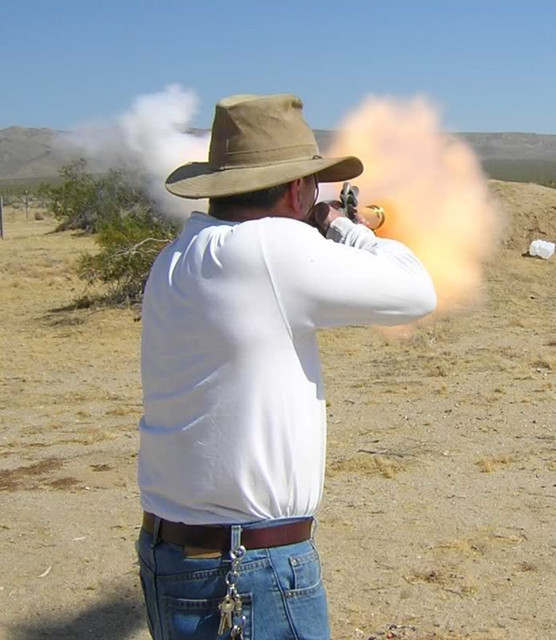
Feeding a 4-gauge is where the scale of this gun stops being an abstraction. The Traditions .54 dive gives you the general loading discipline for a black-powder smoothbore, and that discipline still governs here — cross-reference the Traditions Blunderbuss dive for the fundamentals of black powder, patching, and load work-up. What this volume adds is what changes when the bore is an inch across and the projectile weighs four ounces: the numbers, the components, and the fact that everything about this gun’s appetite is roughly eight times the Traditions gun’s.
Every figure below is a starting reference, not a prescription. Confirm safe loads for your specific barrel with the barrel maker and Stonewall Creek before you shoot, start low, and work up. A 4-bore is not a caliber to guess with.
7.1 What “4-gauge” means for the load
The bore is roughly 1.052 inches, defined the old way — four round balls of bore diameter make a pound. So:
- Round ball: a 4-bore round ball is about four ounces, near 1,750 grains of lead. For comparison, the Traditions .54 ball is about 230 grains. The 4-bore ball is on the order of eight times the projectile mass. That single fact drives the powder, the recoil, and everything downstream.
- Shot charge: loaded as a shotgun, this bore swallows on the order of 4.5 to 5 ounces of shot — a genuine coach-gun payload, not a token pattern.
You are not scaling up a .54 experience. You are loading a small cannon that happens to be shoulder-fired.
7.2 Powder: how much, and which
Use real black powder (or a proven black-powder substitute cleared for your gun), and match the granulation to the bore. A bore this large burns Fg (coarse “cannon/rifle” grade) as its main-charge powder — the coarse granulation is right for a big bore and a big charge; fine powder in this volume burns too fast and spikes pressure. Prime the pan with fine 4Fg for a fast flash, as covered in the lock volume.
Reported working figures for a 4-bore, as starting references only:
- Working load: roughly 100 to 200 grains of Fg. A common, comfortable-to-shoot working charge lives near the lower half of that. Start at the bottom.
- Heavy load: up to roughly 300 to 350 grains of Fg for a maximum charge. This is a heavy, hard-recoiling load and is not where you begin — it is the top of a worked-up ladder, if you go there at all.
To keep those numbers in perspective: a .54 smoothbore lives on charges in the 60–110 grain range. A 4-bore’s starting working load can equal a .54’s maximum, and its heavy load is several times that. Respect the difference.
Work up from the bottom. Load the lowest reference charge, fire it, and only increase in small increments while watching how the gun and you handle it. There is no reason to start heavy, and every reason not to.
7.3 The single round ball
Loaded with a single 4 oz / ~1,750-grain round ball, this is a big point-and-boom arm. Use a patched round ball: a lead ball of the correct undersize wrapped in a lubricated cloth patch that engages the smooth bore, seals the gases, and centers the ball. Cut or buy patching thick enough to seat the ball snugly on the powder without a gap — a gap between ball and charge in a bore this size is dangerous, so always seat the ball firmly down onto the powder and mark your ramrod so you can confirm, every time, that the load is fully down. Never fire with the ball short-started off the powder.
7.4 The shot load — and the true coach-gun charge
Loaded as a shotgun, the 4-gauge throws a 4.5 to 5 ounce shot charge — an enormous single-barrel payload. Build the shot column the traditional way over the powder: powder, an over-powder wad, the shot charge, then an over-shot card to hold it. Match wad thickness to seal the bore.
The load that gives this gun its identity is the historic buck-and-ball coach load — the “fistful of lead” a coach guard or ship’s boarder actually fired: a charge combining a large ball or buck with smaller shot, roughly totaling that 4.5–5 ounce payload (one reported combination is about 100 grains of Fg under roughly two dozen .38-caliber balls, which comes to around 4.5 ounces). That is the blunderbuss doing the exact job it was built for — a wide, devastating, short-range pattern from a single barrel. It is also the most satisfying load this gun fires, and the whole reason to have built a real 4-bore instead of a .54.
7.5 Recoil is a component too
Treat recoil as part of the load, because on a gun this size it is. Four ounces of lead on 150-plus grains of powder produces recoil in a class the Traditions .54 never approaches — this gun’s projectile-and-powder mass is roughly eight times the little gun’s. Builders who shoot 4-bores describe the recoil bluntly; one called the assembled gun “MASSIVE” and the shooting “a blast” in both senses. The load work-up is therefore also a recoil work-up: as you climb the charge ladder, you are finding the load you can actually shoot well and repeatedly, not just the one the barrel can take. Volume 8 covers managing that recoil at the shoulder.
7.6 The discipline, restated
- Real black powder, Fg for the main charge, 4Fg to prime.
- Start at the bottom of the reference range (near 100 grains) and work up in small steps.
- Seat every load firmly onto the powder — patched ball or shot column — and confirm with a marked ramrod. Never a gap, never a short-started ball.
- Confirm safe charges with the barrel maker and Stonewall Creek for your specific gun. These are references, not a load manual for your barrel.
- The shared safety rules — no smoking, powder discipline, one measured charge at a time, never over the muzzle with a body part — live in the Traditions dive and apply in full, more so here.
Sources
Muzzleloading Forum; The High Road; Ballistics By The Inch; American Longrifles forum.
Comments (0)