Puckle Gun · Volume 5
Revolver or Machine Gun? The Puckle in the History of Repeating Arms, and the Myths
What came before and after it, why every serious classification calls it manually operated, how the phrase \"machine gun\" got attached to it, and a table of the stories that do not survive the documents
5.1 The question
The Puckle gun is filed under machine guns in most general histories, in Wikipedia’s categories, and in this hub, where it opens the Machine Guns sub-category beside the Lewis gun and the Chauchat. It is also filed under early revolvers. Both labels are partly right, and the documents show exactly how far each goes.
5.2 Revolving arms before Puckle
Puckle did not invent the revolving chamber. The British War Office’s Textbook of Small Arms 1929, tracing “mechanical fire-arms”, says the use of “a number of chambers revolving round a central axis … occurs before the advent of the flintlock in the first half of the 16th century. A specimen of an arquebus of this period, with four chambers and a single barrel, each chamber having a separate flash-pan, may be seen in the Tower collection.” It goes on: “In 1718 Puckle produced a gun fitted on a tripod mounting, which had a revolving block containing seven or nine chambers, either cylindrical, for ordinary warfare against Christians, or square, to shoot square bullets against Turks.”1
Note the arquebus’s “separate flash-pan” for each chamber. Puckle’s charger, with its covered pan on every chamber (Volume 4), uses an arrangement already two centuries old.
The hub’s History of Muzzleloaders, Volume 13 lists “the occasional eight-shot matchlock ‘revolver’” among the “over-complex multi-shot novelties”, too costly and too prone to chain fire to be more than curiosities. Flintlock revolvers were also made before and around Puckle’s time; the Royal Armoury in Stockholm holds one dated to the early eighteenth century.
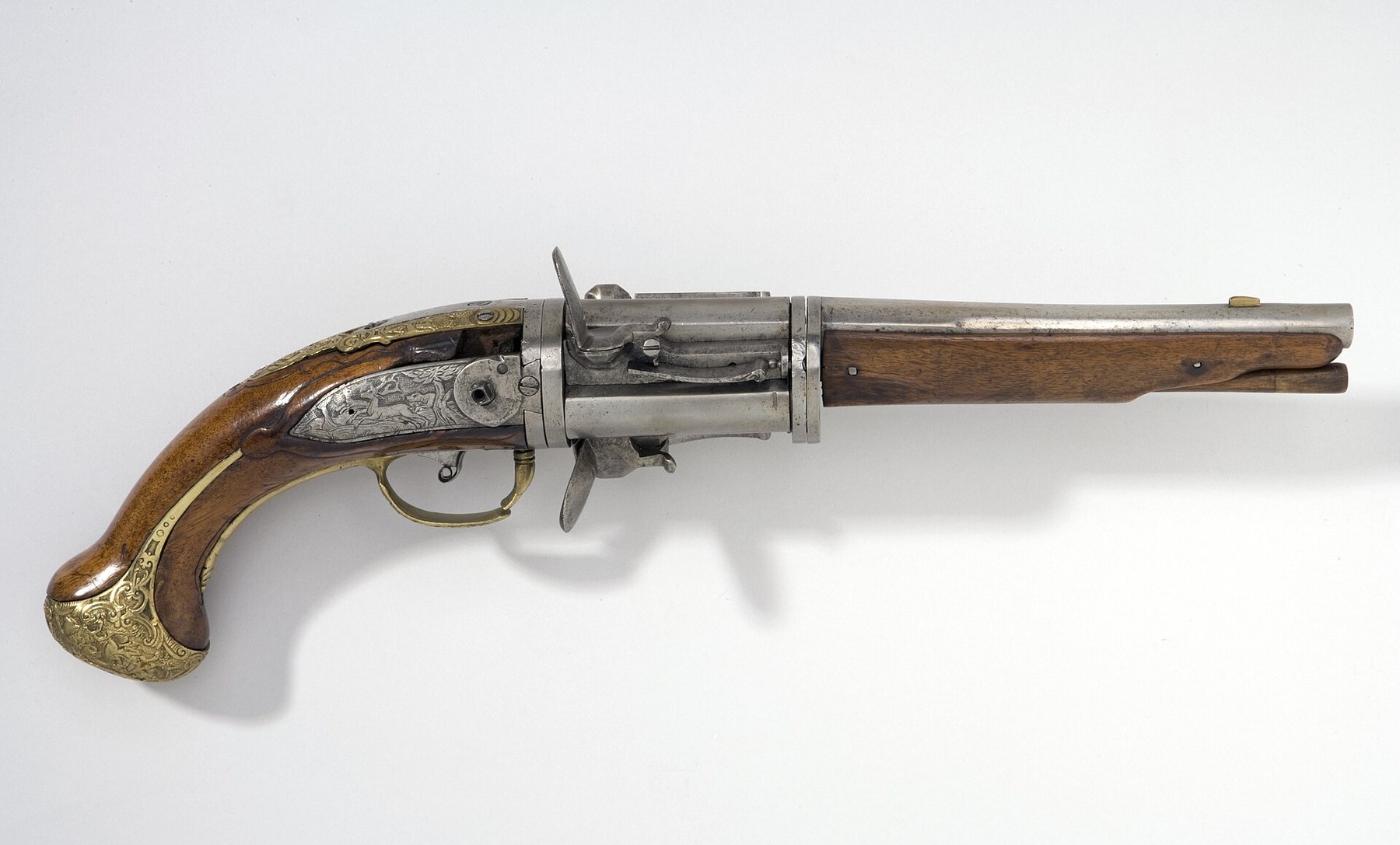
Chinn’s history also records earlier attempts at volume of fire: a 1688 French arrest of a man carrying a breech-loading model to the gunsmiths of Saint-Étienne, and an earlier Scottish patent granted by Charles I to William Drummond for a set of barrels mounted in a circle and turned by hand.2 Chinn notes that the nineteenth-century writer who called Puckle’s gun “the first mitrailleuse ever patented in England” had “ignored the earlier Scottish patent”.
5.3 What was new in 1718
Against that background, the Puckle gun’s new things are not the revolving chamber but these:
- Interchangeable, pre-loaded chamber sets carried and changed as a unit, a magazine in effect (Volume 4).
- A positive screw clamp of chamber to barrel for a gas seal.
- A crew-served mount: a folding tripod with chain, stretchers, swivelling crane and toothed elevating arc. Chinn’s quoted authority found it “almost identical with that used on some recent forms of machine guns”.2
- A patent, one of the first in England whose grant was conditional on a written specification (Volume 1), so that the design was published in a form that survives.
Chinn’s own verdict: “Whether Puckle’s ‘Defense’ represents the first patented manually operated revolving-type machine gun or not is immaterial. Its importance lies in the fact that it certainly represents the most refined design to be found in the whole slow-match era. It also shows that the mechanisms involved in getting a weapon to fire repeatedly had far outstripped the method of igniting successively the charges as they came into alinement.”2 The last sentence is the sharpest thing written about the gun. Chinn’s “slow-match era” is a slip: the Puckle is a flintlock, and its print shows a cock; but his point about ignition stands.
5.4 After Puckle: Collier, Colt and the percussion cap
A century later Elisha Collier, a Bostonian working in London, made the first commercially successful flintlock revolver. Chinn describes its “self-priming pan and gas-tight joints between cylinder and barrel, formed by camming forward the cylinder counter-bored at the forward end to mate with the breech end of the barrel”, and a cylinder “indexed by tension of a spring that had previously been hand wound”.2
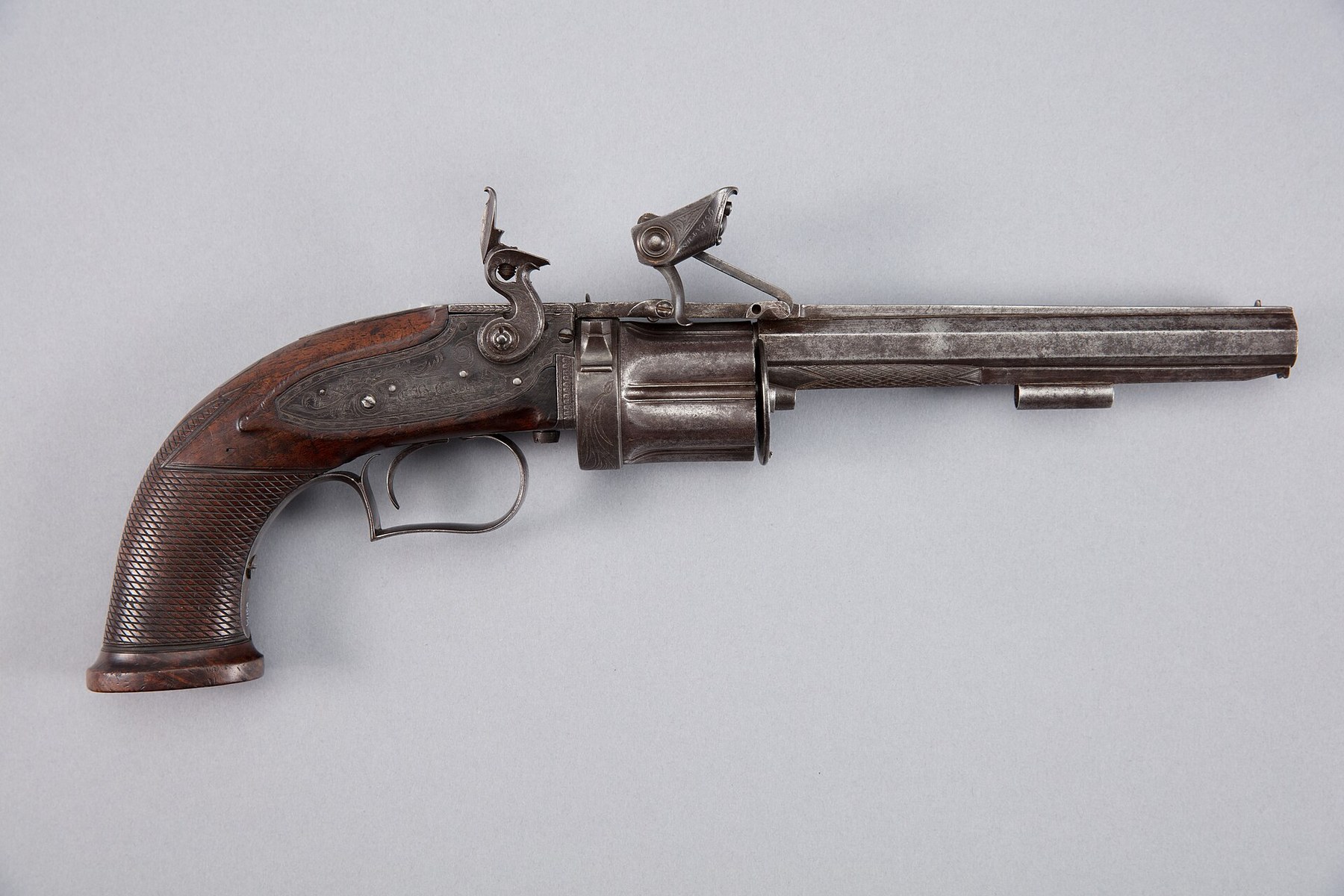
The comparison is direct. Collier solved both of Puckle’s problems that the print leaves open: the cylinder advanced by itself, and the priming was automatic. He kept Puckle’s idea of a sealing joint made by moving the cylinder forward. What he dropped was the interchangeable chamber set, which returned with percussion revolvers whose cylinders could be swapped loaded.
The percussion cap is what finally made repeating arms practical: a sealed primer on each chamber instead of an open pan. That story is in the History of Muzzleloaders, Volume 11, and its two-barrel extreme in the LeMat revolver dive.
5.5 The manually operated guns
Chinn’s history divides machine-gun development into periods. The guns before the true automatics are the manually operated guns, cranked or levered by the gunner, culminating in the Gatling; his chapter “End of the Manually Operated Period” opens “From Gatling’s original patent on 1 November 1862 to 26 June 1883”, and the book then turns to the automatics, beginning with Hiram Maxim’s “original drawings in 1883”.2 Puckle’s gun belongs to the first chapter of that story, and Chinn’s own phrase for it is “manually operated revolving-type machine gun”.
The distinction is the one that matters. In a manually operated gun, the gunner’s hand supplies the energy that loads and fires each round. In an automatic, the shot itself does: recoil in the Maxim, the gas tapped from the barrel in the Lewis gun (Lewis gun, Volume 3), the long recoil of the barrel in the Chauchat. Puckle’s gun does not even use the gunner’s hand to work a mechanism that loads and fires; each shot needs the gunner to unclamp, turn, reclamp, prime and cock. It is a revolver on a tripod.
5.6 Is it a machine gun?
Technically, no. Every working definition of a machine gun turns on automatic fire. US federal law defines a machinegun as a weapon that “shoots, is designed to shoot, or can be readily restored to shoot, automatically more than one shot, without manual reloading, by a single function of the trigger”; Michigan’s statute uses almost the same words.3 The Puckle fires one shot per pull, and every following shot needs hand work. Volume 8 takes up the legal consequences.
Historically, it is in the family. It was designed to deliver a volume of fire from a crew-served mount, it fed from a detachable multi-shot magazine, and it set the pattern of the machine-gun tripod. Placing it at the start of the machine gun’s history, as Chinn does, is fair if “manually operated” is kept attached.
5.7 Where the words came from
Table 1 — Where the words came from
| Phrase | First use found | Source |
|---|---|---|
| ”a Portable Gun or Machine … called a Defence” | 1718 | Puckle’s declaration4 |
| ”Puckle’s Machine” | 1720 | Bowles’s playing card |
| ”Machine Guns of Puckles” | 1722 list, printed 1725 | Uring’s stores table5 |
| ”Puckle’s Machine Company” | Not found in a period document | Modern summaries only |
| ”a revolver, mitrailleuse, or Gatling gun” | 1896 | DNB6 |
| ”first mitrailleuse ever patented in England” | 19th century, as quoted by Chinn | Chinn 19512 |
| ”a patent for a machine gun” | 21st century | UK IPO patent-history page7 |
The Puckle gun was a “machine” because it was a contrivance, in the eighteenth-century sense. Calling it a machine gun in the modern sense came after the Gatling and the mitrailleuse had given Victorian writers a category to put it in.
5.8 The myths, checked
Table 2 — The myths, checked
| Claim | Status | Evidence |
|---|---|---|
| Only two were ever made | Not supported | Two Buccleuch guns; one in St Petersburg; three in the Qing stores in 1804 (Volume 3) |
| The surviving pair are at the Royal Armouries and Boughton | Wrong as stated | Buccleuch guns at Boughton and Beaulieu (Wilcock); a Tower display in the 20th century, probably a loan (Volume 3) |
| Montagu bought them as Master-General of the Ordnance | Wrong | He was Master-General from 1740; in 1722 he was a private colonial proprietor (Volume 2) |
| The patent says square bullets would “convince the Turks of the benefits of Christian civilization” | Not in the patent | The specification’s only words are about materials; the key says “against Turks” (Volume 1) |
| The square-bullet version was never built | Wrong | A square-chambered set survives at Boughton (Volume 3) |
| It fired square bullets from a square barrel | Not supported | The print shows square chambers and a round barrel (Volume 1) |
| Demonstrated to the Board of Ordnance in 1717 | No record found | Patent dated 1718; the 1859 abridgment’s “1717” is an error (Volumes 1 and 2) |
| Nine rounds a minute in rain, measured | One report | 63 shots in 7 minutes, London Journal 31 March 1722, as cited; nine a minute is the same figure divided (Volume 2) |
| Used in combat | No evidence | Shipped to St Lucia 1722; no record of firing there (Volume 2) |
| The tripod was not patented | Wrong | The tripod is drawn and numbered on the specification (Volume 1) |
| “They’re only wounded who hold shares therein” | Misquoted | The card reads “They’re only Wounded that have Shares therein” (Volume 2) |
| Peter the Great bought a brass one in 1718 | Overstated | The museum researcher says “probably 1718 to the early 1720s … acquired (or made)”; the barrel is bronze (Volume 3) |
| 3-foot barrel, 1.25-inch bore | Unsourced | Measured guns: 100 cm and 28 mm (St Petersburg); 92 cm and 2.5 to 4 cm (Beijing) (Volume 3) |
| The first machine gun | Only with qualification | A manually operated revolving gun; no automatic action (above) |
5.9 What could not be verified
- Whether the Livrustkammaren revolver’s “early 18th century” date predates 1718; the museum’s dating is given as published.
- Chinn’s French and Scottish precedents were not traced to their own sources.
References
Footnotes
-
War Office, Textbook of Small Arms 1929 (London: HMSO, 1929), p. 151. https://archive.org/details/textbooksmallarms1929, text read 19 October 2026. ↩
-
George M. Chinn, The Machine Gun, vol. I (Bureau of Ordnance, Department of the Navy, 1951), pp. 16–20 and ch. 16. https://archive.org/details/TheMachineGunVolume1ByGeorgeMChinn, accessed 19 October 2026. ↩ ↩2 ↩3 ↩4 ↩5 ↩6
-
26 U.S.C. § 5845(b), Legal Information Institute, https://www.law.cornell.edu/uscode/text/26/5845; Michigan Compiled Laws § 750.224(1)(a), https://www.legislature.mi.gov/Laws/MCL?objectName=mcl-750-224; both read 19 October 2026. ↩
-
James Puckle, declaration of 25 July 1718, specification of Patent No. 418, reproduced in Chinn, vol. I, p. 18. ↩
-
Nathaniel Uring, A Relation of the Late Intended Settlement of the Islands of St. Lucia and St. Vincent (London, 1725), stores table. https://archive.org/details/bim_eighteenth-century_a-relation-of-the-late-i_uring-nathaniel_1725, accessed 19 October 2026. ↩
-
Sidney Lee, “Puckle, James (1667?–1724)”, Dictionary of National Biography, vol. 47 (1896). https://archive.org/details/dictionaryofnati47stepuoft, accessed 19 October 2026. ↩
-
UK Intellectual Property Office, “The 18th century”, archived 22 April 2014, https://web.archive.org/web/20140422075818/http://www.ipo.gov.uk/types/patent/p-about/p-whatis/p-history/p-history-18century.htm, accessed 19 October 2026. ↩
Comments (0)