Puckle Gun · Volume 2
Shares, Satire and a Wet Trial: The Company, 1722, and the Guns Sent to St Lucia
The broadside and the bubble company, the playing card that mocked it, the one report of the gun firing, and the only documented sale: two guns shipped for the Duke of Montagu's failed colony
2.1 The sequence of events
Table 1 — The sequence of events
| Date | Event | Source |
|---|---|---|
| 15 May 1718 | Letters Patent granted, No. 418 | Specification1 |
| 25 July 1718 | Specification enrolled with the engraved print | Specification1 |
| c. 1720 | Engraved broadside “A Defence” issued; company floated | DNB; Hodgkin23 |
| 1720 | Bowles’s playing card mocks the company’s shareholders | The card4 |
| 31 March 1722 | London Journal reports 63 shots in 7 minutes in rain | As cited by Yefimov5 |
| 20 June 1722 | St Lucia and St Vincent granted to the Duke of Montagu | London Gazette, as cited by Wilcock6 |
| 10 September 1722 | Uring’s convoy leaves Portsmouth with “2 Machine Guns of Puckles” | Wilcock; Uring67 |
| December 1722 | The colony lands at St Lucia | Uring7 |
| 18 January 1723 (N.S.) | Evacuation treaty with the French; the colony may re-embark its arms and stores | Uring7 |
| 26 July 1724 | Puckle buried, St Stephen’s, Coleman Street | DNB2 |
2.2 The broadside: a prospectus on one sheet
No separate printed prospectus for Puckle’s company was found. What survives is the engraved sheet itself, the same picture that formed the patent specification (Volume 1), issued as an advertisement. The Dictionary of National Biography quotes it describing “a portable gun or machine called a defence that discharges soe often and soe many bullets, and can be so quickly loaden as renders it next to impossible to carry any ship by boarding”, and dates it “(1720?)”.2
The best early account of a copy is a note in Notes and Queries of 9 November 1889 by J. Eliot Hodgkin, a collector of prints. He wrote that Puckle “issued, somewhere about the year 1720, an engraved broadside, the only copy of which that I have seen I met with in Paris”, transcribed its title, and described it:3
“The engraving shows a large revolver, or mitrailleuse, on a tripod, the breach of which is turned by hand and contains six chambers, the contents of which are discharged in turn through a single long barrel. The tripod possesses an elevating arrangement, and the piece can be swivelled in any desired direction. The part containing the chambers is removable at pleasure, and when one ‘sett’ had been discharged a charged one was substituted.”
Hodgkin’s “six chambers” is a count of one set on the print; the print also shows sets of seven and nine (Volume 1). The DNB’s “six chambers”, written seven years later, reads like Hodgkin’s.
The sheet is a sales document in the plain sense. The patriotic couplet, “Defending King George your Country and Lawes / Is Defending Yourselves and Protestant Cause”, was written for a Hanoverian, Protestant London a few years after the Jacobite rising of 1715. The list of uses, “Bridges Breaches Lines and Passes, Ships Boats Houses and other Places”, pitches it to the army, the navy, merchants and householders at once. The note that it “can be made to Discharge Granado Shells as well as Bullets” promised more than any surviving gun shows.
2.3 A company in the bubble year
Lee’s DNB entry says Puckle “endeavoured to form a company to develop his invention during the bubble period of 1720, and incurred much unfavourable notice from catchpenny satirists, one of whom stated that the machine was only capable of wounding shareholders”, citing the British Museum’s Catalogue of Satirical Prints, Nos. 1620 and 1625, and Notes and Queries.2
1720 was the year of the South Sea Bubble, when London floated joint-stock schemes by the hundred and most of them collapsed. Yefimov states that shares in Puckle’s company were quoted at £8 in 1720, and that the company sold only a small number of shares; he gives no source for either figure.5 No share list, subscription book or company record was found for this dive. The size of the company, its capital and its fate are unknown.
2.4 The playing card
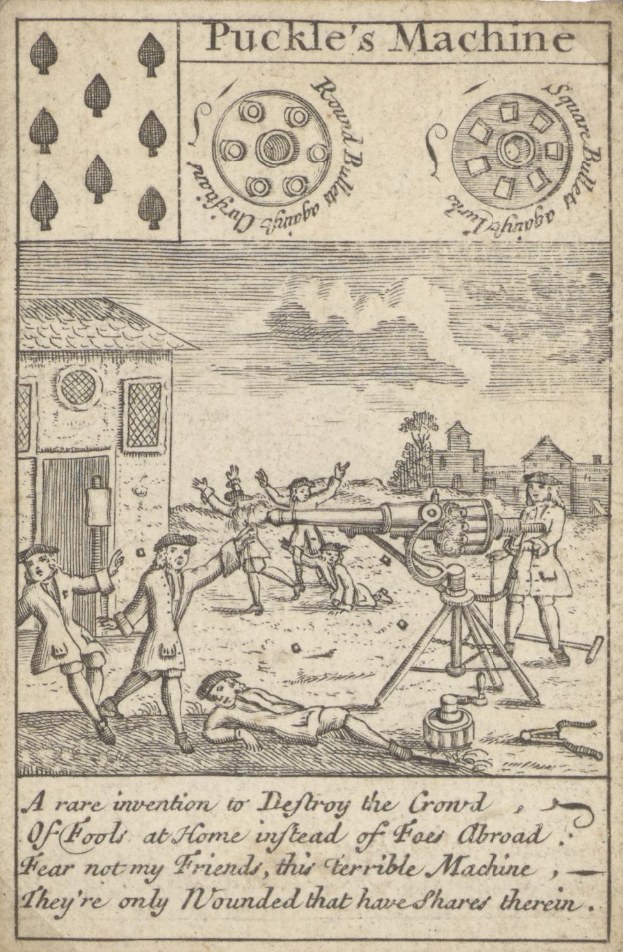
Thomas Bowles published a pack of playing cards in 1720 lampooning the bubble companies, one scheme to a card. Puckle’s is the nine of spades.4 It is the earliest image of the gun after the patent print, and the most informative satire.
The engraver copied the two chamber plates from Puckle’s print and labelled them “Round Bullets against Christians” and “Square Bullets against Turks”. The scene below shows the gun on its tripod firing at a crowd of well-dressed men, some falling; a spare chamber set and what looks like the bullet mould or pincers lie in the foreground; a man stands at the crank behind the gun. The verse is the line every account of the Puckle gun quotes:
“A rare invention to Destroy the Crowd, Of Fools at Home instead of Foes Abroad: Fear not my Friends, this terrible Machine, They’re only Wounded that have Shares therein.”
It is often misquoted. Wikipedia’s article gives “they’re only wounded who hold shares therein”; Hodgkin in 1889 printed “Crowds” for “Crowd”.3 The text above is read from the card.
The joke is about money, not machinery: the “fools at home” are the investors, and the wound is financial. The card is evidence that the gun and its company were well enough known in 1720 to be worth a card in a satirical pack. It is not evidence that the gun failed as a gun.
2.5 Was there a trial in 1717?
Many accounts say Puckle demonstrated a prototype to the Board of Ordnance in 1717, or that “the Navy tested the Puckle Gun and turned it down” in 1717, and that the officers were not impressed.8 No contemporary record of a 1717 trial was found for this dive: no Board of Ordnance minute, newspaper report or letter. The modern accounts cite no document.
Two things make the date suspect. The patent was granted in May 1718, and an inventor normally protects a design before showing it to a buyer. And the Patent Office’s own 1859 abridgment wrongly dates the patent “A.D. 1717, May 15” (Volume 1), which is one way a 1717 date could have entered the literature. That second point is this work’s inference, not a documented origin.
Forgotten Weapons gives a different sequence: the gun “was demonstrated in public in 1721 (after being turned down by the Royal Navy)”.9 No source is given for either the 1721 date or the naval rejection.
2.6 March 1722: sixty-three shots in the rain
The one report of the gun actually firing comes from a London newspaper. Yefimov, a researcher at the Military History Museum of Artillery in St Petersburg, cites the London Journal of 31 March 1722: one man fired 63 shots in seven minutes from “Mr Puckle’s machine”, while it was raining.5 The same figures are repeated in English-language summaries, which cite Charles ffoulkes’s The Gun-Founders of England (1937) and James Willbanks’s Machine Guns (2004). The newspaper itself was not read for this dive (the Burney collection is behind a subscription), and ffoulkes’s book is held by the Internet Archive as a lending-only item whose text could not be searched.
What the figures do and do not say:
- Nine a minute is arithmetic, not a second measurement. 63 shots in 7 minutes is exactly 9 per minute. Every account that gives “nine rounds a minute” is restating the one report.
- 63 is seven times nine. That is consistent with seven nine-chamber sets fired in turn, which would include six changes of chamber set inside the seven minutes. This is an inference from the numbers; the report as cited does not say how many sets were used or who loaded them.
- “One man” fired the gun. Whether the chamber sets were loaded before the trial began is not stated, and almost certainly they were: loading nine chambers from the muzzle end with powder and ball takes longer than 47 seconds.
- “Raining” matters because a flintlock’s priming is exposed when its pan is open. The Puckle’s individual pan covers (Volume 4) may be why it kept firing.
For comparison, the Lewis gun dive records what a real endurance trial looked like two centuries later: a count of every stoppage and broken part. Nothing like that exists for the Puckle gun. One newspaper paragraph, read at second hand, is the whole performance record.
2.7 The Duke of Montagu’s islands
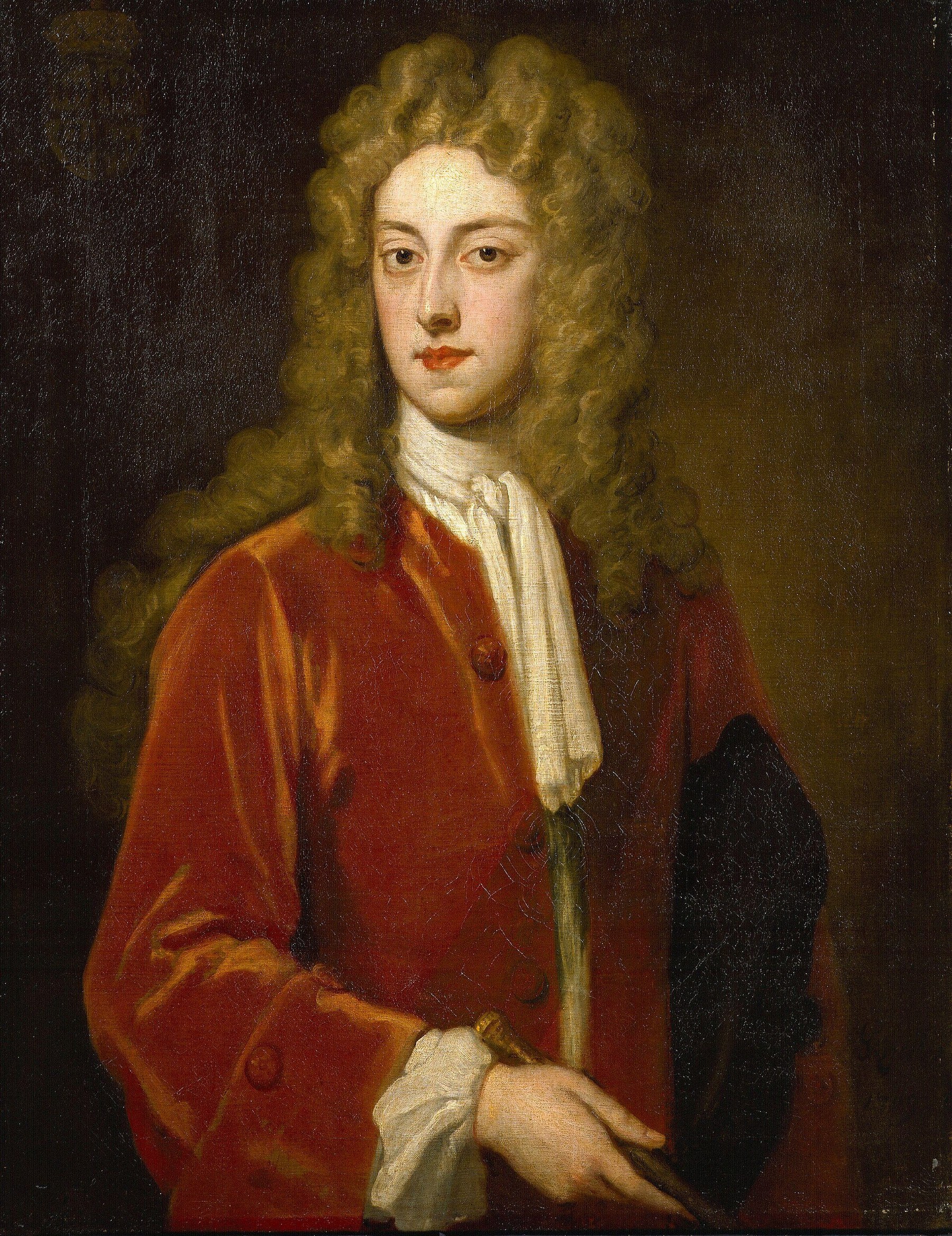
John Montagu, 2nd Duke of Montagu (1690–1749), was granted the West Indian islands of St Lucia and St Vincent in 1722. The Royal Society’s catalogue of its Fellows lists him as “Lord Proprietor and Captain General, islands of St Lucia and St Vincent (1722)”.10 Paul Wilcock’s survey of the Buccleuch armoury dates the grant to 20 June 1722 from the London Gazette of 19 June, and records that the Duke appointed Nathaniel Uring, a merchant captain, as his deputy governor (London Gazette, 23 July 1722).6
A common error: many accounts say Montagu bought the guns as Master-General of the Ordnance. He did not hold that office until 1740; the Royal Society’s record gives “Master General of the Ordnance (1740-death)”.10 In 1722 he was buying as a private proprietor equipping his own colony, at his own expense. Wilcock’s phrasing, that “by the time of his death in 1749 he had served as Master of Ordnance and had utilised his position to commission significant quantities of weaponry”, has been compressed by later writers into a 1722 Ordnance purchase.6
2.8 “2 Machine Guns of Puckles”
Uring published his account of the venture in 1725. It includes a folding table, “An Account of Cannon, Small Arms, and other Stores, sent on the abovesaid Expedition to St. Lucia”.7 The fourth line reads “2 Machine Guns of Puckles.”
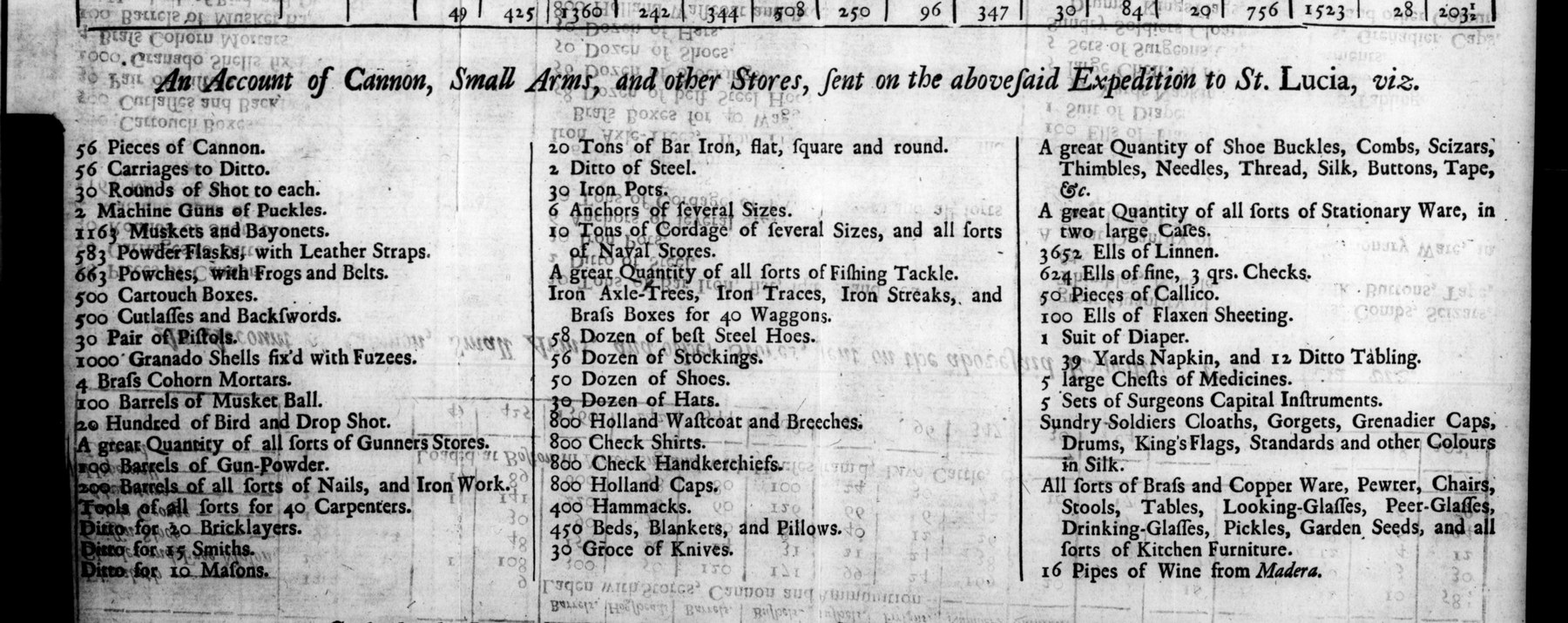
This list is the only documented sale or delivery of Puckle guns. Three things about it are worth noticing.
- The phrase “machine gun” is in print in 1725. It is not the modern technical term. Puckle called his invention “a Portable Gun or Machine”, and a clerk listing stores wrote “Machine Guns of Puckles”: guns of Puckle’s machine type.
- The guns were shipped as colonial stores, alongside 56 cannon, 1,165 muskets, 500 cutlasses, 4 brass coehorn mortars, 1,000 grenade shells with fuzes, tools for carpenters and masons, and 800 check shirts. They were defensive equipment for a settlement, which is exactly what the broadside offered.
- The 1,000 “Granado Shells” are not Puckle ammunition. They are listed separately and the four coehorn mortars on the next line are the obvious weapon for them. Nothing in the list connects the shells to the Puckle guns.
Wilcock identifies the two guns now in the Buccleuch collection (Volume 3) as these two: “particular interest is reference to two easily identifiable artefacts in the Buccleuch Collection today”.6
2.9 St Lucia, December 1722 to January 1723
Uring’s narrative is a day-by-day journal and correspondence. The colony landed in December 1722 at a point it named Montagu Point and began building a battery on a hill and a barricade round its tents and stores. The French in Martinique, who disputed the British claim, served notice to leave within fifteen days. Uring’s journal records men deserting to the French (“Four of our Men deserted to the French”, on one day alone) while the colony worked on its defences.7
On 18 January 1723 (New Style) an evacuation treaty was signed “at the Camp of the Shocque” between the Marquis de Champigny and Uring’s representative Braithwaite. Its fourth article allowed the colony “to reimbark all their warlike Stores, Provisions, Arms, Baggage, Utensils, and in short every Moveable that belongs to them”.7 The French undertook to evacuate their own forces afterwards and leave the island in its former state “till there shall be a Decision of it by the Two Crowns”.
The journal records that “we carried the Guns to the Foot of the Hill” for the battery, without saying which guns; nothing found in the text names the Puckle guns in action. Wilcock writes that “there is no doubt” some of the armoury’s items relate to the expedition and lists the Puckle guns among them; there is no record of either gun being fired at St Lucia.6 The treaty’s fourth article explains how the guns could come home.
Uring put the Duke’s losses at “Forty Thousand Pounds, and upwards”.7
2.10 What happened next
Puckle died in 1724. No further sales, trials or orders have been found. The two Montagu guns passed with the Duke’s estate to Boughton House, and from his heirs to the Dukes of Buccleuch (Volume 3). Boughton’s household inventory of 1801 lists “1 Brass Defence Piece with 9 Chargers on a triangle frame”: the gun was still called by Puckle’s name for it, “A Defence”, eighty years later.6
2.11 What could not be verified
- The London Journal of 31 March 1722 was not read in the original; the figures are as Yefimov cites them.
- ffoulkes (1937), p. 34, cited in English summaries for the trial, was not read (lending-only scan).
- A 1717 trial or a naval rejection: no record found.
- The company: no share list, capital figure or record of winding up; Yefimov’s £8 share price is unsourced.
- British Museum Satires Nos. 1620 and 1625: cited by the DNB; the BM records were not read.
References
Footnotes
-
George M. Chinn, The Machine Gun, vol. I (Bureau of Ordnance, Department of the Navy, 1951), p. 18. https://archive.org/details/TheMachineGunVolume1ByGeorgeMChinn, page image read 19 October 2026. ↩ ↩2
-
Sidney Lee, “Puckle, James (1667?–1724)”, Dictionary of National Biography, vol. 47 (1896). https://archive.org/details/dictionaryofnati47stepuoft, accessed 19 October 2026. ↩ ↩2 ↩3 ↩4
-
J. Eliot Hodgkin, “Anticipations of Modern Inventions: Puckle’s ‘Defence’”, Notes and Queries, 7th series, vol. 8 (9 November 1889), p. 365. https://archive.org/details/sim_notes-and-queries_1889-11-09_8_202, accessed 19 October 2026. ↩ ↩2 ↩3
-
Thomas Bowles, “Puckle’s Machine”, playing card, 1720; Columbia University Libraries, https://dlc.library.columbia.edu/catalog/cul:547d7wm4v5; image via Wikimedia Commons, https://commons.wikimedia.org/wiki/File:Puckles%27s_Machine.png, accessed 19 October 2026. Verse read from the image. ↩ ↩2
-
S. V. Yefimov, “Rapid-fire artillery pieces of the first half of the eighteenth century in the collection of the Military History Museum of Artillery, Engineers and Signal Corps” (in Russian), Voenno-istoricheskii zhurnal, 2019, no. 2. https://cyberleninka.ru/article/n/skorostrelnye-artilleriyskie-orudiya-pervoy-poloviny-xviii-veka-v-sobranii-voenno-istoricheskogo-muzeya-artillerii-inzhenernyh, accessed 19 October 2026. ↩ ↩2 ↩3
-
Paul Wilcock, “The Armoury of His Grace the Duke of Buccleuch and Queensberry”, Arms & Armour 9, no. 2 (2012), pp. 181–205; author’s version, http://eprints.hud.ac.uk/17394/1/BUCCLEUCH_PROJECT_Royal_Armouries_version_2_5_FinalProofEDIT.pdf, pp. 5, 15–16, 20, accessed 19 October 2026. ↩ ↩2 ↩3 ↩4 ↩5 ↩6 ↩7
-
Nathaniel Uring, A Relation of the Late Intended Settlement of the Islands of St. Lucia and St. Vincent, in America; in Right of the Duke of Montagu (London: J. Peele, 1725), stores table, journal for December 1722 and January 1723, Articles of evacuation, and closing estimate of losses. https://archive.org/details/bim_eighteenth-century_a-relation-of-the-late-i_uring-nathaniel_1725, accessed 19 October 2026. ↩ ↩2 ↩3 ↩4 ↩5 ↩6 ↩7
-
Joseph McClain, “The First Patent Machine Gun – The Puckle Gun”, American Society of Arms Collectors Bulletin 126, pp. 64–67, https://americansocietyofarmscollectors.org/wp-content/uploads/2023/10/McCLAIN-the-first-patent-machnie-gun-the-Puckle-gun-v126.pdf, accessed 19 October 2026. ↩
-
Ian McCollum, “Puckle Gun (Video)”, Forgotten Weapons, 25 December 2016, https://www.forgottenweapons.com/puckle-gun-video/, accessed 19 October 2026. ↩
-
The Royal Society, catalogue of Fellows, “Montagu; John (1690 - 1749); 2nd Duke of Montagu”, https://catalogues.royalsociety.org/CalmView/rdf/persons/NA7805, accessed 19 October 2026. ↩ ↩2

Comments (0)