Puckle Gun · Volume 3
The Survivors: Boughton, Beaulieu, St Petersburg, Beijing and the Gun at the Tower
Every Puckle-pattern gun with a published record, what each record actually says, how to tell the guns apart, and why \"only two were ever made\" cannot be right
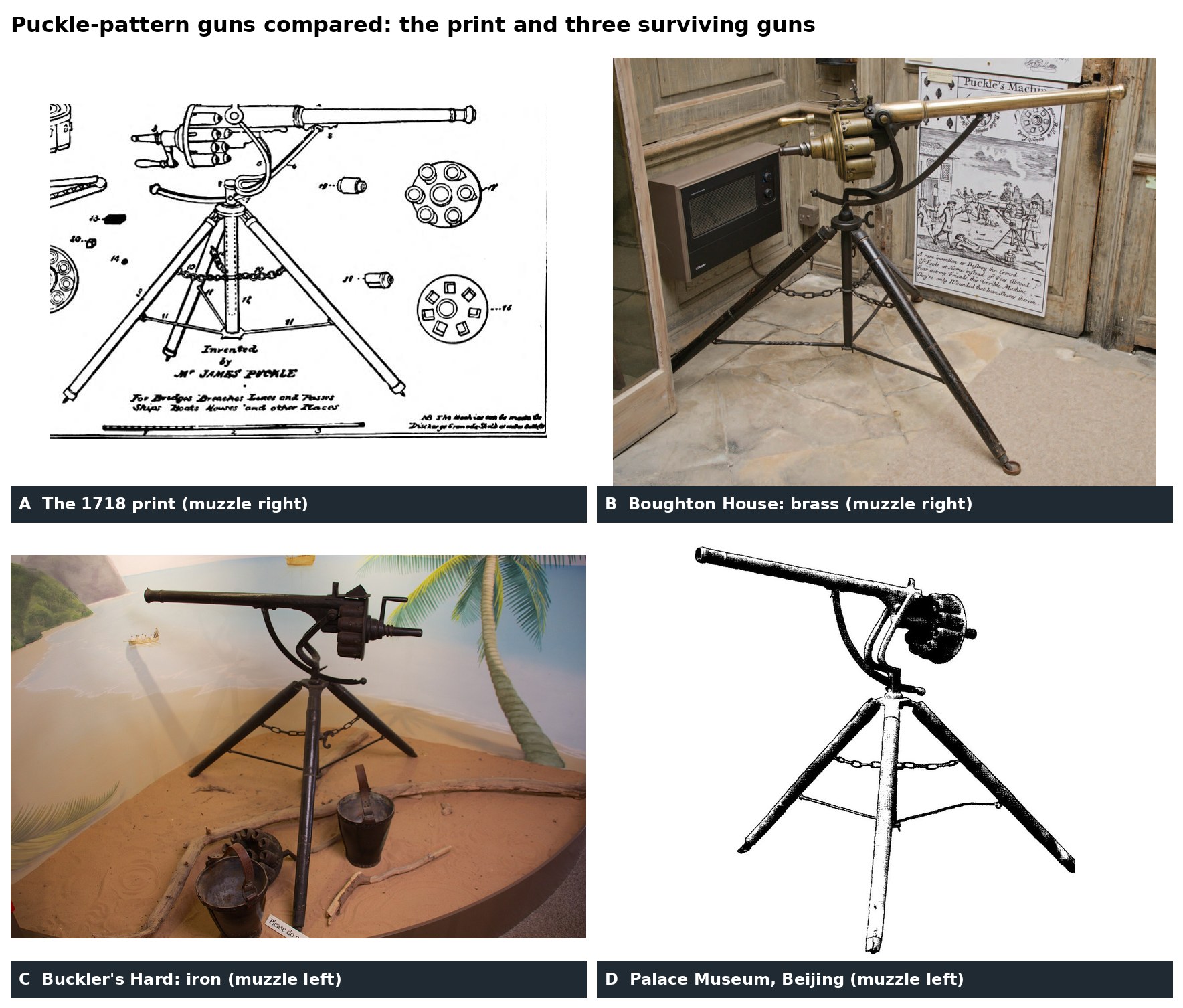
3.1 The short answer
The usual statement is that two Puckle guns survive, at Boughton House and Beaulieu, both from the Duke of Montagu’s 1722 purchase, and that only two were ever made. The first half is supported by the Duke of Buccleuch’s own armoury survey. The second half is contradicted by two museum records: a bronze gun in St Petersburg, catalogued in 1961, and three “wheel guns” recorded in the Qing imperial stores in 1804, one of which the Palace Museum in Beijing illustrates.
The often-repeated pairing of “the Royal Armouries and Boughton House” also needs care: the Royal Armouries’ connection is that one of the Buccleuch guns was shown at the Tower of London in the twentieth century, and no record read for this dive shows a Puckle gun owned by the Royal Armouries.
3.2 The census
Table 1 — The census
| Gun | Material | Chambers | Where | Record |
|---|---|---|---|---|
| Boughton gun | Brass barrel and chamber set, iron tripod | Spare set: 9, square-bored | Boughton House, Northamptonshire (Buccleuch) | Wilcock 2012, with photographs1 |
| Beaulieu gun | Not stated by Wilcock | Not stated | ”on loan at Beaulieu” (Buccleuch) | Wilcock 20121 |
| Buckler’s Hard gun | Iron (from photographs) | Spare set visible, about 9 | Buckler’s Hard Maritime Museum, Beaulieu estate | Photographs, Mike Peel 20142; whether this is the Beaulieu gun or a replica is unresolved |
| St Petersburg gun | Bronze barrel | 9 | Military History Museum of Artillery, Engineers and Signal Corps, inv. no. 14/25 | 1961 catalogue no. 364 via Yefimov 20193 |
| Beijing gun | Not stated (photograph is monochrome) | 11 | Palace Museum | Wang Zilin; Qing inventory of 1804 lists three4 |
| ”Tower” gun | Brass | Not known | Tower of London, 20th century | Blackmore 1961, ill. 77, as cited; probably a Buccleuch loan (below) |
| Copenhagen | Not known | Not known | Tøjhusmuseet (Royal Danish Arsenal) | One footnote in Wilcock 2012; not confirmed1 |
3.3 Boughton House: the brass gun and the square chambers
Paul Wilcock’s 2012 survey of the Duke of Buccleuch’s armoury, published in the Royal Armouries’ journal Arms & Armour, is the only curator-level description of the Montagu guns found for this dive. He writes of the 2nd Duke:
“One of the most famous of these are the Puckle Guns of which this collection boasts two examples, the second on loan at Beaulieu. A remarkable invention, these guns were a forerunner of the machine gun and were fed by drum-magazines, firing either square or round shaped projectiles selected depending upon the religion of the foe!”1
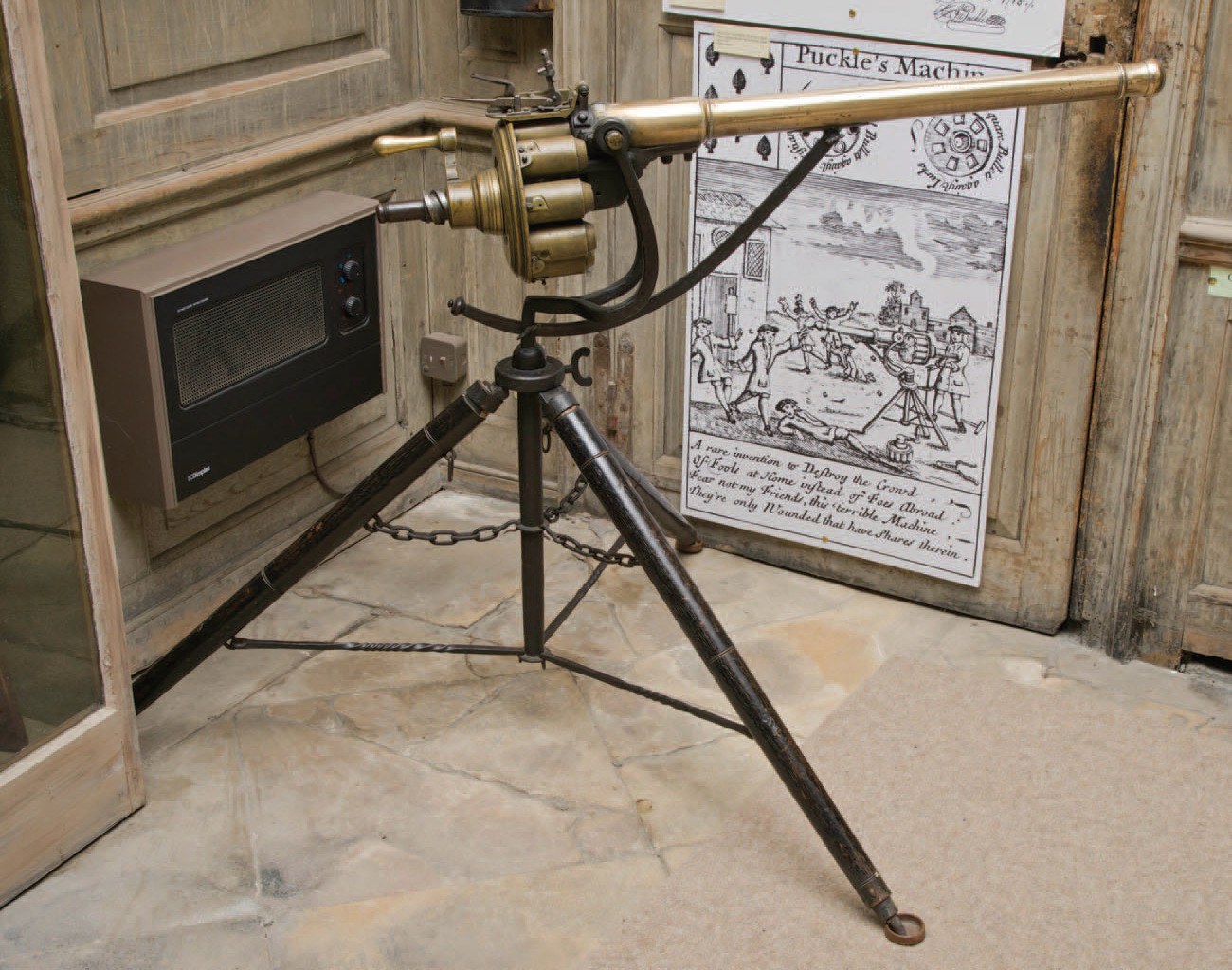
He illustrates the Boughton gun and one of its chamber sets. The gun is brass, barrel and chamber set, on a black-painted iron tripod with a chain between the legs and iron stretcher rods. A lock sits on top of the breech behind the barrel; a crank projects from the rear of the axis.
The second photograph is the important one. Wilcock captions it “Drum magazine for the Puckle Gun”. It shows a spare chamber set from the front: nine brass chamber tubes fixed round a hollow iron centre, on an iron back plate, with small hinged covers on the rim of the plate. Every chamber is square-bored.
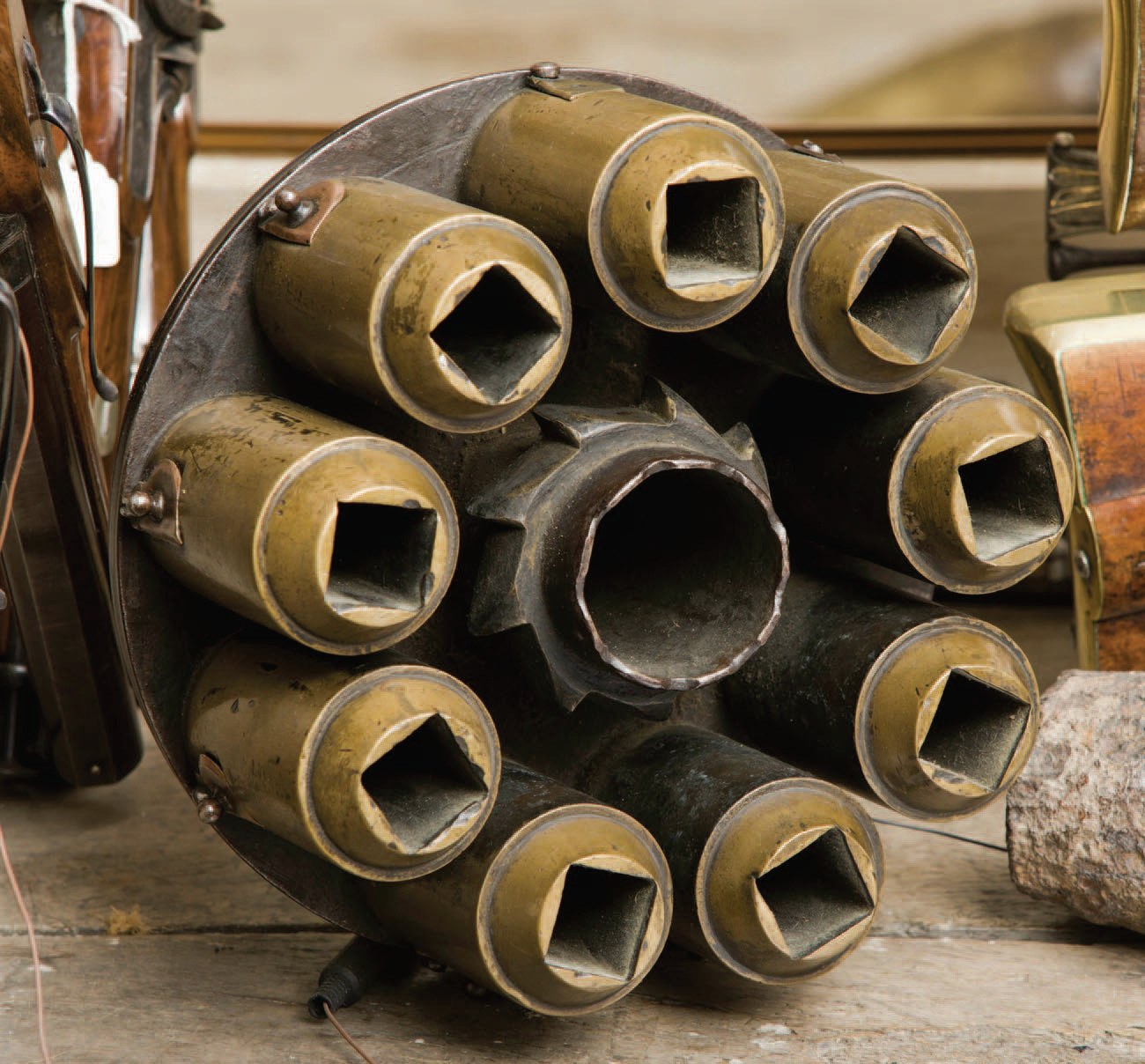
Correction. Forgotten Weapons states that “the square bullet version was never actually built”.5 A square-chambered set exists at Boughton. No square-bored barrel is recorded. The print never proposed a square barrel either: it offered square chambers firing cubes through the one round barrel (Volume 1).
The 1801 Boughton inventory, which Wilcock quotes, lists “1 Brass Defence Piece with 9 Chargers on a triangle frame”.1 “9 Chargers” can be read two ways: nine chambers in the set, or nine chamber sets. Wilcock does not say how many sets survive at Boughton. Both readings are given here; the photographed set has nine chambers.
3.4 Beaulieu and the iron gun at Buckler’s Hard
Wilcock says the second Buccleuch gun is “on loan at Beaulieu”, the Montagu family’s Hampshire estate.1 He does not describe or photograph it.
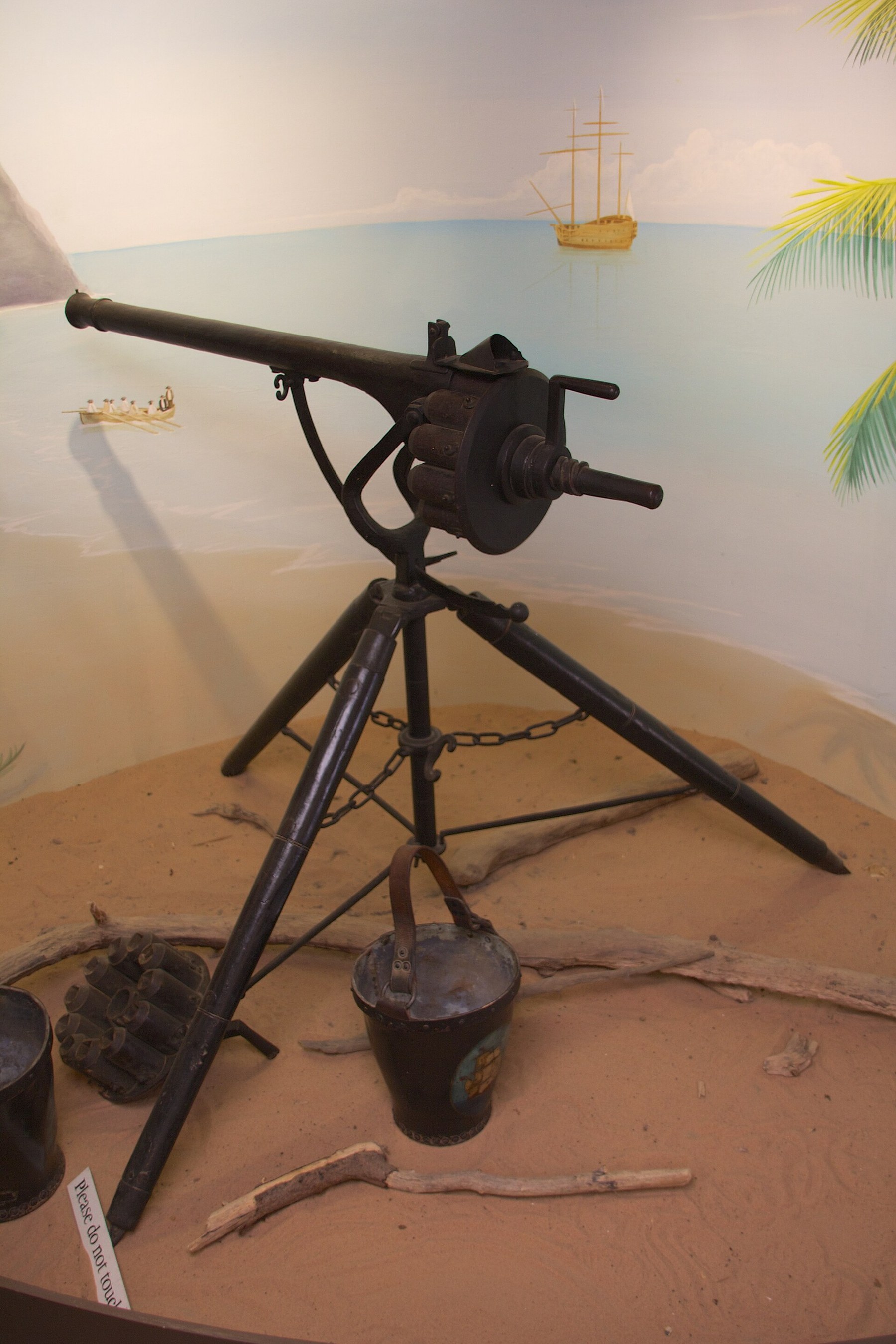
The gun the public can see on the Beaulieu estate is at the Buckler’s Hard Maritime Museum, photographed by Mike Peel in September 2014.2 It is an iron gun, dark all over, standing in a diorama of a tropical beach with a ship offshore, which reads as a reconstruction of the St Lucia landing of 1722. A spare chamber set lies in the sand at its foot. The museum’s own 2023 highlights call it “one of the more unusual artefacts in the museum, this prototype machine gun held both round and square bullets.”6
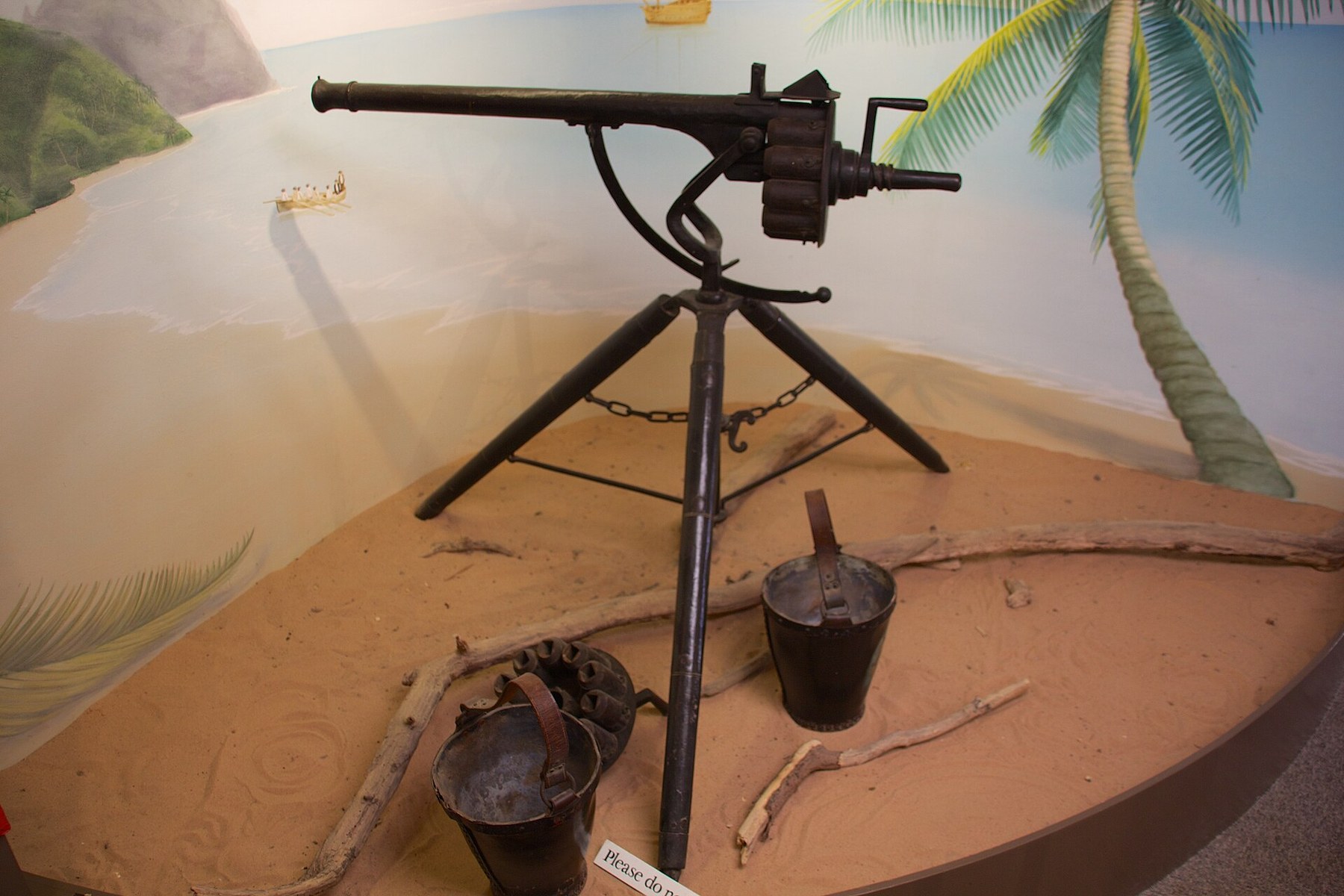
Whether this is the Buccleuch gun on loan, or a replica, is not settled by anything read for this dive:
- An earlier Commons photograph of the same display (2008) is captioned “Replica of a Puckle gun of 1718”, and Wikipedia’s article calls it a replica. Neither cites a museum statement.
- The museum calls it an “artefact” and a “prototype”, which does not say whether it is an original.
- Wilcock places the second original “on loan at Beaulieu” without naming the building.
- A widely repeated sentence, that one of two guns was “a crude prototype made of iron, the other a finished weapon made from brass”, would fit an iron gun at Beaulieu and a brass one at Boughton, but no primary source for it was found.
The question is a simple one for the museum or the Buccleuch Living Heritage Trust to answer, and it is listed for that reason.
3.5 St Petersburg: a bronze gun in Peter the Great’s arsenal
The Military History Museum of Artillery, Engineers and Signal Corps in St Petersburg holds a Puckle gun under inventory number 14/25. Sergei Yefimov, writing from the museum’s collection in 2019, gives its record from the 1961 Catalogue of the materiel of Russian artillery (no. 364, pp. 180–181):3
- bronze barrel, calibre ½ pound (28 mm), length 100 cm;
- a cylinder of nine chambers at the breech, each chamber with a vent and a cover;
- the handle brought the chambers to the breech one after another;
- an arc-shaped iron elevating stand with teeth fixed beneath the barrel;
- the gun traverses freely;
- weight 52.9 kg; stamped on the breech “3 p[uda] 8 f[untov]”, three poods eight pounds.
The stamped weight converts to about 52.4 kg at the standard 16.38 kg pood and 0.4095 kg Russian pound; the catalogue gives 52.9 kg. Both figures are given; the difference is half a kilogram and could be the stand, a later weighing, or a different pound.
Yefimov’s date for the acquisition is cautious: “probably in 1718 to the early 1720s, by order of Peter I, a rapid-fire gun of revolver type was acquired (or made)”. English-language summaries turn this into Peter the Great buying a brass gun that was “delivered to Russia in 1718”. The source says “acquired (or made)”, which leaves open a Russian copy made from the published print. The breech stamp in Russian units fits either story.
Yefimov also says the St Petersburg gun is “one of three surviving in the world”. He does not name the other two.
3.6 Beijing: three “wheel guns” presented by Westerners
The Palace Museum in Beijing publishes an article by Wang Zilin on the imperial collection’s breech-loading guns, ending with what the Qing court called the lunzipao (轮子炮), the “wheel gun”.4 Its evidence:
- The Imperial Household Department’s inventory (no. 2417) for the ninth year of Jiaqing, 1804, records “three wheel guns, each with its stand incomplete, presented by Westerners” (轮子炮三位,各随乂架不全,西洋人进). In the 23rd year of Jiaqing (1818) the store still held the three.
- Wang Zhichun’s Qingchao rouyuan ji (1879) describes a gun from Prussia “like a six-barrel gun, with eight chambers round it, all held by screws, that can be removed when not in use”. Wang Zilin judges it consistent with the museum’s gun.
- The museum’s gun is in three parts, barrel, turntable and tripod, assembled for use. Barrel 92 cm long, bore 4 cm, outside diameter 6 cm, with an adjustable sight 18 cm high. The turntable is 29 cm across and carries eleven small chambers, each 11.5 cm long with a 2.5 cm bore, spaced 6 cm apart, turned by a hand crank. Tripod legs 105 cm, extensible; centre post 50 cm.
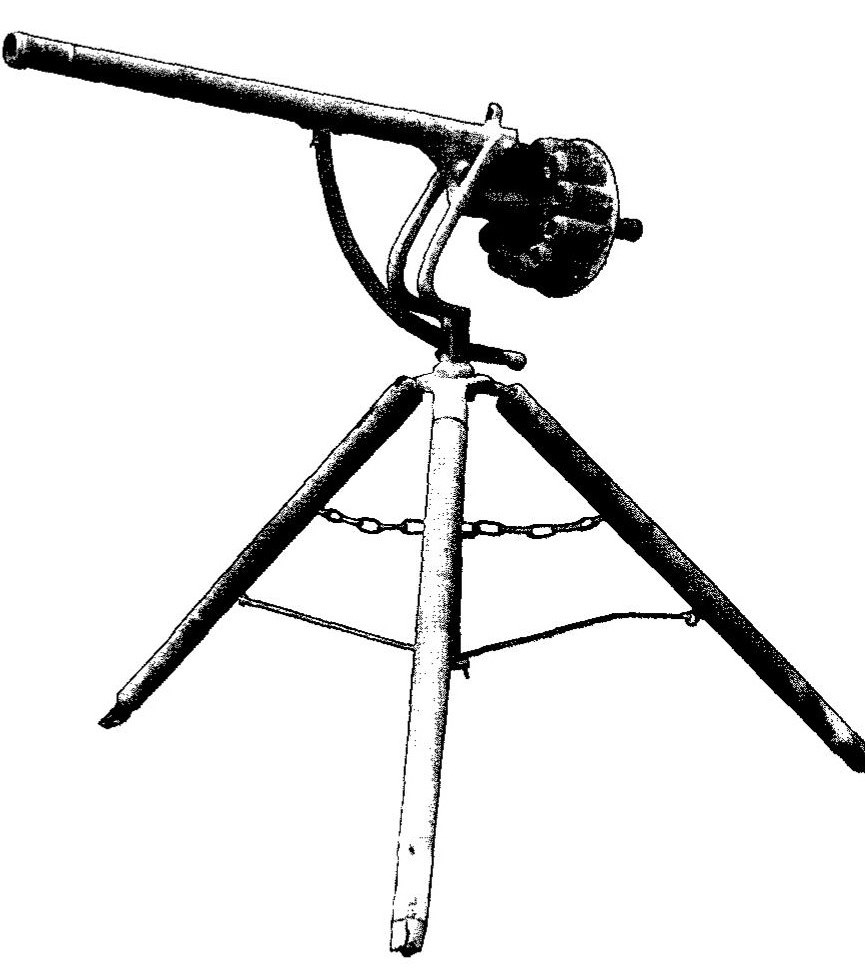
Two cautions. First, the museum article does not mention Puckle; it describes the gun as Western and fired through a touch-hole. The identification here rests on the photograph, which shows every feature of the 1718 print: the tripod with its chain, the crane, the elevating arc, the chamber set and the crank. Second, the published figures disagree with each other: a 4 cm barrel bore does not match 2.5 cm chambers. Both are given as published. One possible reading is that “inner diameter 4 cm” is the breech counterbore that receives the chamber nose, but that is a guess, not a statement in the article.
Who presented three such guns to the Jiaqing Emperor is not recorded in the article.
3.7 The Tower of London and the Royal Armouries
Howard Blackmore’s British Military Firearms 1650–1850 (1961) illustrates, as plate 77, “Puckle’s brass gun in the Tower of London”, according to the citation in Wikipedia’s article; the book was not seen for this dive. An American collector, Joseph McClain, writing in the Bulletin of the American Society of Arms Collectors, says that when he looked for the guns in 2013 the “holders of the two known Puckle Guns” were “the Duke of Buccleuch and the Tower of London”.7
Against that, Wilcock, writing for the Buccleuch collection in the Royal Armouries’ own journal, puts both Buccleuch guns at Boughton and Beaulieu and says nothing of a Royal Armouries gun.1 A forum post that a search engine summarised as quoting Royal Armouries staff, to the effect that two Puckle guns had once been with the Armouries but were conceded in the mid-1990s to be loans, could not be opened (HTTP 403) and is not used as evidence. The Royal Armouries’ online collection could not be searched for this dive.
The likeliest reconciliation is that the brass Boughton gun was lent to the Tower in the twentieth century and has since gone home. That is an inference from the brass material in Blackmore’s caption and the absence of any Armouries object record; it is not confirmed.
3.8 Copenhagen, and a gun from Belgium
Wilcock adds in a footnote that “a third example is known to exist at the Tøjhusmuseet in Copenhagen”.1 He gives no description or inventory number, and no record of it was found in the Danish museum’s published material. It is listed as unconfirmed.
McClain’s article describes buying, in 2014, a Puckle gun “and the plans” from the family of a Mr Baer in Belgium, who had died in December 2013, and importing it to the United States; he calls it “an original Puckle Gun” and, in one place, “the 1715 machine gun”.7 The article gives no provenance, maker, material or dimensions, and “the plans” suggest Baer may have made it. Whether it is an eighteenth-century gun or a modern reproduction cannot be told from the article. Its legal history is useful all the same, and is in Volume 8.
3.9 How many were made?
“Only two were ever made” appears in many summaries, sometimes as “possibly as few as two”. The documents do not support it:
Table 2 — "Only two were ever made" appears in many summaries, sometimes as "possibly as few as two". The documents do not support it
| Evidence | Guns |
|---|---|
| Uring’s stores list, 1722 | 2 shipped for St Lucia8 |
| Buccleuch collection (Wilcock) | 2, at Boughton and Beaulieu1 |
| St Petersburg, inv. 14/25 | 13 |
| Qing inventory, 1804 | 34 |
| Copenhagen (Wilcock footnote) | 1, unconfirmed1 |
If the Buccleuch pair are the St Lucia pair, and the St Petersburg and Beijing guns are genuine eighteenth-century Puckle-pattern guns, at least six are documented, not counting the unconfirmed Copenhagen gun. Whether the Russian and Chinese guns were made by Puckle’s company, made from his published print by someone else, or made later is not known. The number of guns Puckle’s own company made is not known either; “two” is the number known to have been sold.
3.10 Telling them apart
All the guns share the layout of the print. These are the differences that can be seen or read.
Table 3 — Telling them apart
| Feature | 1718 print | Boughton | Buckler’s Hard | St Petersburg | Beijing | Where to look |
|---|---|---|---|---|---|---|
| Barrel material | ”Steel Iron & Brass” (spec.) | Brass | Iron | Bronze | Not stated | Colour; a magnet on the barrel (iron) |
| Chamber count | 6, 7 or 9 by set | 9 (spare set) | About 9 (spare set) | 9 | 11 | Count from the front |
| Chamber bore | Round or square | Square (spare set) | Not seen | Not stated | 2.5 cm | Front of the set |
| Barrel length | Not stated | Not published | Not published | 100 cm | 92 cm | Muzzle to breech face |
| Breech mark | None shown | Not published | Not published | ”3 p. 8 f.” (3 pood 8 lb) | Not published | Top of breech |
| Muzzle in photograph | Right | Right | Left | No image | Left | No photograph here is mirrored |
The magnet test is the quickest field check between brass or bronze and iron. It says nothing about age.
3.11 Dimensions side by side
The figures most often repeated in English, a 3-foot barrel and a 1.25-inch bore, appear in Wikipedia and many derived pages without a primary source. The measured figures differ.
Table 4 — Dimensions side by side
| Source | Barrel | Bore | Chambers |
|---|---|---|---|
| Common English summary (unsourced) | 3 ft (91 cm) | 1.25 in (32 mm) | 6 to 11 |
| St Petersburg catalogue, via Yefimov | 100 cm | 28 mm (½-pound calibre) | 9 |
| Palace Museum, Wang Zilin | 92 cm | 4 cm (barrel); 2.5 cm (chambers) | 11 |
| Forgotten Weapons | Not given | ”about 1.25 in” | 9 |
These are not averaged. A builder working from them (Volume 7) has to choose a gun to copy and say which.
3.12 What could not be verified
- Whether the Buckler’s Hard iron gun is the Buccleuch gun “on loan at Beaulieu” or a replica.
- Blackmore’s plate 77 and the Tower loan.
- The Copenhagen gun.
- The Baer/McClain gun’s age and maker.
- Who supplied the Russian and Chinese guns, and when.
- Measurements of the Boughton gun: none published in the sources read.
References
Footnotes
-
Paul Wilcock, “The Armoury of His Grace the Duke of Buccleuch and Queensberry”, Arms & Armour 9, no. 2 (2012), pp. 181–205; author’s version, http://eprints.hud.ac.uk/17394/1/BUCCLEUCH_PROJECT_Royal_Armouries_version_2_5_FinalProofEDIT.pdf, pp. 5–6 (text, footnote 28, photographs) and 20 (1801 inventory), accessed 19 October 2026. ↩ ↩2 ↩3 ↩4 ↩5 ↩6 ↩7 ↩8 ↩9 ↩10
-
Mike Peel, “Buckler’s Hard Maritime Museum 06 – Puckle Gun” and ”… 07 – Puckle Gun”, photographs, 14 September 2014, Wikimedia Commons, CC BY-SA 4.0, https://commons.wikimedia.org/wiki/File:Buckler%27s_Hard_Maritime_Museum_07_-_Puckle_Gun.jpg, accessed 19 October 2026. ↩ ↩2
-
S. V. Yefimov, “Rapid-fire artillery pieces of the first half of the eighteenth century in the collection of the Military History Museum of Artillery, Engineers and Signal Corps” (in Russian), Voenno-istoricheskii zhurnal, 2019, no. 2, citing Katalog material’noi chasti otechestvennoi artillerii (Leningrad, 1961), no. 364, pp. 180–181. https://cyberleninka.ru/article/n/skorostrelnye-artilleriyskie-orudiya-pervoy-poloviny-xviii-veka-v-sobranii-voenno-istoricheskogo-muzeya-artillerii-inzhenernyh, accessed 19 October 2026. ↩ ↩2 ↩3
-
Wang Zilin (王子林), 《从前膛炮、子母炮到轮子炮》, Palace Museum, Beijing, https://www.dpm.org.cn/defenses/talk/204537.html; text https://img.dpm.org.cn/Uploads/pdf/2237/T00016_00.pdf and plates https://img.dpm.org.cn/Uploads/pdf/2237/T00016_01.pdf (photograph by Ma Xiaoxuan), read from the page images at 250–300 dpi, 19 October 2026. ↩ ↩2 ↩3
-
Ian McCollum, “Puckle Gun (Video)”, Forgotten Weapons, 25 December 2016, https://www.forgottenweapons.com/puckle-gun-video/, accessed 19 October 2026. ↩
-
Buckler’s Hard, “The Buckler’s Hard museum reopens for 2023”, 2 February 2023, https://bucklershard.co.uk/the-bucklers-hard-museum-reopens-for-2023/, accessed 19 October 2026. ↩
-
Joseph McClain, “The First Patent Machine Gun – The Puckle Gun”, American Society of Arms Collectors Bulletin 126, pp. 64–67, https://americansocietyofarmscollectors.org/wp-content/uploads/2023/10/McCLAIN-the-first-patent-machnie-gun-the-Puckle-gun-v126.pdf, accessed 19 October 2026. ↩ ↩2
-
Nathaniel Uring, A Relation of the Late Intended Settlement of the Islands of St. Lucia and St. Vincent (London, 1725), stores table. https://archive.org/details/bim_eighteenth-century_a-relation-of-the-late-i_uring-nathaniel_1725, accessed 19 October 2026. ↩

Comments (0)