Puckle Gun · Volume 8
The Law, and Black-Powder Safety
Why a Puckle gun is not a machine gun, why its big bore does not make it a destructive device, where the antique exemption stops, what Michigan still requires, what happened when one was imported, and the safety rules for a gun with nine charges side by side
8.1 Not legal advice
This volume reads the statutes and one federal agency circular as they stood when read on 19 October 2026. It was not written by a lawyer. Where it applies the text to a Puckle gun, that is this work’s reading and is labelled as such. For a purchase, an import, a build, transport or a question about who may possess a firearm, consult a lawyer who practises firearms law in the state concerned.
The hub’s LeMat revolver dive, Volume 9 works through the same federal antique definitions and the same Michigan sections for a percussion revolver in more detail; this volume concentrates on what is different about a tripod-mounted, big-bore, revolving flintlock.
8.2 The statutes, quoted
Firearm, Gun Control Act, 18 U.S.C. § 921(a)(3): “(A) any weapon (including a starter gun) which will or is designed to or may readily be converted to expel a projectile by the action of an explosive; (B) the frame or receiver of any such weapon; (C) any firearm muffler or firearm silencer; or (D) any destructive device. Such term does not include an antique firearm.”1
Antique firearm, § 921(a)(16):1
“(A) any firearm (including any firearm with a matchlock, flintlock, percussion cap, or similar type of ignition system) manufactured in or before 1898; or (B) any replica of any firearm described in subparagraph (A) if such replica— (i) is not designed or redesigned for using rimfire or conventional centerfire fixed ammunition, or (ii) uses rimfire or conventional centerfire fixed ammunition which is no longer manufactured in the United States and which is not readily available in the ordinary channels of commercial trade; or (C) any muzzle loading rifle, muzzle loading shotgun, or muzzle loading pistol, which is designed to use black powder, or a black powder substitute, and which cannot use fixed ammunition. For purposes of this subparagraph, the term ‘antique firearm’ shall not include any weapon which incorporates a firearm frame or receiver, any firearm which is converted into a muzzle loading weapon, or any muzzle loading weapon which can be readily converted to fire fixed ammunition by replacing the barrel, bolt, breechblock, or any combination thereof.”
Machinegun, National Firearms Act, 26 U.S.C. § 5845(b): “any weapon which shoots, is designed to shoot, or can be readily restored to shoot, automatically more than one shot, without manual reloading, by a single function of the trigger.”2
Destructive device, § 5845(f), in part: “(1) any explosive, incendiary, or poison gas (A) bomb, (B) grenade … ; (2) any type of weapon by whatever name known which will, or which may be readily converted to, expel a projectile by the action of an explosive or other propellant, the barrel or barrels of which have a bore of more than one-half inch in diameter, except a shotgun or shotgun shell which the Secretary finds is generally recognized as particularly suitable for sporting purposes …” and: “The term ‘destructive device’ shall not include … any other device which the Secretary finds is not likely to be used as a weapon, or is an antique …”2
Antique firearm, § 5845(g): “any firearm not designed or redesigned for using rim fire or conventional center fire ignition with fixed ammunition and manufactured in or before 1898 (including any matchlock, flintlock, percussion cap, or similar type of ignition system or replica thereof, whether actually manufactured before or after the year 1898) …”; and § 5845(a) ends: “The term ‘firearm’ shall not include an antique firearm …”2
ATF Industry Circular 98-02 (1998): “The cited definitions make it clear that weapons actually manufactured in or before 1898 are not subject to regulation as firearms. Further, modern replicas of antique firearms using an antique form of ignition such as matchlock, flintlock, or percussion cap are also not subject to regulation as firearms.” It goes on to say muzzleloaders “designed or redesigned to use modern conventional firearm primers do not meet the definition of antique firearms”.3
8.3 Not a machine gun
The Puckle gun is filed among machine guns in histories and in this hub, but it does not meet the legal definition, federal or Michigan. Michigan’s ban, MCL 750.224(1)(a), covers “a machine gun or firearm that shoots or is designed to shoot automatically more than 1 shot without manual reloading, by a single function of the trigger”.4
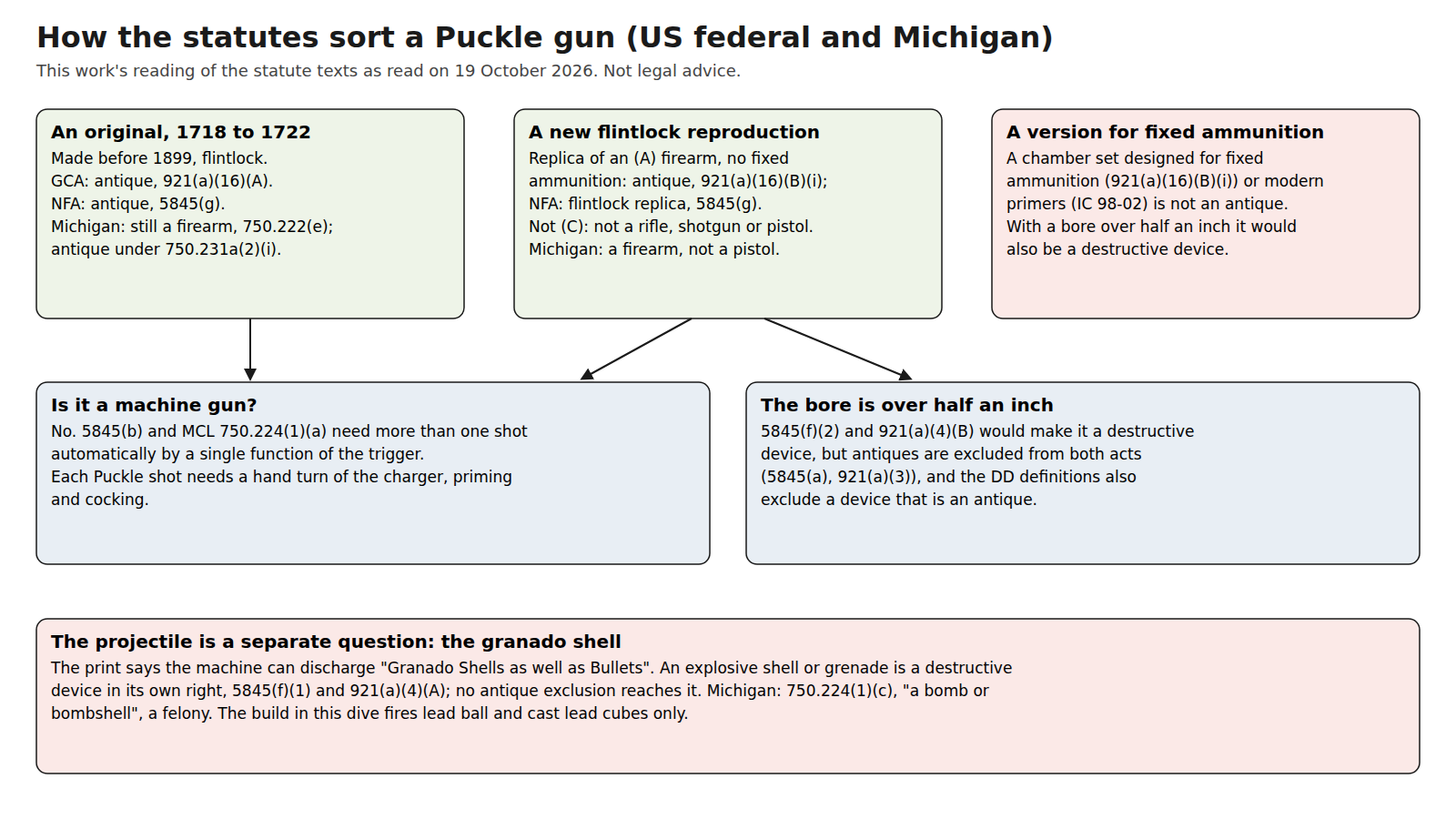
On this work’s reading: each shot of a Puckle gun requires the gunner to back the chamber set off its seat, turn it to the next chamber, screw it home, open and prime a pan, and cock the lock (Volume 4). One function of the trigger fires one chamber. Nothing in the gun fires a second shot automatically. Under both definitions it is not a machine gun, original or reproduction.
That is also why this dive has a build volume and the hub’s select-fire machine-gun dives do not.
8.4 An antique, original or replica
An original (any of the guns in Volume 3) was made around 1718 to 1722 and is a flintlock: an antique under § 921(a)(16)(A) by date, and under § 5845(g). It is not a “firearm” under either federal act.12
A new flintlock reproduction, on this work’s reading:
- It is not within § 921(a)(16)(C), because a Puckle gun is not a “muzzle loading rifle, muzzle loading shotgun, or muzzle loading pistol”: the GCA’s rifles and shotguns are weapons “intended to be fired from the shoulder”, and a tripod-mounted gun with no stock is neither, nor is it a pistol.
- It is within § 921(a)(16)(B)(i): a replica of a firearm described in (A), “not designed or redesigned for using rimfire or conventional centerfire fixed ammunition”. The Puckle print of 1718 describes a pre-1899 flintlock, and a faithful reproduction is a replica of it.
- It is an antique under § 5845(g), which names “flintlock … or replica thereof, whether actually manufactured before or after the year 1898”.
- IC 98-02 says such replicas “are also not subject to regulation as firearms”.3
The (C) exclusions (“incorporates a firearm frame or receiver”, “readily converted to fire fixed ammunition by replacing the barrel, bolt, breechblock”) are stated “for purposes of this subparagraph” and so do not, on their face, apply to a (B) replica. A builder should not lean on that distinction. A Puckle gun’s chamber sets are swapped by design; a set made for cartridges would be a conversion part, and the next section applies.
8.5 The half-inch bore
Every documented Puckle bore is over half an inch: 28 mm in St Petersburg; 2.5 to 4 cm in Beijing; the commonly repeated 1.25 in (Volume 3). A reduced-scale reproduction on a .62 to .75 in barrel (Volume 7) is still over half an inch.
On this work’s reading, that does not make an antique Puckle a destructive device under the NFA, for two independent reasons in the text:
- § 5845(a) excludes “an antique firearm” from the NFA’s “firearm” entirely, and a destructive device is regulated as one kind of “firearm” under § 5845(a)(8).
- § 5845(f) itself excludes “any other device which the Secretary finds … is an antique”.
The GCA works the same way: § 921(a)(3) says “firearm” “does not include an antique firearm”, and § 921(a)(4) excludes from “destructive device” a device the Attorney General “finds … is an antique”.1 The DD exclusions are framed as findings by the agency, which is one reason a builder of anything unusual and large-bored is well advised to ask ATF for a classification in writing (below).
8.6 Where the exemption stops
On the statute text and IC 98-02, a Puckle-pattern gun stops being an antique and becomes a GCA “firearm”, and with its bore an NFA destructive device, if:
- any chamber or chamber set is designed or redesigned for fixed ammunition, rimfire or centerfire;
- the ignition is converted to modern primers (IC 98-02);
- it is made from, or incorporates, a modern firearm frame or receiver.
None of these is part of any build in this dive.
8.7 The granado shell
The 1718 print promises that “the Machine can be made to Discharge Granado Shells as well as Bullets”. A grenade or explosive shell is a destructive device in its own right under § 5845(f)(1) and § 921(a)(4)(A), whatever fires it. No antique exemption reaches the projectile. Michigan’s MCL 750.224(1)(c) separately bans manufacturing, selling or possessing “a bomb or bombshell”, a felony punishable by up to five years.4 The hub’s Hand Mortars dive, Volume 15 treats the projectile question for big-bore muzzleloaders at length.
Lead round ball and cast lead cubes are inert projectiles, and they are the only projectiles in this dive.
8.8 Importing one: the 2014 experience
The only account found of a Puckle-pattern gun crossing borders in modern times is the American collector Joseph McClain’s description of importing the Belgian gun in 2014.5 His account, which is a first-person narrative and the only source for these events:
- The gun was moved from Belgium to England before export, because he feared Belgian export restrictions; English customs “saw ‘Machine Gun’ on the paperwork” and held it “until customs shippers were able to explain why it was not deactivated”.
- At a US Customs office in West Palm Beach, Customs and Homeland Security agents “had a major issue with the Puckle Gun because the paperwork indicated, ‘Machine Gun’”, and he writes that they wanted to arrest him until his import attorney and ATF’s Miami office intervened.
- He had obtained beforehand a determination letter from ATF’s Firearms Technology Industry Service Branch (FTISB), as he names it: “My gun was too old, had an obsolete ignition system and used obsolete ammunition”, his summary of it. The letter itself is not reproduced.
The practical lesson is about paperwork, not law: describe the item on every document as what it is, an antique flintlock gun, never as a “machine gun”; carry the classification letter with the gun. Whether McClain’s gun was eighteenth-century or modern is not established (Volume 3); ATF’s letter, as he summarises it, rested on age, ignition and ammunition.
8.9 Michigan: still a firearm
Michigan’s penal code defines “firearm” as “any weapon which will, is designed to, or may readily be converted to expel a projectile by action of an explosive” (MCL 750.222(e)), with no antique exclusion.6 A Puckle gun that can fire, original or reproduction, is a “firearm” in Michigan.
It is not a “pistol”. MCL 750.222(f) defines a pistol as a firearm “26 inches or less in length”, or one that “by its construction and appearance conceals itself as a firearm”.6 Every documented Puckle barrel alone is about 90 cm or more. The pistol licensing and sales-record regime (MCL 28.422) therefore does not apply in any case, antique or not.
8.10 Michigan: what antique status changes, and what it does not
Michigan’s own antique definition, MCL 750.231a(2), follows the NFA wording: “(i) A firearm not designed or redesigned for using rimfire or conventional center fire ignition with fixed ammunition and manufactured in or before 1898, including a matchlock, flintlock, percussion cap, or similar type of ignition system or replica of such a firearm, whether actually manufactured before or after 1898.”7 An original or a flintlock reproduction is an antique in Michigan.
But Michigan uses antique status only in a few places, chiefly to lift the pistol-licence requirement and in the pistol-transport exception of § 231a(1)(c); since a Puckle is not a pistol, those exceptions do nothing for it. On this work’s reading, the provisions that matter apply in full:
- Transport in a vehicle, MCL 750.227d: a person “shall not transport or possess in or upon a motor vehicle … a firearm, other than a pistol, unless the firearm is unloaded and is 1 or more of the following: (i) Taken down. (ii) Enclosed in a case. (iii) Carried in the trunk of the vehicle. (iv) Inaccessible from the interior of the vehicle.” A misdemeanour.8 For a Puckle, “unloaded” should be read conservatively: no charged chamber set on the gun or in the vehicle. A taken-down Puckle (chamber sets off, gun off the tripod) satisfies (i).
- Felon in possession, MCL 750.224f: no antique exclusion was found in the text, so a person barred by that section is barred from possessing a working Puckle reproduction, even though federal law (§ 922(g)) does not reach an antique.9
- Machine gun and bomb bans, MCL 750.224: the gun is not a machine gun (above); explosive shells are bombshells.
Michigan’s storage and transport rules for black powder itself were not researched for this dive.
8.11 Black powder
ATF’s position on black powder for antique firearms (commercially manufactured black powder in quantities up to 50 pounds, intended solely for sporting, recreational or cultural purposes in antique firearms, is exempt from the federal explosives regulations) is set out in the Hand Mortars dive, Volume 15 and not repeated here.
Black powder or an approved substitute only. Never smokeless, in any quantity. The reasons are given in the hub’s muzzleloader dives; the reproduction maker’s rule quoted in the LeMat dive, Volume 5 (“NEVER LOAD YOUR GUN WITH ANY TYPE OF SMOKELESS POWDER”) applies with more force to a gun whose chambers are clamped to its barrel by a screw.
8.12 Safety rules particular to the Puckle
The general rules for loading, firing and clearing a muzzleloader are in the Traditions blunderbuss dive, Volume 10. The Puckle adds its own:
- A chamber set is a loaded gun pointing out of its front face. Off the gun, on the bench, in a box, a charged set is nine loaded chambers. Keep its front toward a safe direction and its pan covers closed.
- Load sets at a loading table away from the firing point, one chamber at a time, powder from a measure, never from the flask or can into a chamber.
- No open pan except the one about to fire. Chain fire across neighbouring chambers is this layout’s built-in hazard (Volume 6).
- Never stand in front of the chamber set’s face, or beside the joint. Gas and fouling escape at the chamber-to-barrel joint on every shot.
- Screw every chamber fully home before firing. A chamber that is not seated vents most of its gas at the joint.
- Misfire: wait, keep the gun on target, then clear. The Traditions dive’s rule is “at least 60 seconds (many shooters wait two minutes)”. On a Puckle the reason is sharper: do not back the set off a chamber that has misfired, because a hang-fire with the nose clear of the seat fires out of the joint.
- No pre-loaded sets left overnight. Unload and clean the same day.
- Projectiles must pass the bore freely, cubes across their corners as well as balls (Volume 7). A stuck projectile is an obstruction.
- Fire new or repaired guns remotely, as in Volume 7.
- Inert projectiles only.
8.13 Summary
Table 1 — Summary
| Question | Original | Flintlock reproduction | Version for fixed ammunition |
|---|---|---|---|
| Federal GCA “firearm”? | No, antique (A) | No, antique replica (B)(i) | Yes |
| NFA machinegun? | No | No | No |
| NFA destructive device (bore over ½ in)? | No, antique excluded | No, antique excluded | Yes, on the text |
| Michigan “firearm”? | Yes | Yes | Yes |
| Michigan “pistol”? | No (over 26 in) | No | No |
| Michigan antique (231a)? | Yes | Yes | No |
| Michigan vehicle transport | 227d applies | 227d applies | 227d applies |
| Explosive projectiles | Destructive devices / bombshells in all cases |
8.14 What could not be verified
- ATF’s own published position on large-bore muzzle-loading replicas. ATF’s website refuses automated access, and no archived copy of its definitions pages exists; only the 1998 circular was read.
- McClain’s ATF letter: summarised by him, not reproduced.
- The meaning of “unloaded” for a detachable pre-loaded chamber set under MCL 750.227d: the conservative reading is given.
- Michigan black-powder storage rules.
References
Footnotes
-
18 U.S.C. § 921(a)(3), (a)(4) and (a)(16), Legal Information Institute, Cornell Law School, https://www.law.cornell.edu/uscode/text/18/921, read 19 October 2026. ↩ ↩2 ↩3 ↩4
-
26 U.S.C. § 5845(a), (b), (f) and (g), Legal Information Institute, https://www.law.cornell.edu/uscode/text/26/5845, read 19 October 2026. ↩ ↩2 ↩3 ↩4
-
Bureau of Alcohol, Tobacco and Firearms, Industry Circular 98-02, “Classification of muzzle loading weapons that use modern primers for ignition” (1998), TTB archive, https://www.ttb.gov/public-information/industry-circulars/archives/1998/98-02, read 19 October 2026. ↩ ↩2
-
Michigan Compiled Laws § 750.224, Michigan Legislature, https://www.legislature.mi.gov/Laws/MCL?objectName=mcl-750-224, read 19 October 2026 (“complete through PA 91 of 2026”). ↩ ↩2
-
Joseph McClain, “The First Patent Machine Gun – The Puckle Gun”, American Society of Arms Collectors Bulletin 126, pp. 64–67, https://americansocietyofarmscollectors.org/wp-content/uploads/2023/10/McCLAIN-the-first-patent-machnie-gun-the-Puckle-gun-v126.pdf, accessed 19 October 2026. ↩
-
MCL § 750.222, https://www.legislature.mi.gov/Laws/MCL?objectName=mcl-750-222, read 19 October 2026. ↩ ↩2
-
MCL § 750.231a, https://www.legislature.mi.gov/Laws/MCL?objectName=mcl-750-231a, read 19 October 2026. ↩
-
MCL § 750.227d, https://www.legislature.mi.gov/Laws/MCL?objectName=mcl-750-227d, read 19 October 2026. ↩
-
MCL § 750.224f, https://www.legislature.mi.gov/Laws/MCL?objectName=mcl-750-224f, read 19 October 2026. ↩
Comments (0)