Puckle Gun · Volume 1
A Notary's Defence: James Puckle and Patent No. 418
Who Puckle was, what his 1718 patent actually says, why the Patent Office later dated it 1717, and which famous quotations are not in it
1.1 What this dive covers
The Puckle gun is a single-barrelled flintlock gun on a folding tripod, fed from a detachable revolving block of chambers that is turned by hand. James Puckle, a London notary, patented it in 1718 under the name “A Defence”, and advertised it as a gun that could stop a ship being boarded. It is one of the most quoted weapons in the history of the machine gun, chiefly for one detail: separate chamber sets for round bullets “against Christians” and square bullets “against Turks”.
Most of what is repeated about it comes from a handful of modern summaries that copy one another. This dive goes back to the documents: the enrolled specification, the Patent Office’s printed copy and abridgment, a 1720 satirical playing card, the 1725 account of the expedition that took two of the guns to the West Indies, a 2012 survey of the Duke of Buccleuch’s armoury, and the published records of museum guns in St Petersburg and Beijing.
The Puckle gun is a manually operated antique flintlock. It is not a machine gun in law (Volume 8), so unlike the hub’s select-fire machine-gun dives this one carries a build volume.
- Vol 1 (this volume): James Puckle, the patent, and what the specification actually says.
- Vol 2: the company and its broadside, the 1720 bubble satire, the 1722 trial in the rain, and the two guns shipped to St Lucia.
- Vol 3: the surviving guns and how to tell them apart, with a photo plate.
- Vol 4: how it works: charger, screw, lock, crane and tripod.
- Vol 5: where it sits in the history of the revolver and the machine gun, and the myths.
- Vol 6: handling, care and repair of originals and of working reproductions.
- Vol 7: building a working reproduction, from parts and from scratch.
- Vol 8: the law (federal and Michigan) and black-powder safety.
1.2 The gun in one table
Table 1 — The gun in one table
| Figure | Source | |
|---|---|---|
| Patent | No. 418, Letters Patent dated 15 May, 4 George I (1718) | Specification, Chinn p. 181; Patent Office printed sheet2 |
| Specification enrolled | Declaration dated 25 July 1718 | Specification1 |
| Materials | ”Steel Iron & Brass”; tripod “Wood & Iron” | Specification1 |
| Chamber sets in the print | 9 chambers (gun for a boat), 6 round and 7 square (gun for a ship) | Print, counted from the image1 |
| Surviving chamber set, Boughton | 9 chambers, square bores | Photograph in Wilcock 20123 |
| Barrel, St Petersburg gun | Bronze, 100 cm, calibre ½ pound (28 mm), 9 chambers, 52.9 kg | Museum catalogue via Yefimov 20194 |
| Barrel, Beijing gun | 92 cm; bore 4 cm; 11 chambers, each 2.5 cm bore | Palace Museum, Wang Zilin5 |
| Rate of fire claimed | 63 shots in 7 minutes, in rain | London Journal, 31 March 1722, as cited by Yefimov4 |
| Known sale | ”2 Machine Guns of Puckles” shipped for St Lucia, 1722 | Uring 17256 |
The two museum guns disagree with each other and with the widely repeated “1.25-inch bore, 3-foot barrel”. Volume 3 sets every published figure side by side.
1.3 James Puckle, notary and pamphleteer
The fullest early life is the Dictionary of National Biography entry of 1896, signed by Sidney Lee.7 It gives Puckle’s birth as “about 1667”; his father, also James Puckle (1633–1690), was a son of Samuel Puckle, mayor of Norwich in 1656. The younger James took out letters of administration on his father’s estate on 16 June 1690, “who had died a widower beyond sea.”
He was a notary public, in partnership with one Jenkins in Pope’s Head Alley, Cornhill. Lee records that he worked professionally for a company promoting the English fishing industry, “The Royal Fishery of England”, and wrote its publicity: England’s Interest, or a Brief Discourse of the Royal Fishery (1696), reworked as A New Dialogue between a Burgermaster and an English Gentleman (1697), then England’s Way to Wealth and Honour and England’s Path to Wealth (1700, second edition 1718). Several of these survive in early printed-book collections; the Internet Archive holds scans of the 1696 and 1700 editions.
His lasting literary work was The Club, or a Dialogue between Father and Son (1711), a set of character sketches of twenty-five types met at a club at “The Noah’s Ark”, with the father moralising after each. It ran through several editions; the 1713 editions carried his portrait, engraved by George Vertue after a painting by John Closterman.
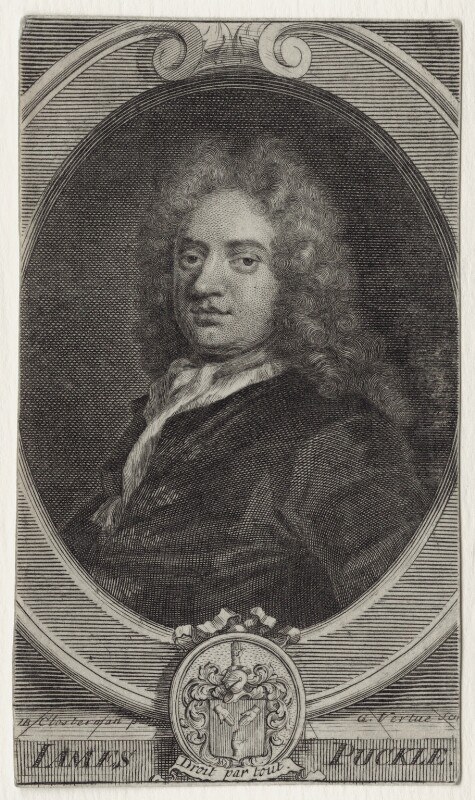
Lee lists him in the parishes of St Margaret, Lothbury, and later St Stephen, Coleman Street; he married twice, the second time on 21 February 1714/15 at New Brentford, to Elizabeth Fownes, a widow; and he was buried at St Stephen’s, Coleman Street, on 26 July 1724.7
Two things in this biography matter for the gun. Puckle was a lawyer who drafted documents for a living, so the patent’s careful legal form is no surprise. And he was a promoter: he had written the selling copy for one joint-stock scheme before he floated his own (Volume 2). Nothing in the record makes him a gunmaker. Who actually built the guns is not known; no maker’s name has been found on any surviving example in the sources read for this dive.
1.4 The patent of 15 May 1718
English patents of this period were royal grants, Letters Patent, giving a monopoly for a term of years. The UK Intellectual Property Office’s own history says that in the reign of Queen Anne the law officers of the Crown made it a condition of grant that “the patentee must by an instrument in writing describe and ascertain the nature of the invention and the manner in which it is to be performed”, and names Puckle’s 1718 patent as “one of the 1st to be required to provide a ‘specification’”.8 Puckle’s own declaration recites the condition.
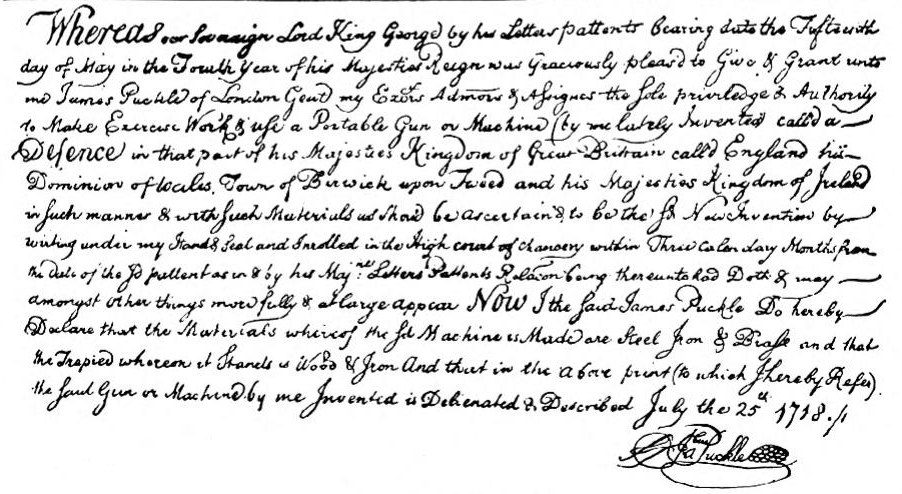
His declaration gives the grant in its own words: Letters Patent “bearing date the Fifteenth day of May in the Fourth Year of his Majesties Reign”, granting “unto me James Puckle of London Gent my Exors Admors & Assignes the sole priviledge & Authority to Make Exercise Work & use a Portable Gun or Machine (by me lately Invented) called a Defence”, in England, Wales, the town of Berwick upon Tweed and Ireland.1 The Patent Office later numbered it No. 418 in its chronological series.9
The grant was conditional: the invention had to be “ascertain’d … by writing under my Hand & Seal and Inrolled in the High court of Chancery within Three Calendar Months from the date of the s’d pattent.” The declaration is dated 25 July 1718, ten weeks after the grant, inside the three months.
1.5 The specification: a print and 150 words
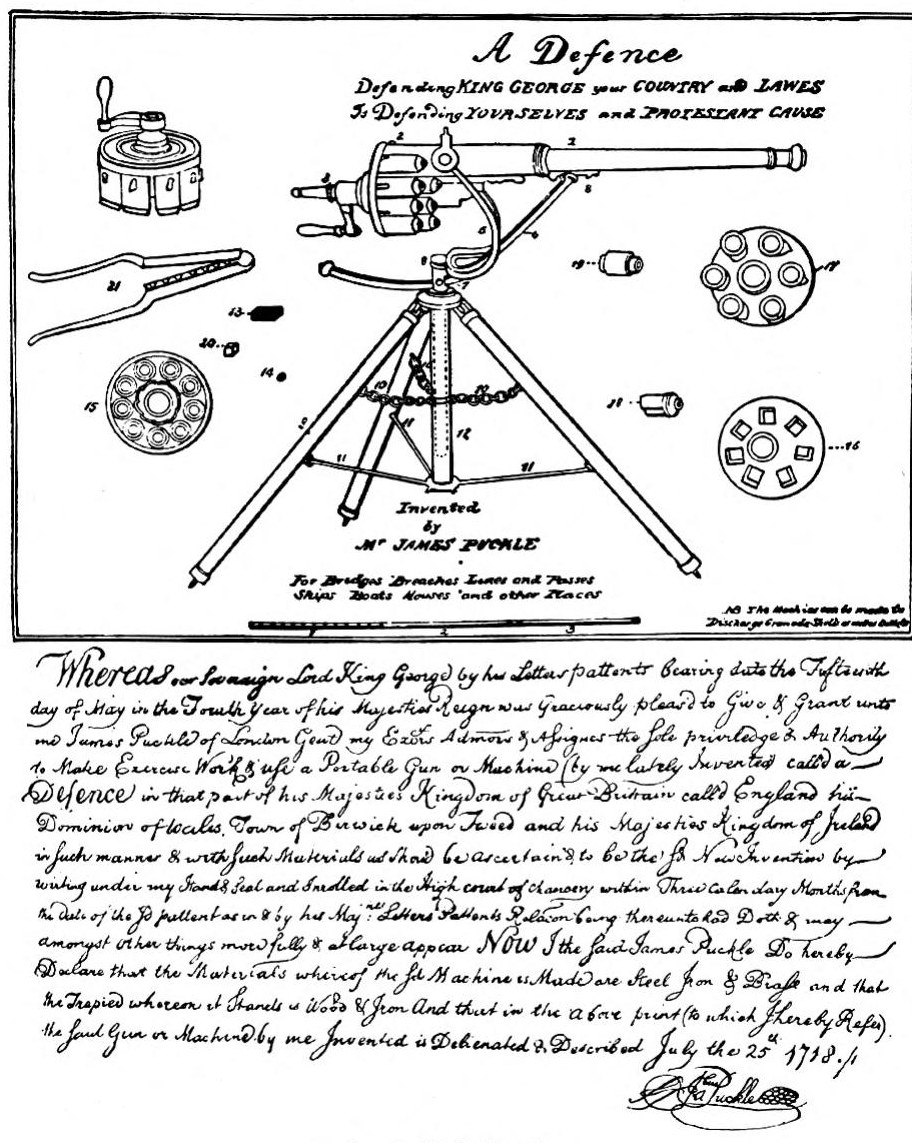
The specification survives because George Chinn reproduced it, print and manuscript together, in the US Navy’s official history The Machine Gun (1951).1 It is far shorter than its reputation. After reciting the grant, the operative part reads, in full:
“NOW I the said James Puckle Do hereby Declare that the Materials whereof the s’d Machine is Made are Steel Iron & Brass and that the Tripod whereon it Stands is Wood & Iron And that in the above print (to which I hereby Refer) the said Gun or Machine by me Invented is Delineated & Described July the 25th 1718.”
That is all the prose there is. The specification makes three claims: the gun is of steel, iron and brass; the tripod is of wood and iron; and the print shows the invention. Everything else, including the round and square bullets, is on the engraving.
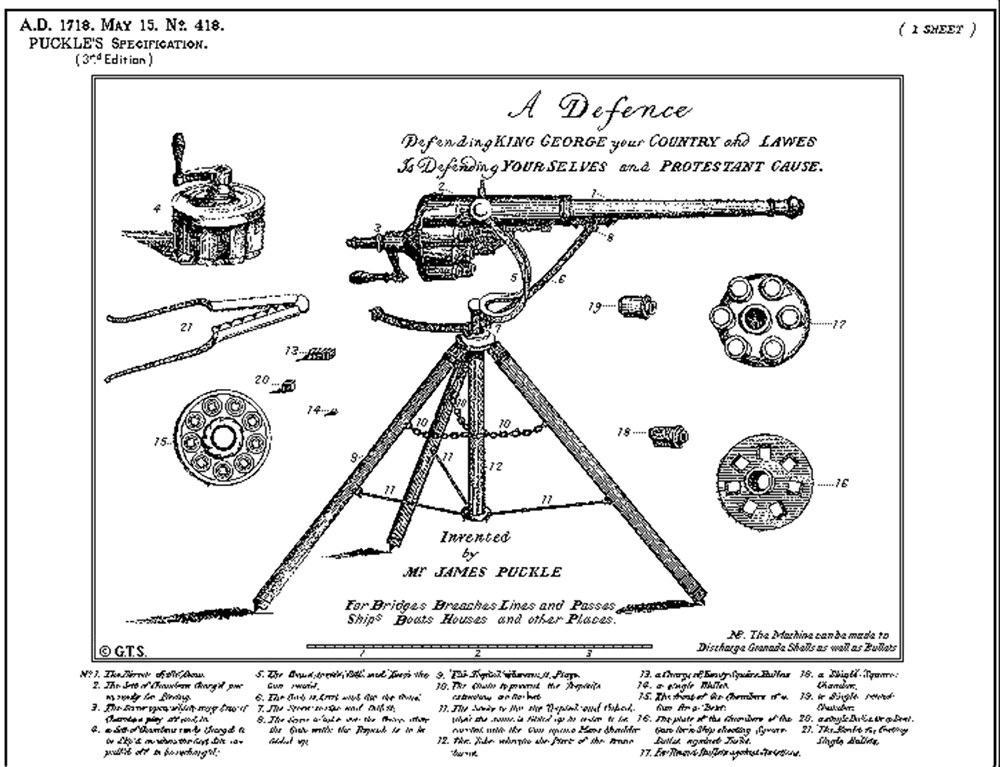
The same engraving was also issued as a broadside to advertise the gun and the company (Volume 2). The Patent Office reprinted the specification in the nineteenth century as a single sheet headed “A.D. 1718. MAY 15. No 418. PUCKLE’S SPECIFICATION (3rd Edition)”, with the print and its numbered key. A copy reproduced in the American magazine Recreation in 1896 is on Wikimedia Commons, catalogued there as a “flier”.2 It is not a flier. Its own heading identifies it as the Patent Office’s printed specification.
1.6 The print and its key
The engraving is headed “A Defence” and carries the couplet
“Defending KING GEORGE your COUNTRY and LAWES Is Defending YOURSELVES and PROTESTANT CAUSE”
with “Invented by Mr JAMES PUCKLE” and “For Bridges Breaches Lines and Passes, Ships Boats Houses and other Places” below the gun. A note at the lower right reads “N.B. The Machine can be made to Discharge Granado Shells as well as Bullets”. A scale bar marked 1, 2, 3 runs along the bottom; the unit is not stated.
The key on the Patent Office sheet is printed small, and the only copy found online is a 1,000-pixel image. The entries below are those that can be read with confidence; the rest are given in Volume 4 with the uncertain words marked.
Table 2 — The print and its key
| No. | Key (as legible) |
|---|---|
| 1 | The Barrell of the Defence |
| 2 | The Sett of Chambers charg’d put on ready for firing |
| 4 | A Sett of Chambers ready charg’d to be screw’d on when the first Sett are pulled off to be recharg’d |
| 9 | The Tripod whereon it plays |
| 14 | A single Bullet |
| 15 | The front of the Chambers of a Gun for a Boat |
| 16 | The plate of the Chambers of the Gun for a Ship shooting Square Bullets against Turks |
| 17 | (the same) for Round Bullets against Christians |
| 18 | A Single Square Chamber |
| 19 | A Single Round Chamber |
| 21 | The Mould for Casting Single Bullets |

Two details in the drawing matter for how the gun worked (Volume 4). The single chambers, items 18 and 19, have a stepped nose: a short, narrower spigot at the front. And the spare set, item 4, shows a small rectangular cover on the rear of each chamber: a pan cover for each chamber’s own priming.
1.7 Round bullets, square bullets
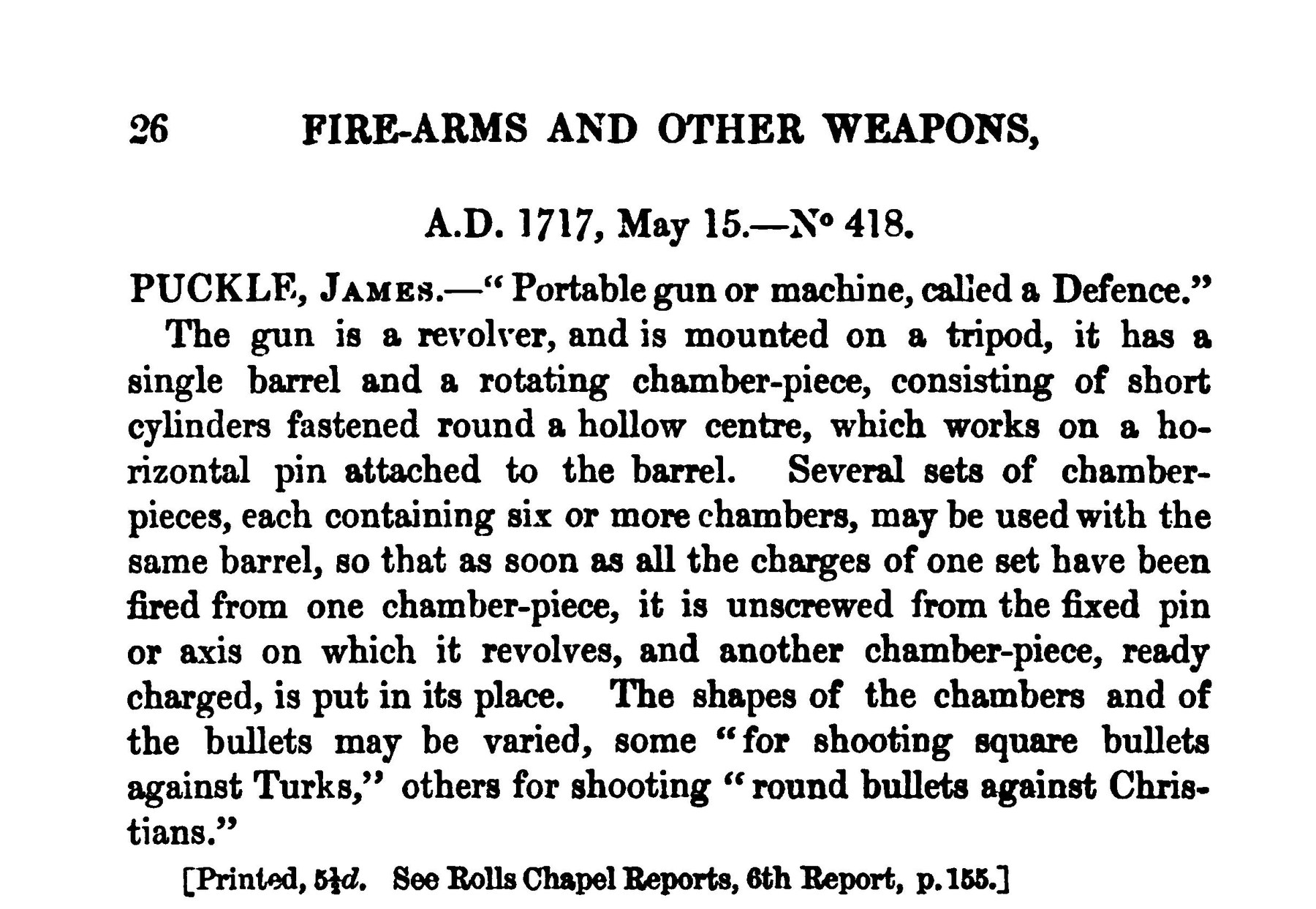
The famous line is real, but it is a caption, not a doctrine. On the print, item 16 is a chamber plate for a ship’s gun “shooting Square Bullets against Turks” and item 17 one “for Round Bullets against Christians”. The 1859 Patent Office abridgment, written from the enrolled specification, summarises it the same way: the shapes of chambers and bullets “may be varied, some ‘for shooting square bullets against Turks,’ others for shooting ‘round bullets against Christians.’”9
What the print shows is square chambers, not a square barrel. Item 13, drawn as a small dark block, is a charge of square bullets (the number in its key line is not legible in the available copy; Yefimov reads the grenade-like charges as twenty cubes4). The barrel (1) is drawn round. Volume 3 shows that a square-chambered set really was made: one survives at Boughton House.
Why square? The print gives no reason. Modern summaries say square bullets would wound more cruelly. That is a plausible reading of the period’s intent, but it is commentary, not something the specification says. The Christian and Turk captions sit beside the Protestant couplet at the top of the print; the whole engraving is patriotic advertising as much as engineering. Chinn’s judgment in 1951 was that Puckle “seems to have been more interested in using the King’s patent office as an expedient to advertise his patriotism and church affiliations.”1
The context for “Turks” is the sea. The print offers the gun for “Ships Boats”; Ian McCollum of Forgotten Weapons describes the intended enemy as “Ottoman pirates using fast and nimble small boats that could not be effectively engaged with large cannon.”10 The DNB quotes Puckle’s broadside describing a gun that “renders it next to impossible to carry any ship by boarding.”7
1.8 or 1718? The Patent Office’s own error
Some modern accounts date the invention, or a first demonstration, to 1717. One source of the confusion is the Patent Office itself. Its 1859 volume of abridgments for firearms heads the entry:
“A.D. 1717, May 15.— No 418. PUCKLE, James.— ‘Portable gun or machine, called a Defence.’”9
The page image confirms that the printed text says 1717; it is not a scanning error. Yet the Patent Office’s own printed specification sheet is headed “A.D. 1718. MAY 15. No 418.”2, and Puckle’s declaration gives the date as 15 May “in the Fourth Year of his Majesties Reign” and signs it 25 July 1718.1
The arithmetic settles it. George I’s reign began on 1 August 1714. His fourth regnal year therefore ran from 1 August 1717 to 31 July 1718, and its 15 May fell in 1718. A clerk converting “4 Geo. I” to a calendar year and taking the year the regnal year began would write 1717. This work’s reading is that the abridgment is wrong and 1718 is right; the abridgment’s date is shown here so that readers who meet “1717” can see where it can come from.
Yefimov’s 2019 article gives the patent as 17 May 1718; every other source read for this dive, including the declaration, gives 15 May.4
1.9 What the patent does not say
Several statements commonly attributed to “the patent” are not in it.
Table 3 — What the patent does not say
| Commonly said | What the documents show |
|---|---|
| The patent says square bullets would “convince the Turks of the benefits of Christian civilization” | No such words in the declaration or the key. The key says only “against Turks” and “against Christians”. |
| The patent describes the mechanism in detail | It describes nothing in words except materials. The print is the description. |
| The tripod was not patented | The tripod is drawn and numbered (9 to 12) on the print the declaration refers to, and its materials are declared. |
| Puckle patented a “machine gun” | He patented “a Portable Gun or Machine … called a Defence”. The word machine is his; machine gun appears in 1722 in a shipping list (Volume 2). |
| Patented in 1717 | Granted 15 May 1718; the 1717 date is the 1859 abridgment’s slip (above). |
The claim that the tripod was not patented appears in an American Society of Arms Collectors Bulletin article (posted online in 2023), which argues from it that Puckle was not the true inventor.11 The print contradicts the premise.
1.10 What could not be verified
- Who made the guns. No maker is named in the specification, the abridgment, Uring’s list or Wilcock’s survey.
- The full key. Items 3, 5 to 8 and 10 to 13 and 20 are only partly legible in the one available copy of the printed sheet. A better copy of the Patent Office sheet, or the enrolment itself (The National Archives, Chancery enrolments), would settle them.
- A 1717 demonstration. No contemporary record of a trial in 1717 was found (Volume 2).
References
Footnotes
-
George M. Chinn, The Machine Gun: History, Evolution, and Development of Manual, Automatic, and Airborne Repeating Weapons, vol. I (Washington: Bureau of Ordnance, Department of the Navy, 1951), pp. 17–19; the specification is reproduced on p. 18 as “James Puckle’s Revolving Gun”. Internet Archive, https://archive.org/details/TheMachineGunVolume1ByGeorgeMChinn, page image read 19 October 2026. Transcription of the manuscript in this volume is from that image. ↩ ↩2 ↩3 ↩4 ↩5 ↩6 ↩7 ↩8
-
Patent Office, “A.D. 1718. May 15. No 418. Puckle’s Specification (3rd Edition)”, one sheet, as reproduced in Recreation (ed. G. O. Shields), vol. 4 (1896); Wikimedia Commons, https://commons.wikimedia.org/wiki/File:Puckle_gun_advertisement.jpg, accessed 19 October 2026. ↩ ↩2 ↩3
-
Paul Wilcock, “The Armoury of His Grace the Duke of Buccleuch and Queensberry”, Arms & Armour 9, no. 2 (2012), pp. 181–205; author’s version, University of Huddersfield repository, http://eprints.hud.ac.uk/17394/1/BUCCLEUCH_PROJECT_Royal_Armouries_version_2_5_FinalProofEDIT.pdf, accessed 19 October 2026. ↩
-
S. V. Yefimov (С. В. Ефимов), “Скорострельные артиллерийские орудия первой половины XVIII века в собрании Военно-исторического музея артиллерии, инженерных войск и войск связи”, Voenno-istoricheskii zhurnal, 2019, no. 2; CyberLeninka, https://cyberleninka.ru/article/n/skorostrelnye-artilleriyskie-orudiya-pervoy-poloviny-xviii-veka-v-sobranii-voenno-istoricheskogo-muzeya-artillerii-inzhenernyh, accessed 19 October 2026. ↩ ↩2 ↩3 ↩4
-
Wang Zilin (王子林), 《从前膛炮、子母炮到轮子炮》 (“From muzzle-loading cannon and composite guns to the wheel gun”), Palace Museum, Beijing, https://www.dpm.org.cn/defenses/talk/204537.html (article PDF https://img.dpm.org.cn/Uploads/pdf/2237/T00016_00.pdf), accessed 19 October 2026. ↩
-
Nathaniel Uring, A Relation of the Late Intended Settlement of the Islands of St. Lucia and St. Vincent, in America; in Right of the Duke of Montagu (London: J. Peele, 1725), folding table “An Account of Cannon, Small Arms, and other Stores”. Internet Archive, https://archive.org/details/bim_eighteenth-century_a-relation-of-the-late-i_uring-nathaniel_1725, page image read 19 October 2026. ↩
-
Sidney Lee, “Puckle, James (1667?–1724)”, Dictionary of National Biography, vol. 47 (London, 1896). Internet Archive, https://archive.org/details/dictionaryofnati47stepuoft, accessed 19 October 2026. ↩ ↩2 ↩3
-
UK Intellectual Property Office, “The 18th century” (patent history page), archived 22 April 2014, https://web.archive.org/web/20140422075818/http://www.ipo.gov.uk/types/patent/p-about/p-whatis/p-history/p-history-18century.htm, accessed 19 October 2026. ↩
-
Commissioners of Patents, Patents for Inventions. Abridgments of Specifications relating to Fire-arms and other Weapons, Ammunition, and Accoutrements (London: Great Seal Patent Office, 1859), p. 26. Internet Archive, https://archive.org/details/patentsforinven04offigoog, page image read 19 October 2026. ↩ ↩2 ↩3
-
Ian McCollum, “Puckle Gun (Video)”, Forgotten Weapons, 25 December 2016, https://www.forgottenweapons.com/puckle-gun-video/, accessed 19 October 2026. ↩
-
Joseph McClain, “The First Patent Machine Gun – The Puckle Gun”, American Society of Arms Collectors Bulletin 126, pp. 64–67, https://americansocietyofarmscollectors.org/wp-content/uploads/2023/10/McCLAIN-the-first-patent-machnie-gun-the-Puckle-gun-v126.pdf, accessed 19 October 2026. ↩

Comments (0)