Moving Ejection Port · Volume 3
Concept A: the Kick Moves the Port
One solenoid for both jobs: the kick mass shaped as the carrier and seen through the port, a lever from the kick to a lighter shuttle, or a shuttle thrown on lost motion; what each costs the kick, how the stops differ front and back, and how a single-coil gun holds open on the last round
3.1 One actuator, two jobs
Decision D5’s first option is one solenoid that gives the kick and moves the port. Its attraction is plain: one coil, one driver stage, one temperature to watch, nothing to sequence under D16, and a port that moves exactly when the gun kicks, as a real carrier does. Its risk is that the two jobs want different things. The kick wants a mass and a stroke chosen for impulse (Solenoid Recoil Vol 8); the port wants something light and quick that is quiet when it stops. Concept A comes in three forms, depending on how the port part is connected to the kick.
3.2 A1: the kick mass is the carrier
The simplest form makes no connection at all: the kick mass is the part seen in the port.
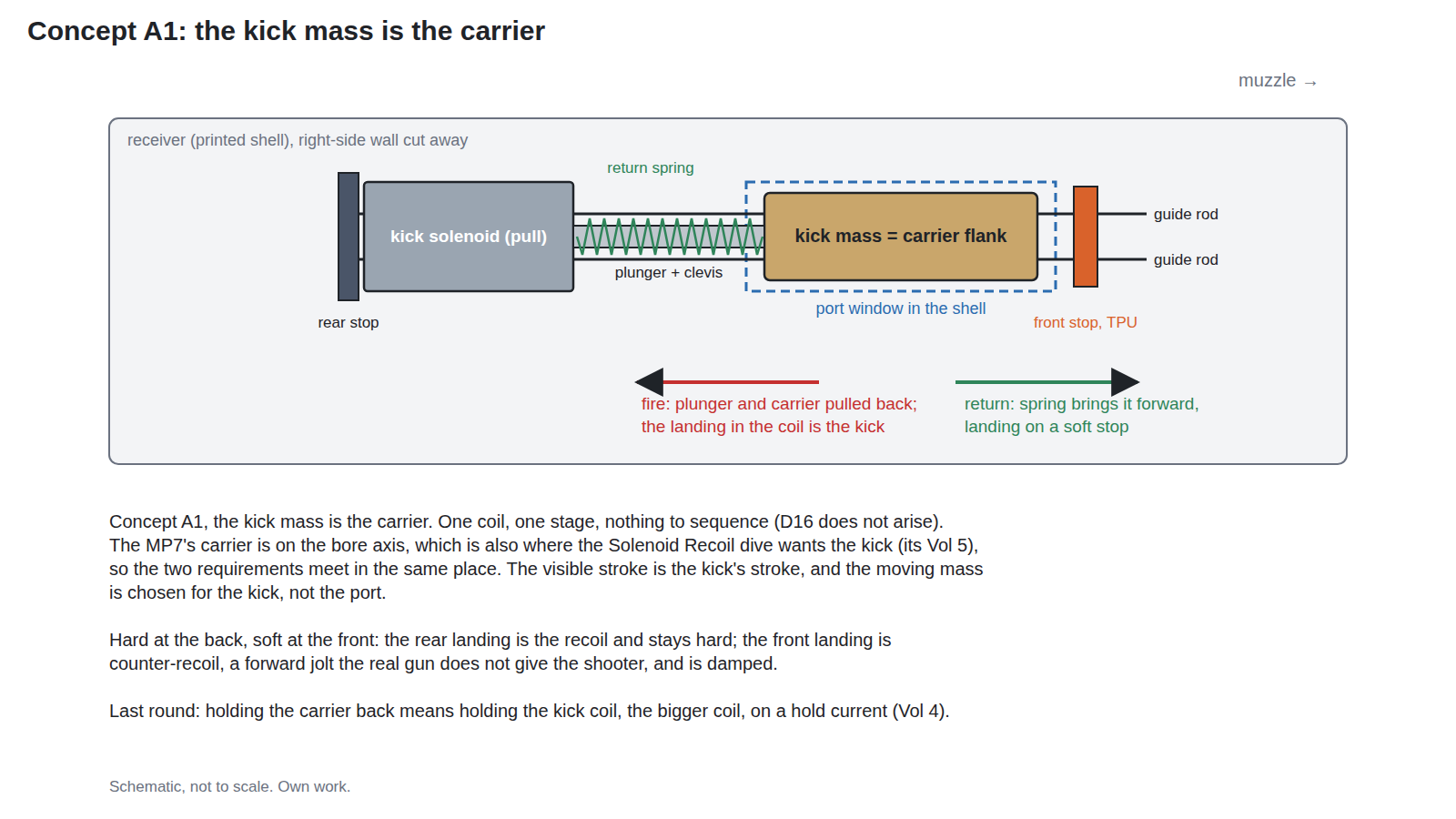
It suits the MP7 unusually well. The real carrier rides on the bore axis, and the bore axis is where the Solenoid Recoil dive’s Volume 5 wants a kick to act: “On the bore axis, or as close as the shell allows”, because a kick above or below the line of the shooter’s hand and shoulder rotates the gun. The port is on the right side of the receiver at bore height. A kick mass on the bore axis, shaped on its right flank like the carrier and running behind the port, satisfies both dives at once. The same Volume 5 already anticipates it: an MP7-pattern gun has no slide on top, “but the moving ejection port the project plans can be driven by, or synchronised with, the recoil mechanism.”
What A1 inherits from the kick:
- The stroke is the kick’s. The bench shortlist’s parts have strokes of 5.5 to 10 mm, and the kick is ranked by impulse with the pulse ended at landing (Solenoid Recoil Vol 8). The port moves as far as the kick does: 10 mm with the 10 mm parts, which is Volume 2’s baseline anyway.
- The mass is the kick’s. For a carbine the Solenoid Recoil dive starts from “a striker of a few tens of grams” (Vol 7). The flank seen in the port becomes part of that mass. A printed flank alone is too light and too weak to be slammed into a stop thousands of times, so in A1 it is a printed shell over a steel slug: the slug carries the mass and takes the plunger’s pin, the printed skin carries the look. Its mass is tuned with the slug, not the skin.
- The timing is the kick’s. The port is back when the plunger lands, 6 to 10 ms after the pulse begins on the Solenoid Recoil model at 24 V, and returns on the spring. A heavier mass returns more slowly for the same spring, which Volume 5 sizes.
What A1 asks of the shell: the guide rods carry the kick’s loads, not only a port part’s, and the rear stop is the kick’s landing, through the solenoid’s frame into the receiver. The MP7 Printed Build dive designs the bay; the guide and stops in Volume 6 here are sized for this case as well as concept B’s.
3.3 Hard at the back, soft at the front
A part that is stopped twice per shot is a part that makes two noises and gives two jolts. In concept A they are not equal.
The rear landing is the kick. The impulse of the mass arriving at the rear is what the shooter feels as recoil (Solenoid Recoil Vol 6 measures it). Damping it softens the kick, so it stays hard, or nearly so: a thin, stiff pad only to keep metal off metal, if the bench finds the clack objectionable.
The front landing is counter-recoil. When the return spring brings the mass forward it arrives with whatever energy the spring gave it, and stops against the front of the guide: a forward jolt. A real MP7 has one too, when the bolt slams home, but the shooter feels it as part of the cycle at 950 rounds a minute; in a light gun at single shots it reads as a second, separate tap. That stop is damped (Volume 5), and the spring is chosen so the mass arrives no faster than it needs to.
The arcade got there first: Taito’s Space Gun parts list names a cushion rubber on the plunger and a stopper rubber on the slide (Arcade Light Guns Vol 5).
3.4 A2: a lever to a lighter shuttle
If the kick mass cannot sit behind the port, because the kick solenoid has to go further back or lower, or a longer visible stroke is wanted, a lever can carry the motion to a separate, light shuttle behind the port.
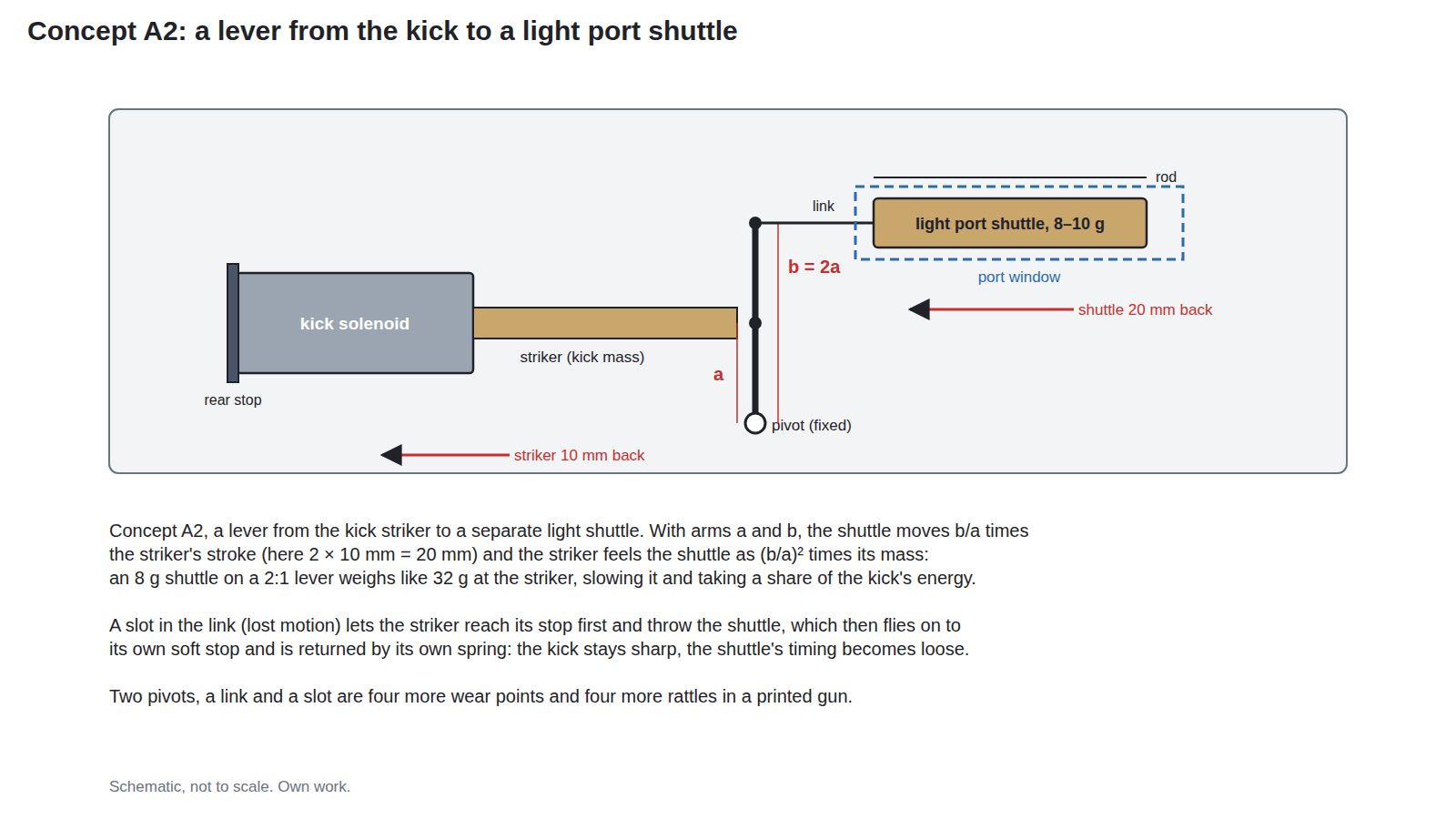
The lever is a ratio, and it charges for it. With the striker joined at a and the shuttle at b, the shuttle moves b/a times as far and as fast, and the striker feels the shuttle’s mass multiplied by (b/a)². A rigid link shares kinetic energy in proportion to these effective masses. Taking a 30 g striker, within the Solenoid Recoil dive’s “few tens of grams”:
Table 1 — The lever is a ratio, and it charges for it. With the striker joined at a and the shuttle at b, the shuttle moves b/a times as far and as fast, and the striker feels the shuttle's mass multiplied by (b/a)². A rigid link shares kinetic energy in proportion to these effective masses. Taking a 30 g striker, within the Solenoid Recoil dive's "few tens of grams"
| Shuttle | Lever b/a | Shuttle stroke | Shuttle’s effective mass at the striker | Share of the moving energy in the shuttle |
|---|---|---|---|---|
| 8 g | 1 (direct link) | 10 mm | 8 g | 21 % |
| 8 g | 1.5 | 15 mm | 18 g | 38 % |
| 8 g | 2 | 20 mm | 32 g | 52 % |
The Solenoid Recoil model puts the landing energy of an 8 Ω open-frame part at 13 mJ at 12 V and 49 mJ at 24 V (Vol 8). A 2:1 lever puts about half of whatever the coil delivers into the shuttle, and half of the kick then depends on how the shuttle is stopped. If it lands on a stop on the frame at the same instant as the striker, its momentum reaches the shooter too and the kick becomes heavier and slower rather than weaker; if it lands on a soft stop, that energy is spent quietly and the kick is weaker. Neither is obviously better, and both are slower than the striker alone, because the coil now accelerates more effective mass. This is exactly the trade the MP7 Donor Build dive’s Volume 2 raises for the gas donor’s factory carrier: at a fixed energy, momentum grows only as the square root of the moving mass.
A2 also adds two pivots and a link. In a printed gun each is a bearing that wears, a clearance that rattles and a place to fail (Volume 5).
3.5 A3: a shuttle thrown on lost motion
A slot in A2’s link changes the coupling from rigid to a throw. The striker moves freely for most of its stroke and picks up the shuttle only at the end, or the shuttle rests against the striker and is pushed only while the striker accelerates, then flies on to its own soft stop and comes back on its own spring. The kick keeps nearly all of its energy, because the shuttle is coupled only briefly.
What it costs is control. The shuttle’s travel depends on how hard it was thrown, which varies with the coil’s temperature and the rail (Solenoid Recoil Vol 3 on unit-to-unit spread), so it may not reach the end of its travel on a weak shot, or may hit its stop hard on a strong one. And a thrown part makes a third noise, the moment of pick-up. A3 is worth one bench trial for its feel, not a place in the design.
3.6 Holding open with one coil
The real gun holds the carrier back after the last round (Volume 1). With one coil, there are three ways to do the same.
Hold the kick coil. After the last shot the fork keeps the kick stage on at a reduced current by pulse-width modulating its input. The kick stage is the regulated DRV8251A of Reference Electronics Vol 5 §5.12, whose inputs accept PWM from 0 to 200 kHz by TI’s datasheet (Volume 4 gives the detail). A seated plunger needs far less current to hold than to pull in (Solenoid Recoil Vol 4). The cost is that the coil being held is the bigger one and is already the hottest part of the gun after a burst. The fork’s state machine (Volume 2) and a hold-time limit make it safe.
Latch it mechanically, by hand. The real MP7 can be locked open without a magazine by holding the charging handle back and pushing the bolt catch lever up (HK MP7 Vol 5). A printed catch that the player engages, and releases with the bolt catch lever, reproduces that gesture with no current at all. It cannot engage itself on the last round, because nothing in a light gun knows the magazine is empty except the firmware.
Do without. Concept A without a hold-open is still a carrier that kicks back on every shot. Volume 1 argued that the hold-open is the half of the effect people notice; if concept A is chosen on feel, the hold costs only firmware.
3.7 Concept A in each build
Table 2 — Concept A in each build
| Build | How concept A is done | Owner |
|---|---|---|
| Printed MP7 (first build, D35) | A1: the kick mass, a printed carrier skin on a steel slug, on two rods behind the port; everything chosen | This dive, Volume 6; shell in MP7 Printed Build |
| Gas donor | The factory carrier already runs behind the port on its own spring and buffer; a pull solenoid draws it back | MP7 Donor Build Vol 2 §2.6 |
| Electric donor | A made moving mass shaped to show in a newly cut port | MP7 Donor Build Vol 2 §2.6 |
3.8 Why this, and why not the others
Table 3 — Why this, and why not the others
| Option | Status | Why, and why not |
|---|---|---|
| A1, the kick mass is the carrier | Proposed as concept A for the printed MP7 | One coil and stage; no D16 sequence; the kick acts on the bore axis where the port is; no extra pivots. Stroke and mass are fixed by the kick, and the hold-open has to hold the bigger coil. |
| A2, rigid lever to a light shuttle | Not proposed | Lets the kick sit away from the port and the shuttle travel further, but a 2:1 lever puts about half the moving energy into the shuttle and adds two pivots and a link to wear and rattle. Worth reconsidering only if the shell cannot put the kick behind the port. |
| A3, lost-motion throw | One bench trial | Keeps the kick sharp, but the shuttle’s travel varies shot to shot and it adds a third noise. |
| Hold-open by holding the kick coil | Proposed, fork work | No new hardware; heat in the hottest coil; needs the hold-time limit. |
| Hold-open by a hand-set catch | Optional | No current; a real gesture; not automatic. |
3.9 What could not be verified
- The energy shares in 3.4 are rigid-link arithmetic from the Solenoid Recoil model’s energies; real linkages have clearance and friction, and how the kick feels with a coupled shuttle is a bench question.
- Whether a printed carrier skin survives being slammed with the kick mass; Volume 5 sets the design rules and Volume 6 the endurance test.
Sources
Solenoid physics, energies and the kick’s placement are from the Solenoid Recoil dive (Volumes 3 to 8). The donor arrangements are from MP7 Donor Build Vol 2. The Space Gun parts list is cited in Arcade Light Guns Vol 5. The MP7’s manual hold-open is from H&K’s English manual as quoted in HK MP7 Vol 5. The DRV8251A’s PWM input range is from Texas Instruments, DRV8251A datasheet (SLVSFU6), https://www.ti.com/lit/ds/symlink/drv8251a.pdf, read 2026-10-19.
Comments (0)