Moving Ejection Port · Volume 1
What the Port Shows: the Real MP7, the Airsoft Copies and the Arcade
Where the MP7's ejection port is and what moves behind it on every shot and after the last one, how the gas-blowback airsoft guns reproduce it, what the arcade cabinets learned from moving parts, and what a light gun has to copy
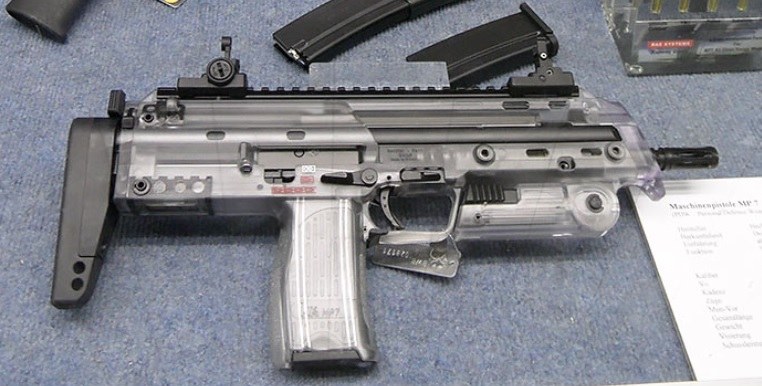
An MP7 light gun that kicks is half of the realism the owner asked for. The other half is a small piece of motion on the right side of the receiver: the bolt carrier showing in the ejection port, jumping back on every shot, and staying back when the magazine runs dry. On the real weapon that motion is not a feature. It is a by-product of a gas-operated action that has to extract and throw a case through the port. In a light gun nothing has to be extracted, so the motion has to be made on purpose, by a mechanism that fits behind the port, keeps up with the kick, survives hundreds of thousands of cycles in printed plastic, and does not make the gun sound like a stapler.
This dive owns that mechanism. This first volume establishes what is being imitated: the real gun’s port and what moves behind it, read from H&K’s own manuals as the HK MP7 dive records them; the airsoft copies that already reproduce it with gas; and the arcade cabinets, whose manuals show what happens to moving parts that are hit thousands of times a day.
1.1 The dive in one table
Table 1 — The dive in one table
| Volume | Subject | What it settles |
|---|---|---|
| 1 | What the port shows | What the real gun, the airsoft copies and the arcade do; what a light gun has to copy |
| 2 | The numbers | Time, stroke, mass and force budgets; the D16 sequence; where the “last round” comes from |
| 3 | Concept A: the kick drives the port | The kick mass as the carrier, or a linkage from it; what it costs the kick |
| 4 | Concept B: an actuator of its own | Solenoid, voice coil, servo, lead screw, cam, shape-memory wire, latching solenoid, compared with numbers; the pick; the electrical side and hold-open |
| 5 | Springs, stops, noise and wear | Return-spring sizing, end-of-travel damping, noise, bushings, printed materials, fatigue |
| 6 | The port cassette for the printed MP7 | A drop-in module with dimensions, parts list, print settings, firmware timing and the ADP3450 bench test |
1.2 What the brief asks for
The category’s decisions fix the scope (Light Guns plan, decision table; DECISIONS.md):
- Kick only, plus a moving ejection port (plan decision 4). No reciprocating slide, no working bolt, no ejected cases. The port is the one piece of visible motion.
- Try both ways of moving it (D5, 18 October 2026): one solenoid that gives the kick and moves the port, and a separate actuator for the port. Decide on feel and reliability. Volume 3 takes the first, Volume 4 the second.
- The two stages never fire at the same instant (D16, 18 October 2026). The supply is sized for one stage, and the firmware interlocks them, backed up by a transistor on the board (Reference Electronics Vol 5 §5.13). Volume 2 shows that the sequence costs nothing that can be seen or felt.
- The first build is a 3D-printed MP7 (D35, 19 October 2026). The MP7 Printed Build dive designs the shell and leaves a space behind the port for this dive’s mechanism; Volume 6 here is the mechanism that goes into it. The airsoft donors of the MP7 Donor Build dive remain a reference, and that dive’s Volume 2 §2.6 sets out the same two concepts in each donor.
1.3 Where the port is, and what is behind it
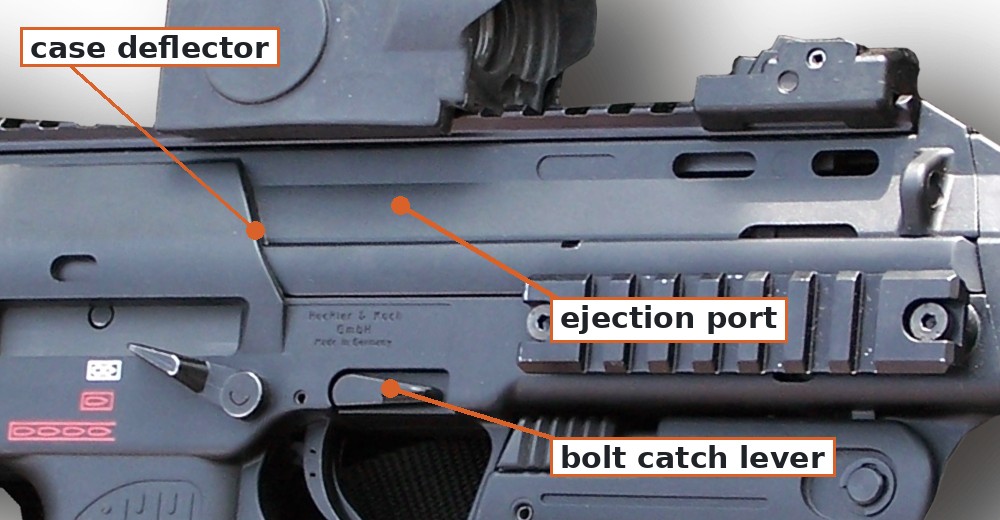
H&K’s English operator’s manual numbers the exterior parts on two figures, left and right. On the right side, item 20 is the case deflector and item 21 the ejection port; the left side has no port. The Spanish manual of 2006 numbers the same two parts 21 and 22. Both lists are reproduced in the HK MP7 dive’s Volume 5, which also shows H&K’s own figures.
What sits behind the port is the bolt group: a bolt head carrier with the rotating six-lug bolt head in front of it, a recoil spring on a guide rod behind, and a buffer in the backplate. The manuals describe the weapon as “Gas operated, firing from a closed bolt, rotary, 6-lug bolt head”, with a short-stroke piston that strikes the carrier’s front face (HK MP7 Vol 5). The carrier is on the bore axis, so the part a shooter sees in the port is the flank of the carrier, at the height of the barrel.
Neither manual lists a dust cover among the exterior parts, and photographs of the weapon show none: the port is a plain opening, closed off only by the carrier’s own flank when the bolt is forward. This matters for the light gun. A gun with a hinged dust cover, such as an AR-15, shows motion as a cover flipping open; the MP7 shows it as a part sliding past an open window. The thing to imitate is a sliding flank, not a flap.
What is not published. H&K gives neither the port’s length nor the bolt’s travel, and the HK MP7 dive lists the bolt’s mass, the piston’s stroke and the recoil-spring rate among the figures it could not find (HK MP7 Vol 5). Two lower bounds follow from the cartridge, whose dimensions are in NATO’s STANAG 4820: overall length 38.5 mm, case length 30.5 mm, rim 8.0 mm (HK MP7 Vol 3). The bolt face has to get behind a cartridge in the magazine before it can push it forward, so the bolt travels more than 38.5 mm; and a fired case 30.5 mm long has to pass through the port, so the port is longer than that. Both are inferences from geometry, not H&K figures. The dimensions for the light gun’s port come instead from the printed build’s starter model or a measured licensed replica (Volume 6).
1.4 What the port does during a shot
H&K’s manual describes the cycle in one paragraph, quoted in full in the HK MP7 dive: gas tapped from the barrel pushes the piston “to the rear against the bolt head carrier. During its rearward travel the bolt head carrier rotates and unlocks the bolt head which extracts and ejects the cartridge case. During the forward travel of the bolt a cartridge is fed from the magazine into the chamber and the bolt head is locked.” The ejector throws the case out of the port on the right, past the deflector behind it. As the carrier runs back it compresses the recoil spring and meets the buffer in the backplate (HK MP7 Vol 5).
Seen from outside, at the port, that is one movement: the flank jumps back, the opening behind it shows for an instant, and the flank comes forward again. H&K gives the rate as about 950 rounds a minute, and NATO’s proof manual as 950 ± 200, with 800 and 1,150 as the limits (HK MP7 Vol 5). One cycle therefore takes 63 ms at 950 a minute, 75 ms at 800 and 52 ms at 1,150.
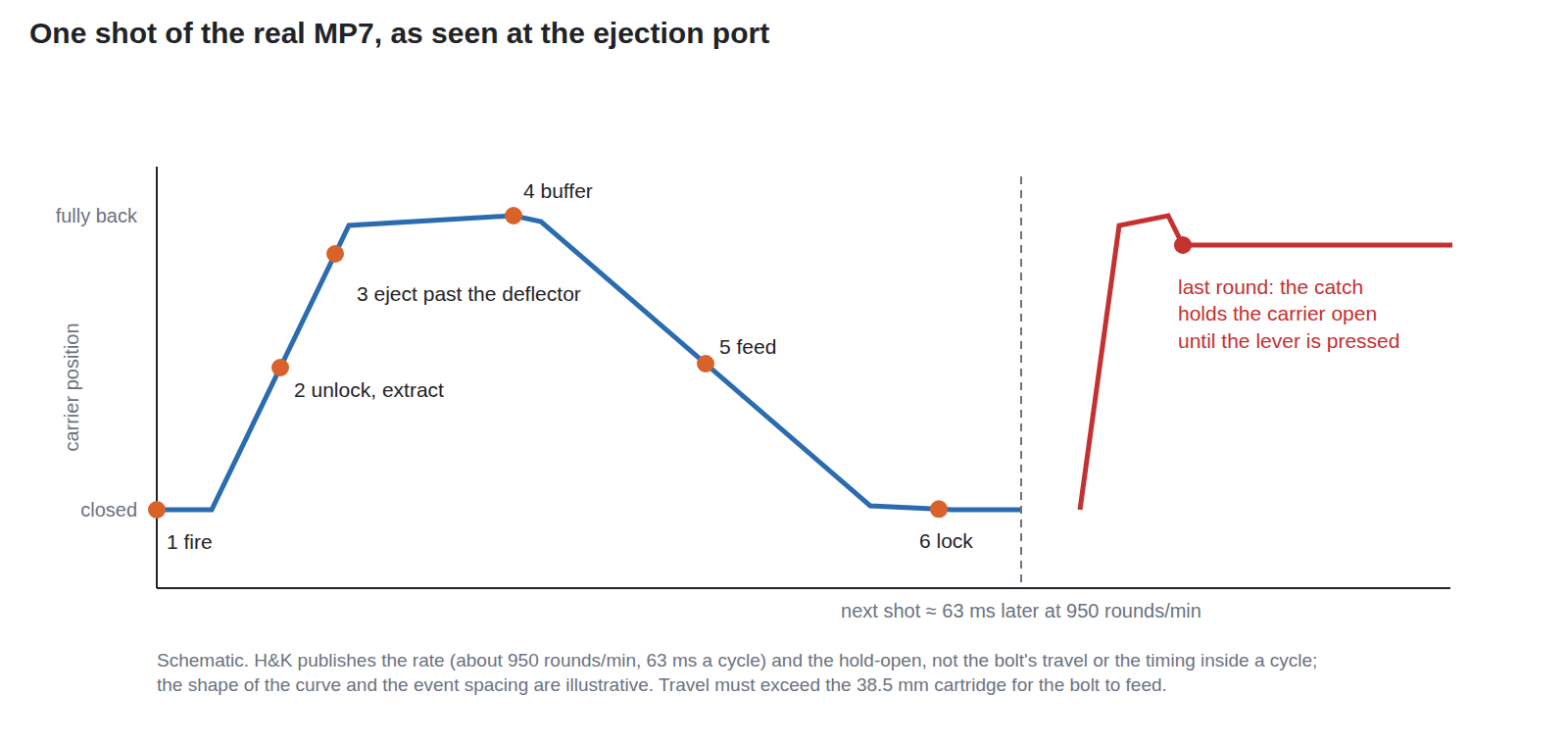
The shape inside the cycle is not published and is drawn only to show order. What is certain is what the eye gets: a single fast stroke per shot, and in automatic fire a blur at about sixteen strokes a second. H&K’s unloading procedure is a reminder of how open the port is. The manual has the user draw the bolt fully back “covering the ejection port with one hand” to catch the ejected cartridge (HK MP7 Vol 6).
1.5 The last round
“When firing the bolt is arrested in its open position after the last round in the magazine has been fired.” That is H&K’s English manual, as quoted in the HK MP7 dive, which reads the troubleshooting tables to show how: the manuals tie a bolt that fails to stay open to a weak magazine spring or a damaged catch, so the empty magazine’s follower lifts the bolt catch into the bolt’s path. The ambidextrous bolt catch/release lever, pressed down, lets the bolt run forward and chamber a round from a fresh magazine “without the need to retract and release the charging handle” (HK MP7 Vol 5).
For the light gun this is the more noticeable half of the realism. A stroke that lasts a few tens of milliseconds is seen as a flicker. A port that stays open when the gun runs dry, and closes when the player reloads, is seen and understood. It is also the half that costs the most: a part held back has to be held by something, and a solenoid holding against a spring is a coil carrying current for as long as the player takes to reload (Volume 4). The Controls and Inputs dive maps the bolt catch lever to button B on the light gun, the lever a real reload ends with.
1.6 The airsoft copies
The gas-blowback (GBB) airsoft MP7s reproduce the port’s motion with the same physics as the real gun, at lower energy: a valve in the magazine releases propellant into a nozzle in the bolt, part of it drives the BB, and the rest drives the bolt carrier back against its recoil spring (MP7 Donor Build Vol 1).
Tokyo Marui’s own page for its MP7A1 GBB states three things that bear on this dive:1
- 「直径約16mmの大型ピストンを採用した新ブローバックエンジンを搭載。」: a new blowback engine with a large piston of about 16 mm diameter.
- 「発射に連動してボルトも作動し、ショートストローク・ガスピストンの動きも再現。」: the bolt moves with each shot, and the movement of the short-stroke gas piston is reproduced as well.
- 「マガジンが空になるとボルトストップが働く」: when the magazine is empty, the bolt stop works, that is, the bolt is held open.
The KWA-made gun sold under licence in the United States behaves the same way, on the evidence of a buyer’s complaint when it did not. A 2015 review on Airsoft GI’s page for the Elite Force MP7 GBB reads: “when i was done shooting all the bb’s out the bolt would not stay back and it would keep firing green gas”, and “the bolt is supposed to stay back when you r done firing.”2 The page listed the gun at $344.95 on 19 October 2026. The airsoft hold-open, like the real one, is worked by the magazine, which is why it fails when a magazine part wears.
The electric airsoft MP7s have no moving bolt; the port area is a moulding, and anything that moves there has to be added (MP7 Donor Build Vol 2). That divides the airsoft guns the same way this dive divides the light gun: the gas guns move the port with the part that makes the recoil (concept A), and anything else has to bring its own actuator (concept B).
1.7 What the arcade learned from moving parts
Arcade guns that kicked with a visible moving part are the nearest thing to a service record for this kind of mechanism. The Arcade Light Guns dive’s Volume 5 reads the parts lists. Taito’s Space Gun (1990) drove a slide with a solenoid, and its parts list names a cushion rubber on the plunger and a stopper rubber on the slide, with a slide base, bush, shafts and return spring: dampers at both ends of the stroke, and a guided slide on shafts. Namco’s Point Blank and Time Crisis guns drove a visible upper slide with a solenoid, which Namco called “blowback”; how those guns were built is in Solenoid Recoil Vol 1. And Time Crisis 3’s troubleshooting entry for a blowback that does not work gives, as a matter of routine, “The solenoid is worn — Replace the solenoid”.
Three lessons carry over directly. A moving part needs a guide, not just an actuator; the arcade slides ran on shafts and bushes. It needs a damper at each end, because the part is stopped twice per shot. And the makers assumed wear, and designed for replacement. Volume 5 turns those into a design.
1.8 What a light gun has to copy, and what it may skip
A light gun’s port is seen under conditions that change what matters:
- The shooter is looking at the screen. The port is on the right side of the receiver, below the sight line, and in a shoulder hold it is barely in the shooter’s view. It is seen by onlookers, in videos, and by the shooter when the gun is lowered: after a burst, and above all when the gun runs dry. The hold-open is therefore worth more than the fidelity of each stroke. This is a judgement, not a measurement.
- Each stroke is a flicker. At 950 rounds a minute nobody can see whether the flank travelled 40 mm or 15 mm; at single shots the difference is visible but not obvious. A stroke shorter than the real one, chosen for the actuator, gives most of the effect. Volume 2 sets the number.
- Order matters little. In the real gun the carrier’s rearward stroke is the recoil, so the two are simultaneous. Decision D16 forces the light gun’s port to follow the kick by a few milliseconds. Volume 2 shows the delay is under the published threshold at which people notice that a touch and a sight are not simultaneous.
- Nothing is ejected. No case, no extractor, no need for the port to show an open chamber. What shows when the flank moves back can be a matt black cavity, and the cheapest realism in the whole mechanism is to make it dark.
What the light gun must not copy is the mechanism. The printed build deletes every internal part of its starter model and has no barrel bore, chamber, bolt or fire control (MP7 Printed Build Vol 1). The moving part behind the port is a printed shape with the outside look of a carrier’s flank, guided on rods, and nothing more.
1.9 How the rest of the dive is arranged
Volume 2 puts numbers on the job: the time a stroke may take, the stroke, the mass and the force, the D16 sequence, and where a light gun can learn that its magazine is empty. Volume 3 is concept A, the kick moving the port, and Volume 4 concept B, a separate actuator, with every candidate compared and the pick explained. Volume 5 covers return springs, end stops, noise and wear in printed parts. Volume 6 is a port cassette for the printed MP7, with dimensions, a parts list and the bench test on the lab’s Analog Discovery Pro ADP3450.
Theory owned elsewhere is linked, not repeated: solenoid physics, selection and drive in Solenoid Recoil; the second power stage as a circuit in Reference Electronics Vol 5; supplies in Power Supplies; the shell in MP7 Printed Build.
1.10 What could not be verified
- The MP7’s port length and bolt travel. H&K publishes neither; the lower bounds above are inferences from the cartridge.
- The absence of a dust cover is read from H&K’s parts keys and from photographs; no source states it in words.
- How the Tokyo Marui and KWA hold-opens are built. Tokyo Marui states only that the bolt stop works on an empty magazine; the KWA evidence is one buyer’s review.
- Whether the shooter notices the port in play. The argument in 1.8 is a judgement; the build will test it.
Sources
Every H&K quotation and figure in this volume is taken from the HK MP7 dive (Volumes 3, 5 and 6), which cites H&K’s English operator’s manual (fax copy, 2011), its Spanish manual (2006), H&K’s product page and NATO AEP-97 as published in Czech standard ČOS 130511, and STANAG 4820 as published in ČOS 130512. The arcade parts lists are cited in Arcade Light Guns Vol 5.
Footnotes
-
Tokyo Marui, “MP7A1 ブラック — ガスブローバック マシンガン”, https://www.tokyo-marui.co.jp/products/gas/machinegun/281, read 2026-10-19. ↩
-
Airsoft GI, “Elite Force H&K MP7 GBB Airsoft SMG by KWA (Black)”, https://www.airsoftgi.com/product/Elite-Force-HK-MP7-GBB-Airsoft-SMG-by-KWA-Black-5635/, price and review (E. Hope, 2015-02-16) read 2026-10-19. ↩
Comments (0)