Air and Blowback · Volume 1
Air in a Light Gun — What Exists, and the Verdict
Which arcade guns really kicked with air (almost none: Namco's 'blowback' is a solenoid), where gas recoil and a laser do live together (police and military trainers), what paintball's electropneumatic markers teach about firing gas from a microcontroller, and the short answer for this build
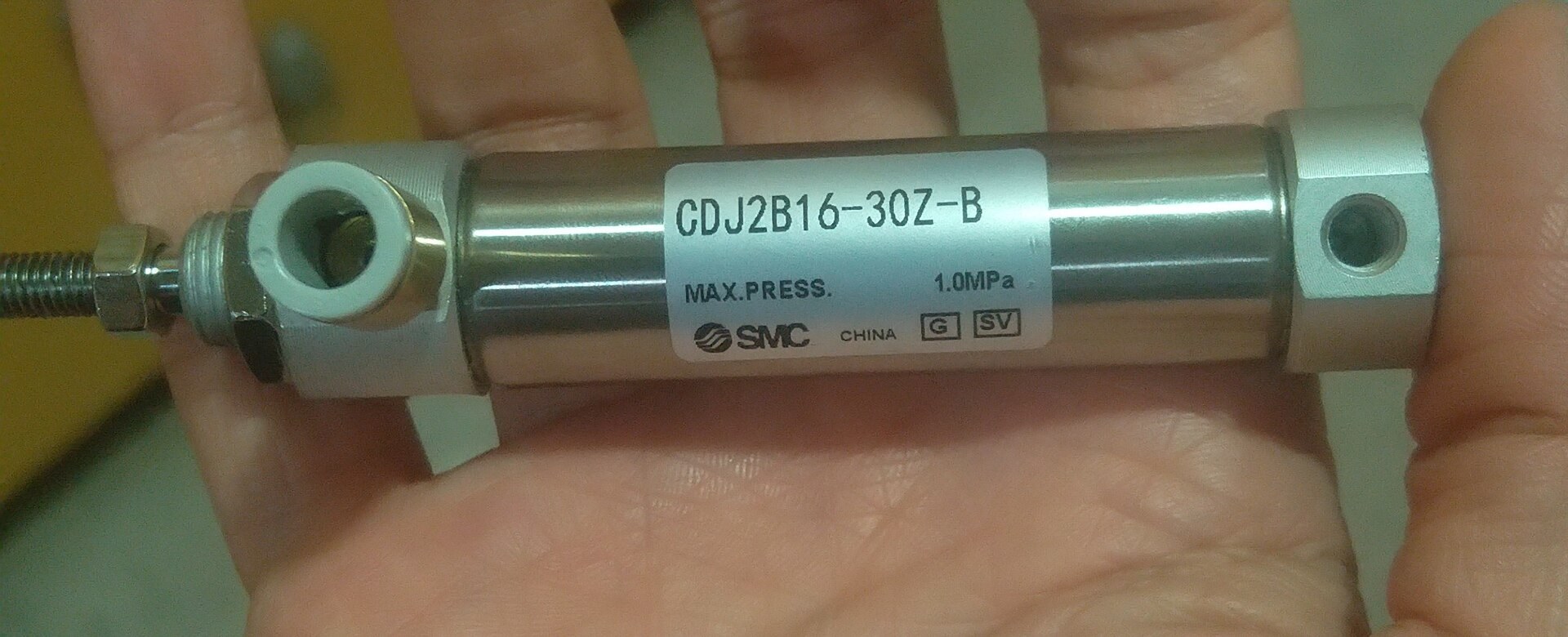
A light gun can be made to kick by compressed air or by a liquefied gas instead of a solenoid. This dive asks whether it should be. It covers the arcade record, the trainers that already combine gas recoil with a light beam, compressed-air recoil built from industrial parts (Volume 2), the gas-blowback airsoft action kept as the recoil engine (Volume 3), and then puts numbers on the felt impulse and the noise and gives a verdict with a bench plan (Volume 4).
The rest of the recoil family lives elsewhere and is linked rather than repeated: solenoid physics, drivers, heat and how to measure a kick in Solenoid Recoil; motors in Motors and Rumble; the arcade cabinets’ recoil parts lists in Arcade Light Guns Vol 5; the gas-blowback MP7 itself in MP7 Donor Build; the moving bolt behind the port in Moving Ejection Port; and the airsoft gases, their pressures and their storage in the Airsoft Gas dive.
1.1 The dive in one table
Table 1 — The dive in one table
| Vol | Title | What it settles |
|---|---|---|
| 1 | Air in a light gun: what exists, and the verdict | The arcade record corrected; the trainer and paintball precedents; the short answer |
| 2 | Compressed-air recoil from industrial parts | Compressor, receiver, regulator, a 24 V valve and a small cylinder, with SMC datasheet figures; why the valve’s flow sets the kick; driving the valve from the carrier; noise; keeping it working |
| 3 | A gas-blowback action as the recoil engine | Firing a GBB from the Pico three ways; gas per shot and per magazine; cooling and pressure sag; CO₂ and tethered air; propane indoors; Michigan |
| 4 | Felt impulse, noise, the verdict and the bench plan | Air, gas and solenoid compared in momentum per shot; why this, and why not the others; the ADP3450 measurements that would overturn the verdict |
1.2 Three ways air can kick a gun
- A cylinder fed from a reservoir. Air from a compressor is stored in a tank, held at a set pressure by a regulator, and admitted to a cylinder by an electrically operated valve. The piston throws a mass into a stop. This is the industrial way to make a short, hard stroke, and it is how anything pneumatic in an arcade cabinet works. Volume 2.
- A gas-blowback action. The airsoft gas gun’s own mechanism: a valve in the magazine releases liquefied propellant into the bolt, and the gas drives the bolt carrier back against its spring. The kick is the carrier hitting its buffer, the same physics as a solenoid striker, at a higher energy. Volume 3.
- A tethered or bottled gas gun with an electronic trigger. The paintball and HPA-airsoft pattern: a switch tells a board to open a solenoid valve, and the valve releases regulated gas into the action. It combines the first two: the action of a gas gun with the supply of a pneumatic system. Volume 3, section on tethered air.
All three end the same way: a moving mass stopped by the gun. What reaches the hand is the momentum of that mass at the stop, as Solenoid Recoil Vol 2 and Vol 5 explain for a solenoid. Air changes what pushes the mass, not what the hand feels at the end.
1.3 The arcade: “blowback” is not air
The brief for this dive named Namco’s Time Crisis 3 and 4 guns as air-recoil guns. They are not. Namco called the moving upper slide of its Point Blank and Time Crisis guns “blowback”, a firearm word, but the operator’s manuals describe a solenoid driving it:
- The Time Crisis II and Time Crisis SD manuals list a solenoid, ST-0860A2, a solenoid bracket, a slide guide, a back spring and a “Silencer rubber” (Solenoid Recoil Vol 1).
- The Time Crisis 4 DX manual replaces a rectangular “Solenoid Unit” held by four M3 screws, with a rubber spacer on the plunger (same volume).
- Time Crisis 3’s troubleshooting entry for a blowback that does not work reads “The solenoid is worn — Replace the solenoid” (Arcade Light Guns Vol 5).
No compressor, tank, hose or valve appears in any of them. The same is true of the wider survey in Arcade Light Guns Vol 5, which reads the recoil parts of a dozen cabinets from 1987 to 2014 and finds a geared motor and crank (Operation Wolf), solenoids throwing a weight or a slide (Operation Thunderbolt, Beast Busters, Line of Fire, Space Gun, Point Blank, Time Crisis), a coil shaking a mounted gun (Terminator 2), eccentric-weight motors (Laser Ghost, Alien3, House of the Dead 4) and a solenoid striking a brass knocker (Aliens Armageddon). None of them uses air in the gun. Sega’s Ghost Squad “reaction” is a solenoid too (Solenoid Recoil Vol 1 §1.6), and the owner’s manual for Sega’s Transformers Human Alliance lists its gun feedback as a controller that “vibrates”, with a motor maintenance section and no air system.1
Searches of manuals, collectors’ forums and retailers for this volume found no hand-held arcade light gun with pneumatic recoil. That is a finding about what could be found, not a proof that none was ever built.
Why the arcade avoided it is easy to see from the operator’s side. A solenoid needs a cable that is already there. Air needs a compressor in the cabinet, a tank, a filter that has to be drained, a hose to each gun that players will pull on, and an exhaust that hisses on every shot. Every manual in the survey already treats the solenoid as the gun’s most fragile part; a hose and a valve would have been two more.
1.4 Where air did reach the arcade
Air shows up in shooting cabinets as an effect on the player, or in big mounted guns, rather than in a hand-held gun:
- Namco’s Tokyo Wars (1996), a tank game, had a deluxe cabinet that “features a pneumatic haptic control that simulates the recoil effect from the tank’s main gun”; the standard cabinets did not have it.2 The gun here is the tank’s main gun, felt through the cabinet, not a gun in the hand.
- Namco’s Dark Escape 4D sells on its “heavy recoil” guns and a rumble seat alongside air blowers aimed at the players; the blowers are an environmental effect, not the gun’s kick.3
1.5 Where gas recoil and a light beam live together: the trainers
The nearest working ancestor of a gas-kicking light gun is not in the arcade at all. It is the firearms training simulator, where a real or replica pistol shoots a laser or an infrared beam at a screen and a gas system cycles its slide.
Dvorak’s training firearm. US patent 6,869,285, “Training firearm”, filed by Charles R. Jones II on 11 June 2003 and granted 22 March 2005, later assigned to Dvorak Instruments, describes the arrangement in detail.4 A commercially available 12 g CO₂ cartridge sits in the magazine well or the handle. The gun’s own firing pin pushes a rod off a conical seat (a 24° included taper) to open the gas valve, a spring closes it again, and the released gas drives the slide back and recocks the hammer, so that “the weapon will cycle every time the trigger is pulled until the gas supply in the cartridge 90 is spent”. The forward end of the same rod strikes a mechanical switch that fires the laser. The gas conduit is to be “rated at 1000 p.s.i. or higher”. The valve is entirely mechanical: the trigger fires the gas and the gas fires the laser. The patent lapsed for non-payment of maintenance fees in 2017. Dvorak sells the idea as its Air Recoil System, described in a trade listing as a drop-in kit that gives “a felt recoil, an audible ‘blast’ and a laser pulse” each pull, on compressed air, CO₂ or nitrogen.5
VirTra’s recoil kits. VirTra, which sells simulators to police departments, fits drop-in recoil kits to service pistols and rifles. Its own article of 15 April 2025 says the kits need CO₂-operated magazines, that “these magazines can simulate end-of-magazine events as well as instructor-initiated malfunctions”, that they are refilled at a proprietary station with “food grade CO₂ commonly used in soda machines”, that “the kits preclude the loading of a live round into the weapon”, and that “shots are only registered when the trigger is intentionally pulled”.6
Two lessons carry over to a game gun:
- Gas recoil can be made reliable enough for daily professional use, with an empty-magazine event and a malfunction an instructor can trigger. The light-gun firmware has both concepts already (reload and ammo count).
- The professional trainers put the gas in the magazine and let the gun’s own mechanism fire it. The electronics only watch. That is option 1 of Volume 3, and it is the simplest way to keep the gas side mechanical.
1.6 Paintball: firing gas from a circuit board
The other precedent is paintball. In an electropneumatic marker, “the trigger, instead of being mechanically linked to the action of the marker, simply activates an electronic micro-switch (or more recently, a magnetic or optical sensor)”, and that signal goes to a “computer-controlled solenoid valve” that moves the bolt and fires.7 The air comes from a tank at 3,000 to 4,500 psi through one or more regulators, and tournament markers run a separate low-pressure regulator, “usually under 690 kPa (100 psi)”, to power the bolt. That last figure is the interesting one: the part of a paintball marker that only moves a bolt runs at the same pressure as an industrial cylinder, below 0.7 MPa.
Paintball also shows the failure the rules had to deal with. Once a board decides when to fire, firmware can fire more than once per pull (“ramping”), so the leagues cap the rate and markers queue shots. A light gun’s firmware already owns the fire rate; a gas or air recoil engine adds nothing new there, but it does mean that a firmware fault becomes a stream of gas releases rather than a stream of solenoid pulses.
The same pattern runs the HPA airsoft engines covered in Airsoft Gas Vol 5, which are solenoid valves on a regulated air line.
1.7 The verdict, in short
For the first build, the printed MP7 (D35) with a regulated-current 24 V solenoid stage (D13, D14):
- Keep the solenoid. Air is not adopted for the first build.
- Air does kick harder. The models in Volumes 2 to 4 put a small cylinder fed through a high-flow valve, or a gas-blowback carrier, at roughly two to ten times the momentum per shot of the solenoids on the bench shortlist. That is the one strong argument for it, and it is a model, not a measurement.
- What it costs is everything else. A compressor running in the room or a propane magazine to fill; a pressurised line in the cable sleeve or flammable gas released indoors on every shot; cooling that weakens a string of shots; a hiss on every shot from the valve exhaust; and, for a gas-blowback action, a gun that may again count as a pneumatic gun under Michigan law if it can still expel a BB (Volume 3).
- One cheap experiment is worth doing. A bench rig of shop air, a regulator, a 24 V valve and a 10 or 16 mm cylinder, measured with the same accelerometer method as the solenoids, would show whether the extra impulse is real and whether it is wanted. Volume 4 lays it out.
The reasons, alternative by alternative, are in Volume 4.
1.8 What could not be verified
- Any hand-held arcade light gun with pneumatic recoil. None found; not proof of absence.
- Tokyo Wars’ deluxe pneumatic system. Known only from Wikipedia citing a 2014 Kotaku Australia article; no Namco manual was read.
- Dvorak’s and VirTra’s figures. No shot count per cartridge or magazine, operating pressure or valve detail was found on either maker’s pages; VirTra’s figure of “900+ psi” for its liquid CO₂ came from a search summary and is not used.
- Laser Ammo’s “Recoil Enabled CZ Shadow 2 Training Pistol (CO2)”. The product page exists, but its description and specifications were empty on 19 October 2026.
Sources
Footnotes
-
Sega, Transformers Human Alliance Owner’s Manual, Output Test (“PLAYER1 CONTROLLER … vibrates … REACTION”, p. 45) and “Repair and Maintenance for Motor” (p. 51), via ManualsLib, https://www.manualslib.com/manual/2584221/Sega-Transformers-Human-Alliance.html, read 2026-10-19. ↩
-
“Tokyo Wars”, English Wikipedia, read 2026-10-19, citing Chris Jager, “Hey, Tanky Tanky! The Top 6 Tank Games Of All Time”, Kotaku Australia, 23 June 2014. ↩
-
PrimeTime Amusements, “Dark Escape 4D” product page, https://primetimeamusements.com/product/dark-escape-4d/, read via search listing 2026-10-19. ↩
-
C. R. Jones II, Training firearm, US 6,869,285 B1, filed 2003-06-11, granted 2005-03-22; assignment to Dvorak Instruments Inc. recorded 2013; expired 2017. https://patents.google.com/patent/US6869285, read 2026-10-19. ↩
-
“Dvorak Instruments Inc. Air Recoil System”, Officer.com product listing, https://www.officer.com/training-careers/specialized-training/product/10042544/dvorak-instruments-inc-air-recoil-system, read via search listing 2026-10-19. ↩
-
Niki Nelson, “Enhance Firearms Training with VirTra’s Recoil Kits”, VirTra, 15 April 2025, https://www.virtra.com/?p=2991, read 2026-10-19. ↩
-
“Paintball marker”, English Wikipedia, read 2026-10-19 (electropneumatic operation; tank and regulator pressures; ramping and rate caps). ↩
Comments (0)