Air and Blowback · Volume 3
A Gas-Blowback Action as the Recoil Engine
Keeping an airsoft GBB's bolt and gas as the kick in a light gun: what changes with no BB, three ways to fire it from the Pico, how much gas a shot and a magazine use, why a string of shots weakens as the magazine cools, CO₂ and tethered air instead of propane, propane released indoors, and what Michigan law makes of a light gun that still works as a gas gun
3.1 How a gas-blowback action cycles
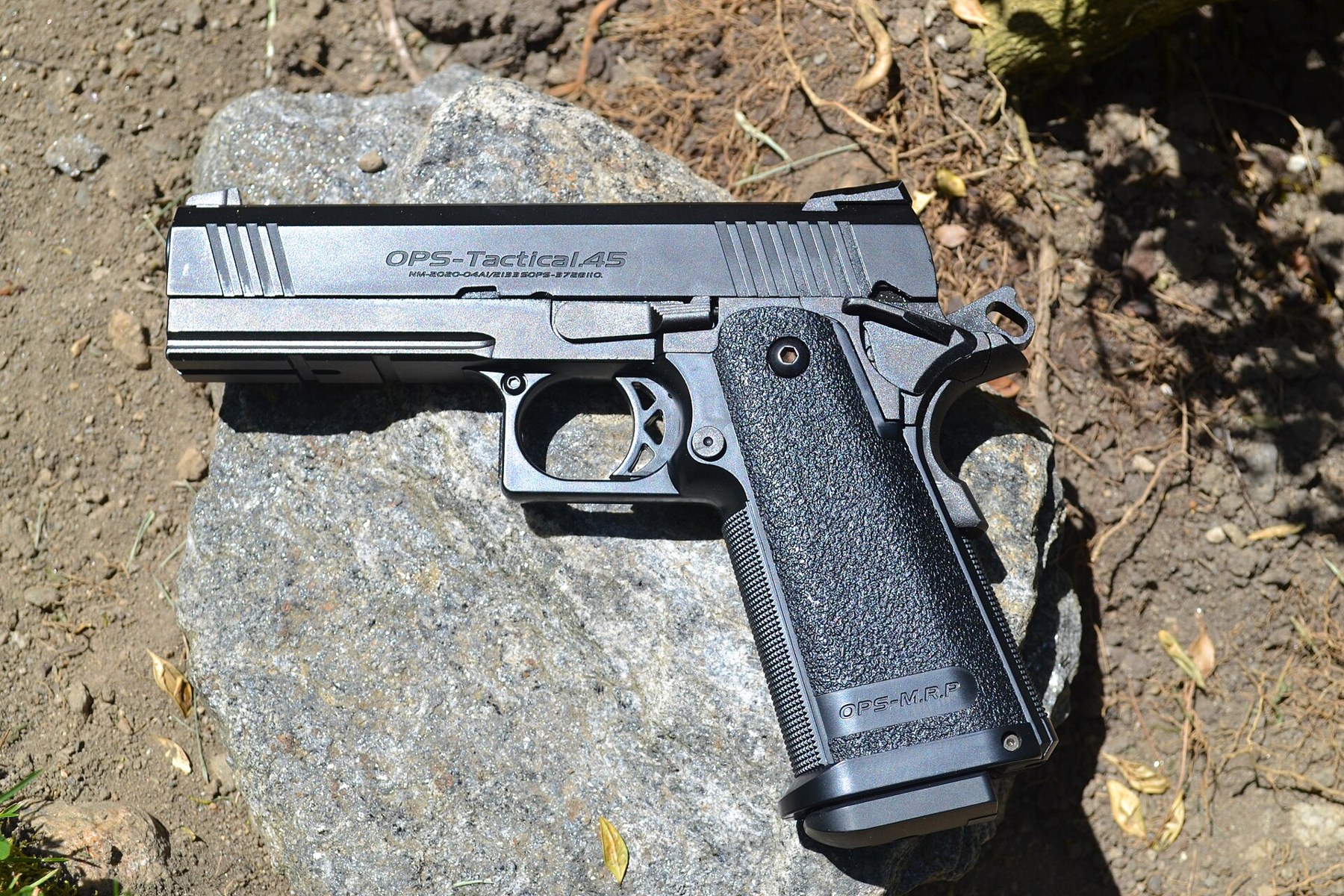
The cycle is covered in its own dives and only summarised here. The Airsoft Gas dive’s Volume 1 describes it: a one-way fill valve in the magazine base takes liquefied gas; on the trigger pull the hammer strikes the magazine’s output valve, which releases a pulse of vapour; part drives the BB and part goes to the blowback unit, which drives the slide or bolt back, re-cocks the hammer and strips the next BB. For the MP7 in particular, MP7 Donor Build Vol 1 and Vol 2 give the KWA-made Elite Force gun and the Tokyo Marui gun, whose “new blowback engine” uses a piston of about 16 mm diameter, and Moving Ejection Port Vol 1 shows that the carrier is what the shooter sees moving in the port.
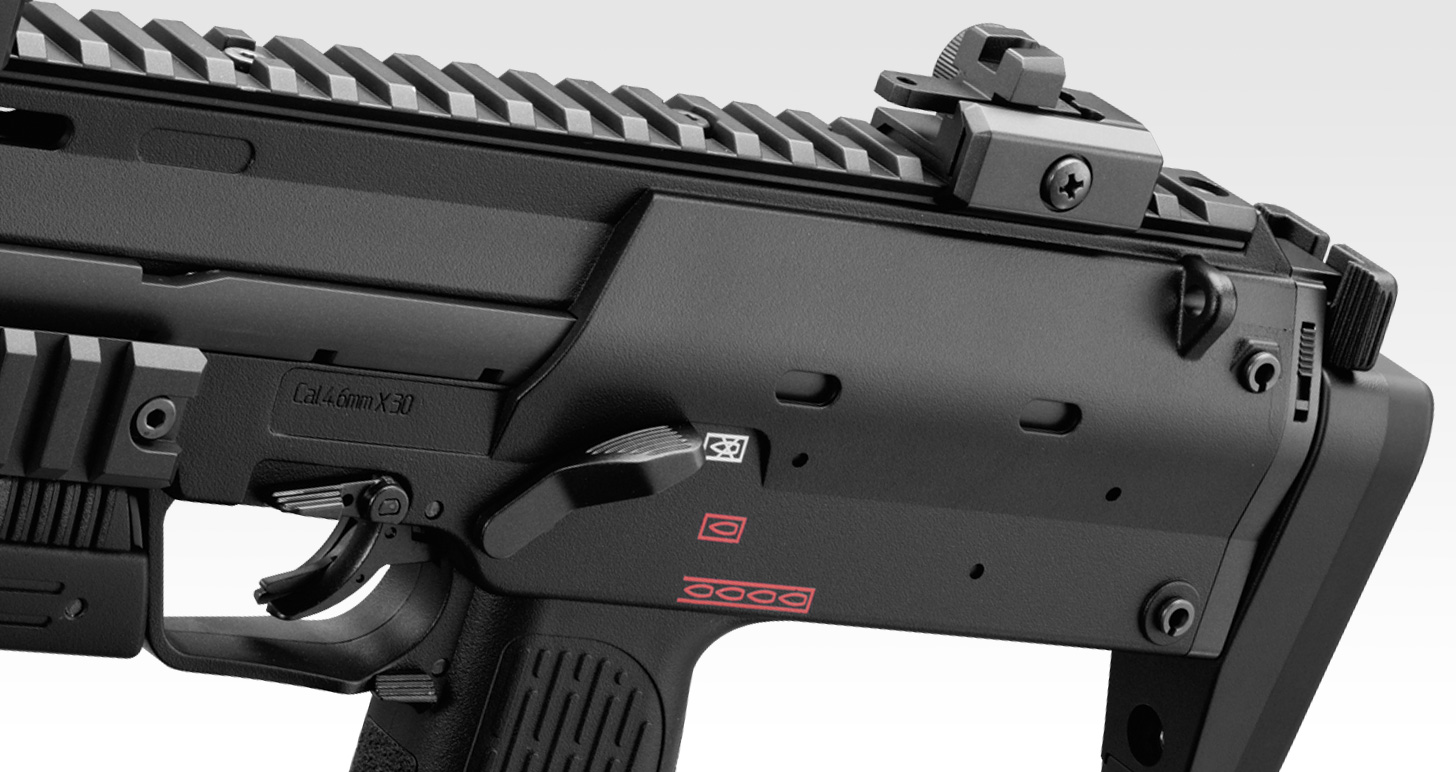
For a light gun the attraction is plain. The carrier already moves behind the port, already has a guide, a recoil spring and a buffer, and the gas drives it far harder than a solenoid of the same size could (section 3.6). It is concept A of the moving port with the actuator built in.
3.2 What changes when there is no BB
A light gun fires no BB. Three consequences follow, none of which the airsoft gun was designed for:
- The hold-open will lock the bolt after the first shot. Tokyo Marui states that “when the magazine is empty, the bolt stop works”, and a KWA owner’s review shows the KWA gun does the same when it is working properly (Moving Ejection Port Vol 1). The hold-open is worked by the magazine’s follower. With no BBs the follower is always at the top, so the bolt locks back on the first shot. The light gun needs the follower held down, or the bolt stop disabled, in the magazine it uses. The game’s empty-magazine event then has to come from the firmware’s ammo count, as VirTra’s trainers do it (Volume 1).
- The gas meant for the BB goes somewhere. The share of the pulse that would have pushed a BB now flows straight down the inner barrel, and the light gun’s camera sits at the muzzle face (MP7 Donor Build Vol 2). Green gas carries silicone oil (Airsoft Gas Vol 2): every shot would blow an oily mist at the camera window and its filter. The inner barrel and hop-up have to come out and the path from the nozzle be either blocked, which changes how the pulse divides between the bore and the blowback chamber, or vented away from the muzzle. Which of the two makes the carrier cycle reliably with no BB in place is a bench question; no source on it was found.
- It may still be a gas gun in law. If the action can still take a BB and fire it, the object is a pneumatic gun under Michigan’s definition (section 3.10). Taking out the inner barrel, hop-up and feed is what turns it into something that no longer “will expel a BB”.
3.3 Three ways to fire it from the Pico
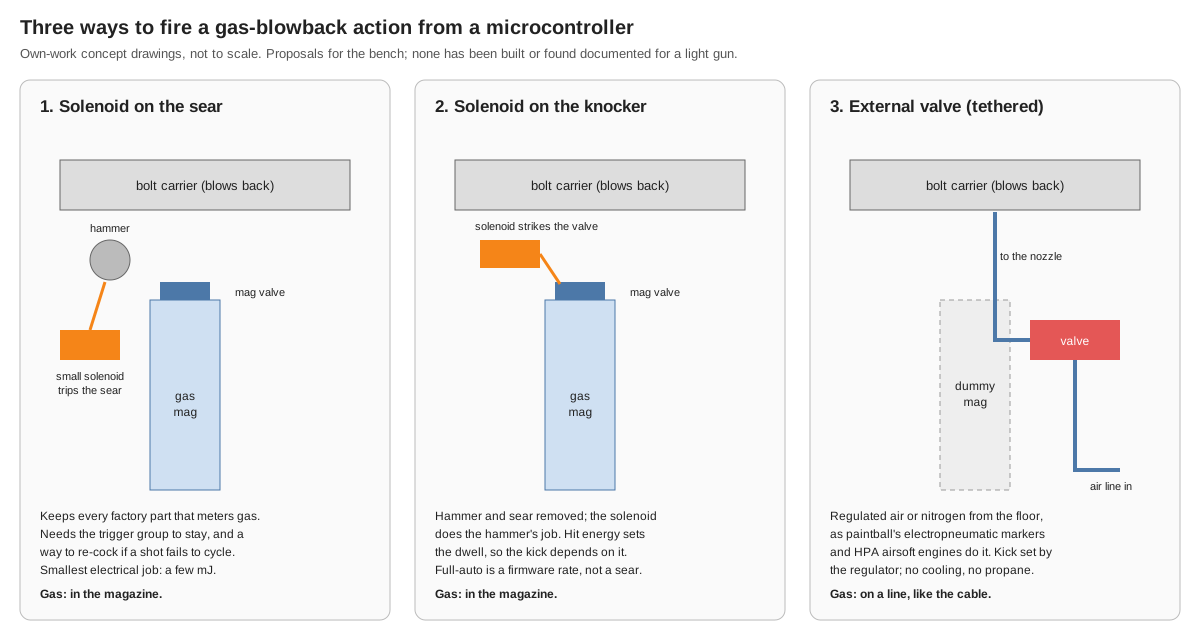
1. A solenoid on the sear. The factory hammer and trigger group stay. A small solenoid, or the trigger’s own mechanism pulled by one, releases the sear; the hammer fires the magazine valve as the factory intended, and the carrier re-cocks it. The electrical job is tiny, a few millijoules to move a sear. The gas metering, the dwell of the valve and the kick stay exactly as the airsoft maker tuned them. Its weakness is the failure case: if a shot fails to cycle the carrier, the hammer is not re-cocked and the next pulse does nothing until someone works the action. This is the professional trainers’ arrangement in electronic form: the gun fires the gas, the electronics decide when.
2. A solenoid on the knocker. The hammer and sear come out and a solenoid strikes the magazine valve’s knocker directly. Full-auto becomes a firmware rate instead of a sear, and there is nothing to re-cock. The cost is that the impact the solenoid delivers sets how long the magazine valve stays open, and so how much gas each shot gets and how hard the carrier kicks. The hammer’s energy is a figure no airsoft maker publishes, so the solenoid has to be matched to it on the bench (Volume 4). A solenoid strong enough to replace a hammer is a solenoid on the Solenoid Recoil shortlist.
3. An external valve on a line. The magazine carries no gas: a dummy, or the spare KWA magazine already planned for the cable exit (D21), carries an air fitting instead. An electrically operated valve, of the kind described in Volume 2, meters regulated air from a line into the nozzle. This is how paintball’s electropneumatic markers and the HPA airsoft engines work (Airsoft Gas Vol 5). The kick is set by the regulator; there is no propane, no cooling and no refilling. The cost is the line, and a valve with enough flow to drive a 16 mm piston as hard as a magazine valve does.
Whichever is chosen, the firmware owns the rate, and a firmware fault now releases gas rather than pulsing a coil; the cap on autofire rate and the on-time limit belong in the firmware for this reason as well as for heat.
3.4 How much gas a shot uses
No maker or reviewer measurement of grams per shot for a gas MP7 was found. Two figures bound it:
- A maker’s pistol figure. Elite Force says “a single can of Elite Force FUEL will power a pistol for about 1800 shots”.1 The can is 8 oz, $13.99 at Airsoft GI and Umarex USA on 19 October 2026.2 That is about 0.13 g per shot, including what is lost filling magazines: roughly 0.8 cents a shot.
- A fill-volume check. A 16 mm piston (Tokyo Marui’s figure) over an assumed 20 mm stroke sweeps 4.0 cm³. Filled with propane vapour at its 20 °C vapour pressure, 7.4 bar gauge, that is about 0.06 g for the blowback stroke alone (own arithmetic from the NIST vapour-pressure equation3), before any dead volume or bore loss.
A gas MP7 with no BB will use somewhere around 0.1 to 0.3 g a shot, and the bench figure is easy to get: weigh the magazine full, fire a counted string, weigh it again (Volume 4). The KWA magazine is a 40-round magazine; a search summary claimed two magazines of shots per fill for the KWA gun, but neither review page fetched carried that figure, so it is not used.
At 0.13 g a shot, an evening of a few hundred shots is one can every five or six evenings. At 0.3 g, every two or three.
3.5 Temperature: why a string of shots weakens
Liquefied gas fires on its vapour pressure, which falls steeply with temperature: propane is about 105 psig at 20 °C and 53 psig at 0 °C (Airsoft Gas Vol 2, which has the full chart). Indoors at room temperature the starting point is good. The problem is that the magazine cools itself: every shot boils liquid propane to replace the vapour that left, and the heat to boil it comes from the remaining liquid and the magazine’s metal.
The NIST correlation for propane gives a heat of vaporisation of about 15.2 kJ/mol at 20 °C, or about 345 J per gram.3 At 0.13 g a shot, each shot takes about 45 J out of the magazine. A die-cast magazine of 300 to 500 g of zinc alloy has a heat capacity of roughly 120 to 200 J/K, so each shot cools it by a quarter to a third of a degree if no heat flows in.
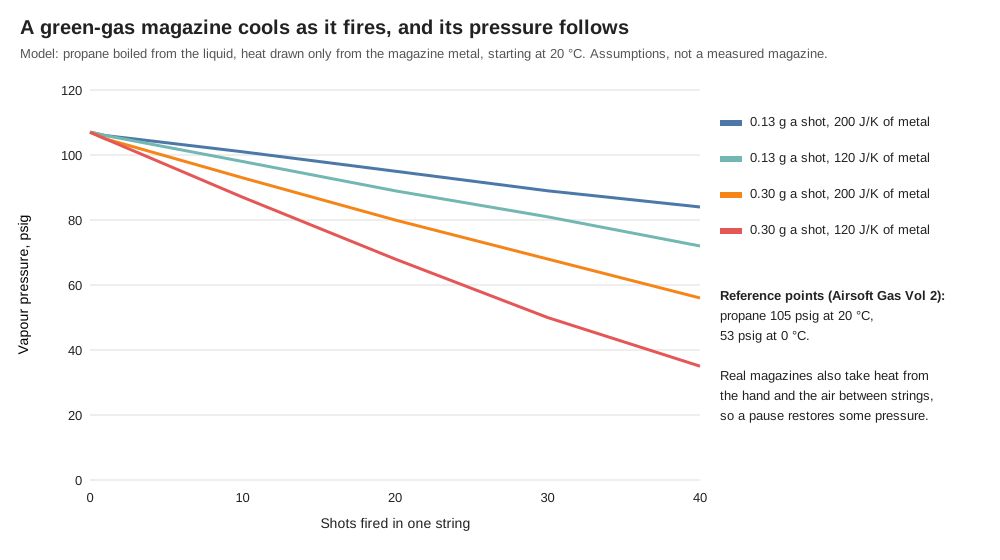
Table 1 — Temperature: why a string of shots weakens
| Gas per shot | Magazine metal | After 10 shots | After 20 | After 40 |
|---|---|---|---|---|
| 0.13 g | 200 J/K | 18 °C, 101 psig | 16 °C, 95 psig | 12 °C, 84 psig |
| 0.13 g | 120 J/K | 17 °C, 98 psig | 14 °C, 89 psig | 8 °C, 72 psig |
| 0.30 g | 200 J/K | 16 °C, 93 psig | 11 °C, 80 psig | 1 °C, 56 psig |
| 0.30 g | 120 J/K | 13 °C, 87 psig | 6 °C, 68 psig | −11 °C, 35 psig |
Since the kick follows the pressure in the blowback chamber, a long string fired quickly kicks noticeably less at the end than at the start, the opposite of the solenoid design’s aim of the same shot every time (D13). A game played in bursts with pauses suffers much less, and the bench test in Volume 4 measures the real curve with a thermocouple on the magazine.
CO₂ behaves the same way, and harder: Elite Force warns that below 60 °F “the valve on a CO₂ powered air gun can freeze up after a succession of shots”.1 Tethered air (option 3) does not cool at all; its regulator holds the pressure regardless, which is the reason HPA airsoft exists (Airsoft Gas Vol 5).
3.6 How hard a gas carrier kicks
The same model as Volume 2’s cylinder, with the Tokyo Marui 16 mm piston, an assumed 20 mm stroke, propane at its 20 °C pressure and an assumed carrier of 60 to 120 g, puts the carrier’s momentum at the buffer at roughly 160 to 520 mN·s, depending on how freely the magazine valve and nozzle pass gas, a figure no maker publishes. That is two to ten times the solenoids on the bench shortlist. Volume 4 sets it beside them, with the reasons it is a range rather than a number.
3.7 CO₂, and tethered air instead of propane
- CO₂ runs at roughly 830 to 860 psi at 70 °F, about seven times green gas, and must never go into a green-gas magazine or gun; the Airsoft Gas dive’s Volume 4 calls a CO₂-filled green-gas magazine what it is, a burst waiting to happen. A CO₂ gas MP7 would be a different gun with its own magazines. It is inert, which is its one advantage indoors, but it cools harder and wears seals faster.
- Tethered air is option 3 of section 3.3. HPA tanks for airsoft and paintball hold 3,000 or 4,500 psi and are pressure vessels with their own rules: in the United States, DOT-3AL aluminium cylinders must be hydrostatically tested every five years.4 A light gun indoors does not need a tank at all. A workshop compressor and regulator deliver 0.5 to 0.7 MPa, about 70 to 100 psi, which is the pressure of green gas at room temperature and inside the 80 to 130 psi band HPA airsoft engines are run at (Airsoft Gas Vol 5). Shop air at about 100 psi reproduces a warm green-gas magazine without propane, without cooling and without refilling, on the line the light gun’s cable already needs. Paintball adds two warnings that carry over: electronic solenoid valves are damaged if liquid CO₂ reaches them, and no lubricant may ever go into a high-pressure fill port, where compression can ignite it.5
3.8 Propane indoors
Every shot of a green-gas light gun releases its gas into the room. Propane is flammable between 2.1 % and 9.5 % by volume in air,6 is denser than air and sinks to the floor and into enclosed spaces.7 The arithmetic for a 40-shot evening at 0.13 g a shot:
- 40 × 0.13 g = 5.2 g of propane, about 0.12 mol, about 2.8 litres of vapour at 20 °C.
- Spread evenly through a 30 m³ room, that is about 0.01 % by volume, two hundred times below the lower flammable limit.
- Concentrated, 2.8 litres reaches the lower limit in about 135 litres of air: the inside of a gun case, a cupboard, or a low corner with no draught.
So the risk is not the room; it is closed spaces and the floor. The rules that follow are ordinary ones: fill magazines outdoors or by an open window, never with any flame or spark nearby; do not store charged magazines in a closed case or cupboard; and play in a room that is ventilated, not one with a pilot light at floor level. Filling releases gas too, as the overflow burp the Airsoft Gas dive describes.
The tethered-air and solenoid options have none of this.
3.9 The magazine is a pressure vessel
The gas magazine holds liquid propane at a pressure that rises with temperature, and it is the gun’s gas tank (MP7 Donor Build Vol 2). D21 already rules that the original is never cut; the bench safety rules for venting one before it is opened are in MP7 Donor Build Vol 3. A light gun that keeps its gas adds two rules of its own: a magazine modified for the cable exit or with the follower pinned down must still be a sound pressure vessel, which means any machining is to a vented spare and is checked for leaks before it is ever filled; and a magazine must never be left charged in a hot car or in sunlight, where its pressure climbs past its design point (Airsoft Gas Vol 2).
3.10 Michigan, and how it looks
The law for this build is set out in MP7 Donor Build Vol 3 and the owner’s decisions D27 (the gun is used only in Ovid, indoors, for gaming) and D28 (both builders are over 21). Two points from it bear on keeping the gas:
- Michigan defines a “pneumatic gun” as “any implement, designed as a gun, that will expel a BB or pellet by spring, gas, or air”. The finished light gun is outside that definition “once the gas system or gearbox is out”. A light gun that keeps its gas system is outside it only if it can no longer expel a BB: inner barrel, hop-up and feed removed, and the bore path blocked. If it can still fire a BB, it is a pneumatic gun again, with the school-zone, preemption and vehicle consequences that table in Vol 3 sets out, and Ovid’s § 20-213 discharge ban, which reaches anything that propels a projectile “by means of … compressed air or gas”, applies to firing it. Blocking the bore (section 3.2) is therefore both an engineering and a legal step.
- It looks and sounds like a gun firing. A gas carrier slamming back with a crack and a hiss, gas venting from the gun, is far more convincing to a neighbour or a passer-by at a window than a solenoid’s click. The house rule in DECISIONS P-MP7-8 (cased, the orange band kept, never in public view) matters more for a gas gun, not less.
3.11 Keeping it working
The maintenance of a gas-blowback action, the silicone oil its seals need, the adapters for filling from propane bottles and the magazine valves’ care are covered by the Airsoft Gas dive’s Volumes 4 and 6 and by the gun’s own manual. For the light gun specifically:
Table 2 — The maintenance of a gas-blowback action, the silicone oil its seals need, the adapters for filling from propane bottles and the magazine valves' care are covered by the [Airsoft Gas](/airsoft/gas/) dive's Volumes 4 and 6 and by the gun's own manual. For the light gun specifically
| Symptom | Likely cause | First check |
|---|---|---|
| Bolt locks back after one shot | Magazine hold-open working with no BBs | Follower blocked down, or bolt stop disabled (section 3.2) |
| Weak kick that recovers after a pause | Magazine cooling | Shorter strings; tethered air (option 3) |
| Weak kick from the first shot | Low gas, cold room, or the bore path stealing gas | Weigh the magazine; check the block in the bore |
| Camera image smeared | Oil mist from the nozzle reaching the muzzle | The bore path is not sealed or vented away from the camera |
| No shot with option 1 | Hammer not re-cocked after a failed cycle | Work the action; see why the carrier short-stroked |
| Gas leak at rest | Magazine valve seal | The gun’s manual; the magazine is a pressure vessel (section 3.9) |
3.12 Why this, and why not the others
Table 3 — Why this, and why not the others
| Option | Verdict for this build | Why |
|---|---|---|
| Keep green gas, option 1 (solenoid on the sear) | Not for the first build | Simplest electrics and the factory kick, but propane released indoors, cooling sag, refilling, the hold-open and bore-gas problems, and a gun that must be made legally incapable of firing a BB. And D35 makes the first gun a printed one, which has no gas action at all |
| Keep green gas, option 2 (solenoid on the knocker) | Not for the first build | All of option 1’s costs, plus a solenoid that has to replace a hammer whose energy is unpublished |
| Tethered air, option 3 (external valve into the nozzle) | The only gas-blowback route worth a later bench trial, in the KWA donor (D47) | No propane, no cooling, no refilling; kick set by a regulator, like D13 for the solenoid; the cable is already a tether. Costs a line, a valve with enough flow, and a compressor |
| CO₂ | Rejected | Needs a different, CO₂-rated gun; cools harder; wears seals; never in a green-gas magazine |
| Bottled HPA (3,000–4,500 psi tank) | Rejected | A high-pressure vessel with five-yearly testing to do what a workshop compressor does at 100 psi indoors |
The comparison with the solenoid and the overall verdict are in Volume 4.
3.13 What could not be verified
- Gas per shot for any gas MP7. Not published; Elite Force’s pistol figure and a volume check are the only bounds.
- KWA “two magazines per fill”. In a search summary only; not found on the review pages fetched.
- The magazine’s mass and heat capacity, and so the cooling curve: assumptions.
- Carrier mass and stroke of the KWA and Tokyo Marui guns: not published; assumed in section 3.6.
- Whether a GBB cycles reliably with no BB with the bore blocked or vented: no source found; a bench question.
- Hammer or knocker energy of any gas MP7: not published.
Sources
Footnotes
-
Elite Force Airsoft, “Green Gas vs CO2 for Airsoft Pistols”, 28 March 2021, https://www.eliteforceairsoft.com/blog/green-gas-vs-co2-for-airsoft-pistols, read 2026-10-19. ↩ ↩2
-
Airsoft GI, “Elite Force Green Gas (1 Can)”, https://www.airsoftgi.com/product/Elite-Force-Green-Gas-1-Can-31727/, read 2026-10-19 ($13.99; “Weight Per Can: 8 oz.”; “Output Pressure: 115 +/- PSI at 70 Degrees Fahrenheit”; “DOT-SP 15593 Approved”; ground shipping only). Umarex USA, “Elite Force Fuel Green Gas”, SKU 2269520, https://www.umarexusa.com/elite-force-fuel-green-gas, $13.99, read 2026-10-19. ↩
-
NIST Chemistry WebBook, propane (CAS 74-98-6), phase change data, https://webbook.nist.gov/cgi/cbook.cgi?ID=C74986&Mask=4, read 2026-10-19: enthalpy of vaporisation correlation of Majer and Svoboda (1985), 278–361 K; Antoine coefficients of Helgeson and Sage (1967), 277.6–360.8 K. Values at 20 °C computed for this dive. ↩ ↩2
-
“Hydrostatic test”, English Wikipedia, read 2026-10-19 (“DOT-3AL gas cylinders must be tested every 5 years and have an unlimited life”). ↩
-
“Paintball marker”, English Wikipedia, read 2026-10-19. ↩
-
PubChem, propane (CID 6334), “Flammable Limits”, from the Hazardous Substances Data Bank and the NIOSH Pocket Guide: lower 2.1 %, upper 9.5 % by volume, https://pubchem.ncbi.nlm.nih.gov/compound/6334, read 2026-10-19. ↩
-
“Propane”, English Wikipedia, read 2026-10-19 (boiling point −42 °C; denser than air, sinks into enclosed areas). ↩
Comments (0)