Air and Blowback · Volume 4
Felt Impulse, Noise, the Verdict and the Bench Plan
Air, gas and solenoid side by side in momentum per shot, and how far all of them fall short of a real MP7; what each costs in noise, upkeep and risk; why this build keeps its regulated solenoid; and the Analog Discovery Pro measurements that would change the answer
4.1 What the hand feels, in one chart
Every recoil mechanism in a light gun ends in a moving mass hitting a stop, and momentum is conserved inside the gun, so the quantity to compare is the momentum the mass carries into the stop. Solenoid Recoil Vol 2 explains why, and Vol 8 gives the solenoid figures. This dive’s models (Volumes 2 and 3) give the air and gas figures on the same basis.
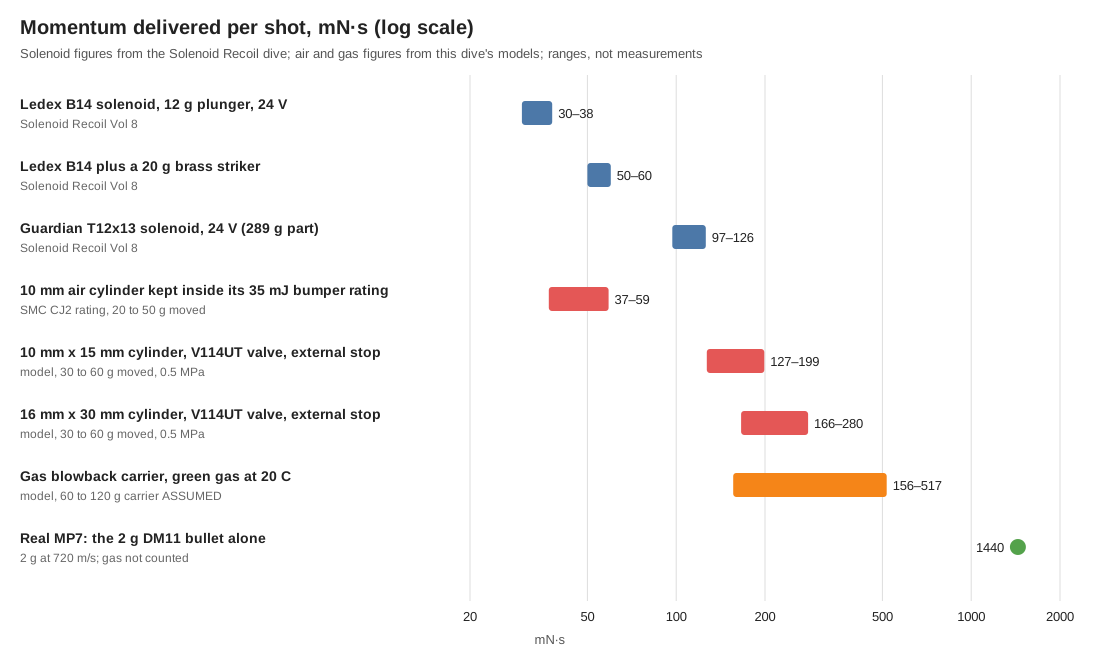
Table 1 — What the hand feels, in one chart
| Mechanism | Momentum at the stop | Source |
|---|---|---|
| Ledex B14 solenoid, 12 g plunger, 24 V | 30–38 mN·s | Solenoid Recoil Vol 8 |
| Ledex B14 plus a 20 g brass striker | 50–60 mN·s | Solenoid Recoil Vol 8 |
| Guardian T12x13 (289 g part), 24 V | 97–126 mN·s | Solenoid Recoil Vol 8 |
| 10 mm air cylinder within its 35 mJ bumper rating, 20–50 g | 37–59 mN·s | SMC CJ2 rating; own arithmetic |
| 10 × 15 mm cylinder, large-flow valve, 30–60 g, external stop | 127–199 mN·s | Volume 2 model |
| 16 × 30 mm cylinder, large-flow valve, 30–60 g, external stop | 166–280 mN·s | Volume 2 model |
| Gas-blowback carrier, 60–120 g assumed, green gas at 20 °C | 156–517 mN·s | Volume 3 model |
Read honestly, the chart says three things. Pneumatics can kick two to five times harder than the solenoids the build is buying, and a gas-blowback carrier possibly more, if the models are right and if the impact happens at an external stop. Kept inside an industrial cylinder’s own rating, air is no stronger than a solenoid. And the overlap at the top is real: the heaviest solenoid on the list reaches the bottom of the air band, at a weight (289 g) that Solenoid Recoil Vol 8 already flags as too much for an MP7-sized shell.
4.2 Against the real gun
The real MP7’s DM11 round fires a 2.0 g bullet at 720 m/s.1 The bullet alone carries 1.44 N·s, or 1,440 mN·s, before the propellant gas adds its share. Even the top of the gas-blowback range is about a third of that, and a solenoid about a fortieth. No mechanism in this dive is a recoil simulator in the trainer’s sense; all of them are a cue. That is worth saying because the case for air rests on “more realistic”, and the gain is from a fortieth to perhaps a fifth or a third of the real thing, not to the real thing. The real gun’s handling belongs to the HK MP7 dive.
4.3 Timing
From the trigger to the stop:
Table 2 — From the trigger to the stop
| Mechanism | Time to the stop | Source |
|---|---|---|
| Solenoid, 24 V, the Solenoid Recoil model | about 10 ms (24 V); about 24 ms (12 V) | Solenoid Recoil Vol 4 |
| Air, large-flow valve | 5 ms valve opening + 10–13 ms stroke, about 15–18 ms | Volume 2 |
| Air, standard valve | 5 ms + 17–27 ms, about 22–32 ms | Volume 2 |
| Gas blowback, solenoid on the knocker | solenoid flight + valve + about 8–17 ms stroke | Volume 3 model |
None is fast enough to matter against a 16.7 ms video frame in a way the others are not. The fastest kick in the list is the 24 V solenoid.
4.4 Noise
- Solenoid: the impact at the stops, which damping and a stiff sub-chassis control (Solenoid Recoil Vol 5). The Time Extension review quoted there found the Sinden’s default recoil “quite loud”.
- Air: the same impact, plus the exhaust of every shot from the valve (Volume 2), plus the compressor whenever it runs; a 12 V pump of the class in Volume 2 is rated at 63 dB at 30 cm.
- Gas blowback: the impact of a carrier that kicks harder, plus the gas venting from the gun on every shot, which is the sound of an airsoft gun firing.
No level for any of these has been measured for this dive. The sound measurement is in the bench plan.
4.5 What each costs to live with
Table 3 — What each costs to live with
| Regulated solenoid (D13) | Compressed air (Volume 2) | Green-gas blowback (Volume 3) | Tethered air into a GBB (Volume 3, option 3) | |
|---|---|---|---|---|
| Consumable | Electricity | Electricity (compressor) | Propane, about 0.13–0.3 g a shot | Electricity (compressor) |
| Tether | The cable (D31) | Cable plus an air line | Cable only | Cable plus an air line |
| Shot-to-shot consistency | Set by current regulation | Set by the regulator | Falls through a string as the magazine cools | Set by the regulator |
| Indoor hazard | Heat, the 24 V rail | A pressurised line below 0.7 MPa | Flammable gas released on every shot; filling; a pressure vessel in the grip | A pressurised line |
| Upkeep | None routine | Drain the filter and tank | Refill; seal oil; the magazine’s valves | Drain the filter and tank; the GBB’s seals |
| Legal status (Michigan) | An object shaped like a gun | The same | A pneumatic gun unless made unable to fire a BB | The same as green gas |
| Fits the first build (D35, printed) | Yes | Only with a cylinder, valve and striker designed into the shell | No: a printed gun has no gas action | No, for the same reason |
4.6 Why this, and why not the others
Picked for the first build: the regulated-current 24 V solenoid stage already decided (D13, D14), unchanged. It is the only mechanism that fits a printed MP7 without bringing in a second tether, a compressor or a gas; it gives the same shot every time by design; and the solenoid shortlist (D15) is already being bought.
Table 4 — Why this, and why not the others
| Alternative | Why it is not the pick |
|---|---|
| Compressed air with a cylinder | Two to five times the modelled kick, but only with a large-flow valve and an external stop that puts the cylinder outside its catalogue rating; adds an air line, a compressor in or near the room, a hiss on every shot and a filter to drain. Worth a bench experiment to measure whether the extra impulse is real and wanted, not a place in the first build |
| Green-gas blowback (options 1 and 2) | The strongest modelled kick and a real moving carrier, but propane released indoors on every shot, a magazine that cools and weakens through a string, refilling, an empty-magazine hold-open and bore gas to defeat, and a gun that must be made legally unable to fire a BB. And the printed gun has no gas action to keep |
| Tethered air into the KWA donor’s action (option 3) | Removes propane, cooling and refilling; set by a regulator like D13. The only gas-blowback route to try, and only later, in the KWA donor once D47’s purchases happen. Needs the air line and compressor of the pneumatic route plus a valve with enough flow |
| CO₂ | Needs a CO₂-rated gun; cools harder; wears seals; and is never put into a green-gas magazine |
| Bottled HPA | A 3,000–4,500 psi vessel with five-yearly testing, to supply what a workshop compressor gives at 100 psi |
| Motors | A different cue (rumble, or a cranked mass like Operation Wolf’s); the Motors and Rumble dive covers them |
What would change this verdict: a bench measurement showing that a 10 mm cylinder with a free striker delivers well over twice the impulse of the best solenoid on the shortlist, at a sound level the owner accepts, and an owner who prefers it in a blind comparison. Then a pneumatic stage would be a candidate for the second gun.
4.7 The bench plan
The solenoid bench in Solenoid Recoil Vol 6 already has the method: a hanging test mass, an analogue accelerometer (ADXL1001 or ADXL1002) into an ADP3450 scope channel, and the impulse found by integrating acceleration across the impact only. The air rig is built to hit the same test mass so that the numbers compare directly.
Rig A, compressed air (proposed, low cost).
- Supply: the workshop compressor, a filter-regulator with a gauge set to 0.3, 0.4 and 0.5 MPa in turn.
- Valve: a 24 V direct-operated three-port valve of the large-flow class (SMC V114A or V114UT, or an equivalent whose C or Cv is known), mounted within a few centimetres of the cylinder.
- Cylinder: a 10 mm bore, 15 mm stroke cylinder (SMC CJ2 or CJP class) pushing a free brass striker of 30 g and then 60 g on its own guide into the test mass’s stop; the rod stops on its own cushion.
- Drive: an ADP3450 digital output into a logic-level MOSFET with a flyback diode; pulse 10, 15, 20 and 30 ms.
- Measure, on the ADP3450’s four scope channels: coil current (sense resistor), cylinder pressure (a 0–1 MPa ratiometric pressure sensor teed into the cap port, powered from a supply rail), the accelerometer, and a microphone.
- Repeat with the same striker driven by the best shortlist solenoid on the regulated stage, same day, same mass.
Pass mark for adopting air for a later gun: measured impact impulse at least twice the best solenoid’s; a sound level the owner accepts at the shooter’s ear; a blind A/B preference.
Rig B, gas blowback (only if the KWA donor is bought, D47).
- Weigh the magazine, full, on a 0.01 g scale; fire a counted string of 10; weigh again. Repeat at strings of 20 and 40. This gives grams per shot with no BB, the figure no maker publishes.
- A thermocouple taped to the magazine body, logged through the ADP3450 (via a thermocouple amplifier) through the string: the real cooling curve to set against Volume 3’s model.
- The accelerometer on the gun’s receiver at the buffer: the carrier’s impact impulse, shot by shot through the string, so the fade can be read directly.
- With the bore blocked and then vented away from the muzzle, note whether the carrier cycles every time and whether oil reaches a clean glass slide held where the camera window would be.
4.8 Proposed decision-log rows
For the controlling session to add to Light-Guns/DECISIONS.md:
Table 5 — For the controlling session to add to Light-Guns/DECISIONS.md
| # | Area | Options considered | Proposed | Status | Why, and why not | Source |
|---|---|---|---|---|---|---|
| AB-1 | Recoil engine, first build | Regulated solenoid; compressed-air cylinder; green-gas GBB; tethered air into a GBB; CO₂; bottled HPA | Keep the regulated solenoid (D13, D14); no air or gas in the first gun | Proposed | Only option that fits the printed gun without a second tether, a compressor or a gas; air’s larger modelled kick is unmeasured | Air-and-Blowback Vol 4 §4.6 |
| AB-2 | Air bench experiment | none; Rig A | Rig A: shop air, 0.3–0.5 MPa, large-flow 24 V 3/2 valve, 10 × 15 mm cylinder, free 30/60 g striker, same test mass as the solenoids | Proposed | Cheap; settles whether air is worth a second gun | Vol 4 §4.7 |
| AB-3 | Gas-blowback route (KWA donor) | green gas, options 1/2; tethered air, option 3; CO₂ | Tethered air (option 3) only, later, if D47 donors are bought; never propane indoors in a light gun | Proposed | Removes flammable gas, cooling and refilling; regulator gives D13-like consistency | Vol 3 §3.12 |
4.9 What could not be verified
- Every air and gas momentum figure in this volume is modelled. The solenoid figures are themselves model results from Solenoid Recoil Vol 8. Nothing has been measured.
- Noise levels for any of the mechanisms.
- The real MP7’s total recoil impulse, including propellant gas; only the bullet’s share is computed here.
Sources
Footnotes
-
“4.6×30mm”, English Wikipedia, read 2026-10-19 (DM11: 2 g bullet, 720 m/s). ↩
Comments (0)