Airsoft Gas · Volume 5
HPA — High-Pressure Air Systems
5.1 What HPA Is
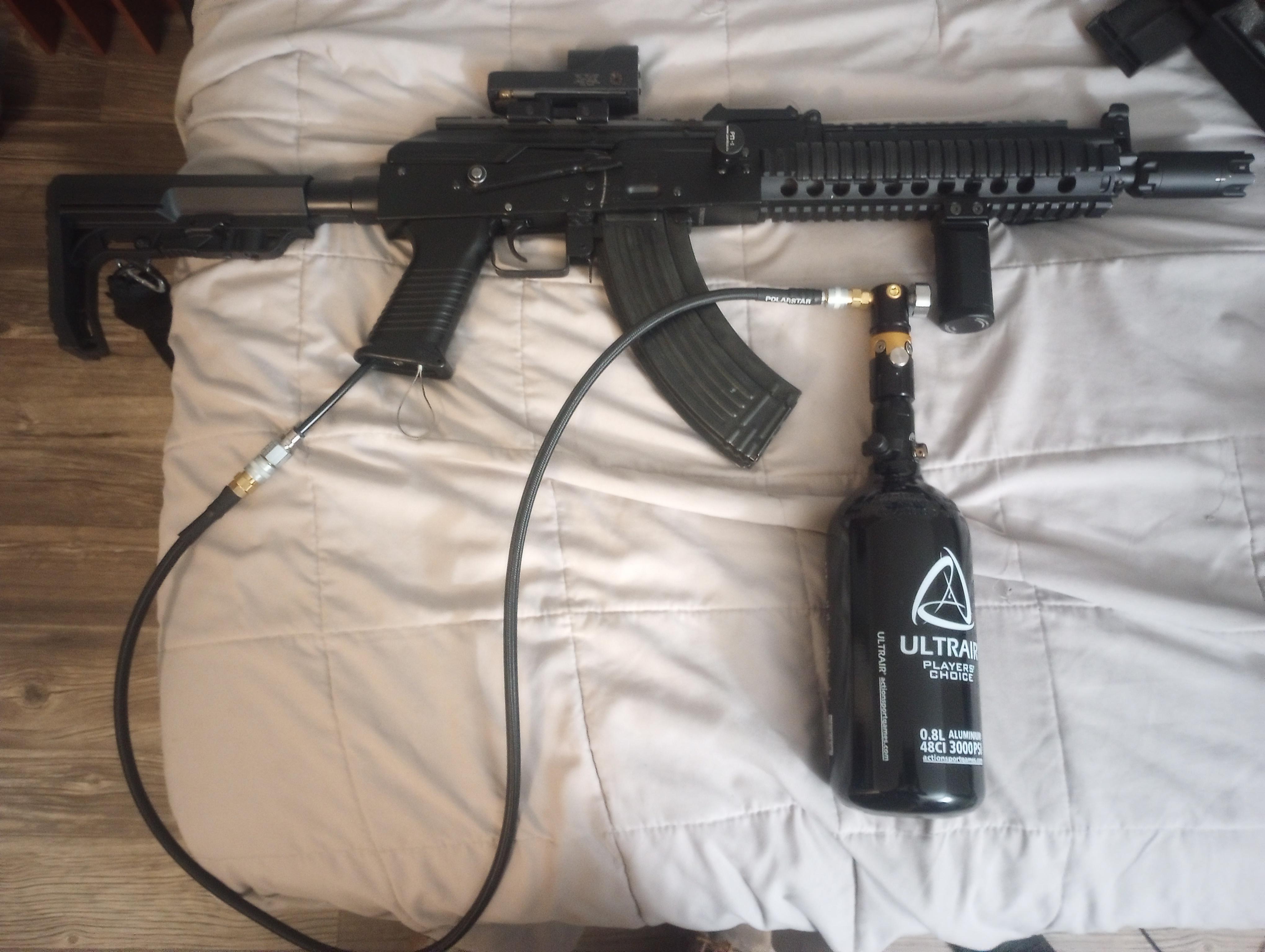
Everything in the previous volumes has been about liquefied gases — green gas, CO₂, the duster propellants — substances that sit in the magazine as a liquid in equilibrium with their own vapor, and whose pressure is therefore dictated by temperature. HPA throws that whole model out. HPA stands for High-Pressure Air, and the operative word is air: ordinary compressed air, stored as a gas at very high pressure in an external tank, fed down a line, and stepped down through a regulator to a constant working pressure before it ever reaches the gun. Nothing in the system is liquefied, so nothing in the system has a vapor-pressure curve.
The signal flow is worth stating plainly because it is the whole architecture: tank → line → regulator → engine (nozzle/poppet). The tank holds the air at 3000 or 4500 psi. A regulator — usually one on the tank head, often a second inline — drops that storehouse pressure down to a low, stable working pressure. A flexible line carries that regulated air to the gun, where a pneumatic engine uses it to launch each BB. Because the regulator delivers the same pressure on every shot regardless of what the tank’s remaining charge is doing, HPA decouples velocity from temperature. That is the headline advantage over both green gas and CO₂. A green-gas gun loses FPS on a cold morning and sags further as the magazine chills under rapid fire; a CO₂ gun cools itself with every shot. An HPA gun does neither — the regulator sees to it that the engine gets the same air whether it is 0 °C or 30 °C, first shot or five-hundredth. The cost of that consistency is a tether: the gun is physically tied by a line to a tank you carry on your back or rig.
5.2 Regulators & Engines
The heart of an HPA build is the engine — the pneumatic unit that replaces an AEG’s mechanical guts — and it is worth being precise about the terminology, because the marketplace is loose with it. A regulator regulates pressure; an engine fires the gun. The two most prominent engine makers are PolarStar and Wolverine.
The PolarStar F2 is a drop-in engine built around a patented dual-solenoid design that controls the nozzle and the poppet independently. It runs on an operating pressure of roughly 45–145 psi and is adjustable across a wide velocity band (the manufacturer cites a range on the order of ~205–500 FPS, figures per maker copy) and from a single shot up to 30-plus rounds per second. Its single-solenoid sibling, the PolarStar JACK, is the more affordable engine — the nozzle doubles as its own poppet — and runs roughly 45–130 psi with comparable top-end velocity and rate of fire. Wolverine’s flagship is the INFERNO (GEN 2), a single-solenoid hybrid open/closed-bolt engine quoting an input range of about 60–140 psi, an adjustable output of roughly 0.5–3 J, and 5–35 RPS (all approximate, manufacturer figures). Wolverine also makes the HYDRA for offset-nozzle platforms — the M14, P90, Thompson and Tavor families whose gearbox geometry will not take a centered engine.
The Redline N7 belongs in this list with a correction attached: it is an engine, not a regulator. It is a true closed-bolt, drop-in cylinder-replacement engine that fills an internal fixed-volume “dump chamber” to whatever pressure the external supply regulator is set to — which means on an N7 you tune FPS by setting the supply regulator rather than dialing the engine itself. (Redline does sell separate regulators, which is part of why the naming gets muddled.) Worth noting too is that HPA is not exclusively a rifle technology: the same regulated-air principle drives some pistols and gas blowback rifles fed by a line, though the drop-in AEG engine is where the bulk of the gear lives.
5.3 Tanks & Regulated Output
The air comes from a paintball/scuba-style compressed-air tank, and there are two material classes. Aluminum tanks are rated to a maximum of 3000 psi; carbon-fiber tanks go to 4500 psi. The carbon-fiber bottle holds roughly 1.5× the air for a given size, which translates to about 35% more shots per fill, along with less weight — at a higher price. Either way, that 3000–4500 psi is a storehouse pressure, not a working pressure, and it must be stepped down hard before it touches the engine.
That is the regulator’s job. The on-tank “head” regulator delivers either a super-low-pressure (SLP) ~300 psi output or a high-pressure (HP) ~600–800 psi output, and a secondary inline regulator then trims that to the engine’s actual input range. The number to anchor on is the engine ceiling: most airsoft engines top out around 130 psi, with 145 psi being about the practical maximum (“really pushing it”). A useful working figure is therefore roughly 0–150 psi adjustable, with engines typically run at ~80–130 psi — the brief’s occasionally-quoted “0–200 psi” overstates the real feed range. A single tank fill yields a large shot count: PolarStar, for example, cites on the order of 1000+ shots from a small 13/3000 tank at a modest energy setting (manufacturer figure, energy- and ROF-dependent), so duration is rarely the limiting factor in a day’s play.
5.4 FPS Consistency & Tuning
HPA is the most shot-to-shot consistent way to power an airsoft gun, and the reason is structural. Because the regulator hands the engine the same pressure every cycle, each shot fires on the same metered volume of air — independent of outside temperature, of how fast the trigger is pulled, and of how much air remains in the tank (velocity stays flat right up until the tank drops below the regulator’s set point). Bottled gases cannot match this: their pressure drifts with temperature and falls as the magazine empties and chills.
Tuning is correspondingly direct. FPS is set by the working pressure — raise the regulator setting and the engine launches the BB harder; lower it and velocity drops, which is how a single gun is dialed from a 350-FPS indoor limit to a 450-FPS outdoor field without changing a spring. Rate of fire is set electronically through the engine’s fire-control unit (FCU/FCB), independently of velocity, allowing arbitrary RPS caps, burst modes, and trigger response. Velocity and rate of fire being independently adjustable — rather than coupled through a spring-and-motor compromise as in an AEG — is precisely why HPA dominates the competitive and high-end ends of the hobby.
5.5 HPA vs Gas vs AEG
The trade-offs sort cleanly against the two alternatives covered elsewhere in this series and against the spring-and-battery AEG:
Table 1 — The trade-offs sort cleanly against the two alternatives covered elsewhere in this series and against the spring-and-battery AEG
| Factor | HPA | Bottled gas (green/CO₂) | AEG |
|---|---|---|---|
| Shot-to-shot consistency | Best — regulated, flat | Drifts with temperature & mag level | Good, mechanical |
| Temperature independence | Full — air, not a vapor | Poor (green gas) / fair (CO₂) | Full |
| FPS / ROF tuning | Independent, dial-in via reg + FCU | Fixed by gas + gun | Spring + motor swap |
| Up-front cost | High (engine + tank + reg + line) | Low–moderate | Low–moderate |
| The tether | Line to a worn tank — the key downside | None (self-contained) | None (battery onboard) |
| Realism | No reciprocating mass on most engines | Realistic blowback kick | No blowback |
| Maintenance | Low once tuned; pneumatic, few wear parts | Higher (seals, CO₂ cool-down, oiling) | Moderate (gears, motor, wiring) |
The defining cost of HPA is not money but the line: the gun is permanently tethered to a tank that must be carried and routed, and that tether is the reason some players never switch despite the consistency. HPA also trades away the visceral recoil of a gas blowback gun — most engines have no reciprocating mass, so no kick — in exchange for being temperature-proof, finely tunable, and, once set up, low-maintenance. It is the choice of players who value a perfectly repeatable shot above realism or self-containment.
Comments (0)