Airsoft Gas · Volume 3
Performance, FPS & Plastic vs Metal
3.1 From PSI to Muzzle Velocity
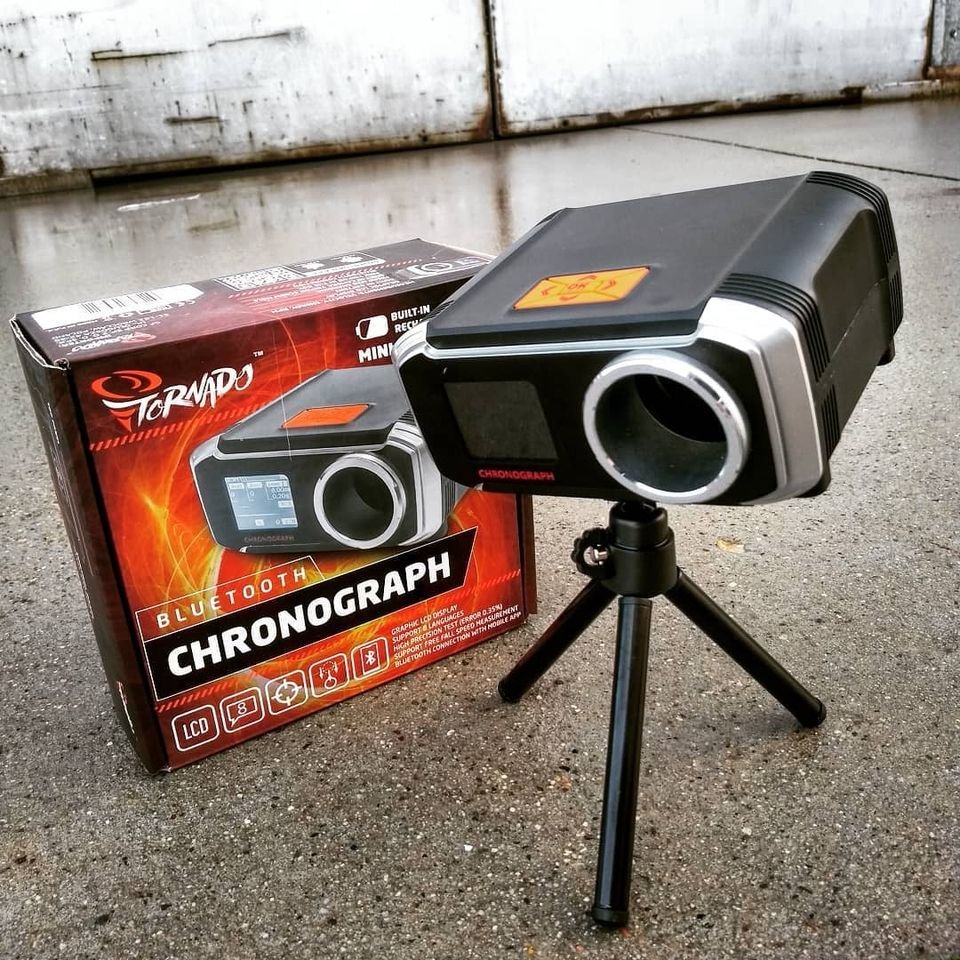
The pressure tiers of Volume 2 are the input; muzzle velocity is the output, and the conversion is not as direct as “more pressure equals more FPS.” When the knock valve opens, the headspace pressure — set by the gas’s vapor-pressure curve at the current temperature — pushes a metered pulse of vapor behind the BB. That pulse accelerates the BB down the barrel until the BB exits. Higher valve pressure means a stronger push and a higher exit velocity, but the relationship is mediated by barrel length, bore seal, hop-up setting, and how much of the gas charge is actually spent before the BB leaves. Two guns reading the same headspace pressure can chronograph differently because one dumps its charge more efficiently into the BB than the other.
What actually matters is not velocity but energy. Field limits, the danger a BB poses, and the honest measure of how “hot” a gun is are all energy quantities, and energy is what the conversion makes legible. The kinetic energy of a BB is E = ½ · m · v², with mass in kilograms and velocity in metres per second (FPS × 0.3048 = m/s). The reference point worth memorizing is 0.20 g at 328 FPS (100 m/s) = 1.00 joule — the anchor every chrono reading is measured against. From there the curve is steep because velocity is squared:
Table 1 — What actually matters is not velocity but energy. Field limits, the danger a BB poses, and the honest measure of how "hot" a gun is are all energy quantities, and energy is what the conversion makes legible. The kinetic energy of a BB is E = ½ · m · v², with mass in kilograms and velocity in metres per second (FPS × 0.3048 = m/s). The reference point worth memorizing is 0.20 g at 328 FPS (100 m/s) = 1.00 joule — the anchor every chrono reading is measured against. From there the curve is steep because velocity is squared
| FPS (0.20 g) | m/s | Joules |
|---|---|---|
| 328 | 100.0 | 1.00 |
| 350 | 106.7 | ~1.14 |
| 400 | 121.9 | ~1.49 |
| 450 | 137.2 | ~1.88 |
| 500 | 152.4 | ~2.32 |
The reason to think in joules rather than FPS is that FPS alone is ambiguous — it only means something when the BB weight is stated alongside it. A “400 FPS gun” is meaningless until you know whether that 400 was read on a 0.20 g BB or a 0.40 g BB, because the two represent very different energies. Joules collapse the ambiguity into one number, which is exactly why the next section matters.
3.2 Joule Creep
Here is the counterintuitive part: switch a gun from a light BB to a heavy one, change nothing mechanically, and the muzzle energy in joules can go up. This is joule creep, and it is a dwell-time effect. A light 0.20 g BB accelerates fast and exits the barrel early — often before the expanding gas charge has finished dumping its energy. The surplus gas behind it is simply wasted out the muzzle. A heavier BB accelerates more slowly, so it dwells longer in the barrel, and during that extra dwell the still-expanding gas keeps pushing. The heavy BB therefore extracts more of the available charge and leaves with higher total kinetic energy than the light one did.
Joule creep is worst exactly where there is a large, slow-dumping reservoir of gas behind the BB — gas blowback rifles and HPA systems, and short barrels (where even a light BB has barely begun to exhaust the charge by the time it exits). A spring AEG with a tightly matched cylinder shows comparatively little creep; a GBBR with a big gas charge shows a lot. As an illustrative figure (approximate), a sniper rig chronographing 2.3 J on 0.20 g can reach roughly 2.7 J on 0.40 g — about a 0.4 J gain with no spring or valve change at all.
The consequence drives field policy. A gun can pass an FPS limit on 0.20 g and still exceed the energy limit on the heavy ammo it actually shoots, which is why serious fields chrono by joules on a known/heavy BB (or enforce a minimum engagement distance) rather than trusting an FPS reading on a 0.20 g BB. FPS-only limits are a loophole that joule creep walks straight through; gas guns, with their abundant charge, are the platform that exploits it hardest.
3.3 Temperature Effects
Everything in this volume rides on the P–T curve from Volume 2, because the headspace pressure that becomes FPS is itself a function of temperature. Three behaviors follow directly. First, per-shot cool-down: vaporizing liquid propellant is endothermic, so every shot pulls latent heat out of the magazine. Second, rapid-fire FPS fade: dump a magazine quickly and the liquid chills, its vapor pressure slides down its own curve, and FPS sags shot-over-shot until the gun short-strokes — then recovers after a rest as ambient heat re-warms the charge. Third, hot-day spikes: the same green-gas gun that chronographed comfortably in spring can climb toward or past its FPS limit on a hot afternoon, because propane’s curve runs from about 53 psig at 0 °C to roughly 141 psig at 30 °C. CO₂’s steeper, higher curve makes it far more forgiving in the cold — it still holds plenty of pressure at 0 °C — which is the main performance argument for CO₂ in winter play.
3.4 Plastic vs Metal
Pressure is also what cracks guns, and the differential is brutal: green gas runs about 110–150 psi, while CO₂ sits above 800 psi — roughly 7.5× the design pressure of a green-gas gun. That pressure drives a faster, harder blowback cycle. On the rearward stroke the slide slams back harder; on the forward stroke a stronger recoil spring whips it forward, the nozzle rams the hop chamber, and shock transfers into the frame. Run that cycle on a thin ABS slide or polymer nose built for propane and it cracks the slide, splits the nose, or blows out seals — sometimes, as vendors bluntly put it, “instantly.”
This is why the green-gas-only versus CO₂-rated distinction is load-bearing. Tokyo Marui and other Japanese pistols are tuned for low-pressure HFC-134a; their plastic slides and outer barrels “break very quickly” on green gas, let alone CO₂. KWA NS2 pistols use metal alloy slides engineered as green-gas platforms. KJ Works explicitly markets guns built to handle CO₂ and commonly ships both green-gas and CO₂ magazines. The general rule is absolute: only a gun made to handle CO₂ should be fed CO₂, and using the wrong gas can both destroy the gun and void the warranty (manufacturer warranty wording here is community-aggregated — treat it as indicative). Magazines are not cross-compatible either; filling a green-gas magazine from a CO₂ source dumps ~60 bar into a body rated for a seventh of that — “you’ve created a bomb.”
A metal slide is the trade you make to survive higher pressure. It adds durability and lets the gun handle stronger gas, but it is heavier, so it cycles slower without supporting upgrades (stronger valves, recoil and hammer springs, more gas) — and a harder recoil spring can itself crack the nozzle or frame over time. CO₂ also means more wear and more frequent maintenance generally. The synthesis: a full-metal slide is effectively a prerequisite for sustained CO₂ use, and the upgrade guidance follows from that — if the goal is CO₂, start from a CO₂-rated metal platform rather than trying to harden a plastic green-gas gun into one.
3.5 Chrono & Safety
The chrono workflow standardizes all of the above. Shoot across a chronograph using 0.20 g BBs as the reference weight, read the result in FPS and (ideally) joules, and compare against the field’s published limit. Because of joule creep, the better fields read or compute joules on a heavier BB, and most pair their limit with a minimum engagement distance (MED) for the hotter classes.
Representative limits look like the table below — but every one of these is typical and varies by field, state, and country, so the only rule that always holds is to chrono to the local posture before play.
Table 2 — Chrono & Safety
| Class | Typical FPS (0.20 g) | Joule equiv. | MED |
|---|---|---|---|
| Pistol / sidearm | ≤350 FPS | ~1.14 J | often none |
| AEG / standard rifle | ≤400 FPS | ~1.49–1.6 J | short or none |
| Indoor / CQB | 300–350 FPS | ~0.84–1.14 J | tighter, often semi-only |
| DMR / sniper | 450–500 FPS | ~1.88–2.8 J | ~100 ft (≈30–40 m) |
The UK regime states the same tiers directly in energy — commonly 1.14 J for full-auto and 2.32 J for semi-auto / bolt-action, which map onto the ~350 and ~500 FPS lines above. And the one non-negotiable that sits above every FPS and joule number: eye protection is mandatory, always. A 1 J BB to an unprotected eye is a permanent injury; rated sealed eyewear (full-seal goggles, not slim shooting glasses, for most fields) is worn from the moment you step on the field to the moment you step off.
Comments (0)