Airsoft Gas · Volume 4
Alternate Gases — Propane & CO₂
4.1 Propane — the Green-Gas Equivalent
The single most useful fact in this whole series is that green gas is propane. Airsoft Innovations had it lab-analyzed and confirmed what the chemistry already implied: the bottled “top gas” sold at airsoft retailers is filtered propane with the strong odorant removed, a mild perfume added back, and a charge of silicone oil mixed in. The propane is the propellant; the silicone oil is what rides into the magazine on every fill to keep the O-rings and valve seals supple. Strip away the branding and the price markup and green gas is a camping fuel.
That equivalence is the whole cost argument. A retail can of green gas runs roughly $9–20 (approximate, and volatile by region and date); a one-pound (16.4 oz) Coleman-style camp propane bottle holds far more gas for about $3–6. The propellant inside is chemically the same, so the per-fill cost of running bulk propane is a small fraction of running green gas — the savings compound fast for anyone who shoots gas regularly. This is why bulk propane is the standard “refill hack” in the hobby.
The catch is the one ingredient propane lacks: raw camp propane is dry. It has no silicone oil, and a gas blowback gun fed dry propane will run its seals without lubrication and dry them out over time. So you cannot simply thread a Coleman bottle onto a magazine fill valve — and even if you could, the fittings do not match. Both problems are solved by a propane fill adapter, which does two jobs at once: it mates the camp-bottle valve to the airsoft magazine’s fill nozzle, and it meters silicone oil into the gas stream so the dry propane arrives at the seals carrying the lubrication green gas would have brought built-in. The adapter is a one-time purchase (roughly $5–35 depending on model), after which every fill is propane-cheap. The adapters themselves — the specific brands, the all-metal versus polymer probe trade-off, and exactly how much silicone oil to dose — are the subject of Volume 6; for the purposes of this volume the point is simply that the adapter is mandatory, and it is mandatory precisely because it restores the silicone oil that bare propane is missing.
4.2 CO₂
CO₂ is a different animal entirely, and the difference is pressure. Where green gas and propane sit around 110–150 psi at room temperature, CO₂ runs to roughly 830–860 psi at 70 °F — about 7.5× the working pressure of green gas. That single number explains everything else about how CO₂ behaves: more velocity, more recoil, more cold-weather margin, and far more stress on everything it touches.
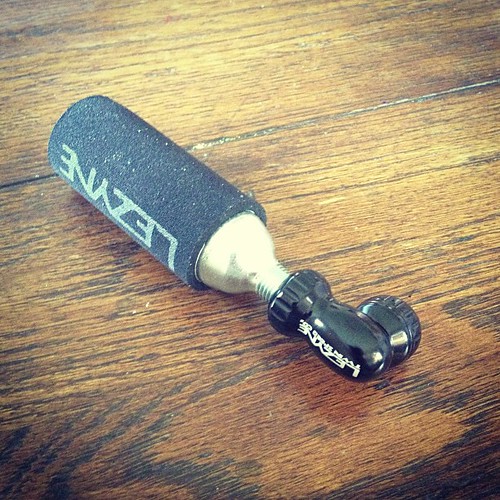
CO₂ is delivered not as a refillable can but as a sealed 12-gram cartridge — the same threaded “powerlet” used across the wider airgun world. The cartridge is pierced inside a CO₂-specific magazine, which holds the liquid CO₂ and the piercing/retention hardware in a much heavier, higher-pressure body than a green-gas magazine. A single 12 g cartridge typically yields somewhere around 40–60 shots (typical; blowback guns sit at the low end, non-blowback higher), heavily dependent on the gun and how fast you shoot.
That last clause matters, because CO₂’s headline weakness is aggressive per-shot cool-down. Its higher pressure and faster expansion pull latent heat out of the cartridge faster than green gas does, so rapid fire chills the magazine quickly — pressure drops, FPS sags, and the gun forces you to pause and let it re-warm. The same physics that gives CO₂ its punch makes it the more temperamental gas under sustained fire.
CO₂ is also hard on hardware. A pierced cartridge left in a magazine holds that 800-plus-psi charge continuously, and the combination of sustained high pressure and repeated cold cycling degrades O-rings — hardening, cracking, and eventually leaking. Over-tightening the cartridge retention screw can deform the seal or crack the magazine body outright. And that same pressure is what shatters plastic: an ABS slide or polymer nose built for propane will crack or blow out seals under CO₂. The governing rule, carried over from Volume 3, is that there are CO₂-rated guns and green-gas-only guns, and the distinction is not advisory.
4.3 Pros, Cons & Safety
The trade-off between the two gases lines up cleanly:
Table 1 — The trade-off between the two gases lines up cleanly
| Factor | Propane / Green Gas | CO₂ |
|---|---|---|
| Cost per fill | Very low (bulk propane) | Per-cartridge, moderate |
| Working pressure | ~110–150 psi | ~830–860 psi (~7.5×) |
| Cold weather | FPS sags as it chills | Holds pressure far better |
| Gun wear | Gentle — longer gun life | High — more maintenance |
| Lubrication | Self-lubricating (green gas); adapter doses oil (propane) | Dry — needs manual silicone |
| Availability | Cans + camp bottles everywhere | 12 g cartridges everywhere |
| Flammability | Flammable | Inert / non-flammable |
The first safety rule is absolute and bears repeating from Volume 3: never run CO₂ in a green-gas-only gun. Roughly 60 bar into a body rated for a seventh of that is not a leak, it is a burst — vendors do not exaggerate when they call a CO₂-filled green-gas magazine “a bomb.” Match the gas to the gun’s rating, every time.
The second cluster is storage and transport. Both gases are pressurized, and pressure rises with temperature, so keep cans and cartridges cool, dry, and out of direct sunlight — a CO₂ cartridge baking in a hot car is a genuine hazard. Bleed magazines down after play to spare the seals (and to avoid storing a charged green-gas mag, which slowly stresses its valve). Remember too that propane and green gas are flammable while CO₂ is inert — a point in CO₂’s favor for indoor and vehicle storage. Finally, pressurized gas generally cannot be shipped or flown; the universal advice is to buy your gas at the destination rather than trying to travel with it (verify the specific carrier and IATA rules before any trip).
Comments (0)