Airsoft Gas · Volume 1
Overview & How Gas Guns Work
1.1 Why Gas
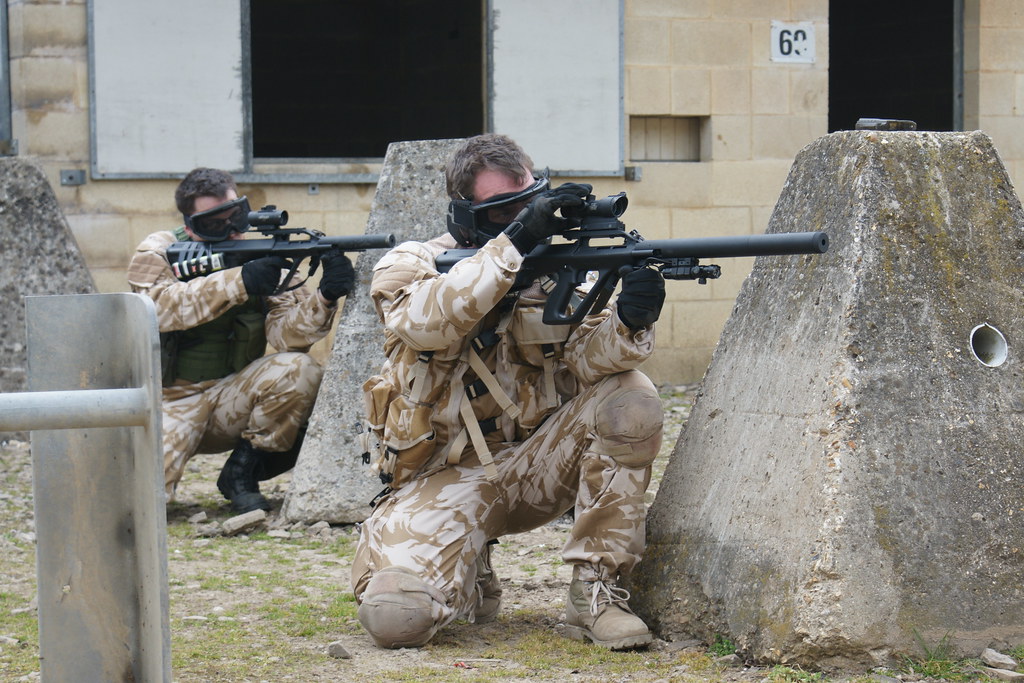
Airsoft has three propulsion families: spring (manual cock-per-shot), AEG (an electric motor driving a piston through a gearbox), and gas. Gas is the family that buys realism. A gas blowback (GBB) pistol or gas blowback rifle (GBBR) stores liquefied propellant in the magazine; each trigger pull dumps a metered charge that both launches the BB and drives a reciprocating slide or bolt rearward — a real blowback cycle, with audible report, a sharp kick into the web of the hand, and a locking-back slide on the last round. Nothing in the spring or AEG world reproduces that. For a maker who cares about the gun behaving like the firearm it replicates — recoil impulse, manual-of-arms, mag changes that matter — gas is the only family that gets there.
The trade-offs are real and worth stating up front. AEGs are temperature-stable, cheap to run, and fire all day on a battery; gas guns are weather-sensitive (output sags in the cold), consumable-hungry (you buy propellant and burn through seals), and mechanically fussier. Spring guns are the most reliable and the cheapest but are single-shot-tempo and offer no recoil. Gas trades operating cost and cold-weather consistency for a fidelity of feel the other two cannot match. The rest of this series is, in effect, an engineering treatment of how to manage that trade-off — which propellant, in which gun, at which temperature, for which use case.
1.2 How a Gas Gun Works
The governing physics is the vapor pressure of a liquefied gas. The propellant — green gas (propane), CO₂, or an HFC refrigerant — sits in the magazine as a liquid in equilibrium with its own vapor. The pressure above that liquid is set by the gas’s vapor-pressure curve at the current temperature, and it is independent of how much liquid remains: as long as any liquid is present, the headspace stays at the saturation pressure for that temperature. That self-regulating reservoir is the whole reason a magazine delivers many shots at roughly constant pressure rather than bleeding down like a fixed air tank.
The mechanism is straightforward. A one-way fill valve in the magazine baseplate accepts gas from the can or cartridge; you charge the mag until liquid stops accepting (a few seconds), and a small overflow burp confirms it. The magazine is the reservoir — propellant and BBs live together. On the trigger pull, the hammer strikes a knock/output valve, releasing a timed pulse of vapor. That pulse splits: part drives the BB down the barrel, part is routed to the blowback unit to cycle the slide or bolt, which re-cocks the hammer, strips and chambers the next BB, and (on the last round) locks back.
The behavior that surprises new gas shooters is per-shot cool-down. Vaporizing liquid propellant is endothermic — it pulls its latent heat of vaporization straight out of the magazine and the liquid charge. Fire slowly and ambient heat keeps the reservoir topped up; fire fast and the liquid chills, its vapor pressure drops down its own P–T curve, and FPS sags shot-over-shot until the gun starts to short-stroke. This is why a GBBR mag dumped on full-auto goes limp after a long burst, then recovers after a rest — the physics, not a fault. The magnitude of the effect tracks the gas’s volatility, and the full vapor-pressure-versus-temperature treatment is the subject of Volume 2.
1.3 The Propellant Family at a Glance
Green gas is the mainstream choice — filtered propane with a little silicone oil mixed in to lubricate seals on every fill (lab analysis confirms green gas is propane). Roughly 109 psig at 70 °F, it is gentle enough for most metal-slide guns and self-lubricating. Red gas is HCFC-22, a stronger ozone-depleting refrigerant now phased out in the US; treat it as legacy. Blue gas is HFC-134a, the deliberately low-pressure “duster” gas (~70–90 psi) that Japanese makers tune their plastic-slide pistols around. Propane is the same propellant as green gas, bought raw at a fraction of the cost — it just needs an adapter to mate the camp-bottle valve to the mag and to meter in silicone oil. CO₂ is the high-pressure bottled option, roughly 830 psia at 70 °F — about 7× green gas — delivering more FPS and harder recoil but demanding a gun built for it. HPA (high-pressure air) is regulated compressed air from a tank, the most FPS-consistent option of all because output is set by a regulator, not a vapor curve.
Table 1 — The Propellant Family at a Glance
| Propellant | Pressure tier (≈70 °F) | Typical use | Pros / Cons |
|---|---|---|---|
| HFC-134a (blue) | Low (~70–90 psi) | Plastic-slide / Japanese pistols | Gentle on plastic / weakest output, cold-sensitive |
| Green gas (propane + oil) | Medium (~109 psig) | Mainstream GBB/GBBR | Cheap, self-lubricating, gentle / flammable, FPS sags cold |
| Propane (raw) | Medium (≈ green gas) | Budget green-gas substitute | Cheapest per fill / needs adapter + manual oiling, flammable |
| Red gas (HCFC-22) | Medium-high (~130–200 psi, approx) | Legacy / phased out in US | Stronger / ozone-depleting, hard to source |
| CO₂ | High (~830 psia) | High-FPS pistols, cold weather | Hotter, consistent in cold, inert / heavy wear, dry, cracks plastic |
| HPA | Tunable (~0–150 psi regulated) | Competitive / tuned rigs | Most consistent, fully adjustable / tethered to a tank, complex |
Each gets its own deep treatment downstream: gas types and the P–T chart in Volume 2; FPS, energy, and the plastic-versus-metal question in Volume 3; propane and CO₂ as alternate gases in Volume 4; HPA in Volume 5; adapters, silicone oil, and sourcing in Volume 6; and a consolidated cheatsheet in Volume 7.
1.4 Decision Guide
Match the propellant to the gun first, then to the climate and use case. If the gun is a plastic-slide or Japanese pistol (Tokyo Marui, Maruzen), stay at its design pressure — HFC-134a or, with care, green gas; a CO₂ magazine in a green-gas gun is a genuine hazard, since dumping ~830 psi into a body rated for ~1/7th of that can rupture it. If the gun is a metal-slide GBB rated for green gas, green gas is the default and raw propane plus an adapter is the budget path to the same chemistry. Reach for CO₂ only in a gun explicitly built for it, and especially when you want higher FPS or cold-weather consistency — CO₂’s pressure margin holds up better than green gas as the temperature drops, at the cost of faster wear and dry (must-oil) operation. For competition or any setting that demands shot-to-shot consistency regardless of weather or rate of fire, HPA is the answer: regulated, fully tunable for FPS and ROF, and immune to per-shot cool-down — at the price of a tethered tank and a more complex setup. On budget: raw propane is cheapest per fill, green gas is the convenient middle, CO₂ cartridges are cheap per cartridge but limited per fill, and HPA is the highest up-front cost with the lowest running cost. Field FPS/joule limits cut across all of this — always chrono to the local rules, covered in Volume 3.
Comments (0)