Airsoft Gas · Volume 2
The Gas Types — Green, Red & Blue
2.1 What “Airsoft Gas” Actually Is
Strip away the marketing colors and “airsoft gas” is a small family of liquefied propellants chosen for one property: each one boils at a convenient pressure near room temperature, so a sealed magazine holds a self-regulating reservoir of vapor over liquid. The dominant member is liquefied propane — sold for airsoft as “green gas,” it is propane with a little silicone oil suspended in it (and the odorant largely stripped). The oil rides into the magazine on every fill and lubricates the O-rings and valve seals; the propane does the work. A manufacturer (Airsoft Innovations) ran a lab analysis and confirmed the obvious — green gas is propane.
It was not always the standard. The hobby grew up on refrigerants. The early “hot” gas was HCFC-22 (R-22, chlorodifluoromethane), and the gentle low-pressure gases were the HFC propellants HFC-134a and HFC-152a — the same compounds sold as canned-air “duster.” HCFC-22 is ozone-depleting and has been phased out in the US, and the HFCs are comparatively expensive. Cheap, widely available propane displaced all of them as the mainstream choice, leaving CO₂ and HPA as the higher-power options above it. The useful way to organize the whole family is not by color but by pressure tier — what the gas reads on a gauge at room temperature — because that single number predicts both how hard the gun kicks and whether the gun can survive it.
2.2 Green Gas
Green gas is the everyday standard, and chemically it is just propane plus silicone oil. Its vapor pressure is therefore propane’s: about 109 psig at 70 °F (≈124 psia). Retailers loosely cite “~115 psi,” and across a normal play-day temperature swing the headspace pressure ranges roughly 110–150 psi. The silicone-oil content is negligible to pressure — for engineering purposes green gas and raw propane sit at the same point on the chart, a fact worth remembering when a vendor claims propane is “weaker” than green gas. It is not; they are the same propellant.
That medium pressure is the reason green gas became the default. It is gentle enough that most metal-slide GBB pistols and GBBRs are tuned around it, it self-lubricates on every fill, and it is cheap and ubiquitous. The everyday fit is a metal-slide gas blowback gun rated for green gas; that pairing is the center of gravity for the whole hobby. (Raw propane delivers the identical chemistry for a fraction of the cost via an adapter — the subject of Volume 4 and Volume 6.)
2.3 Red Gas
Red gas is the high-pressure legacy member: HCFC-22, sold pre-mixed with lubricant and scent and described as “a whole lot stronger than propane or green gas.” It existed to drive guns harder than propane could — more pressure, more FPS, harder blowback — back before CO₂ and HPA filled that role. It has two problems. First, it is an ozone-depleting HCFC and has been banned/phased out in the US, so it is hard to source. Second, its pressure is genuinely contested: sources span roughly 130 to 200 psi at room temperature (one cites ~132 psi, another ~200 psi). Treat any single red-gas number as approximate. The practical posture is to regard red gas as legacy — if a gun was sold as “red-gas compatible,” green gas is the modern stand-in, and pushing an unknown high-pressure refrigerant into a seal set rated for propane is a good way to crack a slide or blow a seal.
2.4 Blue Gas & Specialty / “Ultra”
Blue gas runs the other direction. It is HFC-134a (1,1,1,2-tetrafluoroethane — the common duster gas), a deliberately low-pressure propellant designed for plastic-slide pistols, and it is the factory-default for Japanese guns such as Tokyo Marui and Maruzen. Its pressure is low by design: roughly 70–90 psi, climbing to about 97 psi at 86 °F (30 °C). HFC-152a (1,1-difluoroethane) is a closely related low-pressure duster-type gas used the same way. These sit below green gas on the pressure scale, which is exactly the point — a thin ABS slide that green gas would batter to pieces survives on 134a.
“Specialty” or “ultra” gases sold under various brand names are mostly marketing layered over the same chemistry — a particular HFC blend, an oil package, a scent — positioned somewhere between the low-pressure 134a tier and the medium-pressure propane tier. The honest read is that the pressure tier tells you what matters; a premium label does not move a gas off its underlying vapor-pressure curve.
2.5 Pressure vs Temperature — The Chart
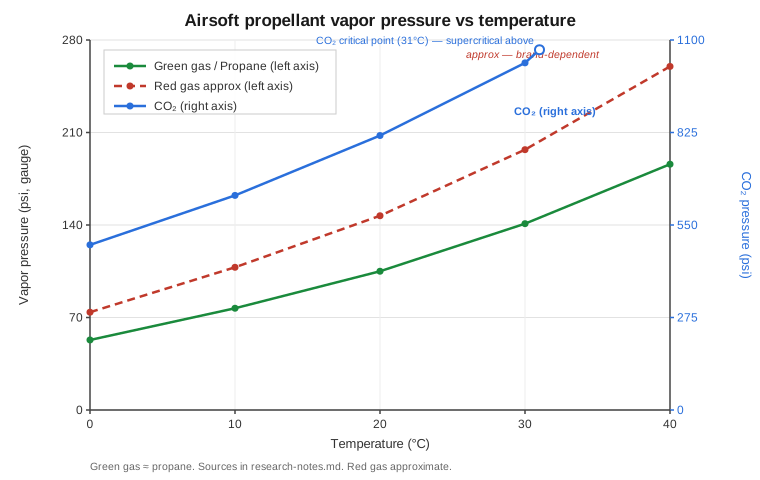
Everything above is a single room-temperature snapshot; the chart is the whole story, because the vapor pressure of a liquefied gas climbs steeply and non-linearly with temperature. Read it as pressure on the vertical axis, temperature across the bottom, and note that CO₂ is plotted against a separate, much higher axis — at any given temperature it sits roughly 5–7× above propane/green gas (e.g. at 20 °C, CO₂ ≈ 831 psia versus propane ≈ 120 psia), which is why CO₂ needs its own scale to be legible on the same plot.
Follow the propane/green-gas curve and the seasonal behavior falls out. On a hot day the pressure spikes — propane rises from about 53 psig at 0 °C to roughly 105 psig at 20 °C and ~141 psig at 30 °C (≈186 psig by 40 °C, an extrapolated endpoint — approximate). On a cold day it sags hard: that same gas is down near 53 psig at 0 °C, barely half its 20 °C value, which is precisely why green-gas guns go soft in winter. The CO₂ curve climbs even more steeply — about 506 psia at 0 °C to ~1046 psia at 30 °C — and then does something propane never does: it runs out of curve. CO₂’s critical point is 31.0 °C (87.8 °F) at ~1071 psia / 1056 psig; above that temperature there is no distinct liquid-and-vapor and therefore no single vapor pressure — the CO₂ goes supercritical and container pressure then depends on fill density rather than a clean P–T curve. That is why the CO₂ line on the chart stops at ~31 °C instead of continuing to 40 °C.
The practical translation is FPS by season. Because the gun fires on whatever pressure the headspace holds, FPS tracks these curves directly: a green-gas gun chronographed comfortably in mid-summer can drop below the field minimum on a cold morning, while the same gun on a hot afternoon climbs toward — or past — its FPS limit. CO₂’s steeper curve and higher baseline make it more forgiving in the cold (it still has plenty of pressure at 0 °C), at the cost of cracking plastic that was never built for 800 psi. The full FPS and energy treatment is Volume 3.
2.6 Which Gas for Which Gun / Season
Table 1 — Which Gas for Which Gun / Season
| Gun / scenario | Recommended gas | Why |
|---|---|---|
| Plastic-slide or Japanese pistol (TM, Maruzen) | HFC-134a (blue) | Low pressure (~70–90 psi) is the design point; green gas batters the slide |
| Metal-slide GBB / GBBR rated for green gas | Green gas (or raw propane) | Medium pressure (~109 psig) is what the gun is tuned for; self-lubricating |
| Budget running cost, green-gas gun | Raw propane + adapter | Same chemistry as green gas, far cheaper per fill — see Vol 4/Vol 6 |
| Gun explicitly built for CO₂ | CO₂ | ~830 psia delivers higher FPS and harder recoil; only metal guns survive it |
| Cold weather, CO₂-capable gun | CO₂ | Pressure margin holds up far better than green gas as temperature drops |
| Hot weather, green-gas gun | Green gas (watch the chrono) | Pressure — and FPS — spike with heat; verify against the field limit |
| ”Red-gas compatible” legacy gun | Green gas (modern stand-in) | Red gas (HCFC-22) is phased out in the US; pressure is contested (~130–200 psi) |
| Competition / weather-proof consistency | HPA | Regulated output ignores the vapor curve entirely — see Vol 5 |
Never put a gas into a gun rated below it. Dropping CO₂ pressure into a green-gas body — roughly seven times its design pressure — is the canonical way to turn a magazine into a hazard, covered alongside the plastic-versus-metal question in Volume 3.
Comments (0)