Chinese Type 63 Rifle · Volume 6
The Law: A Machine Gun from an Embargoed Country
What a Type 63 is in US federal law: a machine gun under the National Firearms Act and § 922(o); why no transferable example was found and why the 1968 amnesty almost certainly came too early; why it cannot be imported for anyone, the 1994 China ban that was announced at a press conference rather than by executive order, curio status that changes nothing, semi-automatic SKS rifles sold under the same name, and Michigan
6.1 The short answer
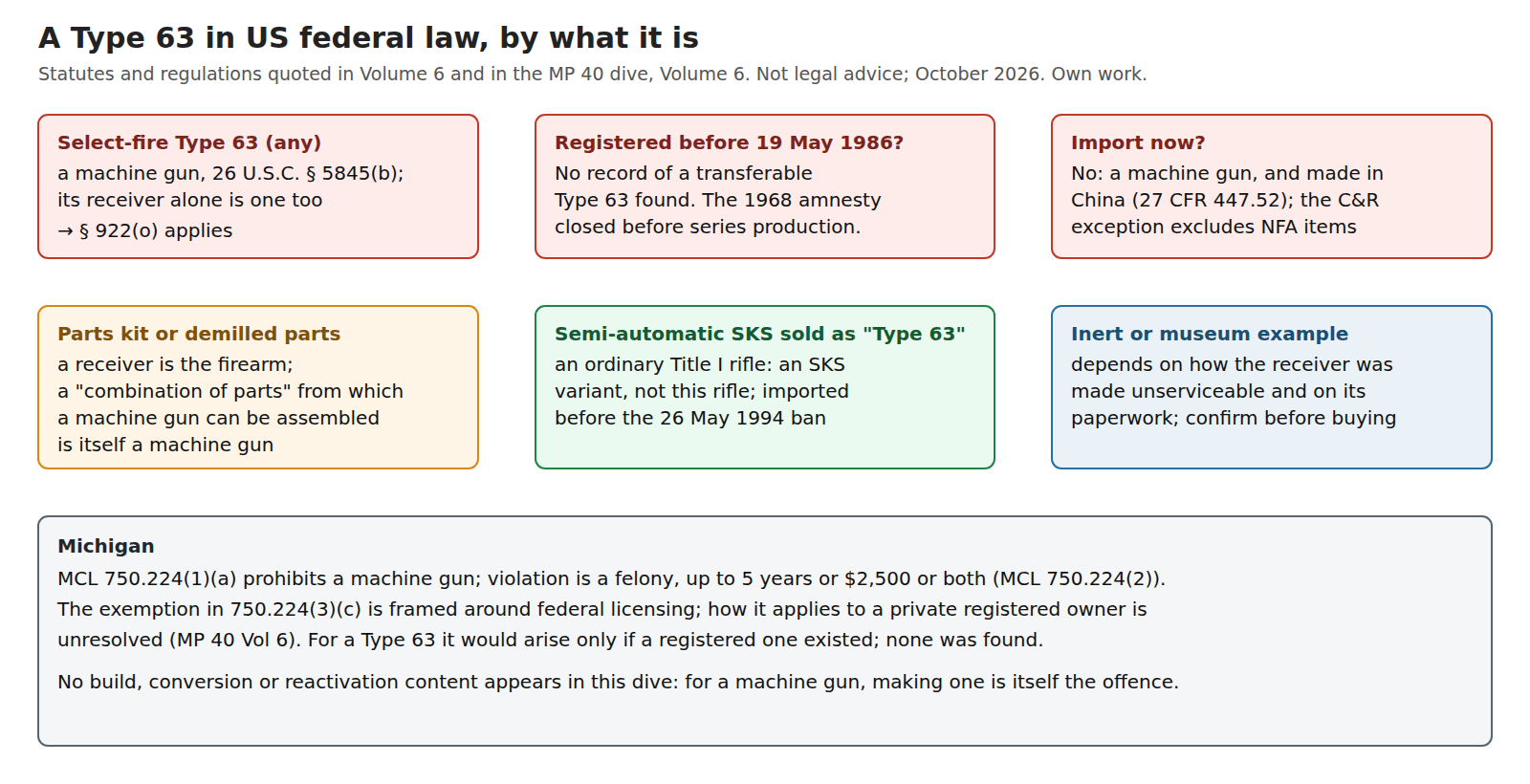
A Type 63 is a machine gun. Under 18 U.S.C. § 922(o), a private person in the United States may own one only if that particular rifle was lawfully registered before 19 May 1986. This research found no record of a transferable Type 63. The timing explains why. The only general registration window for war trophies, the 1968 amnesty, closed on 1 December 1968, and the Chinese sources date the rifle’s series production to 1969. A Type 63 cannot be imported, either: it is a machine gun, which can be imported only for government and dealer-sample use, and it was made in China, an arms-embargoed country under the import regulations. The 1994 ban on Chinese guns and ammunition, often called an executive order, was announced by the President at a press conference and is now carried in the regulations. Rifles sold in the United States as a “Type 63” are semi-automatic SKS variants, ordinary rifles that share only the name. Michigan prohibits machine guns outright except for federal licensees.
Nothing here is legal advice. The statutes and regulations are quoted so that a reader can take them to someone qualified. Laws and agency positions change; this was written in October 2026.
6.2 Where the general law is
The hub’s MP 40 dive, Volume 6, sets out the federal machine-gun law in full: § 922(o) and the Hughes Amendment, the four categories (transferable, pre-1986 dealer sample, post-1986 dealer sample, everything else), the transfer and its tax, semi-automatic reproductions, and Michigan’s MCL 750.224.1 The Škorpion dive, Volume 6, applies the same law to another Communist-bloc select-fire weapon, and the SKS dive, Volume 7, tells the story of the Chinese import window that closed in 1994. This volume applies the law to the Type 63 and adds the parts that are specific to it: its dates, its country of origin, and its name.
6.3 The Type 63 is a machine gun
The National Firearms Act defines a machine gun at 26 U.S.C. § 5845(b):2
“any weapon which shoots, is designed to shoot, or can be readily restored to shoot, automatically more than one shot, without manual reloading, by a single function of the trigger. The term shall also include the frame or receiver of any such weapon, any part designed and intended solely and exclusively, or combination of parts designed and intended, for use in converting a weapon into a machinegun, and any combination of parts from which a machinegun can be assembled if such parts are in the possession or under the control of a person.”
Every Type 63 has a selector with an automatic position, marked 2 (Volume 2). Each one is a machine gun, and so is its receiver alone. Since 19 May 1986, § 922(o) has made it unlawful to transfer or possess a machine gun that was not lawfully possessed before that date, except by or under the authority of a government.1 Public Law 119-21 cut the federal tax on making and transferring short-barrelled rifles and suppressors to $0 from 2026. It did not reach machine guns, whose $200 tax is unchanged.1
6.4 Is there a transferable Type 63?
The rifle was made from 1969 to 1979 (Volume 3), so the calendar does not rule out a pre-1986 registration, as it does for weapons designed after 1986. Whether one exists is another matter.
- No auction record of a transferable Type 63 or “Type 68” was found in searches of auction catalogues and the trade press on 20 October 2026. Rock Island Auction’s Chinese and Vietnam-era lots that turned up were SKS rifles, a North Korean Type 63 SKS, a Type 53 carbine and a Type 56 AK.34
- The US examples that are documented are government property. One is in the National Museum of the Marine Corps (lent to Small Arms Review in 2009), and one was handled by the Army’s Foreign Science and Technology Center in 1974 (Volume 3).5
- The register is not public. The DOJ Inspector General’s 2007 report on the National Firearms Registration and Transfer Record describes the register but gives no counts by model.6
The honest statement is that this research found no record of a transferable Type 63. That is not proof that none exists. A buyer offered one should have the registration checked before anything else, as the MP 40 dive explains.1
6.5 The amnesty came before the rifle
Machine guns brought home from wars reached the private register in two ways: registration at the time, under the rules then in force, or the one-month amnesty created by the Gun Control Act of 1968. The Inspector General:
“the GCA called for a 30-day amnesty period ending December 1, 1968, where anyone possessing an NFA weapon could register the weapon without consequence. However, any NFA weapon not registered during the amnesty is considered contraband, cannot be registered, and must be forfeited or voluntarily surrendered to ATF.”6
That route works for the Chinese weapons that reached Vietnam early. In December 2025 Rock Island Auction sold a milled-receiver Chinese Type 56 AK, “a Vietnam War bringback by USMC Lt. Col. Frank Wolcott”, which “was registered with the Treasury Department during the November 1968 amnesty as a ‘Chinese AK-47’”. It fetched $246,750.4
It almost certainly does not work for the Type 63. The Chinese accounts date its series production to 1969 (Volume 3).78 A Type 63 could only have been registered in the amnesty if it had been made, shipped to Vietnam, captured and brought to the United States by November 1968, before the series production the Chinese sources describe. Rifles captured afterwards had no amnesty to enter. This is an inference from dates, not a search of the register. A small pre-series batch reaching Vietnam earlier is not ruled out by any source, and nothing found suggests it happened.
Dealer samples. Before 1986 a licensed dealer could also hold a machine gun as a sample. A pre-1986 dealer sample of a Type 63 would have had to be imported before 1986, and the next section explains why a Chinese military rifle could not be. No such sample was found.
6.6 Deactivated war trophies
Many trophies were registered as deactivated war trophies, DEWATs. ATF’s NFA Handbook:
“Deactivated War Trophy (DEWAT) firearms are still firearms under the NFA, but have been rendered unserviceable (i.e., incapable of discharging a shot by means of an explosive and incapable of being readily restored to a firing condition).”9
A registered DEWAT is on the register and is transferred through ATF. An unregistered “deactivated” Type 63 is not made lawful by having been deactivated, and the Handbook’s rule is that “rendering a firearm unserviceable does not remove it from the definition of an NFA firearm”. The Lewis gun dive, Volume 8, sets out the DEWAT rules in detail.9 No registered Type 63 DEWAT was found. The amnesty timing above applies to DEWAT registration as much as to live guns.
A museum or display piece that is offered as “deactivated” therefore needs the same question answered as a live one: is there a registration, and does it describe this receiver? Foreign deactivation certificates do not satisfy US law. The MP 40 dive and the hub’s legal posture both make that point.1
6.7 Why one cannot be imported
Two separate bars apply, and either would be enough.
It is a machine gun. The NFA Handbook: “Notwithstanding the prohibition in Section 922(o), licensed importers may import machineguns on or after May 19, 1986 for sale to Federal and State agencies or to FFLs/SOTs as ‘sales samples’ for demonstration to prospective governmental customers … their registration and subsequent transfer are conditioned upon and restricted to sales only to government agencies or as ‘sales samples.’”9 No route exists by which an imported machine gun reaches a private owner.
It was made in China. The import regulations, 27 CFR 447.52(a), set the policy:
“It is the policy of the United States to deny licenses and other approvals with respect to defense articles and defense services originating in certain countries or areas. This policy applies to Afghanistan, Belarus …, Cuba, Iran, Iraq, Libya, Mongolia, North Korea, Sudan, Syria, and Vietnam. This policy applies to countries or areas with respect to which the United States maintains an arms embargo (e.g., Burma, China, the Democratic Republic of the Congo, Haiti, Liberia, Rwanda, Somalia, Sudan, and UNITA (Angola)).”10
Two consequences follow for this rifle. First, China is named as an arms-embargoed country, so a Type 63 “originating” there is caught whatever the purpose of the import. On the face of the rule, even the government and dealer-sample route is closed to it, and no exception was found. Second, Vietnam is itself on the denial list, which matters for the many K63s that are, or have been, in Vietnam.
Albania was removed from the list of proscribed countries in 1995,11 and McCollum reports that “a lot of Type 63s were sent to Albania”.12 That does not help. The rifle still originated in China, and it is still a machine gun.
6.8 The 1994 China ban was not an executive order
The end of Chinese gun imports is usually dated 26 May 1994 and often called an executive order. The record shows otherwise. The President announced it at a press conference on the renewal of China’s most-favoured-nation trade status:
“In view of the continuing human rights abuses, I am extending the sanctions imposed by the United States as a result of the events in Tiananmen Square, and I am also banning the import of munitions, principally guns and ammunition from China.”13
Asked about Chinese retaliation “because of the ban on weapons imports”, he replied that it was appropriate “because it was discreet … it is plainly enforceable”.13 Neither the announcement nor the press conference calls it an executive order. The only executive order in the story is Executive Order 12850 of 28 May 1993, which set human-rights conditions for renewing most-favoured-nation status in 1994. At the same press conference the President announced that he was “moving … to delink human rights from the annual extension of most-favored-nation trading status”.1413 The ban took regulatory form in the State Department’s and ATF’s import rules, where China appears among the countries “with respect to which the United States maintains an arms embargo”.1511
Two details are worth recording because they bear on the hub’s other dives. The President’s stated reason was human rights, and his stated scope was “munitions, principally guns and ammunition from China”. The SKS dive, Volume 7, and the AK-47 dive, Volume 12, describe the 1994 action as directed at Norinco and Polytech in particular. Volume 12 also ties it to period reporting of an ATF enforcement matter. Those are reasonable accounts of how the ban fell in practice, but they are narrower than the President’s own words. For the Type 63 the difference does not matter, since a machine gun was never importable for private sale in the first place.
6.9 Curio or relic changes nothing here
A firearm made more than 50 years ago is a curio or relic by age under 27 CFR 478.11, so Type 63s made from 1969 to about 1976 already qualify, and the rest will by about 2029. The ATF’s published curio-and-relic list contains no entry for the Type 63 or “Type 68”. Its section on NFA weapons classified as curios does list Chinese Type 24 and Type 26 machine guns and the RPD.16
Curio status does not lift § 922(o) and does not open the import route. The curio exception in 27 CFR 447.52(e), which can admit some firearms made in or stored in proscribed countries, is limited to articles “(other than those subject to the provisions of 27 CFR Part 479)”, the NFA regulations. A machine gun is excluded on the face of the rule.10
6.10 Parts, kits and the combination of parts
The receiver is the firearm, and for a machine gun the receiver alone is a machine gun.2 The definition reaches further than that: “any part designed and intended solely and exclusively … for use in converting a weapon into a machinegun, and any combination of parts from which a machinegun can be assembled if such parts are in the possession or under the control of a person.”2
For the Type 63 that has two practical meanings:
- There is no “parts kit” route to a lawful rifle. Unlike the AK, the Type 63 has no US-made semi-automatic receiver, and this dive does not discuss making one.
- Its select-fire parts are not neutral spares. The automatic sear and the select-fire trigger group (Volume 2) belong to a machine gun. Possessing them alongside parts with which they could be assembled into a working weapon raises the “combination of parts” question. Anyone holding such parts should take advice before doing anything with them.
6.11 No conversions
This dive contains no instructions or information for converting, reactivating, restoring, assembling or fitting a Type 63 or any of its parts, and none for altering any other rifle to resemble or function like one. For a machine gun, making one is itself prohibited by § 922(o) and the NFA. The NFA Handbook treats returning a DEWAT to serviceable condition as “making” a firearm, as the Lewis gun dive explains.9
6.12 The semi-automatic “Type 63” on the US market
Rifles sold in the United States under the name “Type 63” are, on the evidence found, semi-automatic Chinese SKS variants. One online auction listing describes a “Chinese Type 63 SKS semi auto rifle … Triangle 26 marked … takes a specialized AK style magazine … import marked (Navy Arms Co.)”.17 The SKS-D and SKS-M with AK magazines are described in SKS Volume 7. These are ordinary Title I rifles with SKS tilting bolts and no selector. They were imported before the 1994 ban and are as lawful as any other SKS in the owner’s jurisdiction. They are not the rifle of this dive, and a seller’s “Type 63” label does not make them collectable as one (Volume 4 explains how to tell).
A Chinese encyclopedia page says that semi-automatic Type 63s with welded selectors were sold “to the North American civilian market” in the early 1990s. No evidence was found of any such import into the United States, and no ATF record or import-marked example was found (Volume 3).18
6.13 Michigan
MCL 750.224(1) provides that “a person shall not manufacture, sell, offer for sale, or possess any of the following: (a) A machine gun or firearm that shoots or is designed to shoot automatically more than 1 shot without manual reloading, by a single function of the trigger.” Under subsection (2), a violation is a felony “punishable by imprisonment for not more than 5 years, or a fine of not more than $2,500.00, or both.” The exemption in subsection (3)(c) covers “a person licensed by the secretary of the treasury of the United States or the secretary’s delegate to manufacture, sell, or possess a machine gun”.19
The MP 40 dive discusses the open question of how (3)(c) applies to a private individual who holds a registered transferable machine gun rather than a federal licence, and does not resolve it.1 For the Type 63 the question is academic unless a registered example exists, and none was found. A semi-automatic SKS sold as a “Type 63” is an ordinary rifle under Michigan law, subject to the same rules as any other SKS.
6.14 What could not be verified
- Whether any Type 63 is on the NFA register, as a transferable, a dealer sample or a DEWAT. The register is not public, and no auction or dealer record was found.
- Whether any Type 63 reached the United States before 1 December 1968. No source dates the first capture.
- Whether ATF has ever granted an exception to 27 CFR 447.52 for a Chinese-origin machine gun for government or law-enforcement purposes. None was found.
- The claimed early-1990s semi-automatic exports to Australia and North America (Volume 3).
- The precise application of MCL 750.224(3)(c) to a private registered owner.
References
Footnotes
-
This hub, MP 40 dive, Volume 6, “Owning One Today in the United States”, sections 6.1 to 6.6, quoting 18 U.S.C. § 922(o), MCL 750.224 and the hub’s legal posture; and Public Law 119-21 as summarised there. /actual-firearms/rifles/mp-40/vol-6/ ↩ ↩2 ↩3 ↩4 ↩5 ↩6
-
26 U.S.C. § 5845(b), quoted from the statutory text as given in the hub’s Škorpion dive, Volume 6, https://www.law.cornell.edu/uscode/text/26/5845 (accessed 2026-10-20). ↩ ↩2 ↩3
-
Rock Island Auction Company, “North Korean Type 63 SKS Rifle with Bayonet and Grenade Spigot”, auction 89, lot 3375, 2023, https://rockislandauction.com/detail/89/3375/north-korean-type-63-sks-rifle-with-bayonet-and-grenade-spigot (accessed 2026-10-20). ↩
-
“World Record: AK-47 Sold For $246,750 At Rock Island Auction”, The Firearm Blog, December 2025, https://www.thefirearmblog.com/blog/world-record-ak-47-sold-for-246-750-at-rock-island-auction-44824594 (accessed 2026-10-20), quoting Rock Island Auction Company’s lot description. ↩ ↩2
-
Frank Iannamico, “Chinese 7.62x39mm Type 68 Rifle”, Small Arms Review vol. 12 no. 11, August 2009, https://smallarmsreview.com/?p=15367 (accessed 2026-10-20). ↩
-
US Department of Justice, Office of the Inspector General, The Bureau of Alcohol, Tobacco, Firearms and Explosives’ National Firearms Registration and Transfer Record, Evaluation and Inspections Report I-2007-006, June 2007, executive digest, https://oig.justice.gov/archives/reports/ATF/e0706/exec.htm (accessed 2026-10-20). ↩ ↩2
-
向军 (Xiang Jun), 我国63式7.62mm自动步枪盛与衰, 《轻兵器》 1993 no. 6, reproduced on 枪炮世界, http://pewpewpew.work/china/rifle/1963/63.htm (accessed 2026-10-20). ↩
-
“资料:新中国步枪发展历程——自制阶段”, 《舰船知识》 via 千龙新闻网, Sina Military, 22 July 2003, http://mil.news.sina.com.cn/2003-07-22/138626.html (accessed 2026-10-20). ↩
-
Bureau of Alcohol, Tobacco, Firearms and Explosives, ATF National Firearms Act Handbook, ATF E-Publication 5320.8, revised April 2009, sections on unserviceable firearms (DEWAT), reactivation and the importation of machineguns (8.3.1); copy in the First Circuit’s citation archive, https://www.ca1.uscourts.gov/sites/ca1/files/citations/ATFNationalFirearmsActHandbook.pdf (accessed 2026-10-20). ↩ ↩2 ↩3 ↩4
-
27 CFR 447.52, “Import restrictions applicable to certain countries”, current text, https://www.ecfr.gov/current/title-27/chapter-II/subchapter-B/part-447/subpart-F/section-447.52 (accessed 2026-10-20). ↩ ↩2
-
Bureau of Alcohol, Tobacco and Firearms, “Importation of Arms, Ammunition and Implements of War”, T.D. ATF-367, 60 FR 47866, 15 September 1995, https://www.federalregister.gov/documents/1995/09/15/95-22942 (accessed 2026-10-20). Removes Albania, Bulgaria, Kampuchea, Outer Mongolia and Romania from the proscribed list and adds the arms-embargo examples, China among them. ↩ ↩2
-
Ian McCollum, “Type 63: China Makes an AK/SKS Hybrid”, Forgotten Weapons, 2024, https://www.forgottenweapons.com/type-63-china-makes-an-ak-sks-hybrid/ (accessed 2026-10-20). ↩
-
William J. Clinton, “The President’s News Conference”, 26 May 1994, The American Presidency Project, https://www.presidency.ucsb.edu/documents/the-presidents-news-conference-1085 (accessed 2026-10-20). ↩ ↩2 ↩3
-
Executive Order 12850, “Conditions for Renewal of Most-Favored-Nation Status for the People’s Republic of China in 1994”, 28 May 1993, The American Presidency Project, https://www.presidency.ucsb.edu/node/227761 (accessed 2026-10-20). ↩
-
US Department of State, “Amendment to the International Traffic in Arms Regulations”, Public Notice 2050, 59 FR 42158, 17 August 1994, https://www.federalregister.gov/documents/1994/08/17/94-20218 (accessed 2026-10-20), giving 22 CFR 126.1’s examples of arms-embargoed countries “(e.g., Burma, China, Haiti, …)”. ↩
-
Bureau of Alcohol, Tobacco, Firearms and Explosives, Firearms Curios or Relics List, ATF P 5300.11, January 1972 through April 2025, sections II and IV (the copy held in this hub’s Ruby pistol dive sources, searched 2026-10-20); and 27 CFR 478.11, definition of “curios or relics”. ↩
-
CT Firearms Auction, “Chinese SKS Type 63 Rifle 7.62X39”, online lot, https://ctfirearmsauction.com/auction_item/chinese-sks-type-63-rifle-7-62x39/ (accessed 2026-10-20). ↩
-
中华网武器大全, “63式自动步枪”, https://m.junshi.china.com/wuqi/13461.html (accessed 2026-10-20). ↩
-
MCL 750.224, Michigan Penal Code (Act 328 of 1931), https://www.legislature.mi.gov/Laws/MCL?objectName=mcl-750-224 (accessed 2026-10-20). ↩
Comments (0)