Chinese Type 63 Rifle · Volume 2
How It Works: An AK Bolt in an SKS, a Gas Regulator, and Three Sears
The Type 63's cycle part by part: the two-port gas regulator and the separate short-stroke piston, the low, wide carrier and the AK-pattern rotating bolt, top-loading from SKS clips into a detachable magazine, the bolt hold-open, the self-contained trigger group with its three sears and 0-1-2 selector, sights and bayonet, and the published figures side by side
2.1 The short version
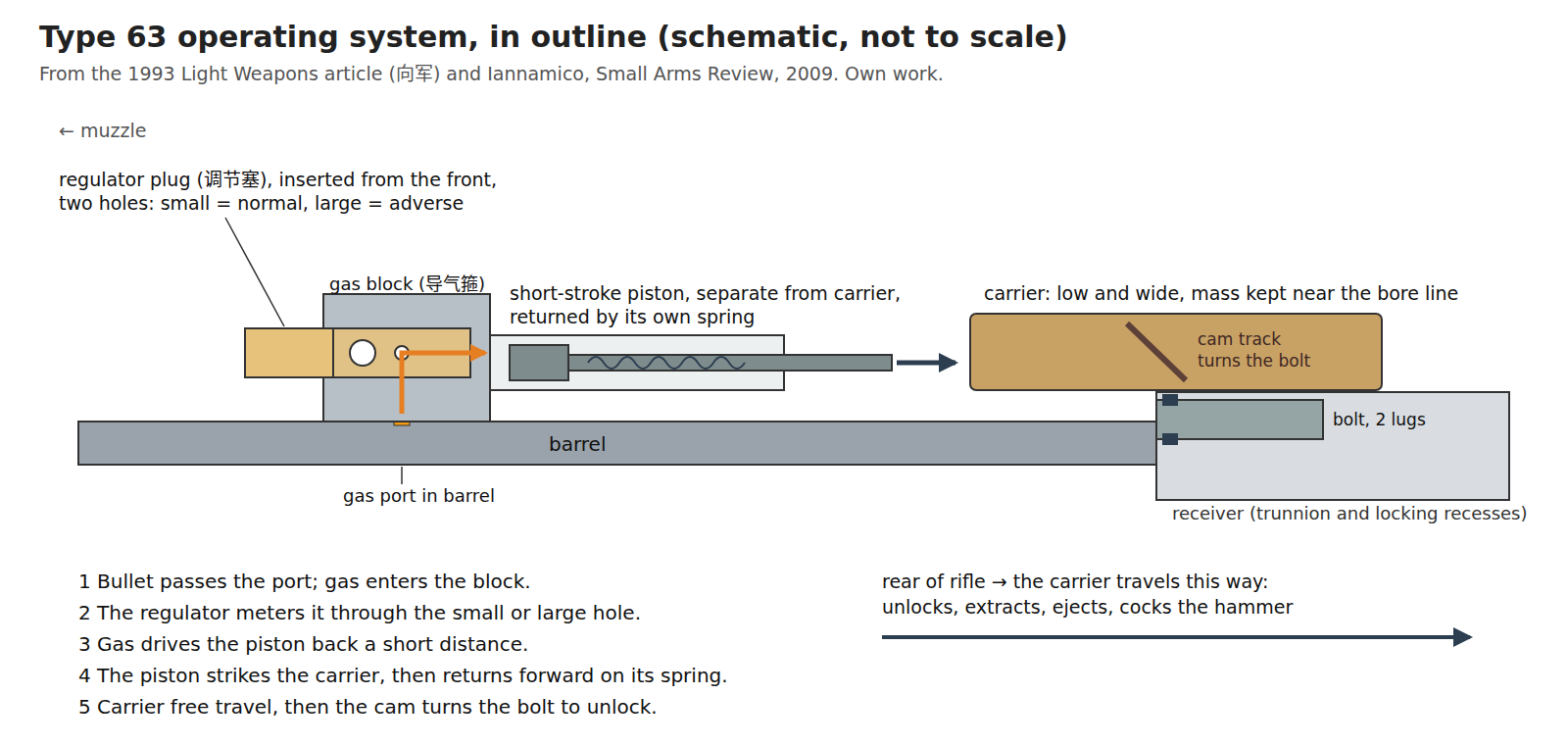
The Type 63 is a gas-operated, rotating-bolt, select-fire rifle. Gas tapped from the barrel passes through a two-position regulator to a short-stroke piston that is not attached to the carrier. The piston kicks the carrier back and is returned by its own spring. The carrier, a wide, low steel forging with an integral charging handle, carries an AK-pattern bolt with two locking lugs, which a cam track in the carrier turns to unlock. The trigger mechanism is a self-contained group, removable as a unit like the SKS’s, with a rotating hammer and three sears: a trigger sear, a semi-automatic disconnector sear and an automatic sear tripped by the carrier. A three-position selector at the front right of the trigger guard is marked 0, 1 and 2. Ammunition comes from a detachable 20-round magazine, which can be refilled in the rifle from SKS stripper clips through guides machined into the carrier. The magazine follower works a bolt hold-open.12
Every one of those choices follows from the requirement in Volume 1: SKS-class accuracy in single shots, controllable bursts and a long service life, in a rifle that still handled like the SKS.
2.2 Where the description comes from
No Chinese manual for the Type 63 was found (Volume 5). The description here combines three kinds of source.
- The designers’ side. The 1993 article in 《轻兵器》 (Light Weapons) describes each assembly as designed and gives the reasons for the choices. It also includes four drawings, two of the regulator and two of the receiver.1
- The examiner’s side. Frank Iannamico’s 2009 article for Small Arms Review describes a captured stamped-receiver rifle from the US Marine Corps museum: the regulator’s operation, the selector markings and the three-sear trigger in detail. A photograph of the trigger group “from the U.S. Army’s Aberdeen Proving Center” accompanied it.2
- The intelligence plate. The Defense Intelligence Agency’s 1983 identification plate labels the external controls (Volume 1).3
Where the sources differ, both versions are given.
2.3 The published figures
The 1993 article’s table, in its own words, is for the rifle as produced. It gives the service life as 10,000 rounds and notes that the original requirement was 15,000.
Table 1 — The published figures
| Item (原文) | 《轻兵器》 1993 | Other published figures |
|---|---|---|
| Length, bayonet open (全枪长 刺刀打开) | 1,342 mm | 1,342 mm (SinoDefence 2006) |
| Length, bayonet folded (刺刀折下) | 1,032 mm | 1,033 mm (SinoDefence); 1,029 mm (Popenker) |
| Width (全枪宽) | 68 mm | — |
| Weight, with one empty magazine and the cleaning rod (全枪重 含一个空弹匣、通条) | 3.87 kg | 3.8 kg (SinoDefence); 3.49 kg (Popenker, conditions not stated) |
| Barrel length (枪管长) | 520 mm | 521 mm (Popenker) |
| Rifling (膛线) | 4 grooves, right hand, rectangular, 240 mm twist (4条右旋矩形膛线,导程240mm) | — |
| Magazine (弹匣容量) | 20 rounds, four issued per rifle (每枪配4个) | 20 (McCollum, Popenker); 15 (Iannamico) |
| Muzzle velocity (枪口初速) | 735 m/s | 735 m/s (SinoDefence) |
| Effective range (有效射程) | 400 m | 400 m (SinoDefence) |
| Rate of fire (理论射速) | 750 rounds/min, cyclic | 750 (Iannamico); practical 40 single, 60 bursts (SinoDefence) |
| Service life (寿命) | 10,000 rounds (original requirement 15,000) | — |
Three of these need a note.
Weight. Popenker’s 3.49 kg and the Chinese 3.87 kg are given side by side. The Chinese figure states what it includes; Popenker’s does not.
Twist. The 240 mm twist (about 1 in 9.45 in) is the AK’s rate, as the AK-47 dive, Volume 1, records it. The 1993 article says only that the rifle’s ballistics were “similar to” the SKS’s (弹道性能……与56式半自动步枪相类似).
The magazine. Iannamico wrote that the magazine “holds 15 rounds” and that “some sources mistakenly state that the magazine holds 20 rounds”.2 Every Chinese source, the 1993 article from inside the programme and McCollum’s hands-on examination all say 20, and a Chinese collector’s photographs show a 20-round magazine beside a rare 10-round one (Volume 4).167 The weight of evidence is for 20. The 15-round figure may describe the magazine that came with the museum rifle Iannamico examined, but that is a guess and is not stated as fact.
2.4 The layout
Seen from outside, the Type 63 is laid out like the SKS: a one-piece wooden stock with a semi-pistol grip, the receiver set into it, a removable receiver cover, a wooden upper handguard over the gas system, a cleaning rod under the barrel, and a folding bayonet hinged under the muzzle. The differences are the magazine, which hangs below the stock ahead of the trigger guard, the selector lever at the front of the guard, and the gas regulator knob, which projects from the front of the gas cylinder.32
The DIA plate labels the right side with “Dust Cover”, “Operating Handle”, “Slide Locks”, “Gas Regulator”, “Selector” and “Magazine catch”, and the left side with “Gas Regulator Retainer”, “Clip Guides”, “Receiver Cover”, “Lock” and “Trigger guard catch”.3 Those are the US analysts’ names and are used below where they help.
2.5 Gas: the port, the regulator and the piston
The 1993 article says that the gas system was “completely redesigned” and was the first on a Chinese rifle to have a gas regulator:
导气系统完全重新设计,首次在步枪上采取了气体调节器结构,活塞、调节塞均自前方装入导气箍上的活塞筒内。
“The gas system was completely redesigned, and for the first time on a rifle a gas regulator was adopted. The piston and the regulator plug are both inserted from the front into the piston cylinder on the gas block.”1
The regulator has two settings. The article gives the reasoning:
在正常条件下用小气孔射击,自动机运动平稳,减少撞击保证射击精度的提高,特殊情况下用大气孔射击自动机有较大能量,保证动作可靠性,同时大量射击是在正常情况下进行,全枪寿命也可以得到保证。
“In normal conditions the rifle is fired on the small gas hole: the working parts move smoothly and impacts are reduced, which keeps accuracy up. In special conditions it is fired on the large hole, so that the working parts have more energy and function reliably. And because most firing is done in normal conditions, the rifle’s service life is also protected.”1
(The 枪炮世界 reproduction reads 上气孔, “upper hole”, for the normal setting, where the blog repost and the logic of the passage have 小气孔, “small hole”. The reading here is “small”, which agrees with Iannamico.)
Iannamico describes how the regulator is changed:
“The gas regulator is adjusted by pressing the retainer and rotating it downward, which will allow it to be pulled free, and the regulator knob rotated to the desired position. The soldier can see the position of the gas regulator spindle, which is indicated by a small and large hole on the back of the knob, at a glance. The smaller of the two gas ports is the normal position.”2
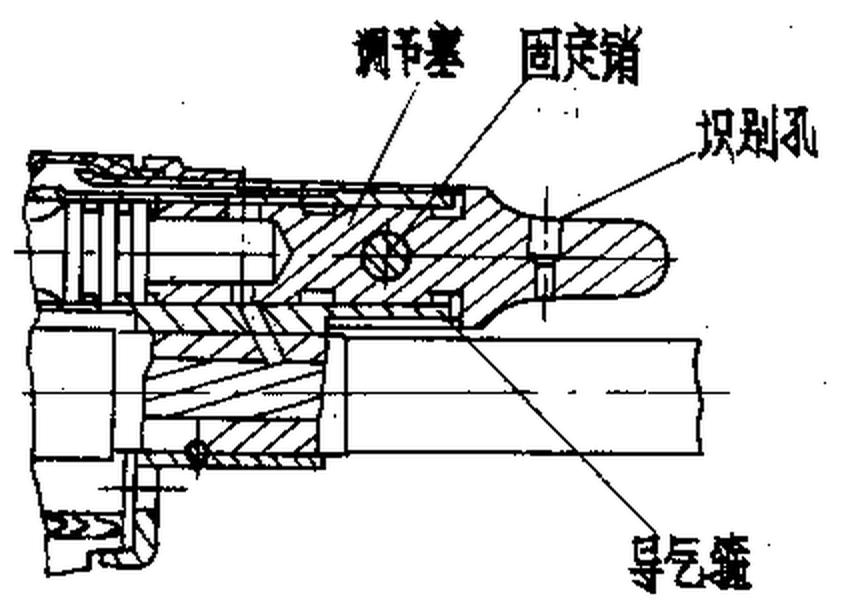
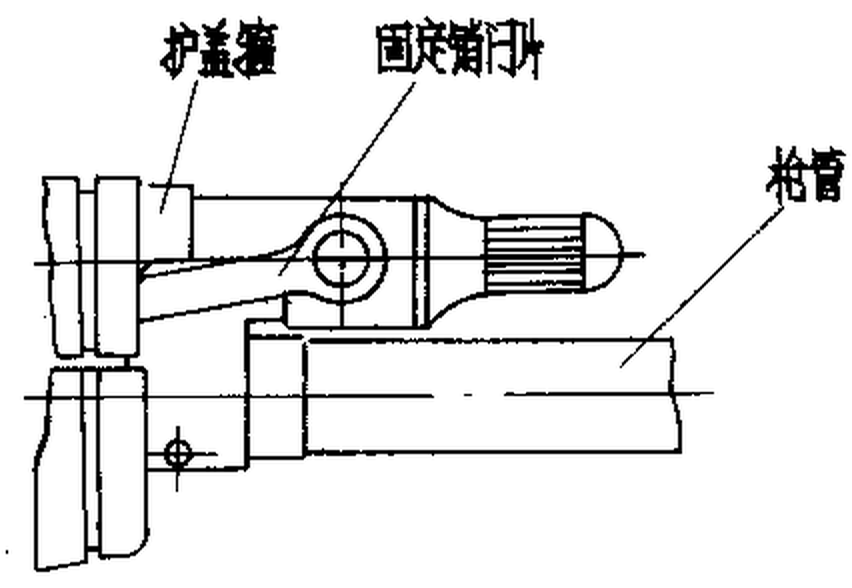
The two Chinese drawings of the regulator, reproduced below, show the same parts: the regulator plug (调节塞), a cross pin that retains it (固定销), a hole in the knob by which the setting is read (识别孔, “identification hole”), the gas block (导气箍) and the retaining pin’s latch (固定销闩片).1
The front-loading arrangement had a cost, and the same article admits it. Because the piston and the regulator plug both enter the gas block from the front and are locked in place, hot gas and burning residue could escape between the plug, the piston and the gas block and blow backwards as sparks, “some of which could reach the shooter’s face and even injure the eyes”. The fix was to fit “a sleeve over the outside of the piston to catch the sparks” (在活塞外面装一个套筒把火星收起来).1 Iannamico describes the piston on a production rifle as “enclosed inside a circular sheet metal heat shield to protect the upper handguard from excessive heat during sustained firing”.2 The sheet-metal shield and the Chinese sleeve may be the same part, but neither source says so.
2.6 Why the piston is separate
The 1993 article names two changes from the AK’s working parts, and gives one reason for both:
63式的自动机有两点改进,一是把活塞与机框分开,二是降低了自动机质量中心距枪管轴线的距离。两者都是从减少动力偶、提高点射精度出发的。
“The Type 63’s working parts have two improvements: first, the piston is separated from the carrier; second, the distance from the working parts’ centre of mass to the bore axis is reduced. Both start from reducing the dynamic couple and improving accuracy in bursts.”1
In the AK, the piston rod is part of the carrier, so the mass that recoils sits well above the bore and moves a long way. Every time it stops against the rear of the receiver, it applies a turning moment that lifts the muzzle. The Type 63 does two things about that. It uses a short piston stroke, which takes the piston’s mass out of the recoiling group. And it makes the carrier low and wide, so that what does recoil sits closer to the bore line. The cost of the second choice appears in Volume 3: a wide carrier needs a wide receiver, the 1993 article gives the receiver’s width as 40 mm, and the stock’s walls on either side of it were left only 4 mm thick.1
Iannamico calls the system “an impingement design that is similar to that used in the SKS”. He means that the piston rod impinges on (strikes) the carrier: “the Type 68’s piston rod impinges directly on the rifle’s bolt carrier. The piston rod extends through a spring that returns the piston to a forward position after engaging the bolt carrier.”2 That is a short-stroke piston, and it should not be confused with direct gas impingement in the AR-15 sense.
2.7 The carrier and the bolt
The carrier is “a steel forging machined for containing the recoil spring, rotating and housing the breech bolt and tripping the automatic sear”, with grooves along its sides that ride on rails in the receiver. The charging handle is integral and sticks straight out to the right, “similar in appearance to that of the SKS rifle”.2
The bolt is the AK’s in principle. In the 1993 article’s words:
自动机借鉴56式冲锋枪结构,机头回转闭锁,闭锁支承面为3mm螺旋面,由两支耳闭锁。机头上的螺旋凸起与机框上的螺旋槽配合,由机框带动机头完成开、闭锁动作及前后运动。大部分结构参数与56式冲锋枪相同。
“The working parts draw on the Type 56 submachine gun’s design. The bolt head locks by rotation; the locking bearing surfaces are a 3 mm helical surface; it locks on two lugs. A helical lug on the bolt head engages a helical cam track in the carrier, and the carrier drives the bolt through unlocking, locking and its movement back and forth. Most of the structural parameters are the same as the Type 56 submachine gun’s.”1
(The phrase 闭锁支承面为3mm螺旋面 is given exactly as printed. It most likely means that the lugs’ bearing faces are cut on a shallow helix, giving primary extraction as the bolt turns, but the article does not explain the 3 mm.)
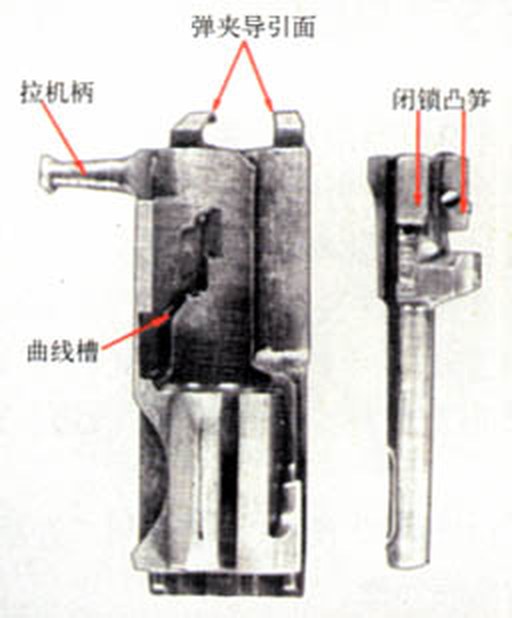
The front of the carrier is cut with clip guides. When the bolt is held open, an SKS stripper clip can be placed in them and its ten rounds pushed down into the magazine without removing it.12 That is the one SKS feature the designers refused to lose, and it explains why the carrier, not the receiver, carries the guides.
2.8 The receiver as designed
The 1993 article describes the receiver that was certified in 1963:
机匣为机加工锻件机匣,枪管与机匣连接为M25×1.5螺纹联接。机匣结构与56式半自动步枪相似,机匣下面,突出前支脚和后支脚以便与发射机支架相扣合,并把枪托结合在枪身上。……机匣的两侧则比较薄,为2.5mm。
“The receiver is machined from a forging, and the barrel is joined to it by an M25×1.5 thread. The receiver’s design is like the Type 56 semi-automatic rifle’s: below it, a front lug and a rear lug project to engage the trigger-group frame and to hold the stock to the action. … The two sides of the receiver are fairly thin, 2.5 mm.”1
The front of the receiver houses the barrel seat and the locking shoulders, and the rear has the rear lug and the surface that the carrier strikes at the end of its travel. The article judged its stiffness and strength “sufficient” and its weight modest.1 This was the receiver that the factories replaced during production with a riveted assembly of thirteen stampings, and the barrel thread they replaced with a press fit and one pin (Volume 3).
2.9 Feeding: magazine, clips and the hold-open
The magazine is of the AK’s double-column, double-feed form but holds 20 rounds:
供弹具采用0.75mm厚的钢板冲焊组合,结构形式与56式冲锋枪弹匣一样,只是改为装弹20发,并增加空仓挂机导向槽,调整了供弹路线,使其更可靠。
“The magazine is stamped and welded from 0.75 mm sheet steel and has the same form as the Type 56 submachine gun’s magazine, but holds 20 rounds, has an added guide slot for the bolt hold-open, and has a revised feed path to make it more reliable.”1
The bolt hold-open is what makes the Type 63 and the AK magazines a one-way street. McCollum: “These magazines can be used in AK rifles, but AK magazines do not function in the Type 63.”6 Iannamico: “The bolt hold-open feature of the weapon prevents the use of a standard AK magazine.”2 The 1993 article explains the geometry: the Type 63’s magazine well had a relief at its rear for the hold-open, and an AK magazine in an unmodified rifle needs the hold-open removed first. The improved rifles made for the 1979 war had their magazine well and catch changed so that they would take the Type 56 AK’s magazines (Volume 3).1
The magazine catch is a lever ahead of the trigger guard, and Iannamico says it is “attached to the trigger housing”.2
2.10 The trigger group and the selector
The 1993 article says that the trigger mechanism was “also redesigned”:
发射机也是重新设计,是回转击锤、挂钩阻铁。其重要特点是击锤簧仍用圆柱螺旋弹簧……发射机仍采用发射机支架组装成独立部件,在全枪分解结合时可以很方便的装、拆于机匣上。工艺制造比56式冲锋枪简单,阻铁、挂钩、支架都可用冲压成型。
“The trigger mechanism was also redesigned. It has a rotating hammer and a hook-type sear. An important feature is that the hammer spring is still a cylindrical coil spring. … The mechanism is still assembled on its own frame as an independent unit, which can be fitted to and removed from the receiver very easily when the rifle is stripped and reassembled. It is simpler to make than the Type 56 submachine gun’s: the sear, the hook and the frame can all be stamped.”1
McCollum describes it as “an SKS-like fire control system (with fully automatic capability)”.6 Iannamico calls the SKS and Type 63 groups “similar modular designs … a variation of the basic design used on the U.S. M1 Garand rifle”.2 The three statements are compatible. The architecture is the SKS’s, a group held in the stock by the trigger guard and removed as one piece, and the Chinese say that the mechanism inside it was new.
Iannamico gives the only detailed description found of how it works.
The selector. “The Type 68 has a three-position selector lever located on the right side of the trigger guard. The safe position is marked with a 0, the semiautomatic position with a number 1 and the full-automatic position is marked with a number 2. The stock is inletted in this area to aid in the manipulation of the selector lever.”2 The Chinese sources put the lever “at the front of the trigger guard, where it can be worked with the index finger” (快慢机选择杆位于扳机护圈前端,可用食指操作).8 Both descriptions fit the photographs: the lever sits at the front of the guard on the right.
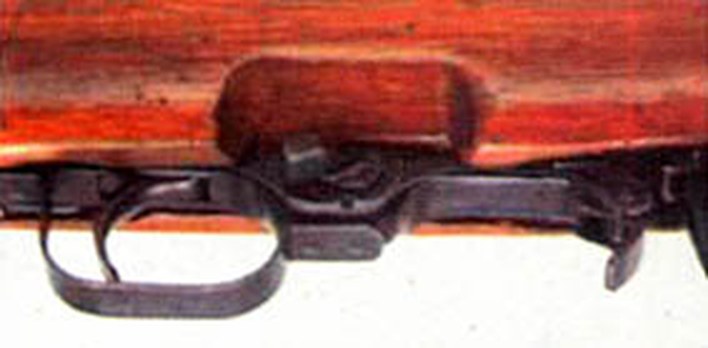
Three sears. “An automatic sear is located forward of the hammer and is actuated by the bolt carrier, a trigger sear is located to the rear of the hammer on the right side and operates with each pull of the trigger, and a semiautomatic sear is located on the left side of the hammer and functions only when the selector is in the number 1 position.”2
How the selector uses them, in Iannamico’s account:2
Table 2 — The trigger group and the selector
| Selector | What it does |
|---|---|
| 0, safe | ”the selector blocks the movement of the trigger sear, preventing the release of the hammer” |
| 1, single | The selector brings the semi-automatic sear into play. The trigger sear releases the hammer; the carrier re-cocks it and the semi-automatic sear holds it “until the shooter’s finger pressure on the trigger is released, at which time the semiautomatic sear releases the hammer, but the hammer is retained rearward by the trigger sear until the trigger is pulled again” |
| 2, automatic | The semi-automatic sear is disengaged. The hammer is cocked by the carrier and “held rearward by the automatic sear until the bolt carrier is in a forward position, at which time the bolt carrier trips the automatic sear and the hammer is released”. Fire continues until the trigger is released or the magazine is empty |
Iannamico adds a point that matters for safety in every mode: “The automatic sear also serves a secondary function as a ‘safety’ sear preventing the hammer from falling unless the bolt is locked in the battery position.”2
2.11 The whole cycle, in order
Assembled from the sources above, for automatic fire with the regulator on the small hole:
- Loaded and cocked. The bolt is locked, its two lugs turned into the receiver’s locking recesses. The hammer is held back by the trigger sear, and the selector is on 2.
- Trigger pulled. The trigger sear releases the hammer, which strikes the firing pin.
- Gas. When the bullet passes the port, gas flows through the regulator plug’s small hole into the piston cylinder and drives the piston back.
- Impulse. The piston strikes the carrier and gives it its rearward momentum. The piston’s own spring returns it forward. The piston is not attached to the carrier.
- Unlocking. The carrier moves back a short distance before the cam track turns the bolt. The bolt rotates, its lugs leave the recesses, and the carrier then takes the bolt back with it.
- Extraction, ejection, cocking. The extractor draws the case and ejects it. The carrier rides over the hammer and cocks it, and the automatic sear catches it.
- Return. The recoil spring drives the carrier forward. The bolt strips a round from the magazine and chambers it, and the cam turns the bolt to lock.
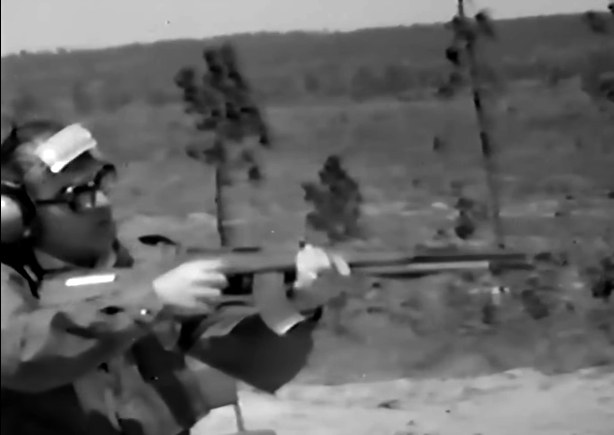
- Trip. In the last of the carrier’s travel, with the bolt locked, the carrier trips the automatic sear and the hammer falls again. The cycle repeats at a cyclic rate of about 750 rounds a minute.12
- Empty. When the last round has been fed, the magazine follower raises the hold-open and the carrier stops to the rear.
In single fire, step 8 does not happen. The semi-automatic sear holds the hammer instead until the trigger is released, and the trigger sear then holds it for the next shot. The detail of the extractor, ejector and firing pin is not described in any source found, and is not reconstructed here.
2.12 Sights
The rear sight is the AK’s type, mounted at the front of the receiver cover. Iannamico: “a sliding bar, tangent type calibrated out to a range of 1,000-meters; the 300-meter battle sight position is indicated by a Roman numeral III.” The front sight is “an AK post type adjustable for elevation and windage”.2 The 1993 article says the same in fewer words: an arc-shaped rear-sight base with a slider, as on the Type 56 AK (弧形表尺座圆形游标).1
2.13 The bayonet
The bayonet was a doctrinal requirement, not an accessory (Volume 1). The 1993 article:
刺刀作为63式上突出的要求提了出来,所以仍采取56式半自动步枪那种固定式可折叠刺刀。刀形断面为三棱刮刀式,刃长310mm,刀尖尖锐,以增强杀伤威力。
“The bayonet was raised as a prominent requirement for the Type 63, so the Type 56 semi-automatic rifle’s fixed folding bayonet was kept. The blade is of triangular section, like a three-sided scraper, 310 mm long, with a sharp point, to increase its lethality.”1
Iannamico describes its use: “To extend the bayonet the soldier pulls the grip rearward and rotates the blade forward locking it onto the L shaped lug under the front sight tower. To retract the blade, the grip is pulled to unlock the bayonet and then rotate it under the barrel until it locks into position.”2

2.14 Stock and furniture
The stock is a full-length wooden one of the SKS’s form, “held at the neck”, with the forefinger on the trigger, “mainly for a firm grip in bayonet fighting”.1 On production rifles the upper handguard was normally plastic. The stock has a stamped steel buttplate with a trap holding an AK-type cleaning kit capsule, with a combination tool, a gas-port cleaning tool, a jag, a patch holder and a bore brush, and the cleaning rod is carried under the barrel.2 The front sling attachment is on the barrel and the rear swivel on the stock, both on the left side.2
2.15 What could not be verified
- The extractor, ejector, firing pin and recoil-spring guide. No source describes them, and they are not reconstructed.
- The regulator’s hole sizes. A Chinese weapons-encyclopedia page gives the two gas holes as “3.8 cm and 2.5 cm”. Those sizes are impossible for a 7.62 mm barrel, and millimetres may have been meant. The page cites nothing, and the figures are not used.9
- “3 mm helical surface”. Given as printed. Its exact meaning is not explained in the source.
- The 15-round magazine. Only Iannamico gives it (above).
- Whether the sheet-metal heat shield is the anti-spark sleeve. Plausible; not stated by either source.
- The practical rates of fire (40 single, 60 in bursts) are given only by SinoDefence.
References
Footnotes
-
向军 (Xiang Jun), 我国63式7.62mm自动步枪盛与衰, 《轻兵器》 (Light Weapons) 1993 no. 6, reproduced with its figures on 枪炮世界, “63式自动步枪”, http://pewpewpew.work/china/rifle/1963/63.htm (accessed 2026-10-20). Translations for this dive. ↩ ↩2 ↩3 ↩4 ↩5 ↩6 ↩7 ↩8 ↩9 ↩10 ↩11 ↩12 ↩13 ↩14 ↩15 ↩16 ↩17 ↩18 ↩19 ↩20 ↩21
-
Frank Iannamico, “Chinese 7.62x39mm Type 68 Rifle”, Small Arms Review vol. 12 no. 11, August 2009, https://smallarmsreview.com/?p=15367 (accessed 2026-10-20). ↩ ↩2 ↩3 ↩4 ↩5 ↩6 ↩7 ↩8 ↩9 ↩10 ↩11 ↩12 ↩13 ↩14 ↩15 ↩16 ↩17 ↩18 ↩19 ↩20 ↩21 ↩22
-
US Defense Intelligence Agency, Small Arms Identification and Operation Guide, Eurasian Communist Countries, 1983, plate “Type 68”, negative 511408, https://commons.wikimedia.org/wiki/File:Diatype63.png (accessed 2026-10-20). ↩ ↩2 ↩3
-
SinoDefence.com, “Type 63 Rifle”, last updated 24 June 2006, https://web.archive.org/web/20070820155744/http://www.sinodefence.com/army/small_arms/type63rifle.asp (accessed 2026-10-20). ↩
-
Maxim Popenker, “Type 63 assault rifle (China)”, Modern Firearms, https://modernfirearms.net/en/assault-rifles/china-assault-rifles/type-63-eng/ (accessed 2026-10-20). ↩
-
Ian McCollum, “Type 63: China Makes an AK/SKS Hybrid”, Forgotten Weapons, 2024, https://www.forgottenweapons.com/type-63-china-makes-an-ak-sks-hybrid/ (accessed 2026-10-20). ↩ ↩2 ↩3 ↩4
-
枪炮世界, “63式自动步枪”, captions to the magazine photographs (“63式常见的20发弹匣与罕见的10发弹匣”, photograph contributed by @Zeke), http://pewpewpew.work/china/rifle/1963/63.htm (accessed 2026-10-20). ↩
-
孤独的老顽童, 昙花一现的中国63式自动步枪, NetEase News repost, undated, https://m.163.com/news/article/BAS2K42S00014OVF.html (accessed 2026-10-20). ↩
-
中华网武器大全, “63式自动步枪”, https://m.junshi.china.com/wuqi/13461.html (accessed 2026-10-20). ↩

Comments (0)