Chinese Type 63 Rifle · Volume 1
Origins: One Rifle to Replace Two, and the Name the West Gave It
Why the People's Liberation Army wanted a single rifle with the SKS's accuracy and bayonet and the AK's automatic fire, how a 'three-way' team of students, soldiers and factory hands designed it from 1959 to 1963, what the design was supposed to deliver, and why Western books call it the Type 68
1.1 The short version
The Type 63 was the first rifle that the People’s Republic of China designed for itself rather than copied. Its official name is 63式7.62毫米自动步枪, the “Type 63 7.62 mm automatic rifle”. It was meant to replace both of the Soviet-pattern weapons that the People’s Liberation Army (PLA) carried in the late 1950s: the Type 56 semi-automatic carbine, which was the SKS, and the Type 56 submachine gun, which was the AK-47. A team formed in 1959 kept almost everything that soldiers liked about the SKS, including the long wooden stock, the long barrel and the folding bayonet. Into that rifle it put a rotating bolt taken from the AK, a detachable 20-round magazine and a selector for single shots or bursts. The design was certified in 1963, which is where the number comes from.12
The certified rifle was good. The rifle that the factories made from 1969 was not, and Volume 3 tells that story. This volume covers the requirement, the people and the design as approved, and it settles a naming muddle that runs through most English writing on the gun. “Type 68” is not a separate rifle that followed the Type 63. It is a Western name for the same rifle, and Chinese writers call it a mistake.

1.2 What the sources are
The best account of the Type 63 in any language is a Chinese magazine article written by someone who was there. Under the title 我国63式7.62mm自动步枪盛与衰 (“The rise and fall of our country’s Type 63 7.62 mm automatic rifle”), it was published under the name 向军 (Xiang Jun) in the Chinese small-arms magazine 《轻兵器》 (Light Weapons), issue 6 of 1993. The author describes the development team as “mostly young people just out of school” and writes about the production years from the factory floor. The full text is reproduced, with the article’s own drawings, on the Chinese reference site 枪炮世界 (Guns of the World).1 Every figure in this dive that matters is quoted from it in the original Chinese and translated here.
A second Chinese account, shorter and more official in tone, appeared in 2003 in a history of the PRC’s rifles published by the naval magazine 《舰船知识》 and carried by Sina Military. It agrees with the 1993 article on dates and adds two numbers of its own, both discussed in Volume 3.2
The English sources are of a different kind. They describe the rifle from the outside, from captured examples. The two used most here are a US Defense Intelligence Agency identification plate of 1983 and Frank Iannamico’s article on a captured rifle from the US Marine Corps museum, in Small Arms Review in August 2009.34 Both call the rifle the “Type 68”. Ian McCollum’s Forgotten Weapons video of 2024 is the most recent hands-on look.5
Several later Chinese web articles repeat the 1993 text, often word for word, and add stories of their own. Where one of them is the only source for a claim, the claim is either labelled or left out. One combat anecdote that circulates widely is not credible and is not repeated (see What could not be verified).
1.3 Two rifles in one squad
By the late 1950s the PLA had adopted copies of three Soviet weapons for the 7.62×39 mm cartridge, which China called the Type 56 round. In Chinese service all three carried the same designation: the Type 56 semi-automatic rifle (the SKS), the Type 56 submachine gun (the AK-47) and the Type 56 light machine gun (the RPD).1 The hub’s SKS dive covers the Chinese SKS in Volume 7, and the AK-47 dive covers the Chinese Type 56 in Volume 12. This dive does not repeat either.
The 1993 article sets out how the army saw the two individual weapons:
56式半自动步枪,射击精度好,带伸折的刺刀,能够体现”刺刀见红”的勇敢精神;56式冲锋枪,能连发射击,火力较猛,但射击精度差,没有刺刀,枪短,有小握把,不利于拼刺格斗。
“The Type 56 semi-automatic rifle shoots accurately and has a folding bayonet that can embody the brave spirit of ‘the bayonet that draws blood’. The Type 56 submachine gun can fire bursts and has heavy firepower, but it shoots inaccurately, has no bayonet, is short, and has a small pistol grip, which is no good for bayonet fighting.”1
Two points in that passage explain the whole rifle. First, the PLA in 1958 classified the AK as a submachine gun, a close-range weapon issued alongside the rifle, not as the rifle itself. Second, the bayonet was not an afterthought. It was a doctrinal requirement, and the AK’s pistol grip and short length counted against it because they made bayonet fighting harder.
1.4 Rifle and submachine gun in one
The new rifle therefore had to be a rifle first. The 1993 article states the requirement as 步冲合一, “rifle and submachine gun combined”:
新研制的自动步枪必须是突出步枪作战效能(射击精度、刺刀)的前提下,揉合进连发射击性能以加强火力。实际上是”步冲合一”的概念,与当今突击步枪概念不同的是特别强调步枪的性能,必须是在全面保持步枪一切特点的基础上,设计成能单发、连发射击的自动步枪。
“The new automatic rifle had to put the rifle’s combat effectiveness (accuracy, the bayonet) first, and blend in burst fire to strengthen its firepower. In practice it was the concept of ‘rifle and submachine gun combined’. Unlike today’s assault-rifle concept, it laid particular stress on the rifle’s performance: it had to be an automatic rifle capable of single and burst fire, designed on the basis of keeping every characteristic of the rifle.”1
There was a second reason, and it was strategic rather than tactical. The doctrine of the period was “people’s war” (人民战争) and “everyone a soldier” (全民皆兵). The militia was to be armed on the same scale as the army, which meant a very large number of rifles. A single rifle that did both jobs simplified that.1
The SKS dive, Volume 4, records the Soviet side: Tula stopped making the SKS in 1958 because the AK “did everything the SKS did, plus automatic fire”. In the same year China began work on a rifle built on the opposite conclusion from the same two weapons.
1.5 A Great Leap Forward project
The programme started in the political climate of 1958. The 1993 article is blunt about it:
1958年,全国掀起”大跃进”高潮,全国群众”鼓干劲""争上游”,放卫星,创奇迹,国防科技界也跟随热潮行动起来,大干”一天等于20年”的工作,63式自动步枪就是在这样的时代背景下开始研制的。
“In 1958 the whole country was swept up in the high tide of the ‘Great Leap Forward’. The masses ‘pumped up their drive’ and ‘strove for the top’, ‘launched satellites’ and ‘created miracles’, and the defence science and technology world followed the tide, working on the principle that ‘one day equals twenty years’. The Type 63 automatic rifle began development against that background.”1
The same passage adds a national-pride argument: “We are going to have the atom bomb and satellites. Can we not make our own rifle?” (原子弹、卫星都要有了,还搞不出自己的步枪吗?). It also says that senior leaders visited the work several times and asked for the rifle to be ready for a parade in Tiananmen Square as early as possible.1
The article is equally clear that there was no proper procedure behind any of this:
当时尚没有一定的研制程序,研制前的战术技术论证,战术技术指标下达以及研制任务的安排都不很正规。
“At the time there was no set development procedure. The tactical and technical study before development, the issue of tactical and technical specifications and the assignment of the development task were none of them very regular.”1
That sentence matters later. When the 1993 author looks back at why the rifle failed, the first cause he gives is that the requirement itself was never properly studied (Volume 3).
1.6 The three-way team
The work was organised according to the political method of the time, the 三结合, the “three-way combination” of technical staff from universities, the army and a factory:
于是就在1959年组成了三结合研制队伍并开进了工厂。
“So in 1959 a three-way development team was formed and moved into the factory.”1
The factory is not named in the 1993 article, and the designers are not named either. That is typical of Chinese accounts of military projects from this period, and no source found names an individual designer of the Type 63. The article describes the team as young people, “both students and teachers, learning by doing”, who were setting up a research institute, a laboratory and a test range at the same time as they designed the rifle. They did it during the famine years that followed the Great Leap, which the article calls “the three years of natural disasters” (三年自然灾害), and it notes that “how hard life was can be imagined”.1
The 1993 article’s verdict on the team’s starting point is frank: “Before Liberation our arms industry did nothing but copy; after Liberation, in the 1950s, it was still copying. Truly independent research and design only began with the Type 63.”1
1.7 What the design set out to do
Three principles were “very clear”, according to the article:1
- The country needed the rifle urgently and it had to be produced quickly.
- The rifle had to keep every characteristic of the semi-automatic rifle, add single and burst fire, and concentrate on improving accuracy in bursts.
- The design method had to be the “three-way combination” and follow “the mass line”.
The engineering answer, described in detail in Volume 2, was to take the SKS’s layout, stock, barrel length, sights and bayonet and to redesign the working parts:
- The bolt came from the AK: a rotating bolt with two locking lugs, turned by a cam track in the carrier. “Most of its structural parameters are the same as the Type 56 submachine gun’s.”1
- The piston was separated from the carrier, unlike the AK’s, and the carrier’s centre of mass was brought down closer to the bore axis. Both changes were made to reduce the turning moment that throws the muzzle up in burst fire.1
- The gas system was redesigned with a two-position gas regulator, which the article says was the first on a Chinese rifle.1
- The trigger mechanism was redesigned as a self-contained group with a rotating hammer, which could be removed from the receiver as a unit.1
- The magazine was a 20-round box of the AK’s pattern, with a slot for a bolt hold-open. The rifle could still be topped up from SKS stripper clips through guides in the carrier without removing the magazine.1
The result looked like an SKS from a distance, and Western soldiers who met it in Vietnam took it for an SKS that could fire automatic (Volume 3).
1.8 The rifle as certified in 1963
即使在这样的艰苦条件下,研制队伍仍然在63年完成了设计定型。国家命名为63式7.62mm自动步枪。
“Even in such hard conditions, the team completed design certification in 1963. The state named it the Type 63 7.62 mm automatic rifle.”1
The Chinese term 设计定型 is a formal stage, “design finalisation” or “design certification”, that comes after state range trials. It is distinct from 生产定型, “production certification”, the approval of the manufacturing drawings and process. The distinction is the hinge of the Type 63 story: the rifle passed the first and, according to the 1993 article, never went through the second (Volume 3).
The 1993 article lists what the certified rifle achieved:1
- Accuracy. Single-shot accuracy equal to the SKS, “at 100 m, an R50 of about 5 cm” (100m距离上R50在5cm左右). R50 is the radius of the circle that contains half the shots. Burst accuracy “much better than the Type 56 submachine gun”, with the muzzle not jumping.
- Reliability. It fired reliably in wind and sand, severe cold and after fording rivers, and passed those tests at the state proving ground, “the first time for a rifle” in China.
- Life. It met a requirement of 15,000 rounds (满足了寿命15,000发要求), against 6,000 for the SKS, without extra weight or special materials.
- Handling. A stiffer and longer bayonet, a long barrel for range, a bolt hold-open, top-loading from clips, and quick field stripping.
It also states that “Chairman Mao and the leaders of the Military Commission inspected it” (毛主席和军委领导还视察过), and that the users and the leadership were “quite satisfied” with the certified rifle.1
The specification table that the 1993 article gives is for the rifle as produced, since it records the reduced service life. It is reproduced in Volume 2 with the other published figures beside it.
1.9 Six years between design and production
Certification in 1963 did not lead to production. The 1993 article dates series production to 1969, and the 2003 account and the English sources agree.126 None of them explains the gap at length. The 1993 article ties the start of production to the slogan “prepare for war, prepare for famine, for the people” (备战、备荒、为人民), which belongs to the war scare of 1969, the year of the armed clashes on the Sino-Soviet border. One later web article says that only a few hundred a year were made for trial units before then, but it cites nothing and is not relied on here (see What could not be verified).
What happened in 1969 is the subject of Volume 3: a crash programme, in the middle of the Cultural Revolution, that changed the rifle’s design several hundred times.
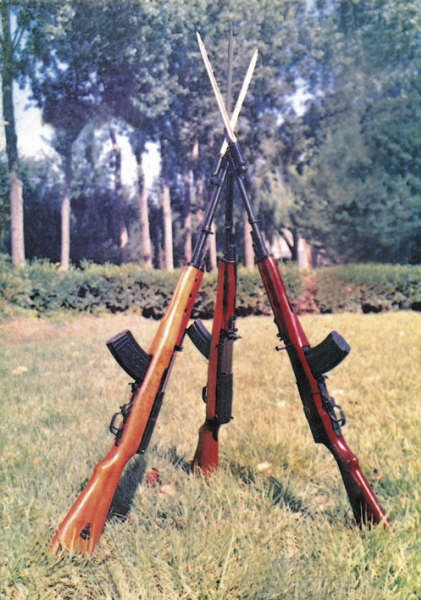
1.10 The name: Type 63, not Type 68
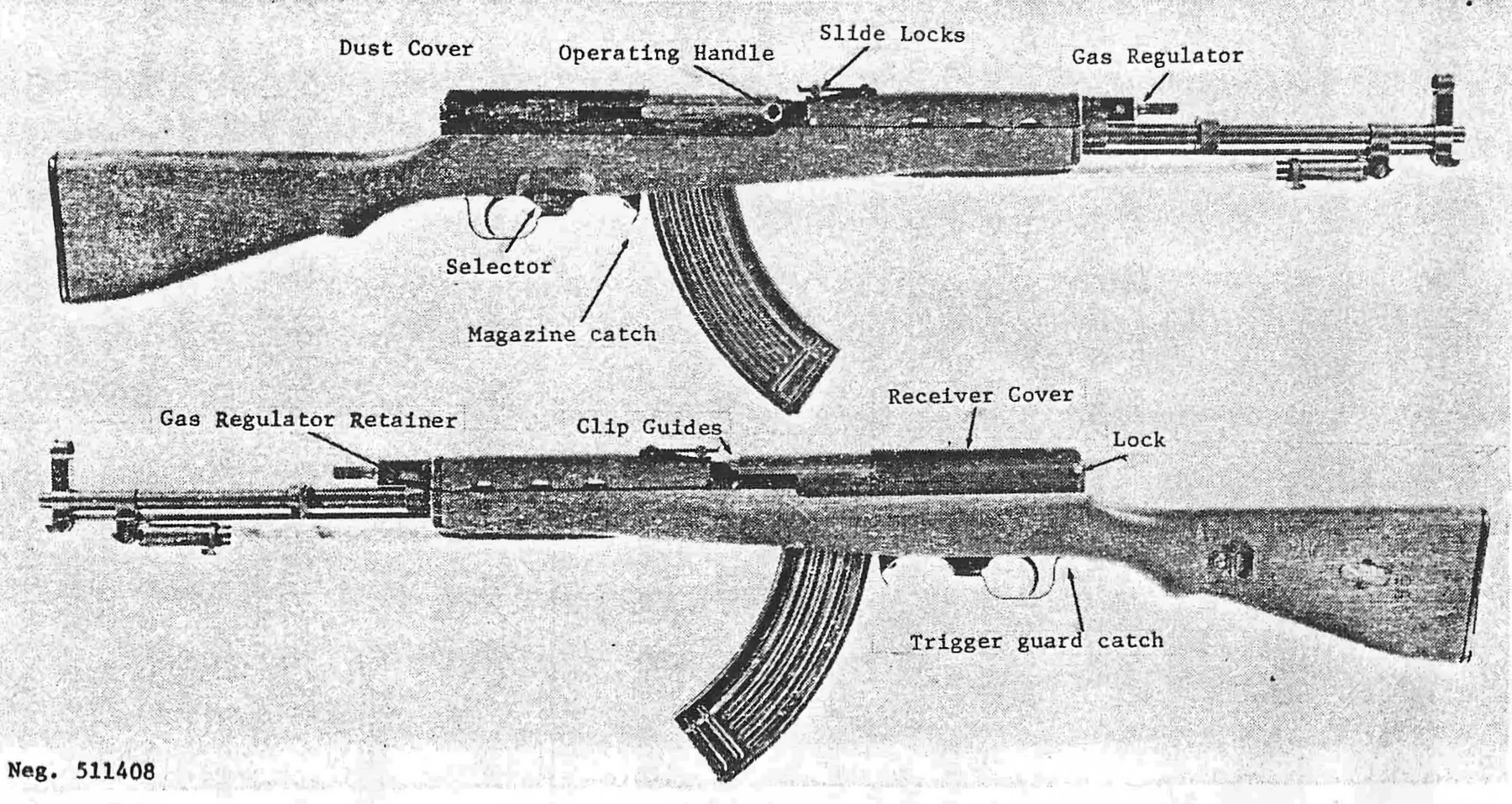
Most English books, and the US government documents of the 1970s and 1980s, call this rifle the Type 68. The US Army’s Foreign Science and Technology Center demonstrated it under that name at Fort Bragg in 1974, the Defense Intelligence Agency’s identification guide of 1983 shows it as such, and Iannamico’s 2009 article is titled “Chinese 7.62x39mm Type 68 Rifle”.734 A blog repost of the 1993 article says that Ian Hogg’s Jane’s Infantry Weapons also used “Type 68”, but that edition was not seen for this dive.8
The Chinese sources treat the name as an error. The 1993 article’s first sentence is:
63式自动步枪是我国自行研制的第一支步枪(在外国被误称为68式)。
“The Type 63 automatic rifle is the first rifle our country developed itself (abroad it is mistakenly called the Type 68).”1
The same article adds that American and Australian soldiers who first met it in Vietnam “thought it was an SKS that could fire bursts, and later called this rifle the Type 68 rifle” (还以为是一种可以连发的SKS,后来他们把这种步枪称为68式步枪).1 SinoDefence (2006) has “often wrongly referred to as Type 68 by Western reports”, and the Bonn International Centre for Conflict Studies’ small-arms guide has “sometimes erroneously referred to as the Type 68”.69
Where the Western number came from is not documented in any source found. Two explanations circulate. One is that the rifle was adopted in 1968, but no source gives any Chinese event in 1968; Chinese accounts put certification in 1963 and series production in 1969. The other is that 1968 was the year Western forces first identified it, which is plausible but unsourced. The honest statement is that no explanation was found.
What this means for the question “what replaced the Type 63?” There was no Chinese Type 68 rifle in between. When the PLA withdrew the Type 63 in 1978, it went back to the Type 56 SKS and the Type 56 AK; the factories restarted SKS production; and the Type 81 family, certified in 1981 and issued army-wide from 1983, finally replaced both (Volume 3).2 Iannamico mentions “reports of a simplified Type 68 rifle designated as the Type 68/73”, and says that he could not confirm that production models existed. Nothing found for this dive confirms it either.4
1.11 Three other rifles with the same numbers
The same two numbers belong to three other Communist-bloc rifles. Each of them causes trouble in auction listings and in captions:
Table 1 — The same two numbers belong to three other Communist-bloc rifles. Each of them causes trouble in auction listings and in captions
| Name | What it is | Where this hub covers it |
|---|---|---|
| Chinese Type 63 | This rifle: select-fire, rotating bolt, detachable magazine, SKS-pattern stock | This dive |
| North Korean Type 63 | An SKS copy, some with a grenade launcher or a side-folding bayonet; the receiver cover is marked with a star in a circle over “63” | SKS dive, Volume 8, which makes the same warning from the other side |
| North Korean Type 68 | An AKM copy, adopted in 1968 | Not covered; named here so that it is not confused with the Western “Type 68” |
| US-market “Type 63” SKS | Semi-automatic Chinese SKS variants sold under that label, such as the AK-magazine SKS-D (Volume 4) | SKS dive, Volume 7 covers the Model D and M |
A North Korean Type 63 SKS sold at Rock Island Auction in 2023 was described as having its top cover “marked with a circled ‘star’ above the model type ‘63’”.10 The rule for a reader holding a rifle marked or described as “Type 63” is to look under it first. A detachable magazine ahead of the trigger guard together with a selector at the front of the guard is the Chinese automatic rifle. Anything else is one of the others.
1.12 A dated record
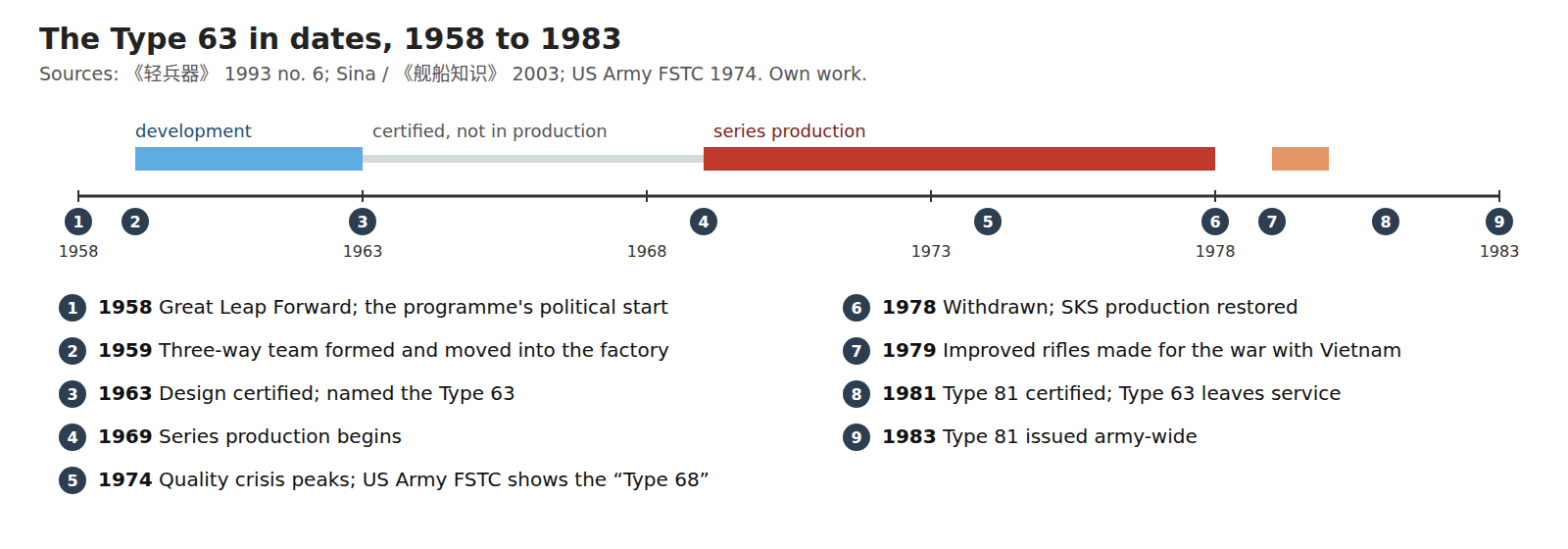
Table 2 — A dated record
| Date | Event | Source |
|---|---|---|
| 1958 | Great Leap Forward; the programme’s political start | 《轻兵器》 19931 |
| 1959 | Three-way team formed and moved into the factory | 《轻兵器》 1993; SinoDefence16 |
| 1960 | Programme start according to McCollum | Forgotten Weapons 20245 |
| 1963 | Design certification; named Type 63 | 《轻兵器》 19931 |
| 1969 | Series production begins | 《轻兵器》 1993; Sina 200312 |
| 1974 | Quality problems peak; a two-year quality campaign follows | 《轻兵器》 19931 |
| 1974 | US Army FSTC demonstrates the “Type 68” at Fort Bragg | FSTC film7 |
| 1978 | Decision to withdraw; SKS production restored | Sina 2003; 《轻兵器》 199321 |
| 1979 | Improved rifles briefly produced and issued for the war with Vietnam | 《轻兵器》 19931 |
| 1981 | Type 81 family certified; the Type 63 formally leaves service | 《轻兵器》 1993; Sina 200312 |
| 1983 | Type 81 issued army-wide | Sina 20032 |
The start of the programme is given as 1959 by the 1993 article and by SinoDefence, and as 1960 by McCollum. The two are set side by side here. The 1993 article is the account from inside the programme.
1.13 What could not be verified
- The designers’ names, and the factory. No source found names an individual designer or the factory that the team moved into in 1959.
- Where “Type 68” came from. No document explains the Western number (above).
- The “Type 68/73”. Reported by Iannamico in 2009 as unconfirmed; nothing further found.
- Hogg’s Jane’s entry. Known here only through a Chinese blog’s paraphrase.8
- A trial-production rate before 1969. One 2026 web article says “two or three hundred a year” for five years of troop trials and gives a unit cost of 105 to 110 yuan. It cites only a magazine title without an issue, and neither figure is used.11
- A combat anecdote not used. A widely copied Chinese web text quotes an unnamed “Australian veteran” who says his patrol was hit by accurate two-round bursts from a “high-precision SKS” with a starred 20-round magazine, which they later called the Type 68. The text gives no name, unit or date. It puts M14s and an M60 in the patrol’s hands, while Australian infantry carried the L1A1 self-loading rifle, and it dates the rifles’ arrival to the “early 1960s”, years before series production began. It is not used. A second web article attributes these stories to a 2002 article in the same magazine and calls them invented.12
References
Footnotes
-
向军 (Xiang Jun), 我国63式7.62mm自动步枪盛与衰 (“The rise and fall of our country’s Type 63 7.62 mm automatic rifle”), 《轻兵器》 (Light Weapons) 1993 no. 6, reproduced with its figures on 枪炮世界, “63式自动步枪”, page created 2005-11-08, updated 2026-03-01, http://pewpewpew.work/china/rifle/1963/63.htm (accessed 2026-10-20). The page also credits 枪火 and 蓝云, “中国63式自动步枪”, 《轻兵器》 2002 no. 5, for some captions. Translations for this dive. ↩ ↩2 ↩3 ↩4 ↩5 ↩6 ↩7 ↩8 ↩9 ↩10 ↩11 ↩12 ↩13 ↩14 ↩15 ↩16 ↩17 ↩18 ↩19 ↩20 ↩21 ↩22 ↩23 ↩24 ↩25 ↩26 ↩27 ↩28 ↩29 ↩30 ↩31 ↩32
-
“资料:新中国步枪发展历程——自制阶段” (“The development of New China’s rifles: the indigenous stage”), 《舰船知识》 via 千龙新闻网, Sina Military, 22 July 2003, http://mil.news.sina.com.cn/2003-07-22/138626.html (accessed 2026-10-20). Translations for this dive. ↩ ↩2 ↩3 ↩4 ↩5 ↩6 ↩7 ↩8
-
US Defense Intelligence Agency, Small Arms Identification and Operation Guide, Eurasian Communist Countries, 1983, plate “Type 68”, negative 511408; scan at https://commons.wikimedia.org/wiki/File:Diatype63.png (accessed 2026-10-20). The full document was not found online. ↩ ↩2
-
Frank Iannamico, “Chinese 7.62x39mm Type 68 Rifle”, Small Arms Review vol. 12 no. 11, August 2009, https://smallarmsreview.com/?p=15367 (accessed 2026-10-20). The rifle examined was lent by the US Marine Corps National Museum. ↩ ↩2 ↩3
-
Ian McCollum, “Type 63: China Makes an AK/SKS Hybrid”, Forgotten Weapons, 2024, https://www.forgottenweapons.com/type-63-china-makes-an-ak-sks-hybrid/ (accessed 2026-10-20). ↩ ↩2
-
SinoDefence.com, “Type 63 Rifle”, last updated 24 June 2006, archived https://web.archive.org/web/20070820155744/http://www.sinodefence.com/army/small_arms/type63rifle.asp (accessed 2026-10-20). ↩ ↩2 ↩3
-
US Army Foreign Science and Technology Center, “Special Forces Foreign Weapons Demonstration”, Fort Bragg, 1974, film; stills at 25:08 and 25:35 on Wikimedia Commons, https://commons.wikimedia.org/wiki/File:Aiming_the_Chinese_Type_68_rifle.jpg (accessed 2026-10-20). ↩ ↩2
-
孤独的老顽童, 昙花一现的中国63式自动步枪 (“China’s short-lived Type 63 automatic rifle”), reposted on NetEase News, undated, https://m.163.com/news/article/BAS2K42S00014OVF.html (accessed 2026-10-20). Most of its text copies the 1993 article. ↩ ↩2
-
Bonn International Centre for Conflict Studies, SALW Guide, “Norinco Type 63”, https://salw-guide.bicc.de/en/weapon/view/102 (accessed 2026-10-20). ↩
-
Rock Island Auction Company, “North Korean Type 63 SKS Rifle with Bayonet and Grenade Spigot”, auction 89, lot 3375, 2023, https://rockislandauction.com/detail/89/3375/north-korean-type-63-sks-rifle-with-bayonet-and-grenade-spigot (accessed 2026-10-20, from the lot title and description). ↩
-
阿腩讲娱乐, 63式自动步枪:中国轻武器自研最惨痛的一次工业复盘, NetEase, 30 August 2026, https://www.163.com/dy/article/L5I2Q3B405566QRM.html (accessed 2026-10-20). ↩
-
充满矛盾学的”63式自动步枪”, NetEase, undated, https://m.163.com/dy/article_cambrian/G73ODHQI0537401P.html (accessed 2026-10-20). An opinion piece; cited only for its claim about where the anecdotes came from. ↩


Comments (0)