Chinese Type 63 Rifle · Volume 4
Telling Them Apart: Type 63 or SKS, Forged or Riveted, and the Markings Nobody Has Catalogued
How to tell a Type 63 from a Chinese SKS across a room and in the hand, the four Type 63s photographed from the same side at the same scale, early and late receivers and carriers, the magazines, the airborne folding-stock sample, what the markings do and do not say, and the rifles that share its name
4.1 The short version
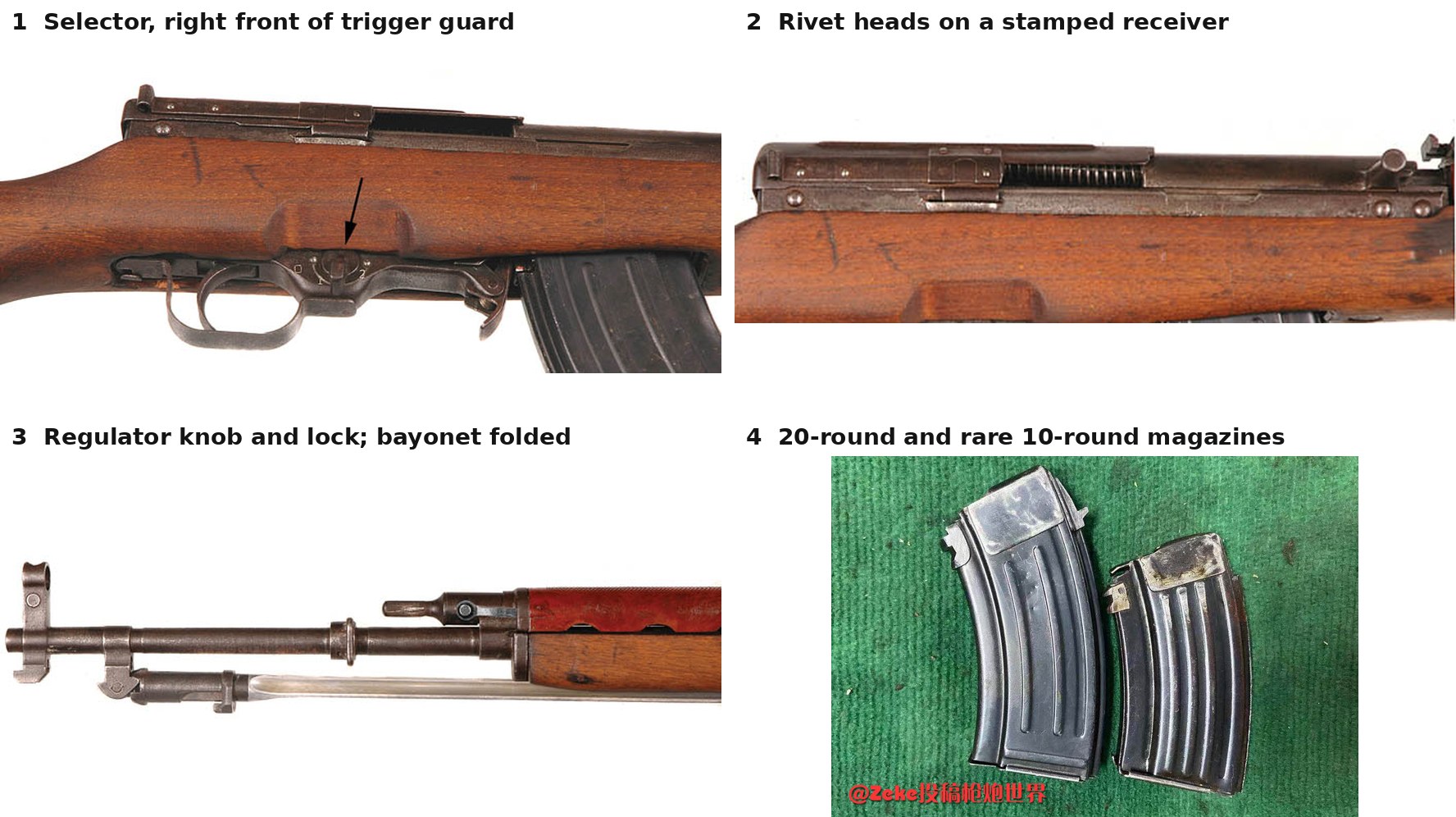
Across a room a Type 63 looks like an SKS. Three things give it away, and all three can be seen from the right side: a curved box magazine hanging below the stock ahead of the trigger guard, a small selector lever at the front of the trigger guard marked 0, 1 and 2, and a gas regulator knob projecting from the front of the gas cylinder. In the hand, with the receiver cover off, the carrier has a cam track and a two-lug rotating bolt where the SKS has a tilting bolt.12
Within the type, the sources describe two receivers, an early one machined from a forging and a later one assembled from stampings with rivet heads on its walls. They also describe late carriers with a roof-shaped top and a solid conical charging handle, a painted finish that flakes, and rifles modified in 1979 to take AK magazines.31 No source found catalogues the factory marks on Type 63 receivers. That gap is stated plainly below, and the Chinese SKS’s factory-code tables are not transferred to this rifle.
4.2 Type 63 or SKS: the five-second check
The hub’s SKS dive, Volume 9, describes the SKS’s tilting bolt and fixed ten-round magazine. Set against it:
- Under the stock. The SKS’s magazine is fixed, a short box that is part of the trigger-guard assembly. The Type 63’s is a separate, longer, curved box, inserted ahead of the guard and released by a catch in front of the guard.1
- At the trigger guard. The Type 63 has a selector lever at the front right of the guard, with the stock cut away around it. An SKS has its safety inside the guard, behind the trigger, and no selector.1
- At the front of the gas system. The Type 63’s regulator knob, with its retainer, sticks out of the front of the gas cylinder. A Chinese SKS has no regulator.12
- Bayonet. Both have a folding spike bayonet hinged under the muzzle. The bayonet tells nothing.
- Length tells nothing. The Type 63’s barrel is 520 mm and its length with the bayonet folded 1,032 mm (Volume 2). The SKS dive gives the SKS 521 mm and 1,020 mm (Volume 1). A Chinese blog’s paraphrase of Ian Hogg says the Type 63’s barrel is longer than the SKS’s. The published figures do not bear that out.3
4.3 Four rifles, one side, one scale
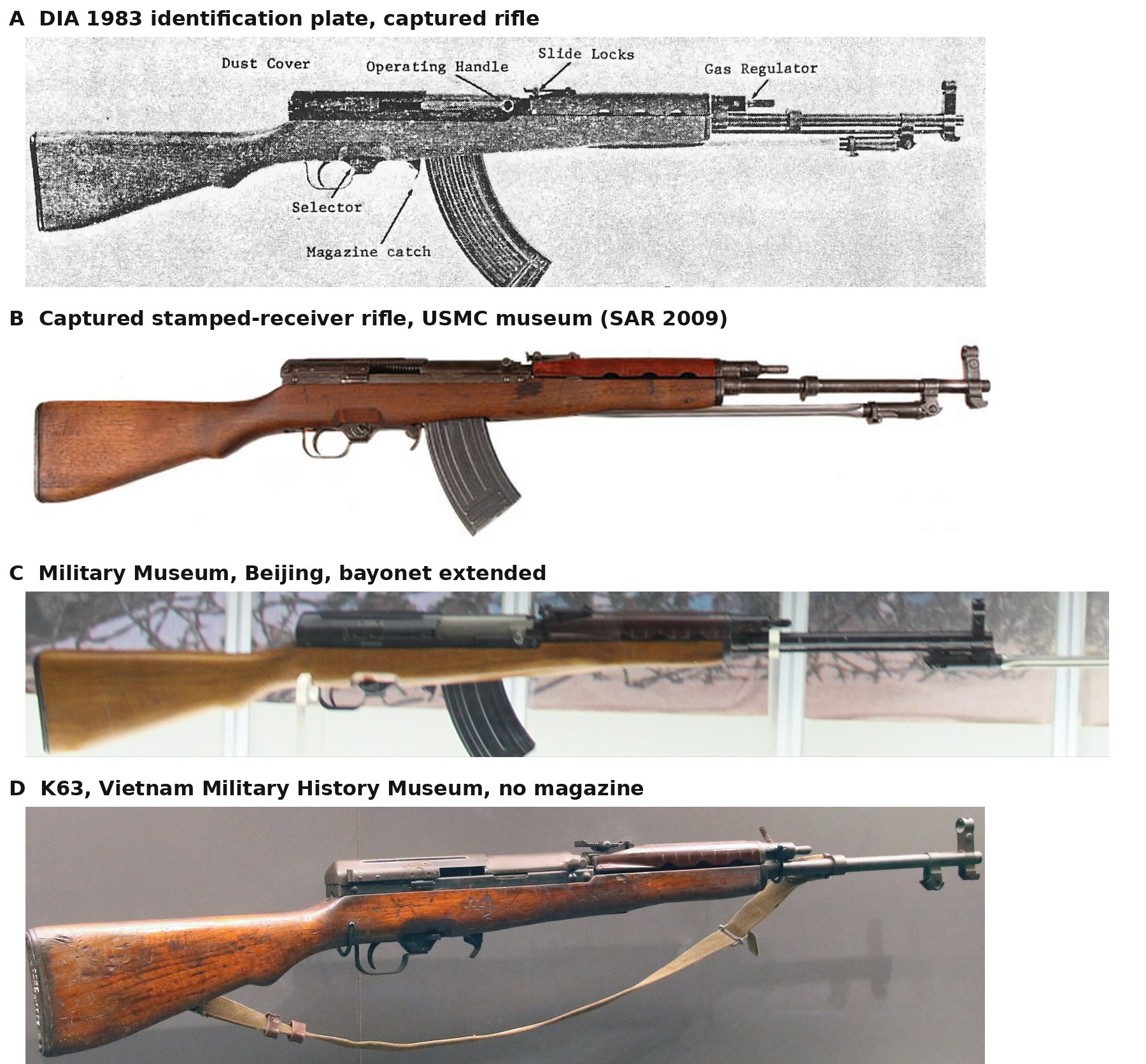
What the plate shows, panel by panel:
- A (DIA 1983). The labels name the parts a soldier works: dust cover, operating handle, slide locks, gas regulator, selector, magazine catch. Whether this rifle’s receiver is forged or riveted cannot be read from the halftone.2
- B (SAR 2009). Stamped receiver, identified by its rivets (detail 2 below). Plastic upper handguard. The rear of the receiver cover is open, showing the recoil spring.1
- C (Beijing). The PLA’s own exhibit, with the bayonet extended and locked on the lug under the front sight. The receiver type cannot be judged at this resolution.
- D (Hanoi). The receiver wall shows round heads below the cover that look like the rivets of the stamped receiver, but the photograph does not settle it. The bayonet has been removed, leaving its hinge under the barrel. The magazine catch and the selector are visible in front of and at the front of the trigger guard.
All four are the same model. Nothing in the sources identifies a Chinese variant with a different designation. The visible differences are production changes, which the rest of this volume covers.
4.4 The details that identify it
4.5 Forged and riveted receivers
The certified rifle had a receiver “machined from a forging”. In production it was replaced by a “stamped-and-riveted receiver … pieced together from 13 parts”, trunnion, left and right walls, rear block, hold-open housing and rivets (Volume 3).3 Iannamico and McCollum both describe the result as two variants:
“There are two variants of the Type 68. Early models had a forged steel receiver while later production used a stamped steel receiver. The stamped receiver is easily identified by the presence of rivets on the sides.”1
“The Type 63 was made in two main variations; initially a milled receiver and later a stamped receiver.”4
How to tell them. Look at the receiver walls between the stock line and the receiver cover. Rivet heads, in the wall and around the hold-open housing, mean a stamped receiver. A smooth, machined wall with no rivets means the forged receiver. The two drawings from the 1993 article (Volume 3) show the difference in construction. In photographs, the stamped receiver’s walls look like sheet with formed edges, and the forged one’s like a solid block.
When the change came is not stated in any source found. The 1993 article says only that rifles made “in the first two years of production, to the certified drawings” were of good quality, and that the problems grew “as output increased and changes multiplied”, peaking in 1974.3 That suggests the forged receiver belongs to the early years, but it does not date the change, and no serial range is published.
4.6 Early and late carriers and finish
The 1993 article names three production changes that can still be seen on a rifle:3
Table 1 — Early and late carriers and finish
| Feature | As certified (early) | As changed in production (late) |
|---|---|---|
| Carrier top | ”three arcs” (三圆弧) | “two straight lines and one arc, like a roof” (两斜线与一圆弧……类似房顶) |
| Charging handle | ”hollow cylinder with a flange at the end” (空心圆筒、端部有突缘) | “solid cone” (实心锥柱) |
| Carrier guides | full length | shortened by 6 mm (no external sign) |
| Finish | black oxide (黑色氧化) | electrophoretic paint (电泳涂漆), uneven and flaking |
The carrier shape and handle can be seen with the cover on, since the carrier rides under it with the handle out to the right. The finish is the least reliable of the three, because rifles may have been refinished in China, Vietnam, Albania or elsewhere since.
The Chinese reference photograph of the carrier reproduced in Volume 2 shows a handle with a flared end, which looks like the hollow, flanged early type, but the photograph’s date and source rifle are not given.
4.7 The 1979 rifles
Rifles made or reworked for the 1979 war had their magazine well and catch modified to take the Type 56 and 56-1 AK magazines as well as the Type 63’s own starred 20-round magazine. The original well had “a relief at its rear for the bolt hold-open”, and on an unmodified rifle the hold-open must be removed before an AK magazine will work.3 The same account also says the improved rifles had a stronger recoil spring, tighter bolt tolerances and a better-hardened firing pin, none of which can be seen from outside.
No source describes how to recognise a 1979 rifle externally other than by trying an AK magazine. An AK magazine that seats and feeds in a rifle whose hold-open is intact suggests a 1979-pattern magazine well. That is an inference from the description, not a documented test.
4.8 Magazines
The Chinese sources and McCollum agree on the standard magazine: 20 rounds, stamped and welded from 0.75 mm sheet, of the AK’s form, with a slot for the hold-open.34 McCollum counts “3 distinct types of magazines made for them, all holding 20 rounds and with a bolt hold-open mechanism”.4 The captions on 枪炮世界 identify:5
- The standard Chinese magazine, “with a five-pointed star on each side” (两侧有五角星图案). This is the magazine the 1979 account calls the “five-star” (五星) 20-round magazine.
- A rarer magazine “that differs from the early design near the mouth”.
- A 20-round plastic magazine.
- A rare 10-round magazine, photographed beside a standard 20 (detail 4 above).
Iannamico gives the capacity as 15 rounds and calls 20 a mistake (Volume 2). The Chinese sources, McCollum and the photographs all say 20, and that is the figure used here.1
AK magazines do not work in an unmodified Type 63, because they lack the hold-open interface, but Type 63 magazines do work in AK rifles.4 A Type 63 found with an AK magazine in it is either a 1979-pattern rifle or one whose hold-open has been removed.
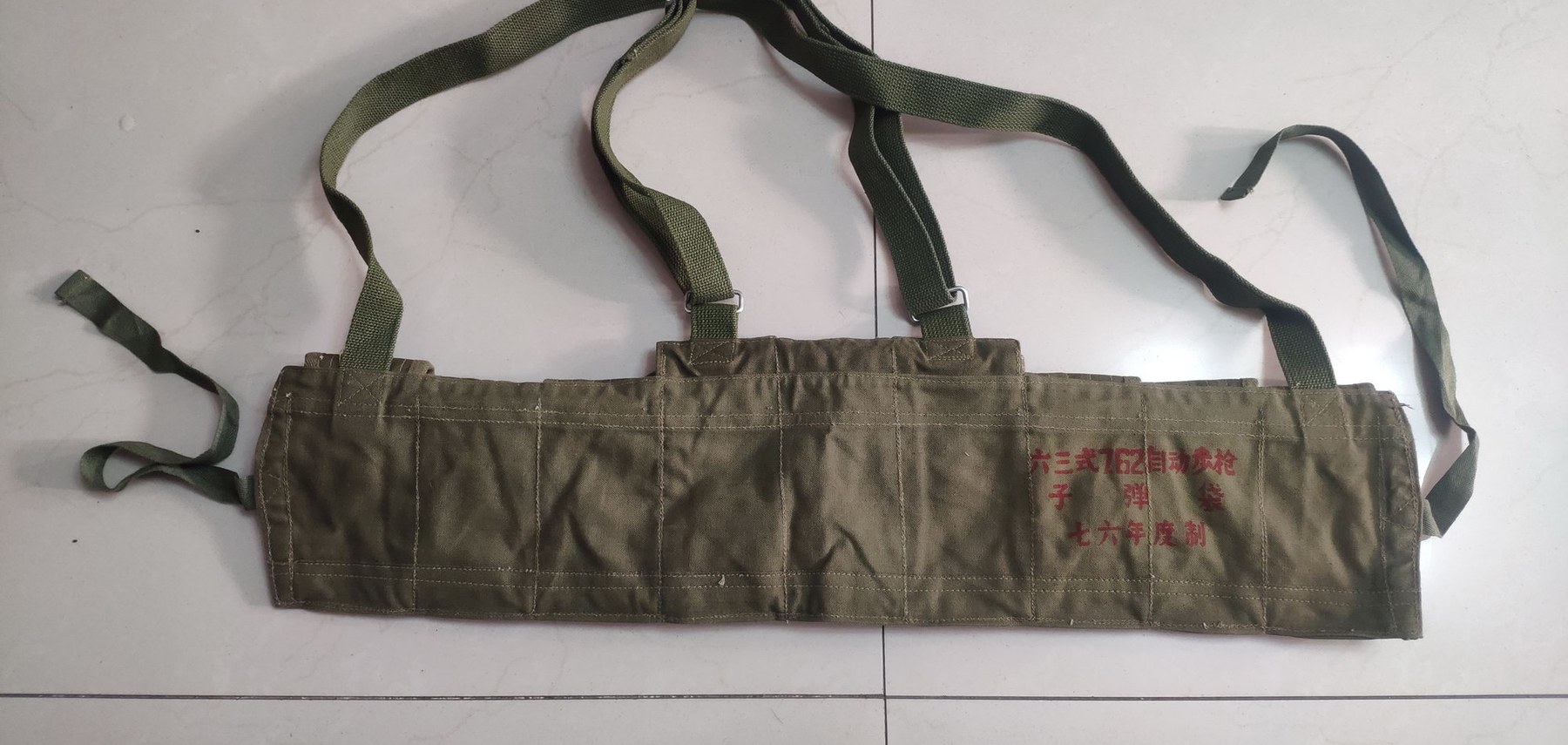
Kit followed the magazine. The PLA issued a five-pocket chest rig and a six-pocket vest for the rifle’s 20-round magazines. 枪炮世界 shows both, and notes that the SKS’s clip pouches, sized for one ten-round stripper clip, will not hold a magazine.5
4.9 The airborne folding-stock sample
The 1993 article: “a batch of Type 63s with folding stocks was specially converted for the airborne troops, but because the technology was immature it was not successful” (当年曾为空降兵专门改制了一批折叠枪托的63式,由于技术不成熟也没有成功). The 枪炮世界 caption to a surviving example calls it “a sample of the Type 63 with a folding stock, said to be the paratroop model, but not mass-produced”.35
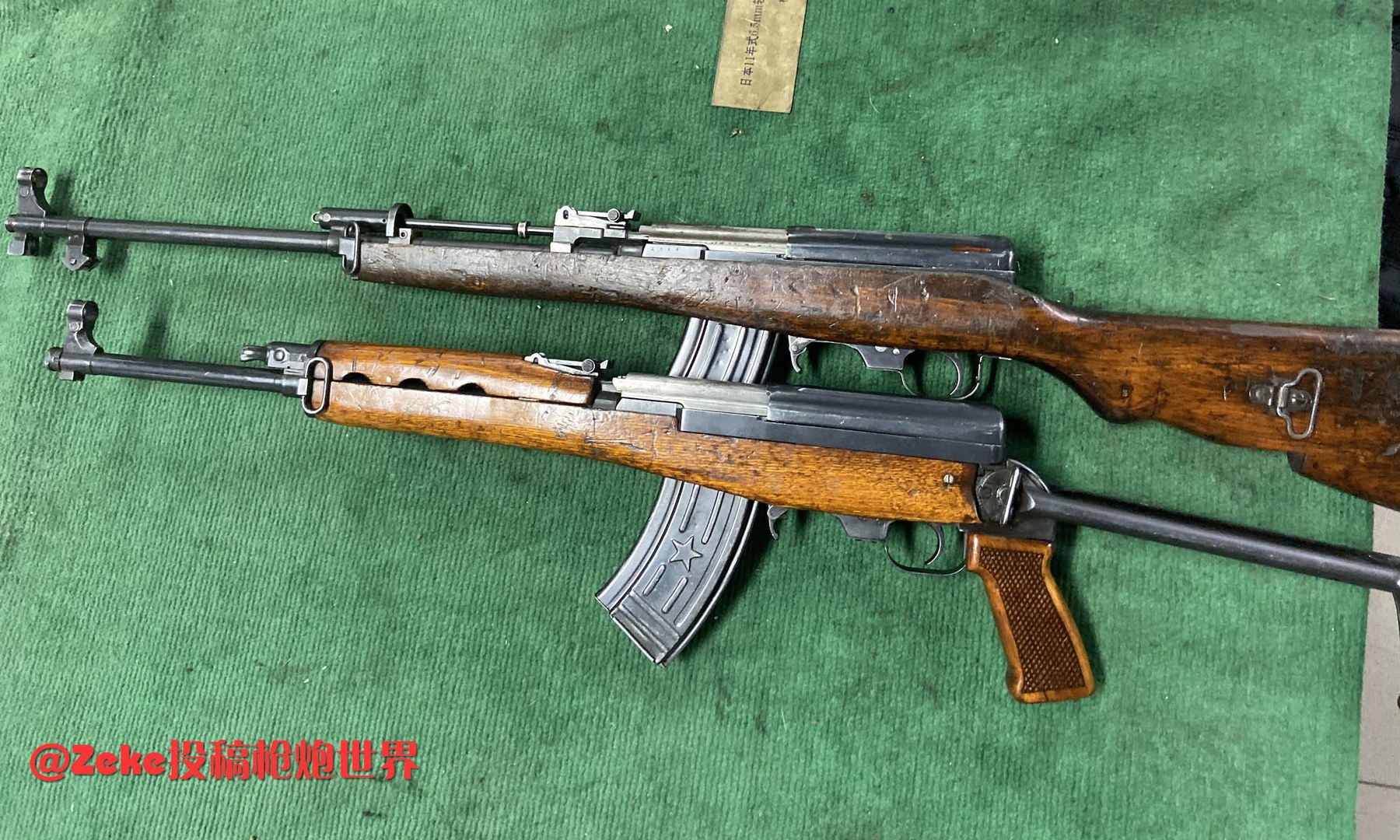
The sample in the photographs has a separate wooden pistol grip behind the trigger guard and a steel stock that folds under the action. The contributor’s sequence of photographs shows the folded stock interfering with the magazine. 枪炮世界 offers that as “possibly one of the reasons it was not adopted”.5 No source gives a quantity.
4.10 Sights
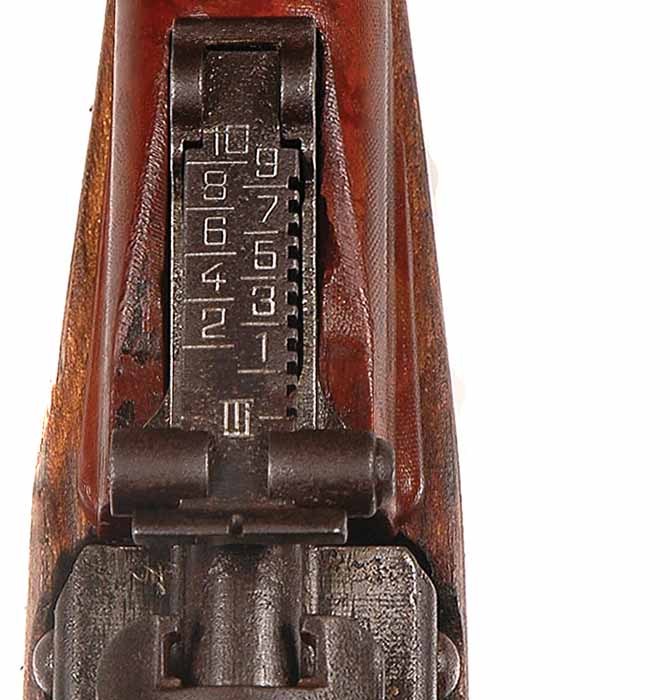
The tangent rear sight is graduated from 1 to 10, that is to 1,000 metres, with a battle setting marked III, which Iannamico reads as 300 metres.1 The DIA plate labels the parts near it “Slide Locks”, without explanation.2
4.11 Markings
What is documented.
- Serial number: “on the left side of the receiver above the magazine well” (Iannamico). His photograph shows a stamped line there.1
- The name: 63式7.62毫米自动步枪, “Type 63 7.62 mm automatic rifle”, is the official designation.3 Kit was stencilled with the numerals written out, 六三式 (above).
- Selector: 0, 1 and 2 (detail 1).1
- Magazine: a star stamped on each side of the standard magazine.5
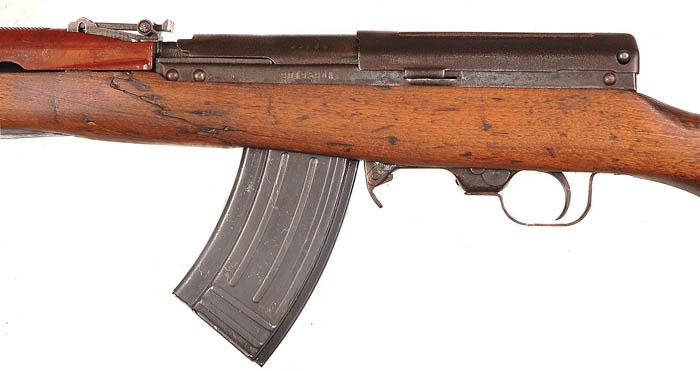
What is not documented. No source found lists the factory codes on Type 63 receivers, says whether they use the shapes and numbers of the Chinese SKS’s codes, or explains the Type 63’s serial numbering. The 1993 article names no factory. One Chinese weapons-encyclopedia page lists three Chongqing plants without evidence (Volume 3).6 The SKS dive, Volume 7, sets out the Chinese SKS’s factory marks and serial schemes in detail. Those tables are for the SKS and must not be read across to the Type 63. A seller who dates a Type 63 from an SKS serial table is guessing.
The detailed photographs of a Type 63’s markings that this dive needs, a legible left-side receiver stamp, the top of the receiver cover and the trigger group, were not found from any source. They are listed as owed in the README.
4.12 Other rifles called Type 63
Volume 1 tabulates the name collisions. For identification:
- North Korean Type 63. An SKS copy. Rock Island Auction describes the cover as “marked with a circled ‘star’ above the model type ‘63’”. It has the SKS’s fixed magazine, tilting bolt and no selector; some have a grenade launcher or a side-folding bayonet. The SKS dive, Volume 8, covers it.7
- US-market “Type 63” SKS. Semi-automatic Chinese SKS variants have been sold under the name. An online auction listing, for example, offered a “Chinese Type 63 SKS semi auto rifle … Triangle 26 marked … takes a specialized AK style magazine … 16-1/2″ barrel … import marked (Navy Arms Co.)”.8 An auction title seen in the same search reads “Chinese Norinco Type-63 SKS-D, Modified for AKM Magazines”. These are SKS-family rifles, covered in SKS Volume 7 under the Model D and Model M. They have the SKS’s tilting bolt and no selector.
- The Western “Type 68”. The same rifle as this one (Volume 1).
The single test that separates the Chinese automatic rifle from all of them is the selector at the front of the trigger guard. A rifle without one is not a Type 63 in the sense of this dive, whatever it is called.
4.13 Tell them apart: the table
Table 2 — Tell them apart: the table
| Feature | Type 63 (this rifle) | Chinese Type 56 SKS | North Korean Type 63 | US-market “Type 63” SKS-D or M | Where to look |
|---|---|---|---|---|---|
| Magazine | Detachable curved 20-round box, ahead of the guard | Fixed 10-round, part of the guard | Fixed 10-round | Detachable AK-type | Under the stock |
| Selector | Lever at front right of the guard, 0-1-2 | None | None | None | Front of the trigger guard |
| Gas regulator | Knob and retainer at the front of the gas cylinder | None | None | None | Front of the handguard |
| Bolt | Rotating, two lugs, cam track in carrier | Tilting | Tilting | Tilting | Receiver cover off |
| Receiver | Forged early, riveted stampings late | Milled (a rare stamped batch, SKS Vol 7) | Milled | Milled | Receiver walls |
| Markings | Serial left side above the magazine well; factory codes undocumented | Factory code and 五六式 on the left | Star in circle over “63” on the cover | Import marks | Left side, cover |
| Legal status in the US | Machine gun (Volume 6) | Title I rifle | Title I rifle | Title I rifle | — |
Sources: 12378; SKS entries from the hub’s SKS dive, Volumes 7 to 9.
4.14 What could not be verified
- When the receiver changed, and any serial or date boundary between forged and riveted rifles.
- Factory codes and serial schemes for the Type 63.
- External signs of a 1979 rifle, other than the magazine-well change.
- Quantities of the plastic and 10-round magazines, and of the folding-stock samples.
- The meaning of the DIA’s “Slide Locks” label.
References
Footnotes
-
Frank Iannamico, “Chinese 7.62x39mm Type 68 Rifle”, Small Arms Review vol. 12 no. 11, August 2009, https://smallarmsreview.com/?p=15367 (accessed 2026-10-20). Photographs of a rifle lent by the US Marine Corps National Museum; trigger group photographed at Aberdeen. ↩ ↩2 ↩3 ↩4 ↩5 ↩6 ↩7 ↩8 ↩9 ↩10 ↩11 ↩12
-
US Defense Intelligence Agency, Small Arms Identification and Operation Guide, Eurasian Communist Countries, 1983, plate “Type 68”, negative 511408, https://commons.wikimedia.org/wiki/File:Diatype63.png (accessed 2026-10-20). ↩ ↩2 ↩3 ↩4 ↩5
-
向军 (Xiang Jun), 我国63式7.62mm自动步枪盛与衰, 《轻兵器》 (Light Weapons) 1993 no. 6, reproduced on 枪炮世界, http://pewpewpew.work/china/rifle/1963/63.htm (accessed 2026-10-20). Translations for this dive. ↩ ↩2 ↩3 ↩4 ↩5 ↩6 ↩7 ↩8 ↩9 ↩10
-
Ian McCollum, “Type 63: China Makes an AK/SKS Hybrid”, Forgotten Weapons, 2024, https://www.forgottenweapons.com/type-63-china-makes-an-ak-sks-hybrid/ (accessed 2026-10-20). ↩ ↩2 ↩3 ↩4
-
枪炮世界, “63式自动步枪”, captions to the magazine, pouch and folding-stock photographs (contributors @Zeke and 这个兔子有点萌), http://pewpewpew.work/china/rifle/1963/63.htm (accessed 2026-10-20). ↩ ↩2 ↩3 ↩4 ↩5
-
中华网武器大全, “63式自动步枪”, https://m.junshi.china.com/wuqi/13461.html (accessed 2026-10-20). ↩
-
Rock Island Auction Company, “North Korean Type 63 SKS Rifle with Bayonet and Grenade Spigot”, auction 89, lot 3375, 2023, https://rockislandauction.com/detail/89/3375/north-korean-type-63-sks-rifle-with-bayonet-and-grenade-spigot (accessed 2026-10-20). ↩ ↩2
-
CT Firearms Auction, “Chinese SKS Type 63 Rifle 7.62X39”, online lot, https://ctfirearmsauction.com/auction_item/chinese-sks-type-63-rifle-7-62x39/ (accessed 2026-10-20). ↩ ↩2

Comments (0)