ArmaLite AR-7 & Explorer II · Volume 6
The Look — a Rifle Shaped by Its Own Packing Case
Why the AR-7 looks the way it does, argued from how it was made: the stock that is a container, the missing fore-end, the aircraft alloy and moulded plastic, the swirled colours, and why a pistol built on the same receiver had to look like a ray gun
6.1 The Claim This Volume Tests
The AR-7 belongs to the same “space age” family of American firearms as the Whitney Wolverine, the Remington Nylon 66 and the Charter Explorer II, and it is usually described in the same adjectives. The hub’s Whitney Wolverine dive argues that the Wolverine’s look was the visible result of one manufacturing decision, a single aluminium casting enclosing a fixed barrel, and that its makers said so in 1956. This volume tests a parallel claim for the AR-7:
Every feature that makes the AR-7 look unlike a conventional rifle is a consequence of one requirement — that the rifle pack into its own stock and float — worked out in aircraft materials by an aircraft company. Unlike the Wolverine, very little about it appears to have been styled for its own sake.
If that is right, each distinctive feature should trace to the packing requirement or to the materials, and the sources should show ArmaLite talking about materials and function rather than appearance. They do.
6.2 What ArmaLite Said It Was Doing
ArmaLite’s founding premise, in its own corporate history, was about materials and manufacture, not appearance: “ArmaLite believed that a ready market existed for firearms of advanced design featuring lightweight, modern alloys and plastics and economical production procedures.” The same document opens by describing ArmaLite’s late-1950s rifles as “innovative rifles that looked unlike any produced before” — the look recorded as a result, not stated as an aim.1
The advertising, as Knupp quotes it, followed the same line. The AR-7 was the “Air Force Survival Rifle,” made with the “latest technology in exotic light alloys,” and “Light, Compact, Safe for Boat, Plane, Car.”2 Every phrase is about weight, size, materials or the survival brief. None located is about line or style — the contrast with the Whitney’s makers, who talked about “graceful contour lines” and “the swept-back, streamlined styling of the newest jet planes,” is complete.3
6.3 The Stock Is a Case
The single most distinctive thing about the AR-7’s shape is the size of its stock relative to the rest of the gun. The reason is that the stock is a container: it holds the barrel, the action and a magazine, and its packed length — 16 ½ in, in Charter’s figures — is set by the 16 in barrel it has to swallow.4 The butt is as long as the barrel because it has to hold the barrel.
From that one requirement follow the stock’s lines:
- It is deep and slab-sided, because a hollow needs walls and a volume large enough for an action beside a barrel. The butt has almost no taper and no cheekpiece.
- Its comb is nearly straight and its butt nearly square, because a moulded container closed by a pressure-fit cap is simplest with flat faces and a flat end.
- The butt cap is a lid. Charter’s manual describes it as “a pressure fit” removed by pushing on its serrations; on the rifle it reads as a thick, flat butt plate.4
- It floats, which on early rifles meant filling the space not used for the parts with foam, and on all of them means a sealed or nearly sealed volume (Volume 2).
A 2014 review notices one more consequence: “the right sided offset on the stock to receiver mounting (which allows room in the stock for the barrel) looks odd but is ergonomically fine.”5 The action is set to one side of the stock’s centre so that, packed, the barrel can lie beside it. The asymmetry is invisible from the side and plain from above.
6.4 No Fore-End
A conventional rifle has a fore-end: wood or plastic under the barrel for the forward hand. The AR-7 has none. The barrel comes out of the receiver bare, held only by its nut, and the rifle’s whole profile is a heavy butt and grip at the back with a thin tube in front.
The fore-end is missing because it could not be packed. Anything under the barrel would either have to come off with the barrel or stay on the receiver, and either way it would need somewhere to go inside the stock. The AR-5 set the pattern: Knupp describes its barrel attaching to the receiver “with a threaded collar,” and nothing else.2 Henry’s current rifle, for all its changes, still has no fore-end. Knupp found the best way to hold one was “a two-handed grip on the buttstock, similar to the hold for firing a handgun” — the rifle has nowhere else to hold.2
The knurled barrel nut is the one feature between receiver and muzzle. It reads as a collar or a fitting, which is exactly what it is: a coupling made by hand, without tools.
6.5 A Receiver Small Enough to Pack
The receiver is a small box with a tube on top, almost featureless on the sides. Three requirements make it so:
- It must fit a pocket in the stock, so it is as small as the bolt and fire-control parts allow and has nothing projecting. The rear sight is the one “ear” on top.
- The charging handle is removable. It pulls out to the right for use and pushes in to stow; Charter’s manual has the owner “depress” it before the action goes into the stock.4 With it pushed in, the receiver’s side is a smooth tube.
- The stock attaches from below, by one screw through the grip, so the receiver has no tang and no stock bolt behind it; its back end is simply closed. The rear of the receiver and the top of the grip meet at a clean joint.
The same receiver, made to pack, is the reason a pistol built on it could not avoid its shape (below).
6.6 Aircraft Alloy and Moulded Plastic
ArmaLite was the gun division of an aircraft maker, and its founder was a Lockheed patent lawyer who had spent years building firearms from “the latest technical advances in plastics and alloys.”1 The AR-7’s materials are the materials of 1950s aircraft and consumer products:
- Aluminium alloy for the receiver and barrel shell, finished black. Charter’s later rifles are finished in “heat cured, semi-gloss black textured enamel.”4
- A thin steel liner for the bore, the one place the bullet and pressure require steel — the construction of ArmaLite’s first rifle, the AR-1 (Volume 2).1
- Moulded ABS (Cycolac) for the stock — a consumer plastic whose trade name also appears, in the same decade, on the moulded body of the Amphicat amphibious car (Volume 2).
The effect of these materials on the look is direct. Aluminium and plastic are made by casting, extrusion and moulding rather than by cutting wood and forging steel, and they produce what those processes produce: smooth, even surfaces; constant wall thicknesses; flat faces meeting in radiused edges; no grain, checkering or engraving. A rifle made this way does not look like a rifle made in a gun factory, and in 1959 almost no rifle had been made this way. Its only direct contemporary is the Remington Nylon 66, a moulded-nylon .22 introduced the same year — and, as Knupp notes, sold at the same $49.95.2
6.7 The Swirled Stocks
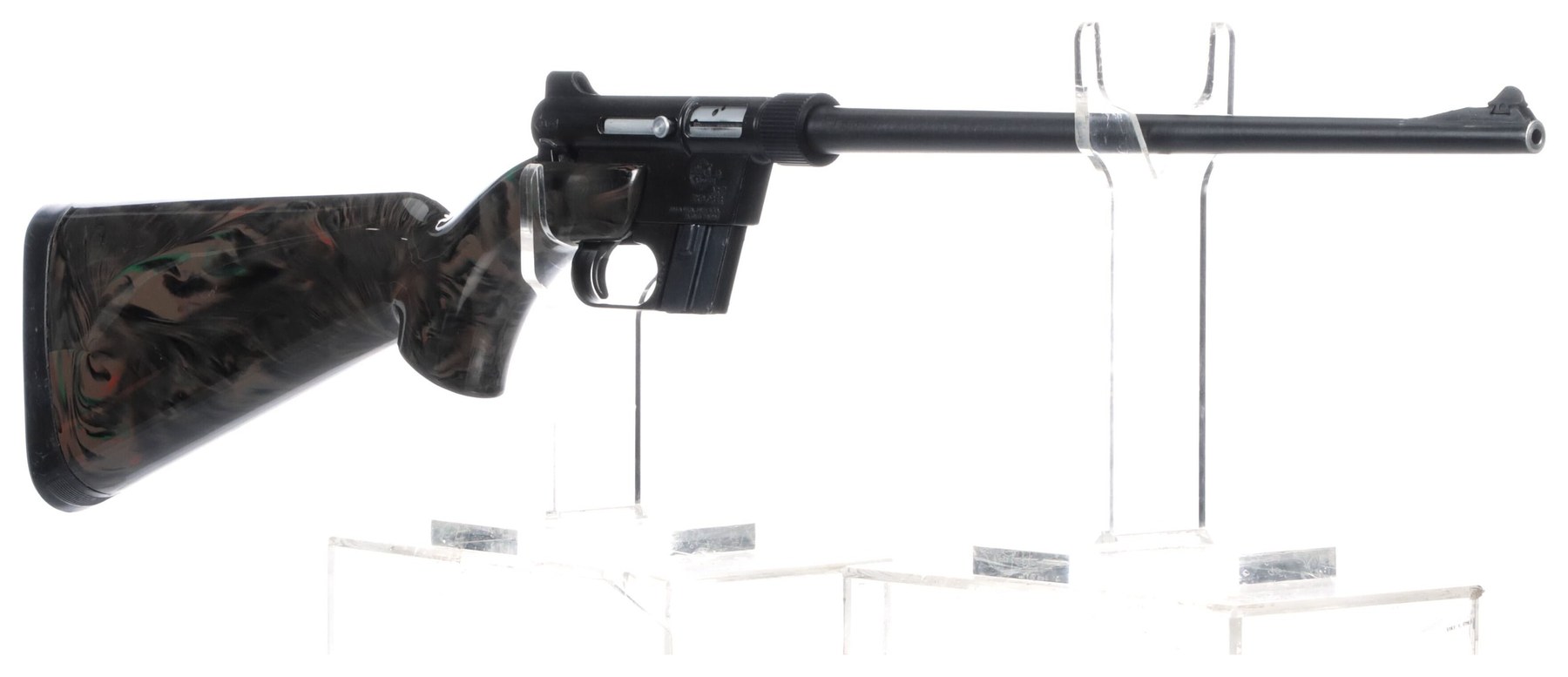
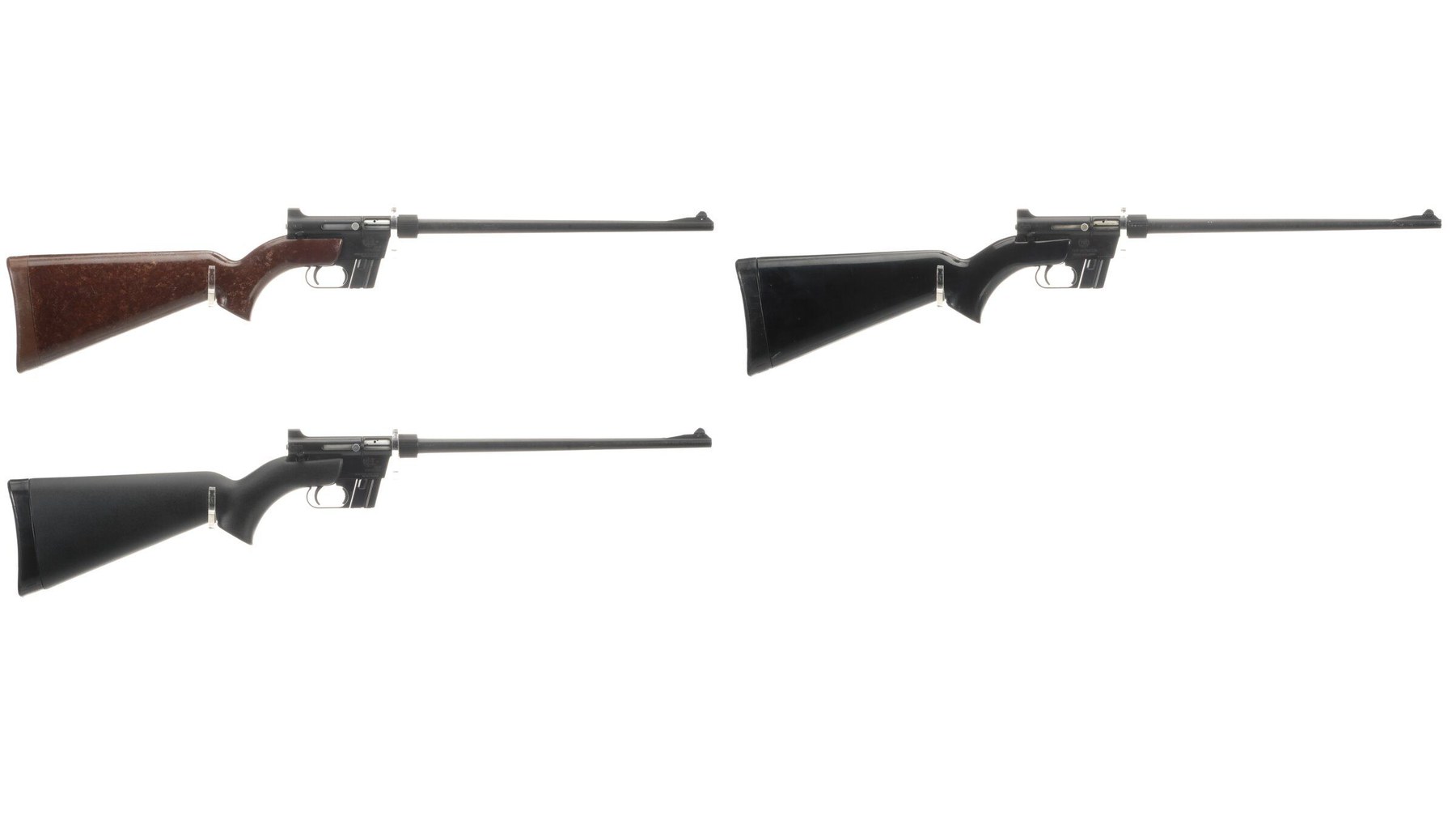
The most “period” thing about an early AR-7 is its stock colour. Sam S. records ArmaLite stocks in black, brown and green, and says the brown and green “tended to have an almost flowing pattern of different shades of colors.”6 Rock Island’s lot photographs show both kinds: a plain, mottled brown and a dark swirl of brown, black and green (Volume 3).
The swirl is a characteristic of the moulding. A stock moulded from plastic in which more than one colour has been deliberately left incompletely mixed comes out marbled, and no two are the same. No source located says whether ArmaLite chose the swirl as a styling feature, adopted it to disguise flow marks, or simply accepted what its moulder supplied, and it is not claimed here either way. What can be said is that it puts the AR-7 among the consumer plastics of its decade, where marbled and mottled mouldings were common, rather than among rifles, where they were not. The Blue Book of Gun Values, as Knupp cites it, now puts a premium on early brown stocks — the collector market treats the colour as the mark of a Costa Mesa gun.2
Charter’s rifles moved to black, silver and camouflage finishes; Henry’s to black and printed camouflage. The swirled stock belongs to ArmaLite’s years.78
6.8 Why the Pistol Looks Like a Ray Gun
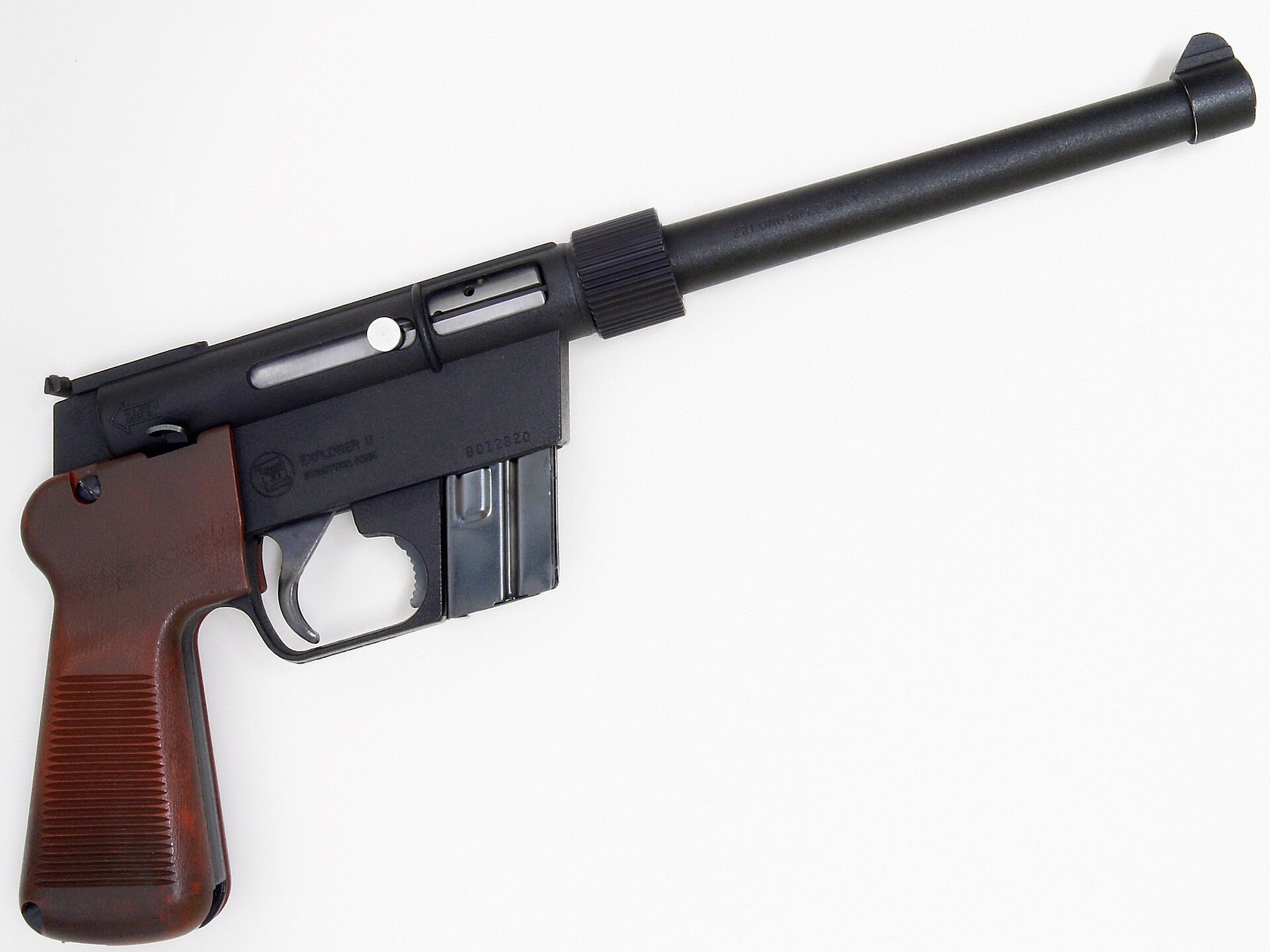
The Charter Explorer II is the member of the family that most often gets called a ray gun, and its shape is the best evidence for the argument of this volume, because nobody designed it to look that way on purpose. It is what an AR-7 receiver looks like when it is turned into a pistol.
On the rifle, the magazine well sits in the front of the receiver, ahead of the trigger guard, and the stock’s grip attaches behind it (Volume 4). A pistol built on that receiver must keep both where they are: the magazine cannot move into the grip without redesigning the receiver and the feed, and the grip must be behind the trigger. So the Explorer II has a magazine well ahead of the trigger and a separate grip behind it — the layout of the Mauser C96, which also carried its magazine ahead of the trigger, and which is the pistol every writer on the Explorer II compares it to.29 Add a long, thin, bare barrel coming out of a knurled collar, a slab-sided receiver with no slide, and a large, raked plastic grip, and the result is the silhouette of a science-fiction pistol, arrived at by keeping a survival rifle’s receiver unchanged.
Hy Hunter reached the same result from the other direction in 1962, dressing the same receiver as a Broomhandle and calling it the “Bolomauser” (Volume 2). The resemblance was apparent to both companies twenty years apart because it is built into the receiver.
The Explorer II’s plastic grip — “Shur-Hold simulated walnut,” in Sam S.’s account — and its gold, silver and camouflage options are the only features on it that look like decisions about appearance.10
6.9 Beside the Whitney Wolverine
The Whitney Wolverine and the AR-7 are the two American firearms of the 1950s most often described as space-age, and both came from aircraft people: the Wolverine from Robert Hillberg, who had led armament work on the F-84, and the AR-7 from ArmaLite, a Fairchild division. The hub’s Wolverine dive argues that the Wolverine’s look followed from casting its frame in one piece around a fixed barrel, and that its makers chose the jet-age styling deliberately and said so.3
The AR-7 reaches a related look by a different route:
Table 1 — The AR-7 reaches a related look by a different route
| Whitney Wolverine (1956) | ArmaLite AR-7 (1959) | |
|---|---|---|
| Governing decision | One-piece aluminium casting enclosing a fixed barrel | Pack into own stock; float |
| Materials | Cast aluminium alloy frame | Aluminium receiver and barrel shell; moulded ABS stock; steel liner |
| Did the makers talk about style? | Yes: “graceful contour lines,” “swept-back, streamlined styling” | Not in any source located: weight, size, “exotic light alloys” |
| Features that read as futuristic | Continuous flowing frame, no slide, tubular top | No fore-end, bare tube barrel, container stock, featureless receiver |
| Where the look comes from | Construction, plus deliberate styling | Construction and packing, with little sign of styling |
Sources: the Wolverine dive’s Volume 4; this volume.3
The Wolverine is a styled object whose styling was made possible by its construction. The AR-7 is an engineered object whose look is almost entirely its packing case. That the two arrive at kindred shapes is evidence that the space-age look of the period came as much from new materials and aircraft practice as from any stylist’s intent. The Wolverine dive’s Kindred Designs section places both among the other guns of the period.
6.10 Googie, the Jet Age, and a Spy’s Rifle
The AR-7 went on sale in the years of Googie architecture — coffee shops, motels and fair pavilions in angled planes, bright plastics and aluminium, built to look like the future — and of the Century 21 Exposition in Seattle. It shares their materials more than their shapes: the Googie building is a style laid over conventional construction, where the AR-7 is a construction with almost no style laid over it.

Where the AR-7’s look did become a style was on screen. Knupp says its takedown made it “overnight … the celluloid spy sniper rifle of choice,” beginning with From Russia with Love in 1963, when Bond assembles it for the camera.2 A rifle that comes out of a case in pieces and goes together in half a minute looks like secret equipment because that is what it is: survival equipment. Film-makers used it for exactly the property ArmaLite had designed in, and the IMFDB list of its appearances, from Bond films to Futureworld (1976), is largely a list of assassins, spies and science fiction (Volume 7).11
References
Footnotes
-
ArmaLite, Inc., “A Historical Review of ArmaLite”, edition of 23 April 1999, Internet Archive copy, https://web.archive.org/web/20081001234245/http://www.armalite.com/images/Library/AL%20HISTORY%20COPY%202.pdf , retrieved 2026-09-19. ↩ ↩2 ↩3
-
Jeremiah Knupp, “The Unlikely Resilience of the AR-7 Survival Rifle”, American Rifleman, 27 December 2016, https://www.americanrifleman.org/content/the-unlikely-resilience-of-the-ar-7-survival-rifle/ , retrieved 2026-09-19. ↩ ↩2 ↩3 ↩4 ↩5 ↩6 ↩7
-
Firearms hub, Whitney Wolverine dive, Volume 4, “The Look — A Casting, a Jet Fuselage, and ‘Modern as Tomorrow’” (quoting W. B. Edwards, “The Oldest Name in Guns Comes Back”, Guns, August 1956), https://firearms.fubsypoly.com/actual-firearms/pistols/whitney-wolverine/vol-4/ . ↩ ↩2 ↩3
-
Charter Arms Corporation, “AR-7 Explorer Parts, Instruction and Warranty Manual” (after July 1975), Internet Archive item
gunmanual_Charter_AR7_Explorer, https://archive.org/details/gunmanual_Charter_AR7_Explorer , retrieved 2026-09-19. ↩ ↩2 ↩3 ↩4 -
“Major Pandemic”, “History of the AR-7 & Henry Repeating’s Survival AR-7”, AllOutdoor, 4 February 2014, https://www.alloutdoor.com/2014/02/04/history-ar-7-henry-repeatings-survival-ar-7/ , retrieved 2026-09-19. ↩
-
Sam S., “Curious Relics #003: ArmaLite AR7”, AllOutdoor, 30 December 2020, https://www.alloutdoor.com/2020/12/30/curious-relics-003-armalite-ar7/ , retrieved 2026-09-19. ↩
-
Sam S., “Curious Relics #004: The AR7 Design Survives”, AllOutdoor, 13 January 2021, https://www.alloutdoor.com/2021/01/13/curious-relics-004-ar7-design-survives/ , retrieved 2026-09-19. ↩
-
Henry Repeating Arms, “U.S. Survival Rifle” product page, https://www.henryusa.com/rifles/u-s-survival-ar-7/ , retrieved 2026-09-19. ↩
-
Sam S., “The Rimfire Report: Charter Arms Explorer II AR7 Pistol Review”, The Firearm Blog, 26 September 2022, https://www.thefirearmblog.com/blog/2022/09/26/rimfire-report-charter-arms-explorer-ii-ar7-pistol-review/ , retrieved 2026-09-19. ↩
-
Sam S., “Curious Relics #005: Charter Arms Explorer II”, AllOutdoor, 27 January 2021, https://www.alloutdoor.com/2021/01/27/curious-relics-charter-arms-explorer-ii/ , retrieved 2026-09-19. ↩
-
Internet Movie Firearms Database, “ArmaLite AR-7” page, read through https://www.imfdb.org/api.php on 2026-09-19. ↩
Comments (0)