ArmaLite AR-7 & Explorer II · Volume 5
Keeping It Working — Takedown, Detail Strip, Maintenance and Repair
The makers' own takedown and stowage sequences, the bolt strip Henry publishes and the fire-control strip nobody does, cleaning and inspection, a malfunction table that starts with the magazine, and where parts still come from
5.1 The Manuals Used
Two makers’ manuals were found, and this volume is built on them:
- Charter Arms, “AR-7 Explorer Parts, Instruction and Warranty Manual” — five pages, with assembly, disassembly, care, an exploded view and a priced parts list. It cites the Magnuson-Moss Warranty Act of July 1975, so it dates from the later Charter years.1
- Henry Repeating Arms, “U.S. Survival .22 Instruction Manual for All H002 Series Rifles,” revision 7.20 — twelve pages, with assembly, operation, cleaning, a bolt strip and a parts list.2
No original ArmaLite instruction sheet was located. Rock Island lot descriptions show that ArmaLite rifles were sold “with papers,” so one existed. The Charter procedure is used for the older rifles because Charter built the same design with the same parts, as Knupp and Sam S. both say.34 Where Charter and Henry differ, both are given.
Before any of the following, the rifle is unloaded: magazine out, bolt drawn back, chamber looked into. Both manuals say so first.
5.2 Assembly From the Stock
Charter’s sequence, which Henry’s repeats with small differences in wording:12
- Remove the butt cap. Charter: hold the stock in one hand, put the thumb of the other on the serrations of the cap, and push “down and outward … from the top”; the cap “is a pressure fit and removes fully.” Henry: hold the stock between arm and chest and pry with both thumbs.
- Take out the action, barrel and magazine. Both makers warn against letting them fall. The charging handle can drop out of the action if it is not held right side up.
- Attach the action to the stock. Put the rear of the action into the slot at the front of the stock and turn the wing bolt (Charter) or stock takedown nut (Henry) in the base of the pistol grip. Charter: “finger tight.” Henry: “until it is firmly and tight.”
- Attach the barrel. Line up the lug on top of the barrel with the slot on top of the receiver and tighten the barrel nut. Charter says “finger-tight”; Henry says “Make certain that the barrel is secured very tightly to the action.” The difference in wording matters (below).
- Replace the butt cap.
- Load and charge. Load the magazine, insert it, pull the charging handle straight out to the right, draw it fully back and let it go.
5.3 Takedown and Stowage
Charter’s disassembly, which contains the one step every AR-7 owner needs to know:1
- Remove the magazine by pressing the release ahead of the trigger. Retract the bolt and look into the chamber.
- “Loosen barrel nut approximately 2 turns. Pull out charging handle, retract bolt about half way and then release so that bolt will strike rear end of barrel sharply. This will separate barrel from tight fit in receiver.”
- Unscrew the nut completely and remove the barrel, holding the receiver right side up so the charging handle stays in.
- Remove the butt cap.
- Put the barrel into its recess in the stock.
- Put the magazine in “with open end down and stop boss to the left.”
- Remove the action from the front of the stock.
- “Depress charging handle and return the action to its pocket in the stock.”
- Replace the butt cap.
Henry’s version differs in two ways: it unscrews the barrel nut “until it is free of the threads” with no instruction to slam the bolt, and its stock takes the action with a magazine still inserted, plus one or two more.2
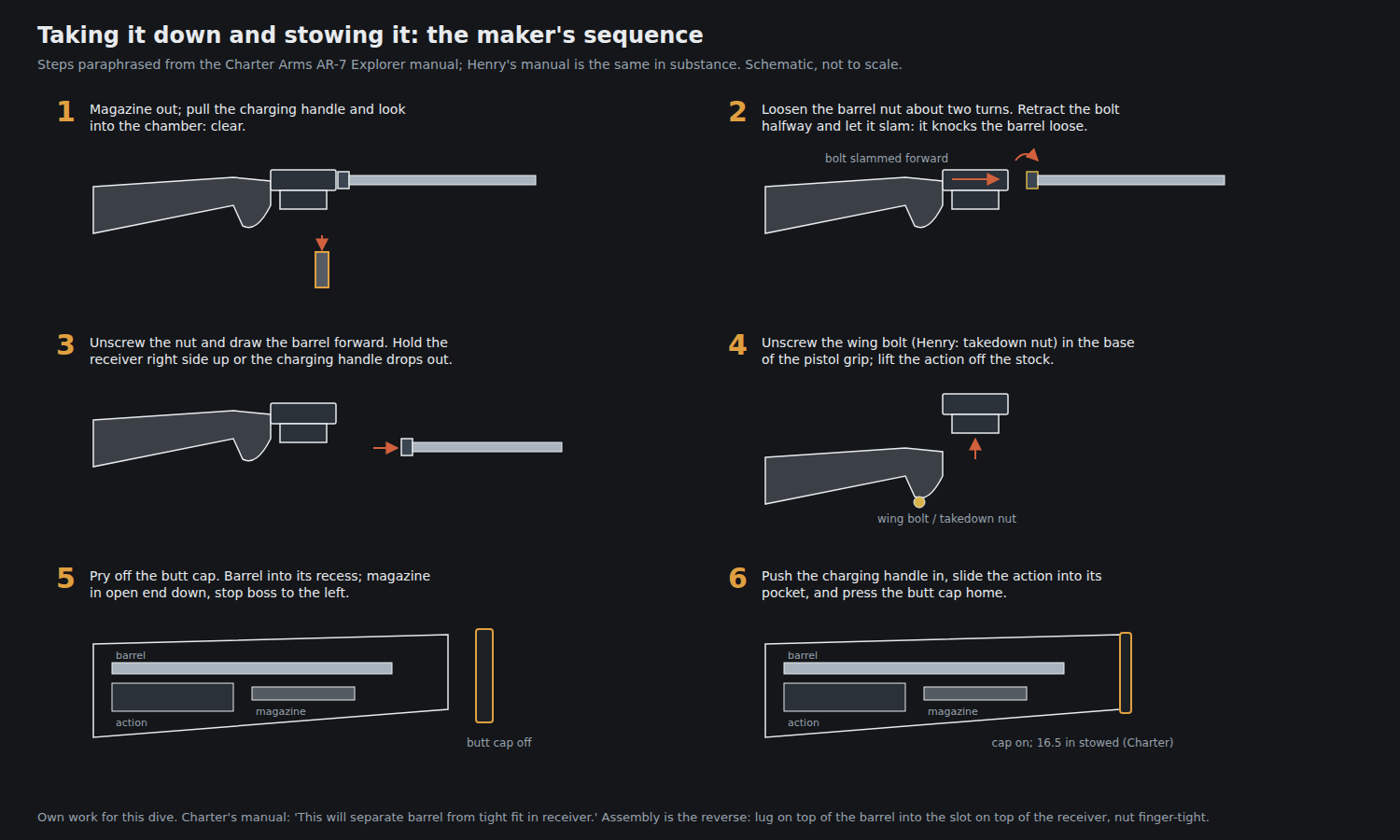
Step 2 says something about the rifle that no advertisement did: the barrel is meant to be a tight fit in the receiver, tight enough that Charter used the bolt as a hammer to break it free. That is the context for the universal advice to keep the nut tight (Volume 4). By the same reasoning, a barrel that drops out freely once the nut is off suggests a fit that has worn; no source gives a tolerance for it.
5.4 Detail Strip: the Bolt
Henry’s manual gives the only bolt-removal procedure found from a maker:2
“Cock the action. Remove the magazine. Insert your index finger into the front of the action and depress the bolt until the charging handle is free to be removed. Tilt the action forward and remove the bolt, action springs and action spring guide. For reassembly, reverse the disassembly instructions.”
Read with the parts list, the sequence is:
- With the barrel off, cock the action and remove the magazine.
- Through the open front of the receiver, push the bolt rearward with a finger against the springs until, in Henry’s words, “the charging handle is free to be removed,” and draw it out.
- Ease the bolt forward and tilt the front of the action down: the bolt, the two action springs and the action spring guide slide out of the front of the receiver tube.
Reassembly is the reverse. The springs go back onto the guide and into the bolt tube behind the bolt, and the charging handle is refitted with the bolt held back in the same way. The firing pin and extractor are retained in the bolt by roll pins (Charter parts 2327 and 2326; Henry 26 and 34); neither maker gives a procedure for removing them, and Henry’s manual says parts “should be installed by a licensed gunsmith.”12
5.5 Detail Strip: the Fire Control, and Why It Is Not Given Here
Neither manual describes removing the sideplate or the fire-control parts. Charter’s care instructions tell the owner not to: “If necessary to clean the action, leave assembled and wash in any petroleum solvent, drain and oil interior lightly.” Sam S., a gunsmith who has written most about keeping these guns running, says the same to readers: “I do not recommend taking your gun apart whatsoever.”15 No procedure for the fire-control strip was found in any maker’s or armourer’s document, and none is reconstructed here.
What a correct procedure has to account for can be read from the parts lists and the photograph of an opened receiver (Volume 4):
- The sideplate comes off with its screw; on a Charter rifle or Explorer II, that screw may also hold a scope base.
- The hammer, trigger and ejector each ride on a pin, and one wire spring bears on both hammer and trigger. That spring is under tension with the parts assembled and will move them when the sideplate comes off.
- The safety is located by a ball detent with its own spring and retained by a snap ring: small parts that are easily lost.
- The magazine latch has its own spring.
- On reassembly, the hammer and trigger must be caught by their shared spring in the right relationship before the sideplate goes back.
A rifle that needs work inside the receiver is a job for someone with the parts to hand and the patience to re-establish those spring relationships; Henry’s advice to use a licensed gunsmith is the conservative course.
5.6 The Explorer II
The Explorer II takes down the same way at the front: the barrel comes off with the nut, and Sam S. found that a split case could be cleared “by taking the barrel off.”5 There is no stock to remove and no stowage. The grip holds one spare magazine. Its parts inside are the rifle’s.56
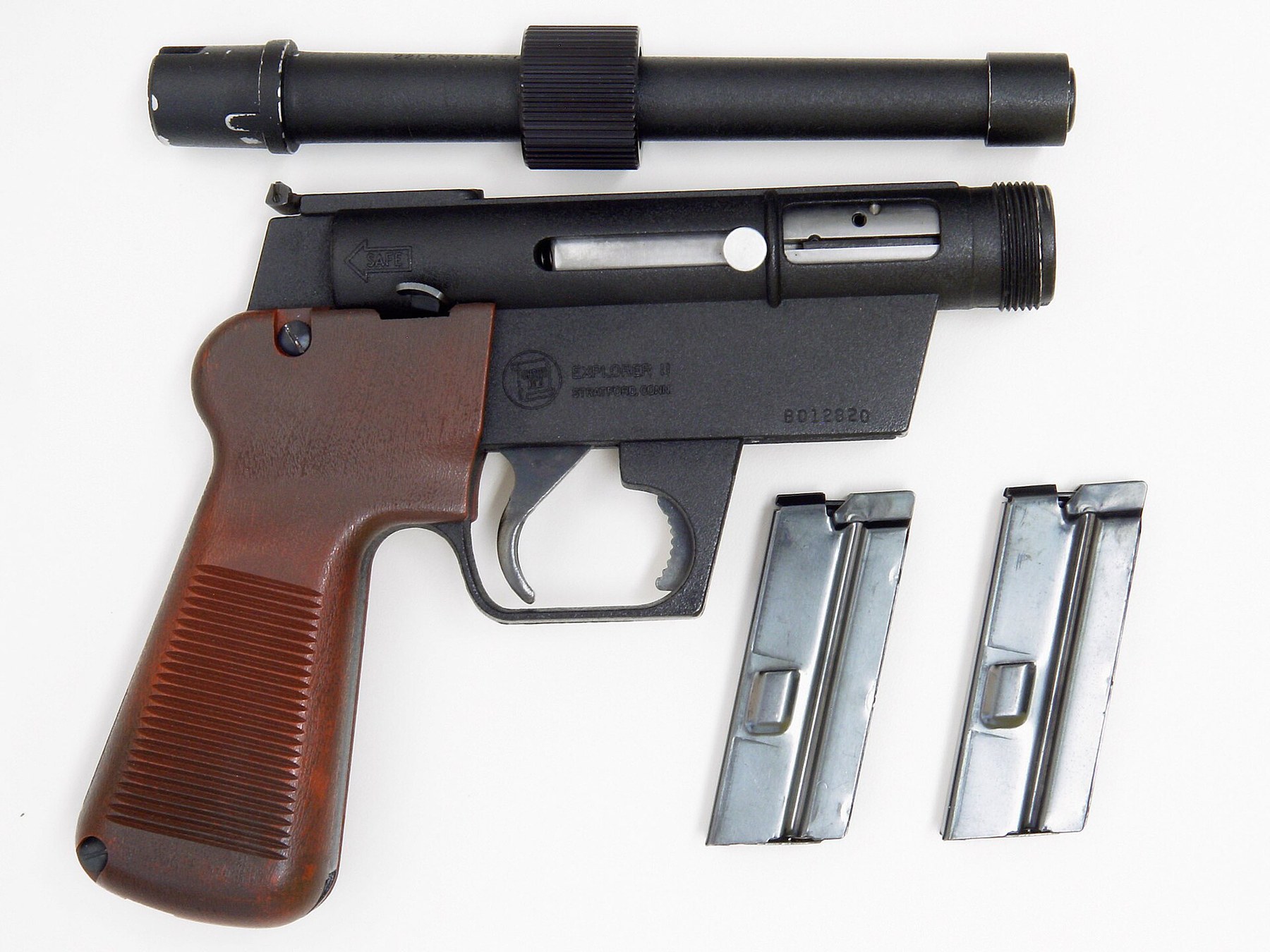
Two pistol-specific repairs are documented by Sam S.:7
- The rear sight. The square-notch rear sight is often found with its blade or windage screws missing. He found that the adjustable rear-sight blade of a Charter Bulldog revolver fits, and identified the windage screws, by measurement of one original, as #2-56 × 5/32 in; he recommends thread-locker because his worked loose. The screw size is his determination, not a published factory figure.
- The scope mount. Charter’s mount (and B-Square’s copy) fixes to the pistol by the large left-hand receiver screw, with two set screws that bear on the top of the frame “ONLY to prevent it from tipping forward.” He tightened the side screw to about 20 inch-pounds; that is his figure, not the maker’s.
5.7 Cleaning and Lubrication
What the makers say.
- Charter: “To keep bore in perfect condition run through an oiled patch after use. Exterior need not be oiled.” For the action: “leave assembled and wash in any petroleum solvent, drain and oil interior lightly with any good grade of gun oil.” The stock “is not harmed by moisture or exposure and may be wiped clean with damp cloth.” Finish damage to barrel and receiver: “Aluminum black touch up.” And in capitals on the page: “For Proper Function, the Action of This Firearm Must be Kept Clean.”1
- Henry: clean and oil the bore “after each shooting session,” from the breech end with the barrel removed, with a nylon or brass brush and solvent, then dry patches, then an oiled patch, wiping out the excess before shooting. Oil the action before inserting a magazine. After damp weather, wipe the bore and metal and re-oil; after soaking rain, snow or salt spray, clean more thoroughly. Between seasons, grease the bore and metal and store dry; do not plug the barrel or store the rifle in an airtight container.2 Knupp reports that Henry recommends cleaning every 100 rounds.3
Cleaning from the breech is easy on an AR-7 because the barrel comes off in seconds: the rod or pull-through goes in at the chamber and out at the muzzle, the direction the bullet travels, and never has to pass through the action.
What experience adds. Sam S.’s regime for his Explorer II is the most detailed located and is attributed to him: keep the magazines clean; keep the bolt springs “LIGHTLY greased and only put dry lube on the bolt if necessary”; the guns “run best as dry as they can comfortably be,” and “adding oil when having malfunctions will only aggravate the issues”; the fire-control pins need “a drop of oil around every six months to a year.” He does a deep clean “once or twice a year,” and treats a gun that starts needing its bolt held open to clear jams as a gun that needs one.67
The two positions are consistent. Both makers call for light oil; the practical warning is against heavy oil in a blowback action whose bolt has little energy to spare (Volume 4).
The stock. On any rifle whose stock has been used for stowage, the recess should be dried after wet use: a hollow stock that has been in water holds it. Knupp found the Henry’s butt cap “doesn’t make a waterproof seal.”3
5.8 Inspection: What to Check, and When
Neither maker publishes an inspection schedule or replacement intervals for any part. Henry’s manual puts the responsibility on the owner: “The gun owner is responsible for periodic inspection and proper maintenance by a qualified gunsmith to ensure that this firearm remains in proper adjustment and that worn parts are replaced.”2 The checks below are drawn from the sources’ descriptions of what goes wrong; the intervals are the natural points in use, not a maker’s schedule.
Table 1 — Inspection: What to Check, and When
| When | Check | Why |
|---|---|---|
| Every assembly | Barrel lug seated in its slot; barrel nut drawn tight | A loose nut is the most-cited cause of lost accuracy and reliability (Volume 4) |
| During shooting | Barrel nut still tight | It “tends to loosen during firing” (Wikipedia) |
| Every session | Magazine lips and ramp: straight, undamaged, symmetrical | The magazine is the feed ramp |
| Every session | Bore and chamber clean; bolt face and extractor claw free of fouling | Blowback bolt has little margin |
| Periodically | Extractor claw sharp and sprung; firing-pin strike marks centred and firm on fired cases | Extraction and ignition |
| Periodically | Action springs: both present, neither kinked | Two springs share the load |
| Before storage | Stock recess dry; bore oiled; not in an airtight case | Henry’s storage advice |
5.9 Malfunctions: Diagnosis in Order
The order matters. Because the feed ramp is in the magazine and the barrel is held by a hand nut, the cheapest and most likely causes of most AR-7 malfunctions are outside the receiver. The table starts there.
Table 2 — Malfunctions: Diagnosis in Order
| Symptom | Check first | Then | Source |
|---|---|---|---|
| Round nose-dives or jams against the chamber mouth | Try another magazine. If the fault follows the magazine, the magazine is bent or worn | Bullet shape: flat-nosed and lead bullets catch the chamber edge; use round-nose, copper-plated high-velocity | Wikipedia; Sam S.; Campbell |
| Two rounds feed at once, or the round pops out of the lips | Magazine lips spread | Replace the magazine | Wikipedia (lips “sprung open or worn”, unconfirmed); Sam S. |
| Fails to feed after firing (bolt short-strokes) | Ammunition: standard-velocity or subsonic will not reliably cycle a Henry and may not cycle any AR-7 | Dirt or heavy oil on the bolt and springs; clean and run nearly dry | Henry manual; Sam S. |
| Fails to eject; empty case left in the chamber | Ammunition velocity; fouled chamber | Extractor claw chipped or its spring weak (Charter 2231, 2254; Henry 33, 35) | Henry manual; parts lists |
| Light strikes or misfires | Barrel nut tight? | Firing pin, hammer and its spring; ammunition lot | Campbell; Wikipedia |
| Accuracy wanders | Barrel nut; barrel lug seated | Front sight has drifted (Major Pandemic advises thread-locker on it once zeroed) | Campbell; AllOutdoor (2014) |
| Bolt will not close with barrel fitted | Wrong barrel: an Explorer II barrel on a rifle, or the reverse, puts the lug in the wrong place | Obstruction or case in the chamber | Wikipedia; Sam S. |
| Barrel will not come off | Follow Charter’s method: loosen the nut two turns and let the bolt strike the barrel | — | Charter manual |
| Charging handle missing | It falls out when the action is inverted without a barrel fitted | Replacement is a listed part (Charter 2232; Henry 14) | Both manuals |
| Split case | Remove the barrel to clear it | — | Sam S. |
After a malfunction the makers’ safety instructions come first: hold the rifle pointed safely for 30 seconds after a failure to fire before opening it, as Henry’s manual directs, and never force a jammed action.2
5.10 Magazine Care and Tuning
The magazine is the part that most decides whether an AR-7 works, so it deserves more care than on other rifles.
- Use the maker’s magazines. Knupp’s Henry failed only with other makers’ magazines; Henry recommends its own.3 Sam S. found Henry magazines work in a Charter Explorer II, fitting “tighter”; his original ArmaLite and Charter magazines work when undamaged; the Ram-Line 25-round plastic magazine did not work at all.7
- Protect the lips. Carry magazines where their open ends cannot be struck or crushed, and store them in the stock or a pouch, not loose.
- Keep them clean. Sam S.: “Keep the magazines in tip-top clean shape.”6
- Number them and test them. Because each magazine is a different feed ramp, a magazine that causes stoppages should be identified and set aside, not mixed back in.
Tuning — bending feed lips back into shape — is the repair most often suggested informally for these magazines. No maker’s or armourer’s instruction for it was found, and no dimensions for the lips or the ramp are published by any source located. Without a reference dimension or a known-good magazine to compare against, bending lips is guesswork; with a good magazine alongside, the lips of a bad one can at least be compared for symmetry and spread. A magazine that has been bent enough to need tuning is usually cheaper to replace, since Henry magazines are in current production.
Wikipedia’s suggestion of “minor beveling of the chamber of the barrel” to help feeding is a permanent change to the barrel and is outside owner maintenance; it is recorded, not recommended.8
5.11 What Breaks, Who Fixes It, and Where Parts Come From
What the owner can do: everything in the assembly, takedown, bolt strip, cleaning and inspection above; replacing magazines, the charging handle, the barrel nut, sights and sight screws, the stock and butt cap.
What the makers reserve: Charter listed the barrel and the receiver as “only available at factory.” The receiver is the serialised firearm; the barrel, on a rifle, is the part whose length makes it a rifle.1 Henry says “not all parts are available for sale” and that those that are “should be installed by a licensed gunsmith,” and it asks owners to call before sending a rifle in.2
Period prices. Charter’s parts list gives a snapshot of what the parts cost in the later 1970s or 1980s: action springs 50 cents each, extractor $1.25, firing pin $2.25, bolt assembly $16.75, barrel $14.00 (factory only), receiver $14.00 (factory only), stock $21.00, stock assembly $26.00, and a combined “rebluing and readjusting” service for $25.00.1
Where parts come from now.
Table 3 — Where parts come from now.
| Rifle | Source of parts | Notes |
|---|---|---|
| Henry U.S. Survival | Henry Repeating Arms | In production; lifetime warranty; magazines sold |
| ArmaLite, Charter, Survival Arms, AR-7 Industries | Used and surplus parts: Numrich, CFNParts; AR-7.com for stocks, barrels and shrouds | Named by Sam S.; availability not checked for this dive |
| Explorer II | Scarce; Sam S. found front sights and grip parts at AR-7.com and “miscellaneous bits” at Numrich | Pistol barrels, mounts and the 10 in barrel are scarce and expensive |
Interchangeability. The sources support a few specific statements and no general one:
- Explorer II internal parts and magazines are the rifle’s.5
- Henry magazines fit and feed in a Charter Explorer II.7
- Explorer II and rifle barrels are deliberately not interchangeable (Volume 3).
- The B-Square scope base made for the Charter “will not fit the Henry receiver,” according to Wikipedia.8
- A 2014 review says “many older parts are still interchangeable” with Henry’s rifle, without saying which.10
Beyond those, parts from one maker’s rifle should be assumed to need fitting in another’s until tried.
References
Footnotes
-
Charter Arms Corporation, “AR-7 Explorer Parts, Instruction and Warranty Manual” (after July 1975), Internet Archive item
gunmanual_Charter_AR7_Explorer, https://archive.org/details/gunmanual_Charter_AR7_Explorer , retrieved 2026-09-19. ↩ ↩2 ↩3 ↩4 ↩5 ↩6 ↩7 ↩8 ↩9 -
Henry Repeating Arms, “U.S. Survival .22 Instruction Manual for All H002 Series Rifles” (revision 7.20), https://www.henryusa.com/wp-content/uploads/2021/04/Henry-H002-Series-User-Manual.pdf , retrieved 2026-09-19. ↩ ↩2 ↩3 ↩4 ↩5 ↩6 ↩7 ↩8 ↩9 ↩10
-
Jeremiah Knupp, “The Unlikely Resilience of the AR-7 Survival Rifle”, American Rifleman, 27 December 2016, https://www.americanrifleman.org/content/the-unlikely-resilience-of-the-ar-7-survival-rifle/ , retrieved 2026-09-19. ↩ ↩2 ↩3 ↩4
-
Sam S., “Curious Relics #004: The AR7 Design Survives”, AllOutdoor, 13 January 2021, https://www.alloutdoor.com/2021/01/13/curious-relics-004-ar7-design-survives/ , retrieved 2026-09-19. ↩ ↩2
-
Sam S., “Curious Relics #005: Charter Arms Explorer II”, AllOutdoor, 27 January 2021, https://www.alloutdoor.com/2021/01/27/curious-relics-charter-arms-explorer-ii/ , retrieved 2026-09-19. ↩ ↩2 ↩3 ↩4 ↩5
-
Sam S., “The Rimfire Report: Charter Arms Explorer II AR7 Pistol Review”, The Firearm Blog, 26 September 2022, https://www.thefirearmblog.com/blog/2022/09/26/rimfire-report-charter-arms-explorer-ii-ar7-pistol-review/ , retrieved 2026-09-19. ↩ ↩2 ↩3 ↩4 ↩5
-
Sam S., “Curious Relics #45: Charter Arms Explorer II”, AllOutdoor, 10 August 2022, https://www.alloutdoor.com/2022/08/10/curious-relics-45-charter-arms-explorer-ii/ , retrieved 2026-09-19. ↩ ↩2 ↩3 ↩4 ↩5
-
Wikipedia, “ArmaLite AR-7” (revision 1357130734, 31 May 2026), https://en.wikipedia.org/wiki/ArmaLite_AR-7 , consulted 2026-09-19 as a pointer. ↩ ↩2 ↩3
-
Dave Campbell, “A Look Back at the ArmaLite AR-7 Explorer”, American Rifleman (undated), https://www.americanrifleman.org/content/a-look-back-at-the-armalite-ar-7-explorer/ , retrieved 2026-09-19. ↩
-
“Major Pandemic”, “History of the AR-7 & Henry Repeating’s Survival AR-7”, AllOutdoor, 4 February 2014, https://www.alloutdoor.com/2014/02/04/history-ar-7-henry-repeatings-survival-ar-7/ , retrieved 2026-09-19. ↩ ↩2
Comments (0)