ArmaLite AR-7 & Explorer II · Volume 2
From AR-5 to AR-7 — the Design, the Law It Waited On, and the ArmaLite Years
Who designed the AR-7 and what it was made of, the 1960 change in federal law that made a 16-inch barrel a rifle barrel, how ArmaLite sold it, the 'Air Force survival rifle' that the Air Force never adopted, and what happened to it by 1973
2.1 A Civilian Rifle From a Military One
By 1959 ArmaLite had adopted a survival rifle nobody bought, had lost the U.S. Army’s service-rifle competition to the M14, and had licensed the AR-10 and AR-15 to Colt. Knupp quotes L. James Sullivan, one of its designers, on the result: ArmaLite “had no reason for being and needed one.”1 The company’s own history puts it more starkly: after the Colt licence, “ArmaLite was in trouble. It’s only rifle in production was the .22 caliber AR-7.”2
The AR-7 was ArmaLite’s answer to its own problem. The company, Knupp writes, “claimed that reports of the AR-5 in the press resulted in a flood of letters asking for a civilian version of the rifle.” It first considered lengthening the AR-5’s barrel to 16 in and selling it as it was. That plan was dropped in favour of “a new design that used as much of the AR-5’s technology as possible.”1 ArmaLite’s history dates the AR-7 to 1959 and describes it exactly: “the civilian version of the Air Force adopted AR-5 Survival Rifle,” and “the first commercial item to be put into production by the ArmaLite Division of Fairchild.”2
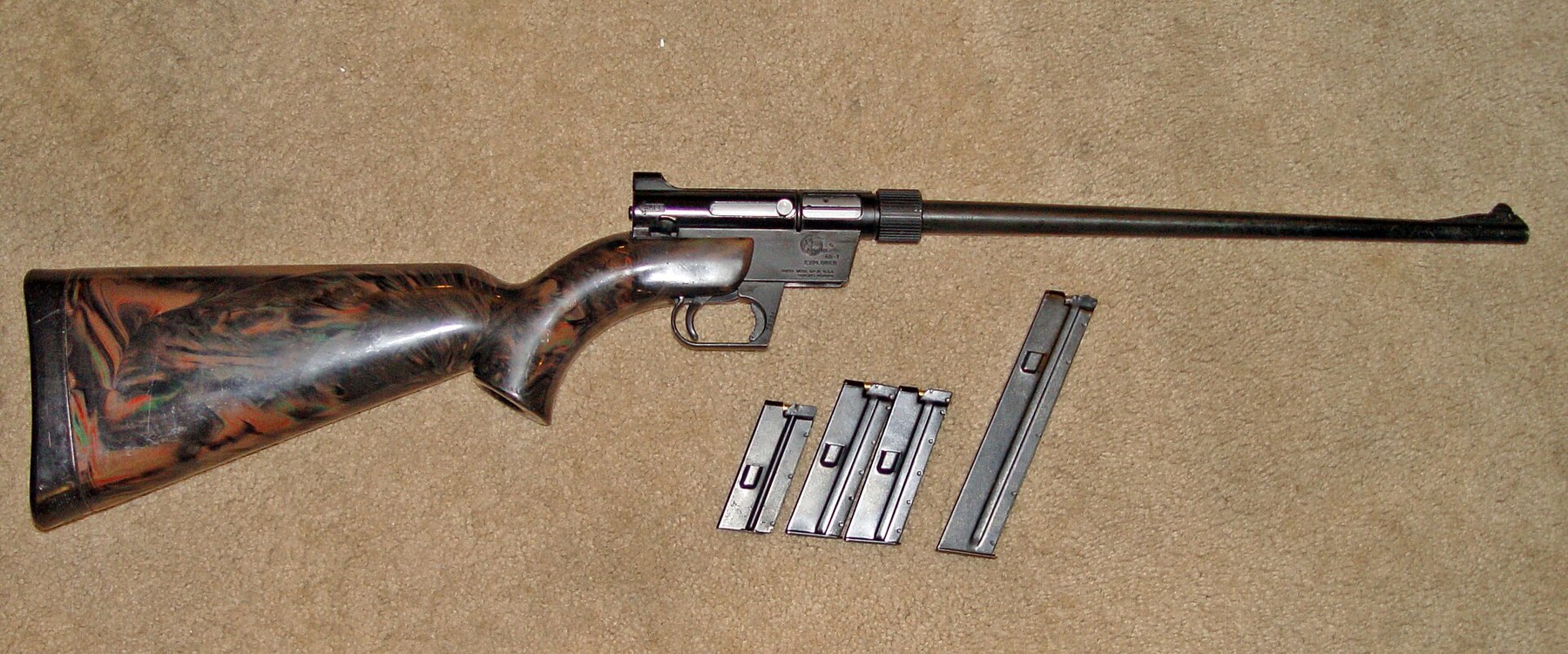
What changed between the AR-5 and the AR-7 was the operating system and the cartridge. The bolt-action .22 Hornet became a blowback semi-automatic in .22 Long Rifle, fed from an eight-round detachable magazine.12 What stayed was everything that made the AR-5 a survival rifle: the aluminium receiver, the steel-lined aluminium barrel held on by a hand-tightened nut, and the hollow stock that holds the rest of the gun and floats.
2.2 Who Designed It
The AR-7 is usually credited to Eugene Stoner alone. Knupp’s account, the most detailed located, spreads the credit across four people, and it is the account followed here:
- Charles Dorchester, general manager, ordered the project.
- Eugene Stoner, head of engineering, produced the design layout. “The AR-7’s ‘ornamental’ patent was issued in Stoner’s name.”
- L. James Sullivan, “fresh off of the AR-15 project,” was engineer-in-charge; he “made working prototypes and finalized the internal design.” In Knupp’s words, “Sullivan’s action was simple.”
- Tom Tellefson, ArmaLite’s plastics engineer, designed the floating stock, moulded in a plastic called Cycolac.1
An “ornamental” patent is a design patent: it protects appearance, not mechanism. That it was issued in Stoner’s name fits the division of labour Knupp describes, with Stoner responsible for the layout and look and Sullivan for how the parts worked. The design patent’s number was not found: the patent search services that could identify it refused scripted access during this research, and Knupp does not give it. The patent drawing therefore does not appear in this dive; it would be the best single image of the rifle as its designer intended it, and it is listed as owed in the dive’s README.
The NRA Museum’s AR-7 is a relic of the design process. The museum’s text says “the Cycolac stock shown on this example was used as a pattern for later production guns.”3
2.3 What It Is Made Of
The sources agree on the materials, and the rifle’s weight follows from them.
Table 1 — What It Is Made Of
| Part | Material | Source |
|---|---|---|
| Receiver | Aluminium alloy; Knupp calls it a casting | Knupp; Campbell; Wikipedia |
| Bolt | Steel | Campbell (“the bolt being the exception”); Wikipedia |
| Barrel | Rifled steel liner inside an aluminium shell | Campbell (“The first barrels were made from aluminum with a steel liner”); Knupp; ArmaLite history (the AR-1 barrel) |
| Stock | Cycolac plastic, foam-filled on early guns | Knupp; NRA Museum; Charter manual (“high quality cycolac”) |
| Recoil spring guide, butt cap | Plastic | Wikipedia |
Sources: Campbell (American Rifleman, undated); Knupp (2016); the Charter Arms manual; Wikipedia’s AR-7 article used as a pointer.4156
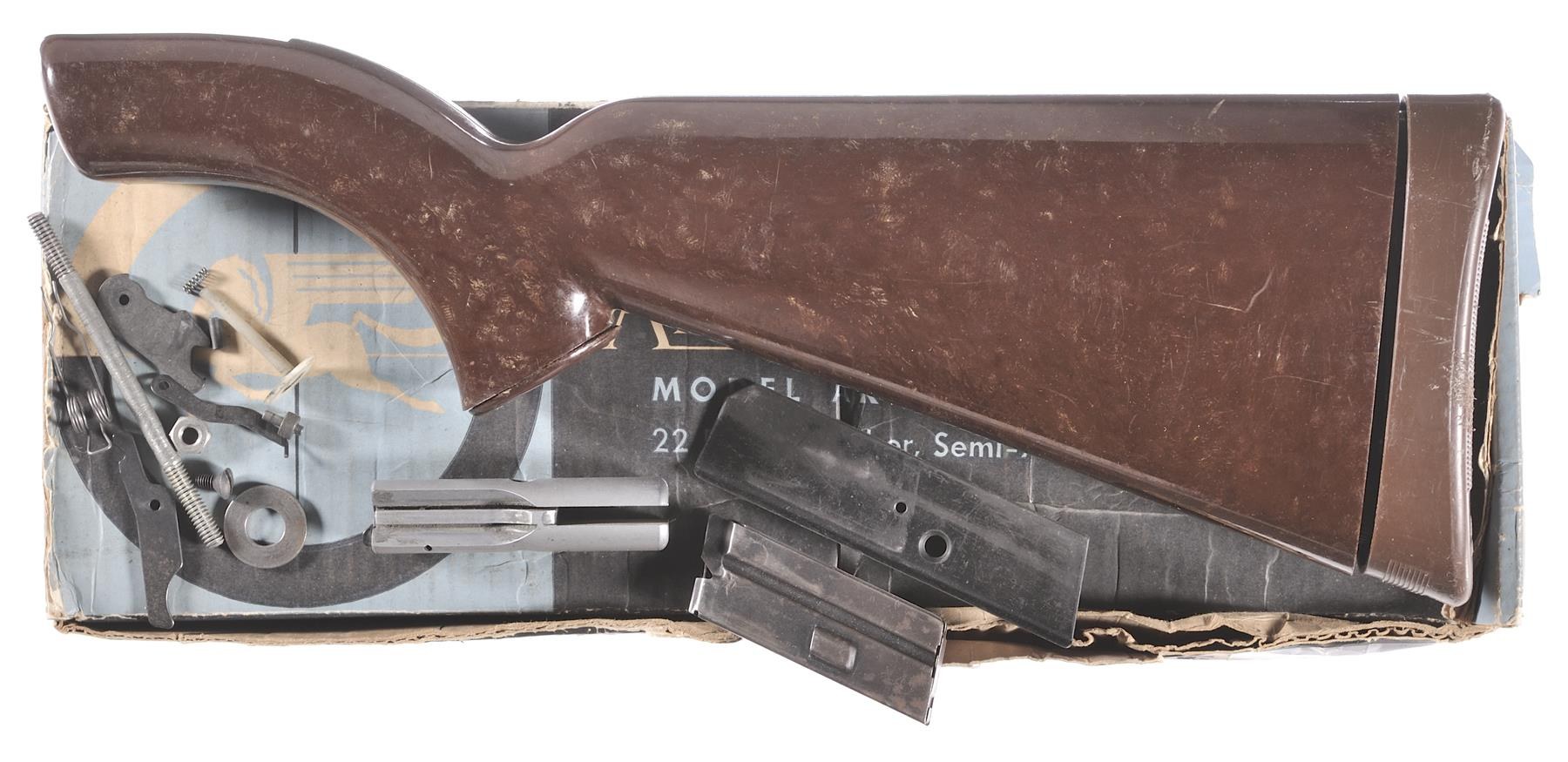
Cycolac is an ABS plastic. That matters because the Wikipedia article on the AR-7 says that Henry’s version replaced “the original stock plastic, which was prone to cracking and failure,” with ABS.6 Cycolac is a trade name for acrylonitrile butadiene styrene — Wikipedia’s articles on SABIC, which now owns the name, and on the 1960s Amphicat vehicle, whose body was “vacuum-formed Marbon Cycolac ABS plastic,” both say so.7 If the ArmaLite and Charter stocks were Cycolac, as Knupp, the NRA Museum and Charter’s own manual all state, then they were already ABS. What Henry changed was the moulding — a hollow stock rather than a foam-filled one, a textured surface, internal pockets for more magazines (Volume 3) — not the family of plastic. The claim that the original stocks crack more readily than Henry’s could not be tested against any source and is not repeated here.
The steel-lined aluminium barrel was not invented for the AR-7. ArmaLite’s history describes its first rifle, the AR-1 Parasniper begun in 1952, as having “an anodized aluminum barrel with a thin steel liner.”2 The construction is the company’s founding idea applied to the heaviest part of a rifle: put steel only where the bullet and the pressure need it, and make the rest of aircraft alloy. Campbell adds that “some experimental barrels were made of composites but are rarely seen outside the factory.”4
The weights quoted vary slightly by source: “as little as 2 ¾ pounds” (ArmaLite history), “2 ½ lbs” (Campbell), 2 ½ lb (the Charter manual). Overall length is 35 in (Campbell) or 34 ½ in (Charter), and the packed length 16 ½ in (Charter).245 For comparison, Knupp found the Henry of 2016 about half a pound heavier than the original and attributed the difference mainly to “thicker castings” in the action; Henry’s current specification is 3.5 lb.18
2.4 The Stock: Case, Float and Grip
The stock does three jobs, and each shaped it.
It is the case. Barrel, action and one magazine fit inside it, and a pressure-fitted butt cap closes it. Wikipedia notes that the original stock “did not accept the receiver with a magazine in place”; a single spare magazine rode in its own pocket.6 With practice, Knupp says, the rifle went from stowed to “assembled and ready to fire in about 30 seconds.”1
It floats. ArmaLite claimed the AR-7 “will float in water, either assembled or in the stowed configuration.”2 On early guns the hollow was foam-filled; Sam S.’s survey of the ArmaLite rifle says the stock “was foam on the inside in the first iterations drawing from its AR-5 cousin but quickly moved to common plastic versions.”9 Knupp’s test of the later Henry, with its hollow, unsealed stock, is the only measured result located: stowed, it sank after about two minutes; assembled, after about six.1 Wikipedia says the original ArmaLite stock “retained buoyancy longer than some later stocks by other makers,” which is consistent with the foam but was not measured by any source seen.6
It is the grip. Because the stock has to hold the action, it attaches to the rear of the receiver with a single screw through the base of the pistol grip — a “wing bolt” in Charter’s manual, a “stock takedown nut” in Henry’s.510 The result is a full, deep pistol grip moulded in one with the butt, which is the rifle’s most recognisable line (Volume 6).
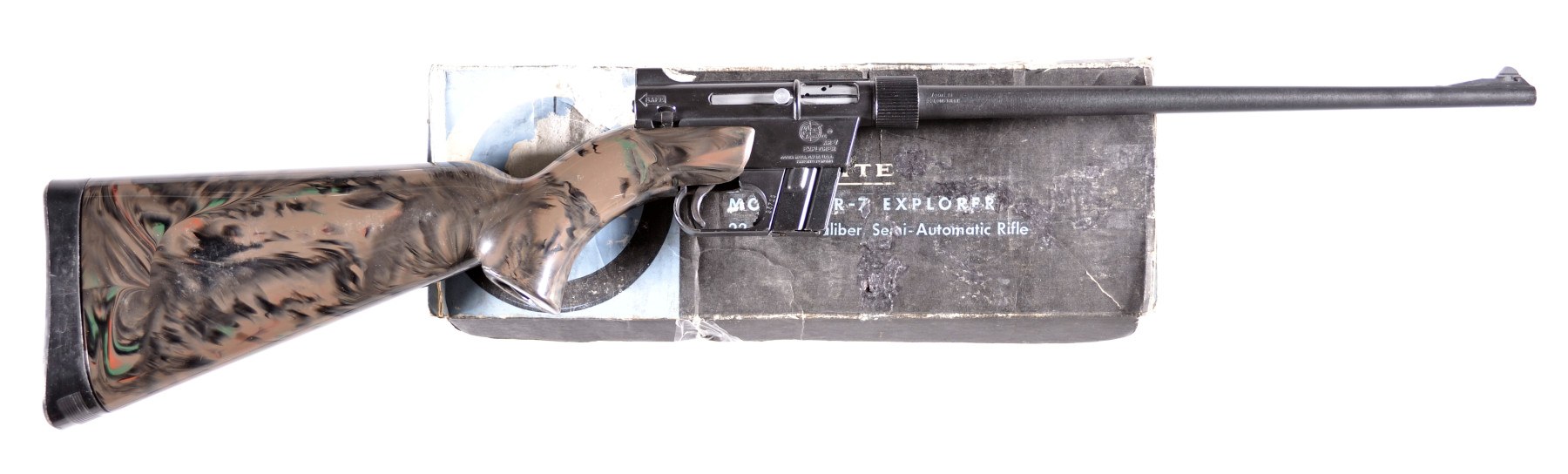
ArmaLite’s stocks came in more than one colour. Sam S. lists black, brown and green, and says the brown and green “tended to have an almost flowing pattern of different shades” — the swirled stocks.9 Knupp, citing the Blue Book of Gun Values, says early Costa Mesa rifles with brown stocks command a premium.1 Rock Island’s lot photographs show both a plain, mottled brown and the black-brown-green swirl on rifles catalogued as ArmaLite (Volume 3).
2.5 Sixteen Inches, and a Law Passed in June 1960
The AR-7’s barrel is 16 in long, and every maker has kept it at or just above that length. The reason is federal law, and the dates are closer together than any account of the rifle located has noticed.
The National Firearms Act of 1934 defined a regulated “firearm” as “a shotgun or rifle having a barrel of less than eighteen inches in length,” along with other weapons.11 Under that definition a 16 in rifle barrel was a short-barrelled rifle: registrable, taxable at $200 on transfer, and commercially impractical.
On 1 June 1960, Public Law 86-478 amended the Internal Revenue Code’s definition. Section 3 redefined a “firearm” as “a shotgun having a barrel or barrels of less than 18 inches in length, or a rifle having a barrel or barrels of less than 16 inches in length.” The shotgun line stayed at 18 in; the rifle line moved to 16.12
Set against the AR-7’s dates:
Table 2 — Set against the AR-7's dates
| Date | Event | Source |
|---|---|---|
| 1956 | AR-5 adopted with a 14 in barrel | ArmaLite history; Knupp |
| c. 1959 | ArmaLite considers lengthening the AR-5 barrel to 16 in for civilians; drops the idea for a new design | Knupp |
| Late 1959 | AR-7 production starts | Knupp |
| 1 June 1960 | Public Law 86-478: rifle barrels of 16 in and over are no longer NFA “firearms” | 74 Stat. 149 |
| July 1960 | First AR-7s ship | Knupp |
The first AR-7 left the factory about a month after its barrel length became legal for an ordinary rifle. Before 1 June 1960, a 16 in .22 rifle sold over the counter would have been an unregistered short-barrelled rifle under the 1934 definition.
What the documents do not show is intent. No source located says ArmaLite designed to the new figure, lobbied for it, or timed its first shipments to it; the bill that became Public Law 86-478, H.R. 4029 of the 86th Congress, was largely about occupational and transfer taxes. The coincidence of dates is a fact; the connection is an inference, and it is offered here as one. It does explain why the AR-5’s 14 in barrel could never have gone on sale to civilians as it was, and why the AR-7’s barrel has never been shorter than 16 in on a rifle. When Charter Arms later made a pistol version, it had to make the pistol’s barrels physically incapable of fitting the rifle (Volume 3).
2.6 Production and Price
Knupp’s account, the only one located that gives numbers, says production began in late 1959 and the first rifles shipped in July 1960. “All of the AR-7’s components were made by subcontractors in the Los Angeles area and then brought in-house to be assembled, inspected and tested.” It was “the first ArmaLite product to be made in-house,” and “ten thousand AR-7s were manufactured in the first 18 months of production.”1 No total production figure for ArmaLite’s AR-7 was located.
The price at introduction was $59.95, quickly cut to $49.95 — “the same price as Remington’s Nylon 66, another futuristic plastic rifle introduced around the same time.”1 The hub’s Ruger 10/22 research independently records a 1964 comparison in which the AR-7 is “$4.55 less” than the $54.50 Ruger, which is $49.95 by arithmetic.13
ArmaLite’s advertising, as Knupp quotes it, sold the AR-7 as the “Air Force Survival Rifle,” built with the “latest technology in exotic light alloys,” “Light, Compact, Safe for Boat, Plane, Car,” and stressed its “handgun convenience”: a pistol-sized package where handguns could not legally be carried. Later advertising recommended it for “hunting and plinking,” and one showed a diver’s companion using an AR-7 against sharks.1 ArmaLite also, Knupp says, “actively marketed the AR-7’s first big-screen appearance” in From Russia with Love (1963), “which caused an up-tick in sales” (Volume 7).
2.7 The Survival Rifle the Air Force Never Adopted
ArmaLite’s own slogan created the most persistent error about the AR-7. Henry’s product page today says: “Since 1959 this compact rifle, originally designed by Eugene Stoner, has been the choice of U.S. Air Force pilots who need a small-caliber rifle they can count on should they have to punch out over a remote area.”8 Wikipedia’s article opens by calling the AR-7 “developed … from the AR-5 that was adopted by the U.S. Air Force,” which is true, and many retailers shorten it to an adopted Air Force rifle, which is not.6
The record:
- The Air Force adopted the AR-5 as the MA-1 in 1956 and bought about a dozen (Volume 1).12
- No source located records an Air Force adoption, type classification or purchase of the AR-7. ArmaLite’s own history says only that “small numbers were sold to various military forces for use as survival rifles.”2
- Sam S., writing on the AR-7 for AllOutdoor in 2020, calls Air Force adoption “a very surprising misconception” and says his research found it false; he repeats the point in The Firearm Blog in 2022.914
- The one documented military user is Israel (below), whose air force issued ArmaLite-made AR-7s in modified form.
The AR-7 is therefore best described as it was designed: the civilian version of an Air Force survival rifle, sold on the strength of that rifle’s adoption.
2.8 Hy Hunter: Tommy Gun, Carbine and “Bolomauser”
Within three years of its introduction the AR-7 had become a platform. Hy Hunter Firearms Manufacturing Co., of 8255 Sunset Strip, Hollywood, took the inside front cover of GUNS magazine for January 1962 to sell three guns that Knupp and Wikipedia identify as built on AR-7 receivers and barrels:1615
- a “.22 Caliber M1 Carbine,” $49.95, “8-shot, semi-automatic,” with an optional 16-shot “over-and-under magazine” ($6), a 4-power scope ($12.50) and a compensator ($4);
- the “T-62 Civilian Defense Weapon,” a Thompson look-alike, $49.95, with the same extras;
- the “Bolomauser Machine Pistol,” $49.95: “.22 Long Rifle Cal. Semi-automatic 8-shot, 7½” barrel. Extras: 12” barrel (manually interchangeable), $12.00 … Special pistol scope and mount, $14.95.”15
The advertisement does not name ArmaLite, and the AR-7 identification rests on Knupp and Wikipedia; the Internet Movie Firearms Database likewise describes the Bolomauser as “a pistol version of ArmaLite AR-7 that was manufactured in the 1960s.”16 Taken together, those sources establish something the Explorer II’s reputation obscures: the first AR-7 pistol was not Charter’s. A Broomhandle-styled pistol on the AR-7 action, with a 7½ in barrel and an interchangeable 12 in one, was on sale by mail in 1962, eighteen years before the Explorer II. Knupp calls Hy Hunter’s copy for the T-62 — “the perfect weapon for civilian defense, house-to-house fighting, jungle warfare” and “repulsing enemy paratroopers” — “some of the most optimistic marketing of the AR-7 ever printed.”1
The derivatives reached television and film before the Explorer II existed. IMFDB records a T-62 stocked like a Thompson in Get Smart (1965–70) and The Ambushers (1967), and the Bolomauser in the Matt Helm film Murderers’ Row (1966) (Volume 7).16
2.9 After Fairchild: the Lion, the Custom and the Israeli Rifle
In 1961 Fairchild was in financial difficulty, and “the original principals of ArmaLite acquired ArmaLite from Fairchild, including rights and title to all ArmaLite designs except the AR-10 and AR-15.”2 Stoner left for Colt the same year. The company, now ArmaLite, Inc., kept going on the AR-7’s sales while it developed the AR-17 shotgun and the AR-18 rifle. Knupp records a small detail that helps date rifles: when Fairchild left, “the Pegasus took flight from the ArmaLite logo and was replaced by a lion, although the winged horse stayed on the AR-7’s receiver casting throughout its production.”1
In 1964 ArmaLite put the action into a Monte Carlo wood stock and sold it as the AR-7 Custom, one pound heavier and $15 dearer.1 It gave up the floating stock and the stowage, which is the whole idea of the gun; no photograph of one was located.
The Israeli pilots’ rifle is the AR-7’s one documented military service. Knupp’s account, which is the source here:
- Israel issued AR-7s to the pilots and navigators of its F-4 Phantom (“Kurnass”) fighters, stowed in the seat packs of their Martin-Baker Mk 7 ejection seats.
- Israel Military Industries replaced the hollow stock with a collapsible wire stock and a pistol grip “borrowed from the FN-FAL,” shortened the barrel to 13.5 in, and fitted a Mauser K98-type hooded front sight and an FAL-style front sling swivel. Two spare magazines rode on the stock; 40 loose rounds went in the hollow grip — 64 rounds in all.
- The ArmaLite markings on the right of the receiver were usually removed; the serial numbers were left.
- In the mid-1990s Briklee Trading Company imported what its staff estimated as “only a few hundred” into the United States, silver-soldering a 3 in extension to the muzzle to reach the 16 in minimum. Briklee’s manual warned that this AR-7 would not float.
- In 2010, the personal effects of an Israeli F-4 navigator missing over Lebanon since 1986 were returned in a prisoner exchange; news reports identified his weapon as an ArmaLite AR-7.1
Wikipedia adds that the rifles were “made by ArmaLite and sold to the Israeli Military,” replacing a Beretta 1951 pistol, and spells the importer “Bricklee.”6 No licensed photograph of an Israeli AR-7 was located. A Rock Island lot of 2024 catalogued as ArmaLite shows an AR-7 with a folding wire stock, a pistol grip, a hooded front sight and a sling swivel — the Israeli configuration in outline — but its barrel is roll-marked in a modern typeface, RIA’s text does not call it Israeli, and it is not used here as an example of one.
2.10 1973: Out of the Rifle Business
By the early 1970s ArmaLite had decided its future lay with military sales of the AR-18. Its history: “In order to concentrate full effort on the military sales program, ArmaLite elected to discontinue its other commercial firearm activities. In mid-1973 ArmaLite sold the AR-7 rifle to Charter Arms.”2 Knupp calls it the sale of “the manufacturing rights,” and notes it gave Charter, a revolver maker, its first rifle.1 What Charter did with it, and what came after, is Volume 3.
References
Footnotes
-
Jeremiah Knupp, “The Unlikely Resilience of the AR-7 Survival Rifle”, American Rifleman, 27 December 2016, https://www.americanrifleman.org/content/the-unlikely-resilience-of-the-ar-7-survival-rifle/ , retrieved 2026-09-19. ↩ ↩2 ↩3 ↩4 ↩5 ↩6 ↩7 ↩8 ↩9 ↩10 ↩11 ↩12 ↩13 ↩14 ↩15 ↩16 ↩17 ↩18 ↩19
-
ArmaLite, Inc., “A Historical Review of ArmaLite”, edition of 23 April 1999, Internet Archive copy, https://web.archive.org/web/20081001234245/http://www.armalite.com/images/Library/AL%20HISTORY%20COPY%202.pdf , retrieved 2026-09-19. ↩ ↩2 ↩3 ↩4 ↩5 ↩6 ↩7 ↩8 ↩9 ↩10
-
National Firearms Museum (NRA Museums), “ArmaLite AR-7 Explorer Rifle”, Case 22, https://www.nramuseum.org/guns/the-galleries/innovation,-oddities-and-competition/case-22-the-weird-and-the-wonderful/armalite-ar-7-explorer-rifle.aspx , retrieved 2026-09-19. ↩
-
Dave Campbell, “A Look Back at the ArmaLite AR-7 Explorer”, American Rifleman (no date on the page), https://www.americanrifleman.org/content/a-look-back-at-the-armalite-ar-7-explorer/ , retrieved 2026-09-19. ↩ ↩2 ↩3
-
Charter Arms Corporation, “AR-7 Explorer Parts, Instruction and Warranty Manual” (Stratford, Connecticut; after July 1975, since it cites the Magnuson-Moss Act), Internet Archive item
gunmanual_Charter_AR7_Explorer, https://archive.org/details/gunmanual_Charter_AR7_Explorer , retrieved 2026-09-19. ↩ ↩2 ↩3 -
Wikipedia, “ArmaLite AR-7” (revision 1357130734, 31 May 2026), https://en.wikipedia.org/wiki/ArmaLite_AR-7 , consulted 2026-09-19 as a pointer only. ↩ ↩2 ↩3 ↩4 ↩5 ↩6 ↩7
-
Wikipedia, “SABIC” (product list: “Cycolac (acrylonitrile butadiene styrene)”) and “Amphicat” (“Vacuum-formed Marbon Cycolac ABS plastic”), located through the Wikipedia search interface, 2026-09-19. ↩
-
Henry Repeating Arms, “U.S. Survival Rifle” product page, https://www.henryusa.com/rifles/u-s-survival-ar-7/ , retrieved 2026-09-19. ↩ ↩2
-
Sam S., “Curious Relics #003: ArmaLite AR7”, AllOutdoor, 30 December 2020, https://www.alloutdoor.com/2020/12/30/curious-relics-003-armalite-ar7/ , retrieved 2026-09-19. ↩ ↩2 ↩3
-
Henry Repeating Arms, “U.S. Survival .22 Instruction Manual for All H002 Series Rifles” (revision 7.20), https://www.henryusa.com/wp-content/uploads/2021/04/Henry-H002-Series-User-Manual.pdf , retrieved 2026-09-19. ↩
-
National Firearms Act, 26 June 1934, ch. 757, § 1(a), 48 Stat. 1236, https://www.govinfo.gov/content/pkg/STATUTE-48/pdf/STATUTE-48-Pg1236.pdf , retrieved 2026-09-19. ↩
-
Public Law 86-478, 1 June 1960, § 3, 74 Stat. 149, amending 26 U.S.C. 5848(1), https://www.govinfo.gov/content/pkg/STATUTE-74/pdf/STATUTE-74-Pg149.pdf , retrieved 2026-09-19. ↩
-
Firearms hub research note
Actual-Firearms/Rifles/Ruger_10-22/02-inputs/research-history-mechanism.md(1964 price comparison with the AR-7). ↩ -
Sam S., “The Rimfire Report: Charter Arms Explorer II AR7 Pistol Review”, The Firearm Blog, 26 September 2022, https://www.thefirearmblog.com/blog/2022/09/26/rimfire-report-charter-arms-explorer-ii-ar7-pistol-review/ , retrieved 2026-09-19. ↩
-
Hy Hunter Firearms Mfg. Co., advertisement, GUNS, January 1962, inside front cover; Internet Archive copy of http://www.gunbooks.ca/guns/1962/G0162.pdf , https://web.archive.org/web/20141016113030/http://www.gunbooks.ca/guns/1962/G0162.pdf , retrieved 2026-09-19. ↩ ↩2
-
Internet Movie Firearms Database, “ArmaLite AR-7” page (sections for the AR-7, Hy Hunter Bolomauser, T-62 and Charter Explorer), read through https://www.imfdb.org/api.php on 2026-09-19. ↩ ↩2
Comments (0)