ArmaLite AR-7 & Explorer II · Volume 3
The Makers, and How to Tell Them Apart — Charter, the Explorer II, Survival Arms, AR-7 Industries and Henry
The maker sequence checked source by source, what each company changed, the Charter pistol and why its barrel will not fit the rifle, the copies abroad, and a photographic key to whose AR-7 is whose
3.1 The Sequence, and Why the Dates Disagree
Every account of the AR-7 gives a list of makers, and no two lists agree. The table below sets out what each source located actually says. The ArmaLite corporate history is a primary source for its own company; the others are secondary.
Table 1 — The Sequence, and Why the Dates Disagree
| Maker | ArmaLite history (1999) | Knupp, American Rifleman (2016) | Campbell, American Rifleman (undated) | Wikipedia (2026) | Sam S., AllOutdoor (2021) |
|---|---|---|---|---|---|
| ArmaLite, Costa Mesa CA | developed 1959; sold to Charter mid-1973 | production late 1959, first shipped July 1960; sold 1973 | ”introduced” 1958 and “marketed … from 1959 to 1973” | 1959–1973 | 1959–1973 |
| Charter Arms, Stratford CT | from mid-1973 | 1973–1990 | 1973–1990 | 1973–1990 | 1973–1990 |
| Survival Arms, Cocoa FL | — | from 1990 | 1990–1997 | 1990–1997 | 1990–1997 |
| AR-7 Industries LLC, Meriden CT | ”ArmaLite reintroduced it in early 1998” | from 1998 “into the early 2000s” | 1997–2004, “when it was bought by Armalite” | 1998–2004, bought by ArmaLite 2004 | 1998–2004, “bought out by ArmaLite” |
| Henry Repeating Arms | — | from 1998 | from 1997 | 1997– ; but also “in 1980 … rights passed on to Henry” | 1998– |
Three corrections follow from the table.
Campbell’s “introduced in 1958” is contradicted by his own article (which says ArmaLite marketed the rifle from 1959) and by ArmaLite’s history, which dates the design to 1959. Knupp’s production dates — late 1959, first shipments July 1960 — are the most specific located and are used in this dive.
Wikipedia’s “in 1980, the design and production rights passed on to Henry Repeating Arms” is wrong. Henry Repeating Arms did not make the rifle before 1997 or 1998 by any source, including Wikipedia’s own maker list two paragraphs earlier, and the rifle was being made by Charter in 1980. Knupp and IMFDB both say Henry did not buy the design at all: it “reverse-engineered” the AR-7 once the patent protection was gone.26 (IMFDB’s “when the patent expired in 1998” cannot be right either: any patent granted around 1960 would have expired long before 1998. The point that survives is that Henry did not need a licence.)
There were two AR-7 lines at once. From 1997 or 1998 until 2004, AR-7 Industries of Meriden, Connecticut, and Henry of Brooklyn were both making AR-7s. ArmaLite’s 1999 history says “ArmaLite reintroduced it in early 1998” — meaning the new ArmaLite of Geneseo, Illinois, which had revived the name in the 1990s and which Campbell, Wikipedia and Sam S. all say bought AR-7 Industries in 2004.13 A Rock Island lot sold in 2025 as an “Armalite AR-7 Explorer,” which RIA describes as “manufactured in 1998-2004,” is consistent with ArmaLite-marked guns from that line; RIA gives no basis for the dating, and the rifle’s swirled stock looks like the Costa Mesa pattern, so it is recorded here and not used as an example.7
The exact start year of both the late lines — 1997 or 1998 — could not be settled from the sources and is given both ways.
3.2 Charter Arms, 1973–1990
Charter Arms was a Connecticut revolver maker, and the AR-7 was its first rifle.2 Knupp’s account of the handover has Charter’s president, David Ecker, keeping one of the first Charter rifles on his saltwater fishing boat for three months, and shooting the occasional shark with it, before announcing it. The Charter rifle “stayed true to the original design and retailed for $64.95,” and Charter’s advertising called it the “world’s only unsinkable, come-apart rifle.”2
Charter’s own parts and instruction manual gives the specification of its rifle:8
- .22 Long Rifle; semi-automatic; detachable box magazine of 8 rounds.
- Barrel: “16” precision high grade steel rifling.”
- Stock: “Full pistol grip, recessed to stow barrel, action, and magazine, high quality cycolac.”
- Safety: “Convenient thumb safety at rear of receiver. Locks trigger.”
- Sights: square-blade front “adjustable for windage by tapping”; aperture rear adjustable for elevation.
- Weight 2 ½ lb; overall 34 ½ in; stowed 16 ½ in.
- Finish: “Heat cured, semi-gloss black textured enamel. Blued steel internal parts. Bolt and Charging Handle, cadmium plated to resist corrosion.”
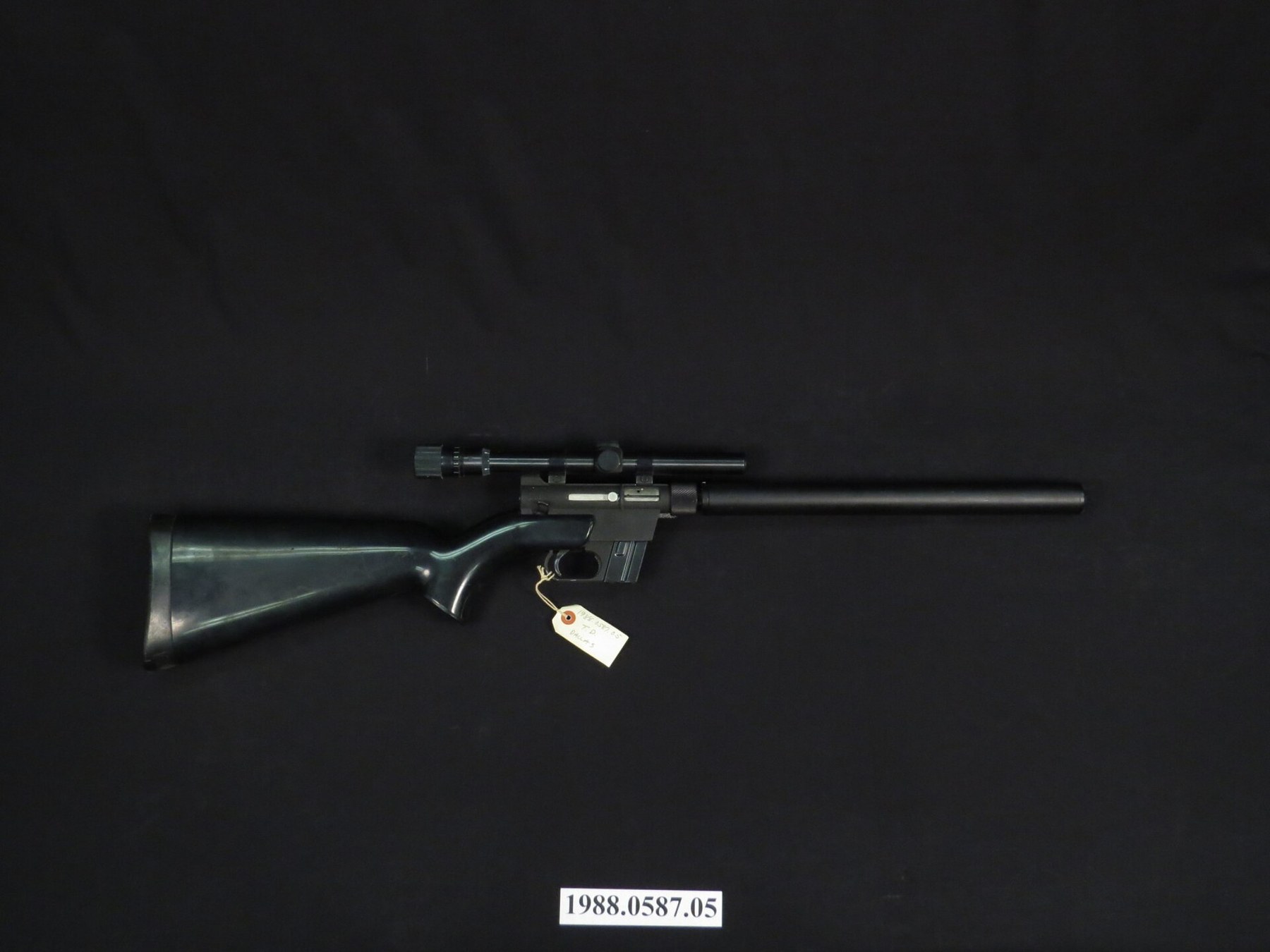
Charter also sold the rifle in a silver finish (“AR7S”) and a camouflage finish (“AR7C”), according to Sam S., who photographs Charter examples.5 The rifle still carried one magazine in the stock. Charter or its accessory makers added a way to mount a scope: Wikipedia and IMFDB describe a detachable 3/8 in tip-off rail, and Wikipedia a B-Square “Charter Arms AR-7 Explorer Scope Mount Base” held by the receiver’s sideplate screw — which, it notes, stops the receiver from fitting back into the stock.46
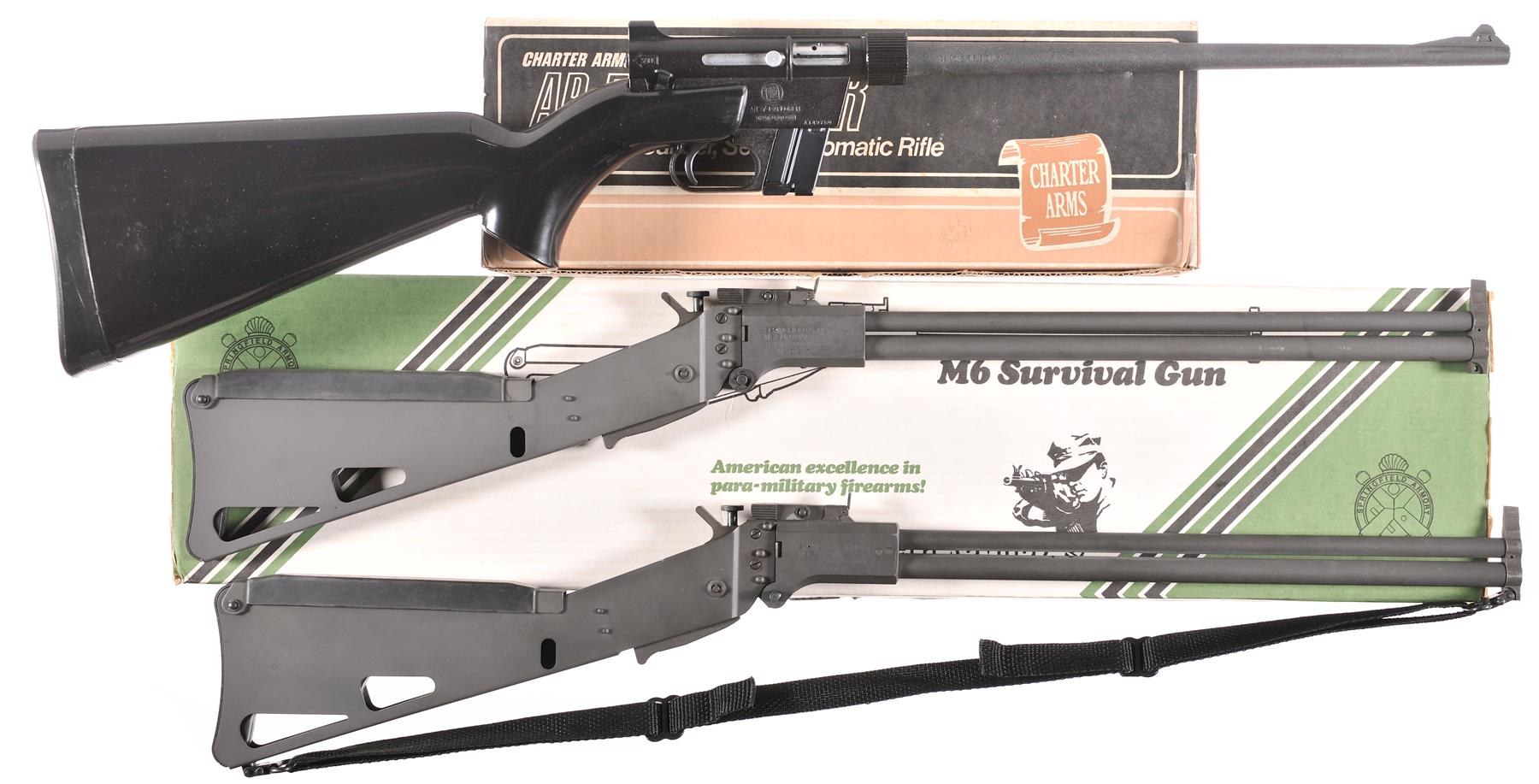
The Charter years are the ones blamed for the AR-7’s reputation. How far that blame is supported is argued in Volume 4.
3.3 The Explorer II Pistol, 1980–1986
By the late 1970s AR-7 sales were falling, and Charter tried to revive them with a pistol.9 The Explorer II was introduced in 1980 and discontinued in 1986, dates on which Knupp and Sam S. agree.210
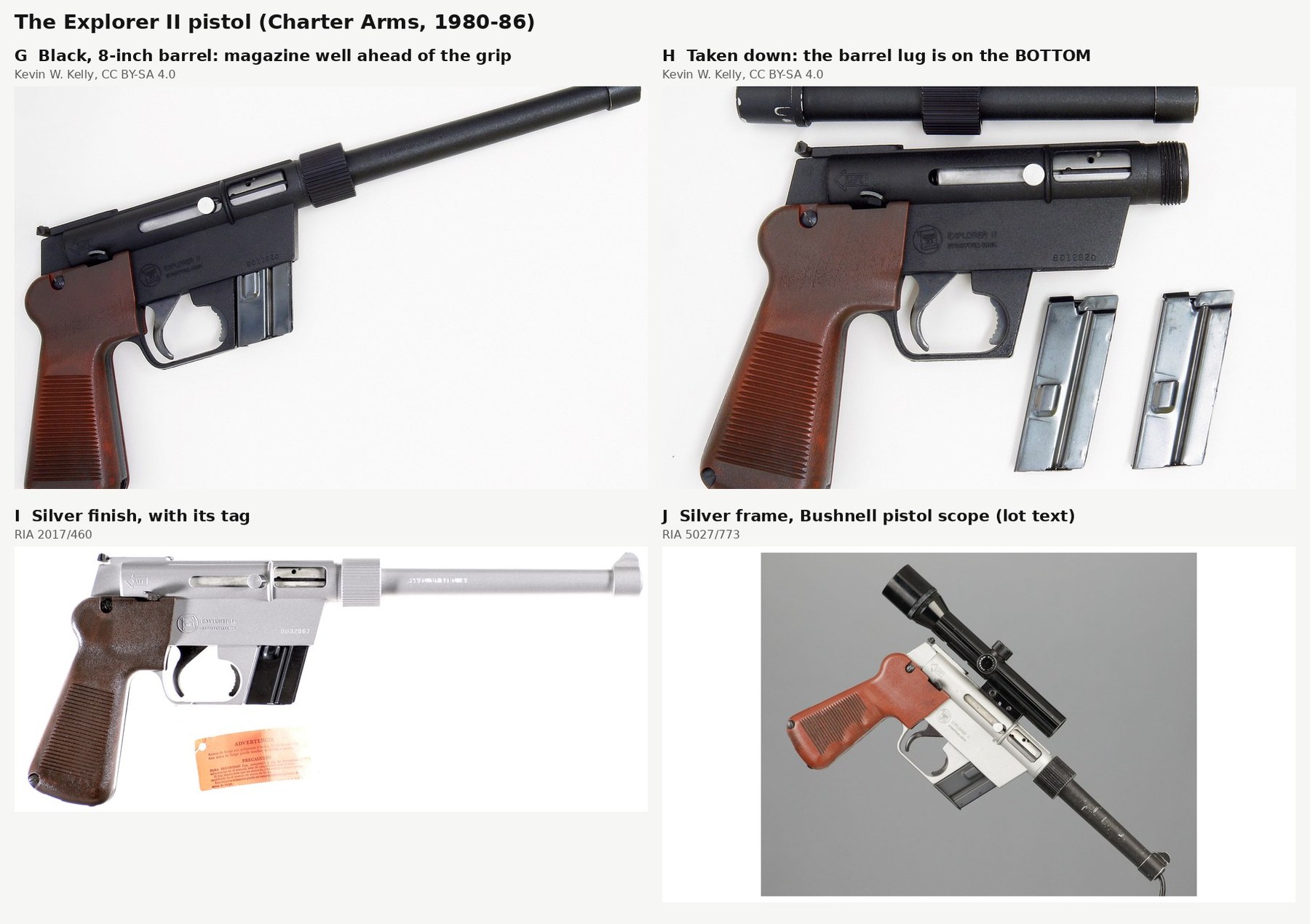
What makes it a different gun is the receiver. The Explorer II has “an AR7 receiver with a fixed pistol grip more or less. The grip is literally a part of the receiver so it cannot have a stock attached.”9 Everything inside is the rifle’s: “It uses the exact same internal parts and magazines.”10 The magazine sits in a well ahead of the trigger guard, well forward of the grip, which with the long barrel gives the profile every writer compares to the Mauser C96 Broomhandle.23
The detail changes, from Knupp and Sam S.:21011
- Sights: the rifle’s peep was replaced by a square-notch rear sight adjustable for windage and elevation, because the front sight is fixed. Sam S. found that a Charter Bulldog revolver’s adjustable rear-sight blade fits it.
- Grip: “Shur-Hold simulated walnut” plastic, with room inside for a spare magazine.
- Barrels: 8 in as standard; 6 in and 10 in optional. Sam S. says the 10 in was sold in its own box and has a thinner, more triangular front sight.
- Finishes: black; silver (the second most common); camouflage (scarce); and gold, “an extremely limited run” discontinued before the pistol was.
- Scope mount: a Charter mount fixed by the large left-hand receiver screw, later copied by B-Square; both scarce.
Sales, Knupp says, “were dismal.”2 No production figure was located by any source, including Sam S., who has been compiling surviving serial numbers.
3.3.1 Why the pistol’s barrel will not fit the rifle
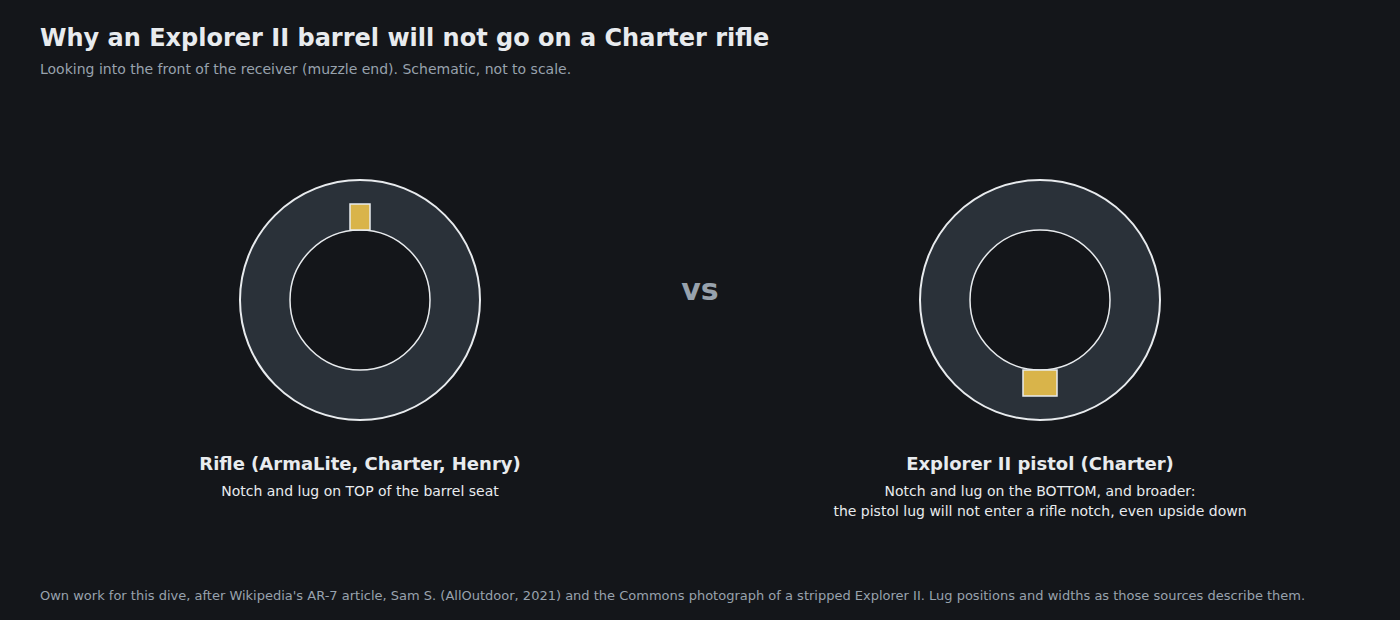
The Explorer II exists because of the same line in federal law that set the rifle’s barrel length (Volume 2). A pistol barrel of 6, 8 or 10 in fitted to a rifle receiver with a shoulder stock would make a short-barrelled rifle, regulated under the National Firearms Act. Charter prevented it mechanically. On every AR-7, a lug on the barrel engages a notch in the front of the receiver to index the barrel before the nut is tightened. On the rifle, lug and notch are on top. On the Explorer II they are on the bottom, and larger:45
“The notches and pins on the pistols were not just larger than the rifle version but they also were indexed on the bottom rather than the top.”10
Sam S. adds that a pistol barrel “would not fit” a rifle “even upside down,” and Wikipedia that a pistol barrel forced onto a rifle would put the rifle’s extractor opposite the barrel’s extractor slot, so the bolt could not close.54 The Commons photograph of a stripped Explorer II shows the lug on the underside of the barrel.
The legal consequences of swapping parts between the two — including what United States v. Thompson/Center Arms Co. allows — are set out in Volume 7.
The Explorer II was not the first AR-7 pistol. Hy Hunter’s “Bolomauser” of 1962, with a 7½ in barrel and an interchangeable 12 in one, used the same action eighteen years earlier (Volume 2).
3.4 Survival Arms, 1990–1997
In 1990 Charter sold the rights to Survival Arms, Inc., of Cocoa, Florida, which made the rifle until 1997.23 Knupp names one change: its “notable change was making the rifle’s barrel entirely out of steel.”2 A 2014 AllOutdoor review by “Major Pandemic” adds that Survival Arms “nixed the whole AR-7 pistol idea” and did not restore the rifle’s reputation; it gives no evidence for the second claim.12
No licensed photograph of a Survival Arms rifle was located, either on Wikimedia Commons or among the Rock Island lots indexed for this dive, and its receiver markings are not described by any source seen. The identification key below therefore describes it in words only: an AR-7 with an all-steel barrel and a Survival Arms marking.
3.5 AR-7 Industries and the Second ArmaLite
AR-7 Industries, LLC, of Meriden, Connecticut, made the rifle from about 1998 until 2004, when ArmaLite — by then a different company, revived in Geneseo, Illinois — bought it.34 Sam S.’s one “notable takeaway” is that “heavy all-steel barrels were offered,” and Wikipedia says its “solid steel barrels [were] much heavier than the AR-7 barrels by ArmaLite, Charter or Henry.”54
ArmaLite’s own April 1999 history, written while this line was in production, gives the date from its side: “ArmaLite reintroduced it in early 1998.”1 How ArmaLite and AR-7 Industries were related before the 2004 purchase is not explained by any source located.
3.6 Henry Repeating Arms, 1997 or 1998 to Today
Henry Repeating Arms, then of Brooklyn and since 2007 of Bayonne, New Jersey, began making its own AR-7 in 1997 (Campbell, Wikipedia) or 1998 (Knupp, Sam S.).3425 Knupp calls it “the single event that did the most to keep the AR-7 alive,” and gives the scale: “In the nearly two decades since, Henry has become the most prolific AR-7 manufacturer, producing more than a half-million units.”2 If that figure is right, Henry has made more AR-7s than all the earlier makers together are likely to have made; no earlier total was located to compare with it.
Henry calls the rifle the U.S. Survival (models H002B, black; H002C, True Timber Kanati camouflage; H002VWP, True Timber Viper Western camouflage). Its product page gave, on 19 September 2026: barrel 16.125 in, “Steel Covered with Coated ABS Plastic,” twist 1:16; overall length 35 in; weight 3.50 lb; peep rear and blade front sights; “3/8” Grooved Receiver”; ABS stock; two 8-round magazines; and manufacturer’s suggested retail prices of $360 for the black rifle and $440 for either camouflage.13
What Henry changed, from Knupp and Henry’s own material:21314
- The barrel: a steel barrel “shrouded in plastic” rather than a steel liner in an aluminium shell.
- The finish: a Teflon coating on the receiver (Knupp); Henry’s page speaks of “a protective coating for complete corrosion resistance.”
- The receiver: thicker castings, and from 2007 an integral 3/8 in grooved rail for rimfire scope rings — “though it looks like a Picatinny rail,” Knupp notes, it is not.
- The stock: textured and grooved at the grip; redesigned inside so the action goes in with a magazine in place, plus pockets for two more — “24 loaded rounds” carried against the original’s eight in the stock and none in the action. A bright orange front-sight insert (Sam S.).5
- Buoyancy: the hollow Henry stock is not sealed. Knupp’s test: about two minutes afloat stowed, six assembled.
- Warranty: a limited lifetime warranty, and an ammunition statement that matters for reliability: “This gun will not cycle subsonic ammunition. We recommend you use high or hyper velocity ammunition” (Volume 4).
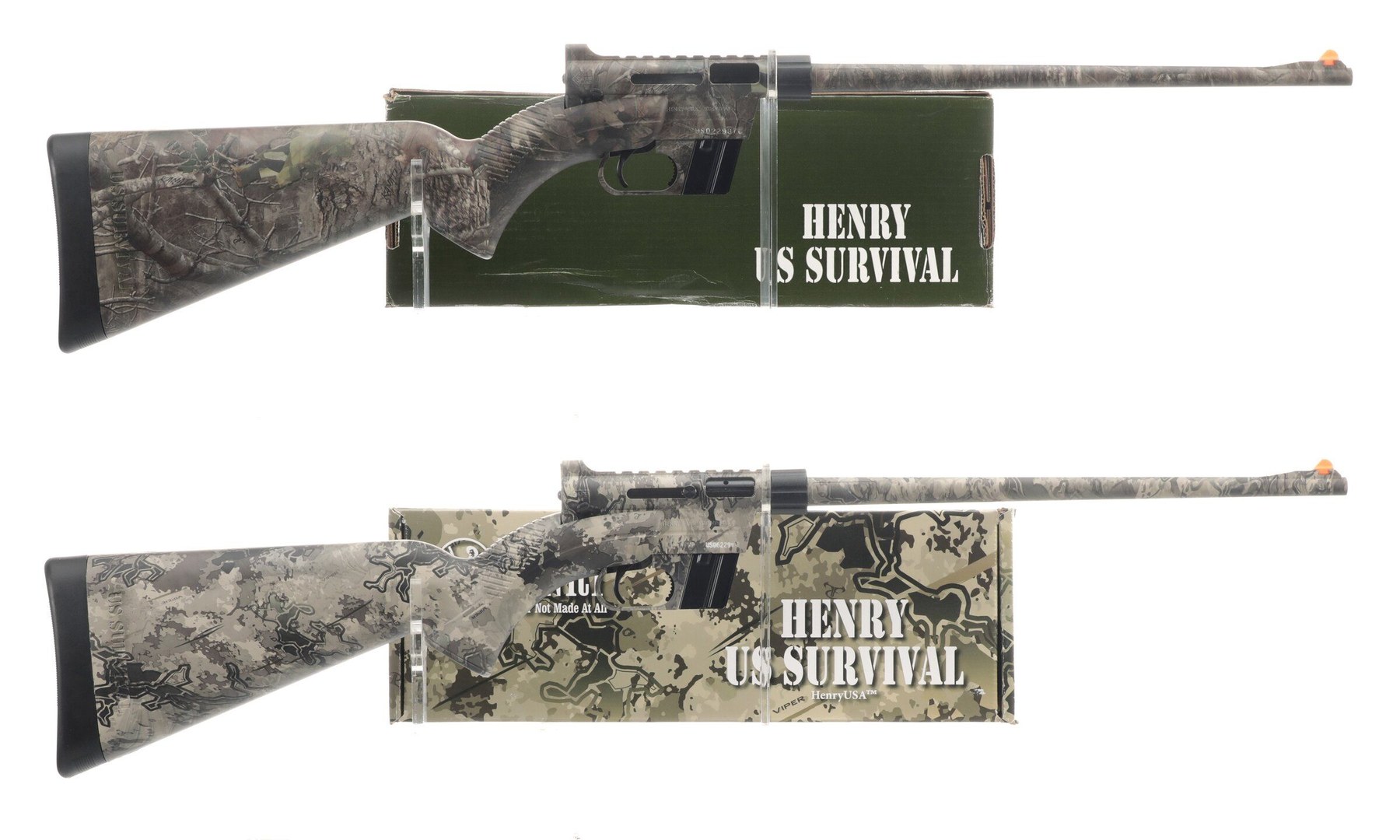
Wikipedia adds that Henry introduced a 5-round magazine for jurisdictions limiting hunting-magazine capacity; this was not confirmed on Henry’s own pages.4
3.7 Copies and Cousins Abroad
Three foreign guns built on the AR-7 idea are recorded by sources that could be checked only at second hand:
- Argentina: “Sistema de Armas .22 LR Fire,” by Industrias Brenta. Campbell calls it a licensed copy, “some of which included additional features like telescopic sights, barrel shrouds and pistol grips.”3 Wikipedia cites a Brenta manual in an Argentine forum archive that was not read.
- West Germany: the Preetz Model 65. IMFDB describes it as “a clone of AR-7 that was produced by West German company Josef G. Landmann-Preetz … in 1965-1975,” in .22 LR and .22 WMR, with a variety of stocks.6
- Italy: the Pietta Bingham PPS-50, a .22 look-alike of the Soviet PPSh-41 which IMFDB says “is based on the AR-7 mechanism.”6
None of the three was examined, and no licensed photograph of any was found.
3.8 Whose AR-7 Is It? The Comparison Plates
The AR-7’s shape has barely changed in sixty-five years, so the maker has to be read from details. The plates below put the makers side by side, the same side facing, at the same overall length, and then close in on the receiver where the maker’s name and the features that changed are found.
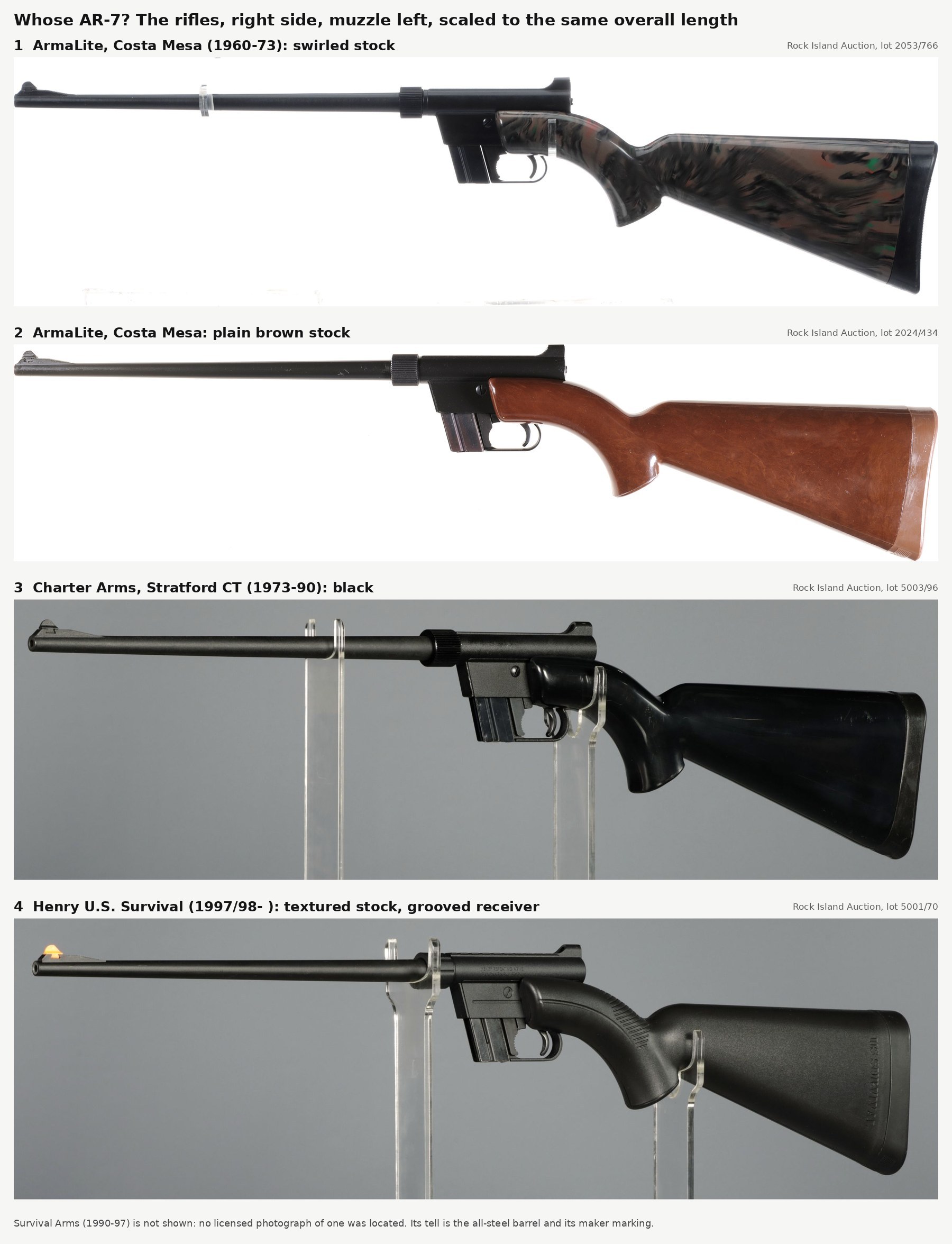
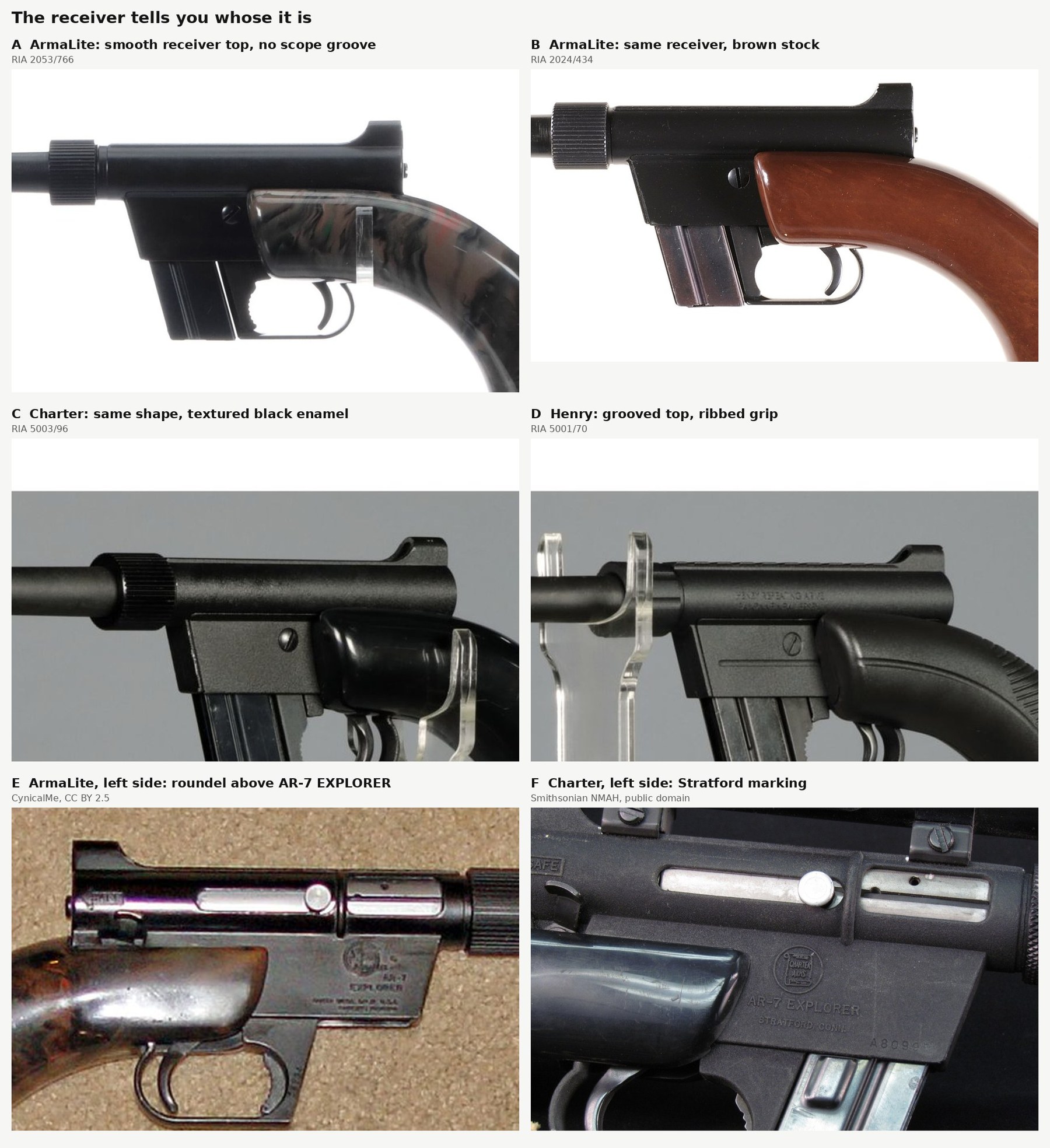
The identification rule used for every photograph in this dive: the maker is taken from the auction house’s lot title or the museum’s record, then checked against the gun — a grooved receiver top, orange-tipped front sight and ribbed grip mean Henry, whatever the listing says; a Charter or Stratford marking means Charter; a smooth receiver top with a swirled or brown stock and no Charter marking is consistent with ArmaLite. Where a lot’s description and its photograph pulled in different directions, the photograph was not used.
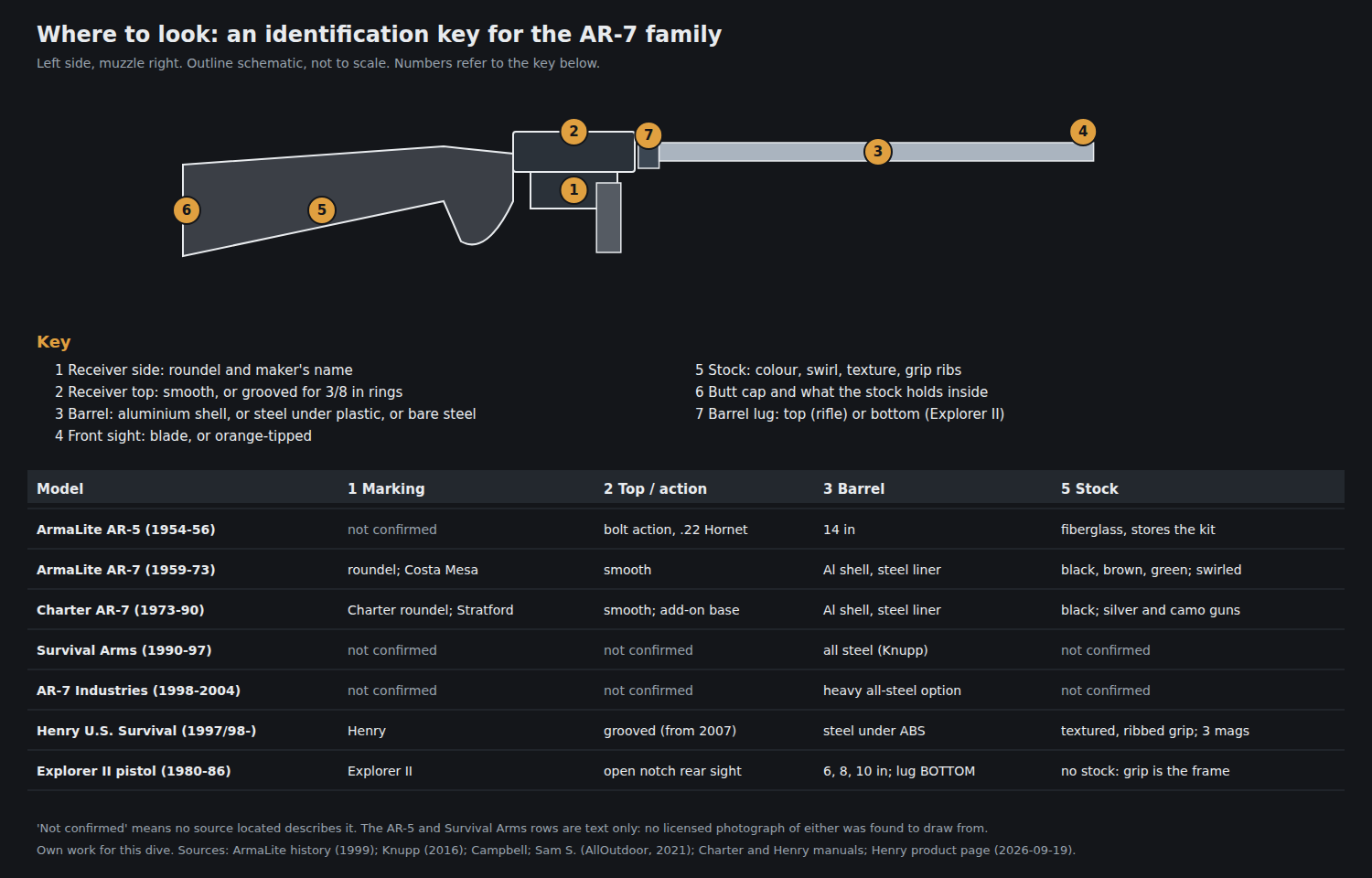
3.9 Tell Them Apart: the Table
Table 2 — Tell Them Apart: the Table
| Feature | ArmaLite (1959–73) | Charter (1973–90) | Explorer II (1980–86) | Survival Arms (1990–97) | AR-7 Industries (c. 1998–2004) | Henry (1997/98– ) | Where to look |
|---|---|---|---|---|---|---|---|
| Maker’s mark | ArmaLite roundel over “AR-7 EXPLORER” | Charter roundel; “STRATFORD CONN." | "EXPLORER II” | not described by any source | not described | Henry name | Left side of receiver (right side on Henry) |
| Receiver top | smooth; no scope provision | smooth; add-on base via sideplate screw | pistol frame; Charter or B-Square mount | not described | not described | 3/8 in grooved rail from 2007 | Top of receiver |
| Barrel | steel liner in aluminium shell | steel rifling in a barrel of the same pattern | 6, 8 or 10 in; lug on the bottom | all steel | heavy all-steel offered | steel under coated ABS | Barrel near the nut; lug under the nut |
| Front sight | blade, drift for windage | square blade, tap for windage | fixed | not described | not described | orange-tipped blade | Muzzle |
| Rear sight | peep, elevation (later flip aperture) | peep, elevation | open square notch, windage and elevation | peep | not described | peep, flip aperture | Rear of receiver |
| Stock | black, brown or green; swirls; foam-filled early | black textured; silver and camo guns | none: grip is the frame, spare mag inside | not described | not described | textured, ribbed grip; holds action with mag plus two more | Stock and butt |
| Finish | black | textured black enamel; bolt and handle cadmium-plated | black, silver, camo, gold | not described | not described | black or camo, Teflon-type coating | Receiver surface |
Sources: Charter manual; Henry manual and product page; Knupp; Campbell; Wikipedia; Sam S. (AllOutdoor, 2020–22); the photographs in this volume.8141323415510
“Not described” means that no source located describes it, not that the feature is absent. A Survival Arms rifle or an AR-7 Industries rifle, photographed from both sides, would fill most of those cells; both are listed as owed in the README.
References
Footnotes
-
ArmaLite, Inc., “A Historical Review of ArmaLite”, edition of 23 April 1999, Internet Archive copy, https://web.archive.org/web/20081001234245/http://www.armalite.com/images/Library/AL%20HISTORY%20COPY%202.pdf , retrieved 2026-09-19. ↩ ↩2 ↩3
-
Jeremiah Knupp, “The Unlikely Resilience of the AR-7 Survival Rifle”, American Rifleman, 27 December 2016, https://www.americanrifleman.org/content/the-unlikely-resilience-of-the-ar-7-survival-rifle/ , retrieved 2026-09-19. ↩ ↩2 ↩3 ↩4 ↩5 ↩6 ↩7 ↩8 ↩9 ↩10 ↩11 ↩12 ↩13 ↩14
-
Dave Campbell, “A Look Back at the ArmaLite AR-7 Explorer”, American Rifleman (undated), https://www.americanrifleman.org/content/a-look-back-at-the-armalite-ar-7-explorer/ , retrieved 2026-09-19. ↩ ↩2 ↩3 ↩4 ↩5 ↩6 ↩7 ↩8
-
Wikipedia, “ArmaLite AR-7” (revision 1357130734, 31 May 2026), https://en.wikipedia.org/wiki/ArmaLite_AR-7 , consulted 2026-09-19 as a pointer. ↩ ↩2 ↩3 ↩4 ↩5 ↩6 ↩7 ↩8 ↩9
-
Sam S., “Curious Relics #004: The AR7 Design Survives”, AllOutdoor, 13 January 2021, https://www.alloutdoor.com/2021/01/13/curious-relics-004-ar7-design-survives/ , retrieved 2026-09-19. ↩ ↩2 ↩3 ↩4 ↩5 ↩6 ↩7 ↩8
-
Internet Movie Firearms Database, “ArmaLite AR-7” page, read through https://www.imfdb.org/api.php on 2026-09-19. ↩ ↩2 ↩3 ↩4
-
Rock Island Auction Company, lot 5018/748, “Armalite AR-7 Explorer Semi-Automatic Rifle with Box”, sold 17 August 2025, https://www.rockislandauction.com/detail/5018/748/ , retrieved 2026-09-19. ↩
-
Charter Arms Corporation, “AR-7 Explorer Parts, Instruction and Warranty Manual” (after July 1975), Internet Archive item
gunmanual_Charter_AR7_Explorer, https://archive.org/details/gunmanual_Charter_AR7_Explorer , retrieved 2026-09-19. ↩ ↩2 -
Sam S., “The Rimfire Report: Charter Arms Explorer II AR7 Pistol Review”, The Firearm Blog, 26 September 2022, https://www.thefirearmblog.com/blog/2022/09/26/rimfire-report-charter-arms-explorer-ii-ar7-pistol-review/ , retrieved 2026-09-19. ↩ ↩2
-
Sam S., “Curious Relics #005: Charter Arms Explorer II”, AllOutdoor, 27 January 2021, https://www.alloutdoor.com/2021/01/27/curious-relics-charter-arms-explorer-ii/ , retrieved 2026-09-19. ↩ ↩2 ↩3 ↩4 ↩5
-
Sam S., “Curious Relics #45: Charter Arms Explorer II”, AllOutdoor, 10 August 2022, https://www.alloutdoor.com/2022/08/10/curious-relics-45-charter-arms-explorer-ii/ , retrieved 2026-09-19. ↩
-
“Major Pandemic”, “History of the AR-7 & Henry Repeating’s Survival AR-7”, AllOutdoor, 4 February 2014, https://www.alloutdoor.com/2014/02/04/history-ar-7-henry-repeatings-survival-ar-7/ , retrieved 2026-09-19. ↩
-
Henry Repeating Arms, “U.S. Survival Rifle” product page, https://www.henryusa.com/rifles/u-s-survival-ar-7/ , retrieved 2026-09-19 (prices are manufacturer’s suggested retail on that date). ↩ ↩2 ↩3
-
Henry Repeating Arms, “U.S. Survival .22 Instruction Manual for All H002 Series Rifles” (revision 7.20), https://www.henryusa.com/wp-content/uploads/2021/04/Henry-H002-Series-User-Manual.pdf , retrieved 2026-09-19. ↩ ↩2
-
Sam S., “Curious Relics #003: ArmaLite AR7”, AllOutdoor, 30 December 2020, https://www.alloutdoor.com/2020/12/30/curious-relics-003-armalite-ar7/ , retrieved 2026-09-19. ↩
Comments (0)