ArmaLite AR-7 & Explorer II · Volume 4
How It Works, and Why It Jams — Blowback, the Magazine That Is the Feed Ramp, and the Record by Maker
The AR-7's cycle part by part, the design decisions that make it fussy about ammunition and magazines, and what the sources actually support about which makers' rifles work
4.1 The Parts
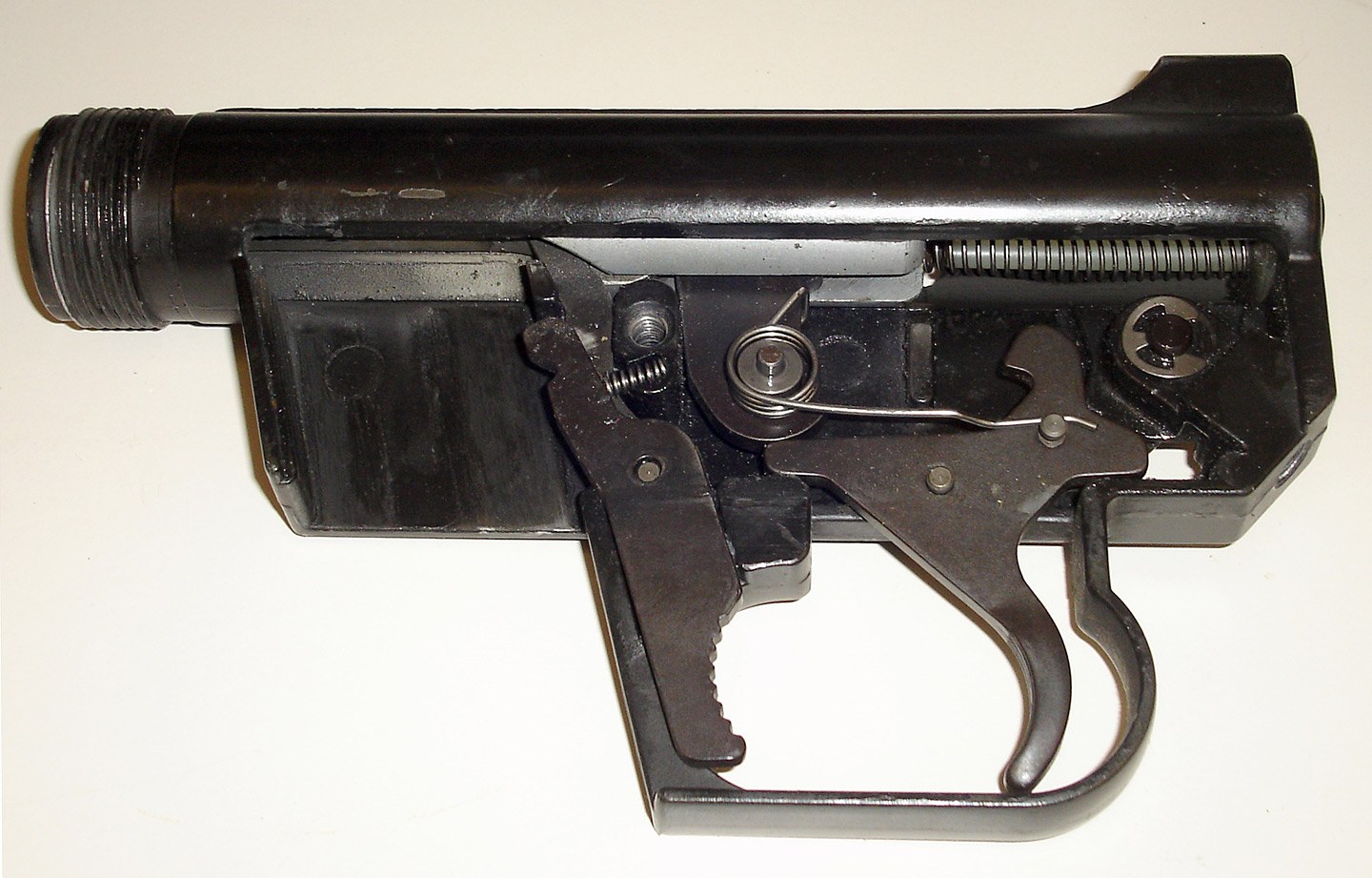
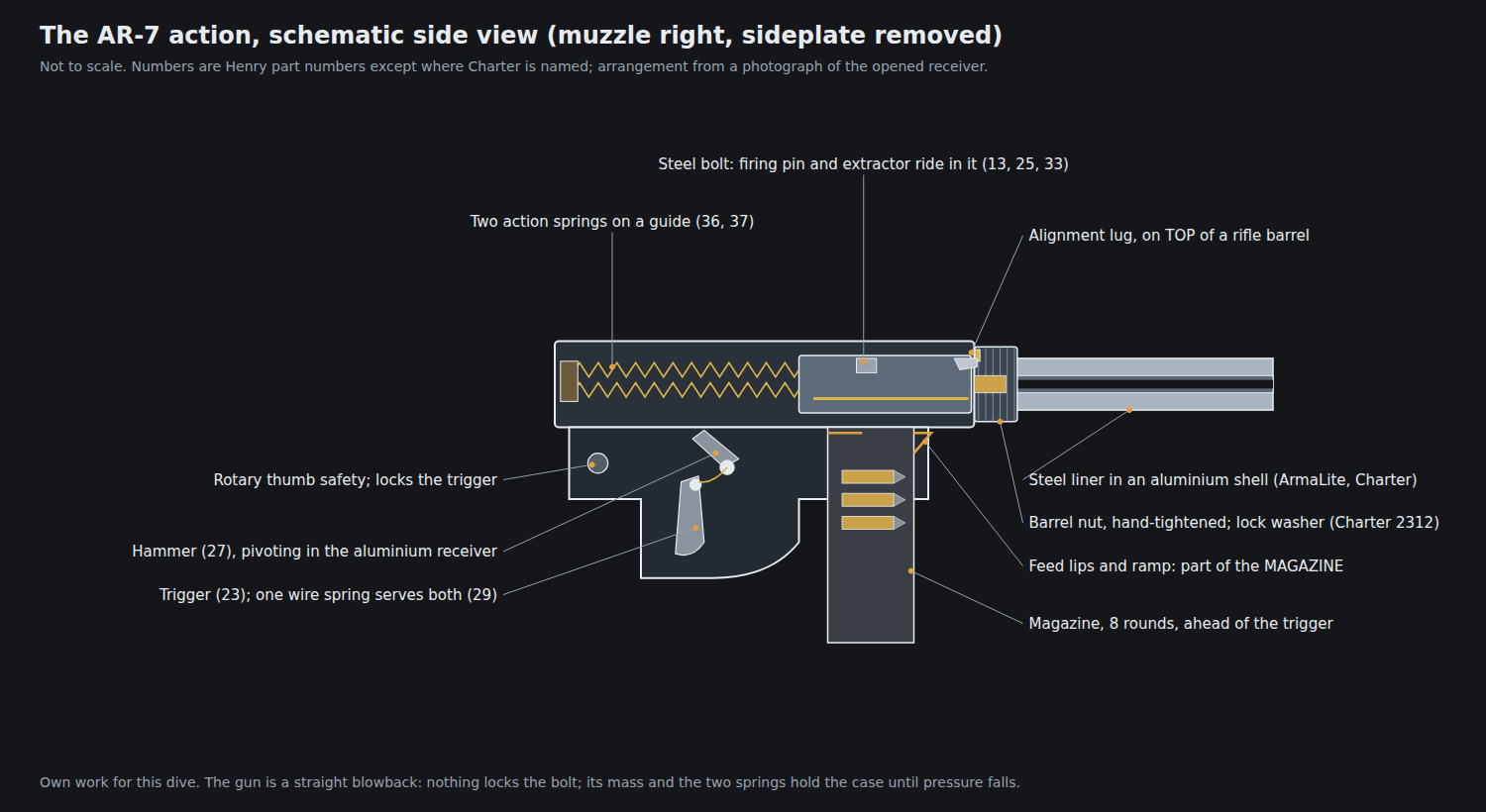
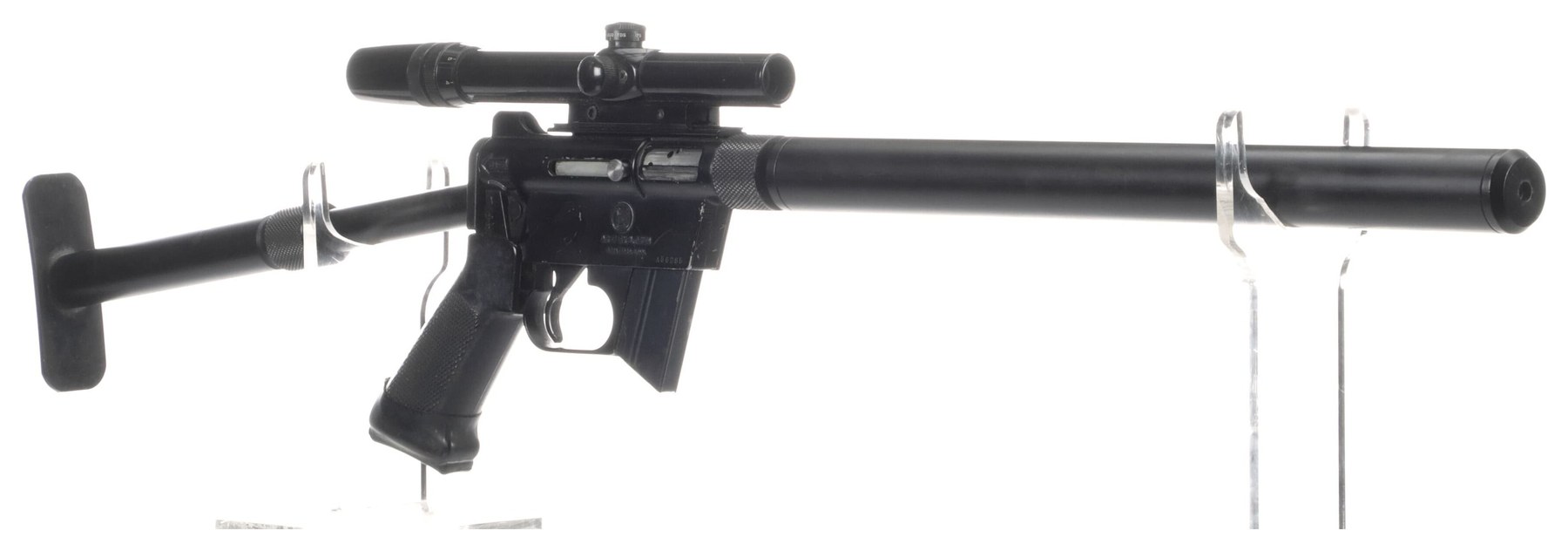
The AR-7 has very few parts, and the two makers’ parts lists that were found agree on what they are. Henry’s list, from its current manual, names 37 numbered items, and Charter’s, from the 1970s–80s, about the same number.12 Grouped by function:
- Receiver and sideplate: an aluminium receiver closed on one side by a removable sideplate, held by the sideplate screw. The receiver’s upper part is a tube that holds the bolt and its springs; the lower part holds the fire-control parts and the magazine well; the front is threaded for the barrel nut.
- Bolt group: a steel bolt carrying the firing pin (retained by a roll pin), the extractor with its spring and pin, and a removable charging handle that plugs into the bolt through a slot in the receiver’s right side.
- Action springs: two coil springs and a single “action spring guide” behind the bolt, in the receiver tube.
- Fire control: hammer and pivot pin, trigger and pivot pin, one wire spring for both (Charter’s “hammer and trigger spring,” Henry’s “hammer/trigger spring”), and an ejector on its own pivot pin.
- Safety: a rotating thumb safety at the right rear, located by a ball detent and retained by a snap ring.
- Magazine and latch: an eight-round detachable box, and a magazine latch with its spring ahead of the trigger.
- Barrel group: the barrel, the barrel nut and, in Charter’s list, a barrel-nut lock washer; the front sight on the barrel and the rear sight on the receiver.
- Stock group: the stock, the stock takedown screw and its nut (Charter: “wing bolt”), and the butt cap.12
4.2 The Cycle, Step by Step
The AR-7 is a straight blowback: nothing locks the bolt to the barrel. The bolt is held closed only by its own mass and the force of the two action springs, and it begins to move as soon as the cartridge case begins to push back on it. That is normal for a .22 Long Rifle, whose pressures are low enough that a bolt of modest weight delays opening until the bullet has left.34
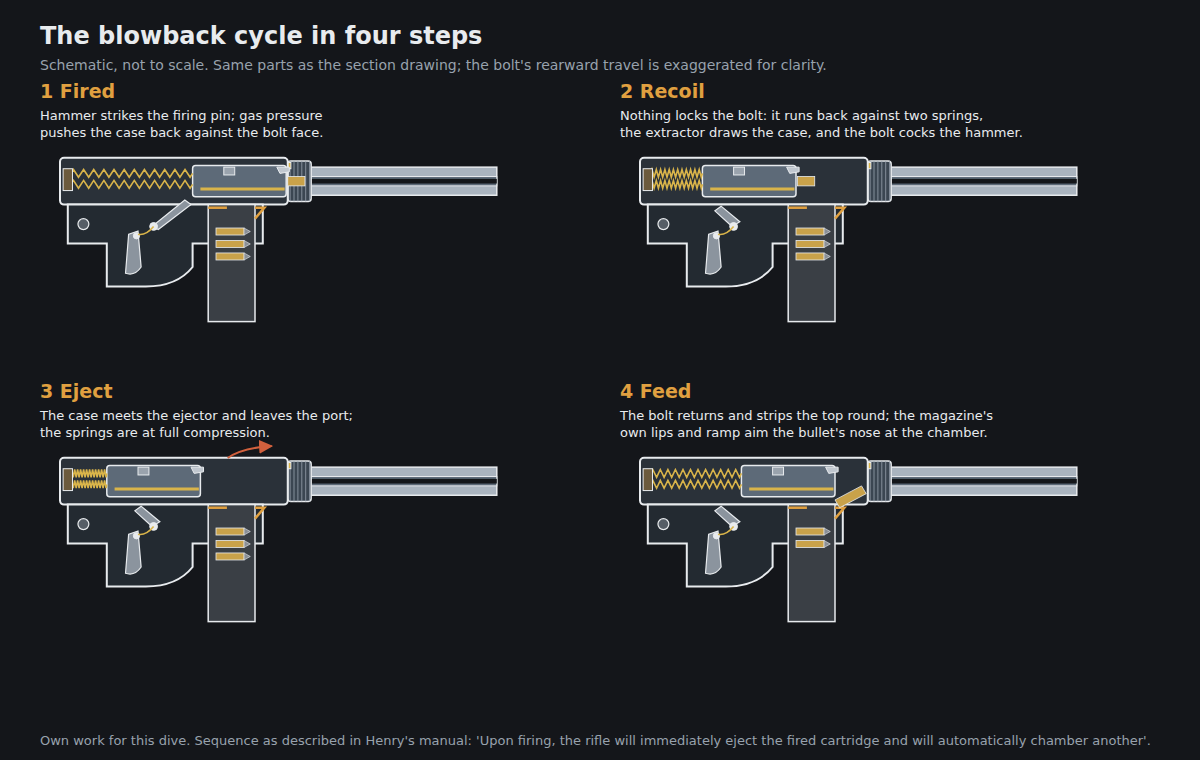
- Cocked and ready. The bolt is closed on a chambered round; the hammer is held back by the trigger’s sear. Henry’s manual notes that the safety “cannot be engaged … unless the hammer and trigger sear surfaces are engaged by cocking the bolt” — the safety works on the cocked trigger, not on the hammer.1
- Firing. The trigger releases the hammer, which rotates up and forward and strikes the rear of the firing pin in the bolt. The pin crushes the cartridge rim against the chamber’s edge and the priming compound fires the charge.
- Recoil. Gas pressure drives the bullet forward and the case backward against the bolt face. Because the bolt is not locked, the case pushes the bolt rearward, compressing the two action springs. The extractor claw, hooked over the rim, keeps the case on the bolt face.
- Cocking. The bolt passes over the hammer and pushes it back until the sear catches it.
- Ejection. Near the end of the bolt’s travel the case strikes the ejector, pivots about the extractor, and leaves through the ejection port on the right.
- Feeding. The springs drive the bolt forward. Its face catches the rim of the top cartridge in the magazine and pushes it forward; the magazine’s feed lips release it and its ramp and lips direct the bullet’s nose upward into the chamber.
- Locking — or rather, closing. The bolt seats the round, the extractor snaps over the rim, and the rifle is ready to fire again. Henry: “Upon firing, the rifle will immediately eject the fired cartridge and will automatically chamber another live cartridge.”1
There is no last-round hold-open: Campbell notes “there is no provision to lock the bolt to the rear.”3 The bolt closes on an empty chamber after the last shot.
4.3 Why the Bolt Is Heavy and the Springs Are Stiff
Every source that discusses the AR-7’s reliability starts from the same design fact. Campbell: “Because the bolt is heavy for the otherwise lightweight rifle, it utilizes heavy-for-caliber dual recoil springs.”3 Wikipedia: “All iterations of the AR-7 from the ArmaLite to the Henry U.S. Survival rifle use a bolt and dual recoil springs that are heavy compared to most other .22 semiautomatics.”4
The consequence follows from how blowback works, and is stated here as reasoning rather than as a measurement from any source. A blowback bolt is driven back by the momentum the cartridge gives it. The heavier the bolt and the stiffer its springs, the more energy it takes to drive the bolt far enough to eject the case, cock the hammer and pick up the next round. A cartridge that gives the bolt too little — a standard-velocity or subsonic load, a weak lot, a gun slowed by dirt or thick oil — leaves the bolt short of the magazine, and the rifle fails to eject or fails to feed. The heavy bolt and stiff springs give a margin against the opposite problem, the bolt opening too early; they cost the margin at the weak end. That is the mechanism behind the ammunition advice that follows, and behind Sam S.’s observation that these guns “run best as dry as they can comfortably be”: oil and fouling add drag that the bolt cannot spare.5
4.4 The Magazine Is the Feed Ramp
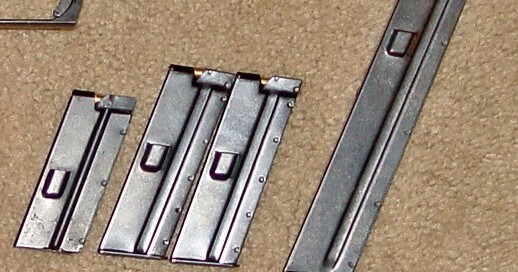
The AR-7’s most consequential design decision is where the feed ramp is. On most .22 rifles, the receiver or barrel has a ramp below the chamber that guides the bullet’s nose upward as the bolt pushes it forward. On the AR-7, the ramp belongs to the magazine.
- Wikipedia: “The feed ramp is part of the magazine and is subject to damage from mishandling.”4
- Sam S.: “The gun itself does not have a dedicated feed ramp. The feeding is entirely reliant on the condition of the magazines.”6
- Sam S. again, on the Explorer II: “the feed ramp is built into the magazines.”7
- Campbell: “the feed ramp was susceptible to damage making feeding from the magazine problematic.”3
The design is lighter and simpler, and it makes the receiver easier to cast and machine, because the receiver needs no ramp. Its cost is that every magazine is also a feed ramp: a magazine dropped on its lips, bent in a pocket, or stored loaded for years changes the path of the bullet into the chamber, and the rifle’s reliability changes with it. A rifle with one good magazine and one bad one is two different rifles. This is the single most important fact for anyone diagnosing an AR-7 that will not feed, and Volume 5 turns it into a procedure.
The other half of the feed path is the chamber mouth. Wikipedia says “flat-nosed bullets tend to jam on the edge of the chamber of the barrel,” and that feeding can be smoothed by “minor beveling of the chamber of the barrel.”4 Sam S. reports more feed trouble with lead bullets, “the tips getting caught on the barrel.”5 Both are consistent with a feed path set by a removable magazine rather than by a fixed ramp in line with the chamber: the bullet’s nose arrives at the chamber less precisely guided, and a blunt or soft nose catches where a round, jacketed one slides.
Wikipedia also says “later production magazines include an external wire spring to align the cartridge; earlier magazines used two pinch marks at the top of the magazine body, which in use could become sprung open or worn.” That sentence carries a “citation needed” tag, no other source located describes the change, and it is recorded here as unconfirmed.4
4.5 Ammunition: What the Makers Said, and When
The ammunition advice in circulation says the makers have always recommended high-velocity, 40-grain, round-nose ammunition. Campbell: “Manufacturers from the original Armalite to the current Henry Repeating Arms … recommend using only high-velocity ammunition with 40 grn. round-nose bullets.”3 The makers’ own manuals found for this dive say something more specific:
Table 1 — The ammunition advice in circulation says the makers have always recommended high-velocity, 40-grain, round-nose ammunition. Campbell: "Manufacturers from the original Armalite to the current Henry Repeating Arms ... recommend using only high-velocity ammunition with 40 grn. round-nose bullets."[^campbell] The makers' own manuals found for this dive say something more specific
| Maker, document | What it says |
|---|---|
| Charter Arms, rifle manual (after 1975) | “Designed to accept standard or high velocity .22 L.R. rim fire ammunition. The use of other than this recommended ammunition will void the one year full warranty.” |
| Henry, H002 manual (rev. 7.20) | “You can use either standard or higher velocity. We find that the gun functions best with .22LR high velocity.” And, in the ammunition section: “This gun will not cycle subsonic ammunition. We recommend you use high or hyper velocity ammunition.” |
| Henry, as reported by Knupp (2016) | “it recommends using only factory magazines and round-nose 40-gr. high-velocity ammunition.” |
So Charter explicitly allowed standard-velocity ammunition; Henry allows it but prefers high velocity and rules out subsonic. No ArmaLite manual was found, so what ArmaLite recommended is not known from its own words. The general statement that “the makers” always required high-velocity round-nose ammunition could not be confirmed for Charter and is not repeated here as fact. What is consistent across every source is the practical advice: high-velocity, round-nose, copper-plated ammunition feeds most reliably, and anything else can be loaded by hand, one round at a time, as Campbell and Wikipedia both note.34
The hub’s .22 Rimfire dive covers choosing .22 ammunition by gun; the velocity classes it defines are the ones that matter here.
In practice the recommendation is less restrictive than it sounds. Knupp’s Henry functioned “perfectly” with Remington Yellow Jacket hyper-velocity hollow points (33 gr, truncated) and bulk 36-gr hollow points as well as 40-gr round-nose.8 Sam S.’s Explorer II fired even “the oldest poorly kept 22 long rifle” he could find with one failure, from a split case.9 The failures both writers produced came from magazines, not cartridges.
4.6 The Barrel Nut
The barrel is held to the receiver only by a knurled nut that is tightened by hand. Every maker says to make it tight, and every other source says to keep it that way:
- Henry: “Make certain that the barrel is secured very tightly to the action.”1
- Campbell: “the barrel nut must be checked often and kept tight to get maximum accuracy and reliability.”3
- Wikipedia: “The barrel takedown nut tends to loosen during firing and may need hand-tightening to maintain both accuracy and reliability.”4
- Charter’s parts list includes a barrel-nut lock washer (part 2312), a part whose only purpose is to resist the nut backing off.2
Why a loose nut affects reliability as well as accuracy is not explained by any source, and the following is reasoning. The nut draws the barrel’s rear face against the receiver. If it loosens, the barrel can move slightly forward and wobble, which changes the gap between the bolt face and the rear of the chamber and the alignment of the chamber with the magazine’s feed path. A rimfire needs the rim held firmly between the bolt face and the chamber for the firing pin to crush it reliably, and a feed path that depends on a separate magazine has no margin for a barrel that has moved. Charter’s instruction to free the barrel by slamming the bolt against it (Volume 5) shows how tight a fit the design intends.
4.7 The Safety and the Controls
- Safety: a rotary thumb lever at the right rear of the receiver. Charter: “rotate safety lever back in direction of pointing arrow marked ‘SAFE’. Safety engages only when rifle is cocked.” Its specification says it “locks trigger.”2 Henry’s wording is the same in substance.1
- Charging handle: a knob that is pulled straight out to the right to use, and pushed in to stow. Henry: “Grasp the charging handle knob with thumb and index finger and pull straight out to the right. This will allow the shooter to ‘hook’ the index finger around the handle.” Both makers warn that it can fall out of the receiver if the action is not held right side up.12
- Magazine release: a lever inside the front of the trigger guard, pressed to drop the magazine.12
- Sights: a peep rear sight adjustable for elevation (later a flip sight with two apertures) and a front blade drifted or tapped for windage.32
4.8 Reliability by Maker: What the Sources Support
The AR-7’s reputation is that it jams, and that some makers’ rifles jam more than others’. The usual form of the story is that ArmaLite made good rifles, Charter made bad ones, Survival Arms did not fix them, and Henry finally did. The sources that make each claim are set out below, with what they rest on.
Table 2 — Reliability by Maker: What the Sources Support
| Claim | Who makes it | What it rests on |
|---|---|---|
| Charter’s quality declined | Wikipedia: “According to some accounts posted by enthusiasts, this is when quality began to deteriorate.” “Major Pandemic” (AllOutdoor, 2014): “Most consider the Charter Arms ownership … the beginning of the dark period.” | Enthusiast accounts, unnamed; a reviewer’s summary of opinion. No failure data. |
| Charter’s early problems were fixed | Wikipedia, citing Duncan Long, AR-7 Super Systems (Paladin, 1990): “the first production at Charter had problems which were corrected in later production runs.” | A 1990 book, not seen for this dive. |
| Charter barrels warped | Wikipedia: “Barrels were said to have a tendency to warp.” | Unattributed (“were said”). |
| Survival Arms did not improve it | ”Major Pandemic” (2014) | Assertion only. |
| Henry fixed it | Knupp: 500 rounds “completely reliable” with Henry magazines; Henry states “reliability was its top priority.” Major Pandemic: reliable “after break-in.” Sam S.: Henry rifle and magazines, “never had any problems.” | Three reviewers’ own guns. |
| All makers’ guns are sensitive to magazines, ammunition and cleanliness | Campbell; Wikipedia; Sam S.; Charter’s manual (“For Proper Function, the Action of This Firearm Must be Kept Clean”); Henry’s manual | The design itself (above) and the makers’ own warnings. |
What the record supports is narrower than the story.
No source located gives failure rates by maker. Every statement that one maker’s rifles were worse than another’s rests on unattributed enthusiast accounts, a reviewer’s summary of opinion, or a 1990 book that was not seen. None of it is data, and this dive does not repeat it as fact.
The causes that are documented are common to every maker. The heavy bolt and stiff springs, the feed ramp in the magazine, the sensitivity to bullet shape and velocity, and the hand-tightened barrel nut are the design, and every maker kept them. Wikipedia makes this point itself: the heavy bolt and springs are in “all iterations … from the ArmaLite to the Henry.”4
Age and magazines confound the comparison. An ArmaLite AR-7 examined today is 53 to 66 years old; a Charter is 36 to 53. Because the feed ramp is in the magazine, a rifle’s performance depends on the condition of magazines that may be as old as the gun, may have been dropped or stored loaded for decades, and may not be the ones it was sold with. Sam S., who uses original magazines, writes that “more often than not the feed ramp is damaged or the magazine, in general, is in unsatisfactory condition.”7 A comparison of a new Henry with its new magazines against a forty-year-old Charter with whatever magazines came with it measures the magazines as much as the maker.
Instructions changed, and so did the ammunition advice. Sam S. argues that the AR-7’s “unfair and unfortunate label of a jam master” owes much to manuals that “did a pretty poor job explaining the proper care and maintenance required,” and he found his Explorer II ran “flawlessly” once cleaned and lubricated by Henry’s instructions.911 The Charter manual found for this dive bears him out: its care section is five lines long. Charter also approved standard-velocity ammunition, which Henry now says is the weaker choice and which the design’s physics would predict to be marginal.
The one maker change aimed at reliability that is documented is Henry’s: thicker castings, a coated finish, a stock that carries more magazines, and an insistence on its own magazines and high-velocity ammunition. Knupp’s test is the best evidence for the result — and in it the rifle failed only when he used other makers’ magazines.8
The fair summary, then: the AR-7 is a design that tolerates less than most .22 semi-automatics, with its tolerance concentrated in the magazine; the claim that one maker’s rifles are intrinsically worse is plausible but unsupported by any data located. A buyer is better served by judging the particular gun and, above all, its magazines, than by the name on the receiver.
4.9 Magazines by Maker
Table 3 — Magazines by Maker
| Magazine | What the sources report |
|---|---|
| Original ArmaLite / Charter 8-round, steel | IMFDB: “the standard 8 round magazine of steel.” Sam S.: work as intended and preferred in his Explorer II, but often found with damaged feed ramps. |
| Henry 8-round | Knupp: reliable in the Henry, which failed with other makers’ magazines. Sam S.: fit the Explorer II “tighter” but fed as well as originals. |
| ArmaLite and Triple K 10- and 15-round | Campbell and Wikipedia list 10-, 15- and 20- or 25-round magazines. Sam S.: his Triple K 15-round “always seemed … decent”; no feeding problems traced to it. |
| Ram-Line 25-round, plastic | Sam S.: “comically bad”; eleven consecutive rounds his best after two hours of clearing jams. |
| Henry 5-round | Wikipedia only; not confirmed on Henry’s pages. |
References
Footnotes
-
Henry Repeating Arms, “U.S. Survival .22 Instruction Manual for All H002 Series Rifles” (revision 7.20), https://www.henryusa.com/wp-content/uploads/2021/04/Henry-H002-Series-User-Manual.pdf , retrieved 2026-09-19. ↩ ↩2 ↩3 ↩4 ↩5 ↩6 ↩7 ↩8 ↩9 ↩10
-
Charter Arms Corporation, “AR-7 Explorer Parts, Instruction and Warranty Manual” (after July 1975), Internet Archive item
gunmanual_Charter_AR7_Explorer, https://archive.org/details/gunmanual_Charter_AR7_Explorer , retrieved 2026-09-19. ↩ ↩2 ↩3 ↩4 ↩5 ↩6 ↩7 ↩8 ↩9 -
Dave Campbell, “A Look Back at the ArmaLite AR-7 Explorer”, American Rifleman (undated), https://www.americanrifleman.org/content/a-look-back-at-the-armalite-ar-7-explorer/ , retrieved 2026-09-19. ↩ ↩2 ↩3 ↩4 ↩5 ↩6 ↩7 ↩8 ↩9 ↩10
-
Wikipedia, “ArmaLite AR-7” (revision 1357130734, 31 May 2026), https://en.wikipedia.org/wiki/ArmaLite_AR-7 , consulted 2026-09-19 as a pointer; its reliability section cites Duncan Long, AR-7 Super Systems (Paladin Press, 1990), not seen. ↩ ↩2 ↩3 ↩4 ↩5 ↩6 ↩7 ↩8 ↩9 ↩10
-
Sam S., “The Rimfire Report: Charter Arms Explorer II AR7 Pistol Review”, The Firearm Blog, 26 September 2022, https://www.thefirearmblog.com/blog/2022/09/26/rimfire-report-charter-arms-explorer-ii-ar7-pistol-review/ , retrieved 2026-09-19. ↩ ↩2 ↩3
-
Sam S., “Curious Relics #003: ArmaLite AR7”, AllOutdoor, 30 December 2020, https://www.alloutdoor.com/2020/12/30/curious-relics-003-armalite-ar7/ , retrieved 2026-09-19. ↩
-
Sam S., “Curious Relics #45: Charter Arms Explorer II”, AllOutdoor, 10 August 2022, https://www.alloutdoor.com/2022/08/10/curious-relics-45-charter-arms-explorer-ii/ , retrieved 2026-09-19. ↩ ↩2 ↩3 ↩4
-
Jeremiah Knupp, “The Unlikely Resilience of the AR-7 Survival Rifle”, American Rifleman, 27 December 2016, https://www.americanrifleman.org/content/the-unlikely-resilience-of-the-ar-7-survival-rifle/ , retrieved 2026-09-19. ↩ ↩2 ↩3 ↩4 ↩5
-
Sam S., “Curious Relics #005: Charter Arms Explorer II”, AllOutdoor, 27 January 2021, https://www.alloutdoor.com/2021/01/27/curious-relics-charter-arms-explorer-ii/ , retrieved 2026-09-19. ↩ ↩2
-
“Major Pandemic”, “History of the AR-7 & Henry Repeating’s Survival AR-7”, AllOutdoor, 4 February 2014, https://www.alloutdoor.com/2014/02/04/history-ar-7-henry-repeatings-survival-ar-7/ , retrieved 2026-09-19. ↩
-
Sam S., “Curious Relics #004: The AR7 Design Survives”, AllOutdoor, 13 January 2021, https://www.alloutdoor.com/2021/01/13/curious-relics-004-ar7-design-survives/ , retrieved 2026-09-19. ↩
-
Internet Movie Firearms Database, “ArmaLite AR-7” page, read through https://www.imfdb.org/api.php on 2026-09-19. ↩
Comments (0)