ArmaLite AR-7 & Explorer II · Volume 1
The Brief — Aircrew Survival Rifles, Fairchild's ArmaLite, and the AR-5
Why the U.S. Air Force wanted a rifle that packed into its own stock and floated, what it had before, the aerospace company that answered in weeks, and the adoption that bought almost nothing
1.1 What This Dive Covers
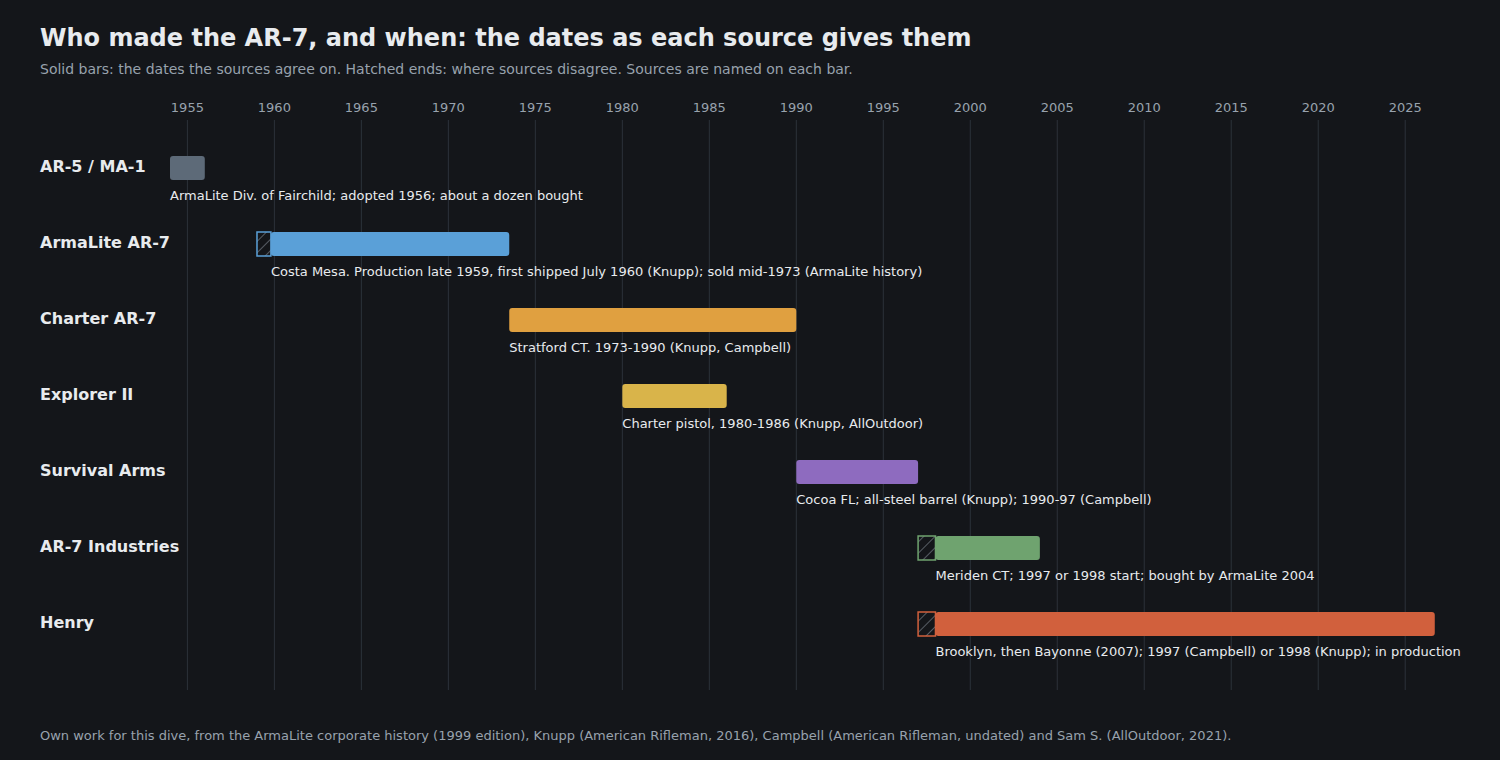
The AR-7 is a .22 Long Rifle semi-automatic that comes apart without tools and packs its barrel, action and magazine into its own hollow plastic stock, which floats. It was designed in the late 1950s at ArmaLite, then a division of the Fairchild Engine and Airplane Corporation, in the same small engineering shop, and in the same years, that produced the AR-10 and AR-15. It has been made, with interruptions, for more than sixty years by at least five companies, and it is in production today as the Henry U.S. Survival rifle. Between 1980 and 1986 it was also sold as a pistol, the Charter Arms Explorer II.
This dive is a reference, not the record of a particular gun. It runs in seven volumes:
- The brief (this volume): the Air Force requirement, the survival rifles that already existed, and the AR-5 that answered it.
- From AR-5 to AR-7: the design, the people, the materials, a 1960 change in federal law that the rifle’s barrel length depended on, and the ArmaLite years to 1973.
- The makers, and how to tell them apart: Charter Arms, the Explorer II, Survival Arms, AR-7 Industries and Henry, with identification plates and a table.
- How it works, and why it jams: the blowback cycle part by part, the magazine that carries the feed ramp, and the reliability record by maker, argued from sources.
- Takedown, detail strip, maintenance and repair, from the makers’ own manuals.
- The look: why an aerospace company’s survival rifle looks the way it does, argued from how it was made.
- On screen and at auction: From Russia with Love, the Star Wars blaster that really was an AR-7, collecting values, and the law.
The “AR” in the name stands for ArmaLite, and the AR-7 shares nothing mechanical with the AR-15 beyond the company and some of the people. The ArmaLite and Stoner background of the AR-15 is covered in the hub’s AR-15 dive and is not restated here.
1.2 The Problem: Aircrew Down in Empty Country
A survival weapon for aircrew answers a narrow question: what a crew needs if its aircraft comes down far from anywhere, and help is days or weeks away. The answer the Second World War produced was a gun for food rather than for fighting. Jeremiah Knupp’s history of the AR-7 in American Rifleman (2016) lists the wartime answers: the Germans issued a Sauer drilling in 9.3×74 mm R and 12 gauge to fliers in North Africa; the Americans tried .45 ACP shot cartridges (M12 and M15) for the pistols pilots already carried; and the Army Air Forces issued 15,000 Stevens Model 24 over-and-unders, .22 Long Rifle over .410, with plastic Tenite stocks, to bomber and transport crews in the Pacific.1
After 1947 the new Air Force had a larger version of the same problem. Strategic bombers now flew routinely over thousands of miles of Arctic and ocean. Knupp opens his account with Operation Chrome Dome, the 1960s airborne alert in which B-52s carrying thermonuclear weapons flew standing patterns round the clock, and with the small rifles in their survival kits, “designed to disassemble so they would take up as little precious weight and space as possible.”1
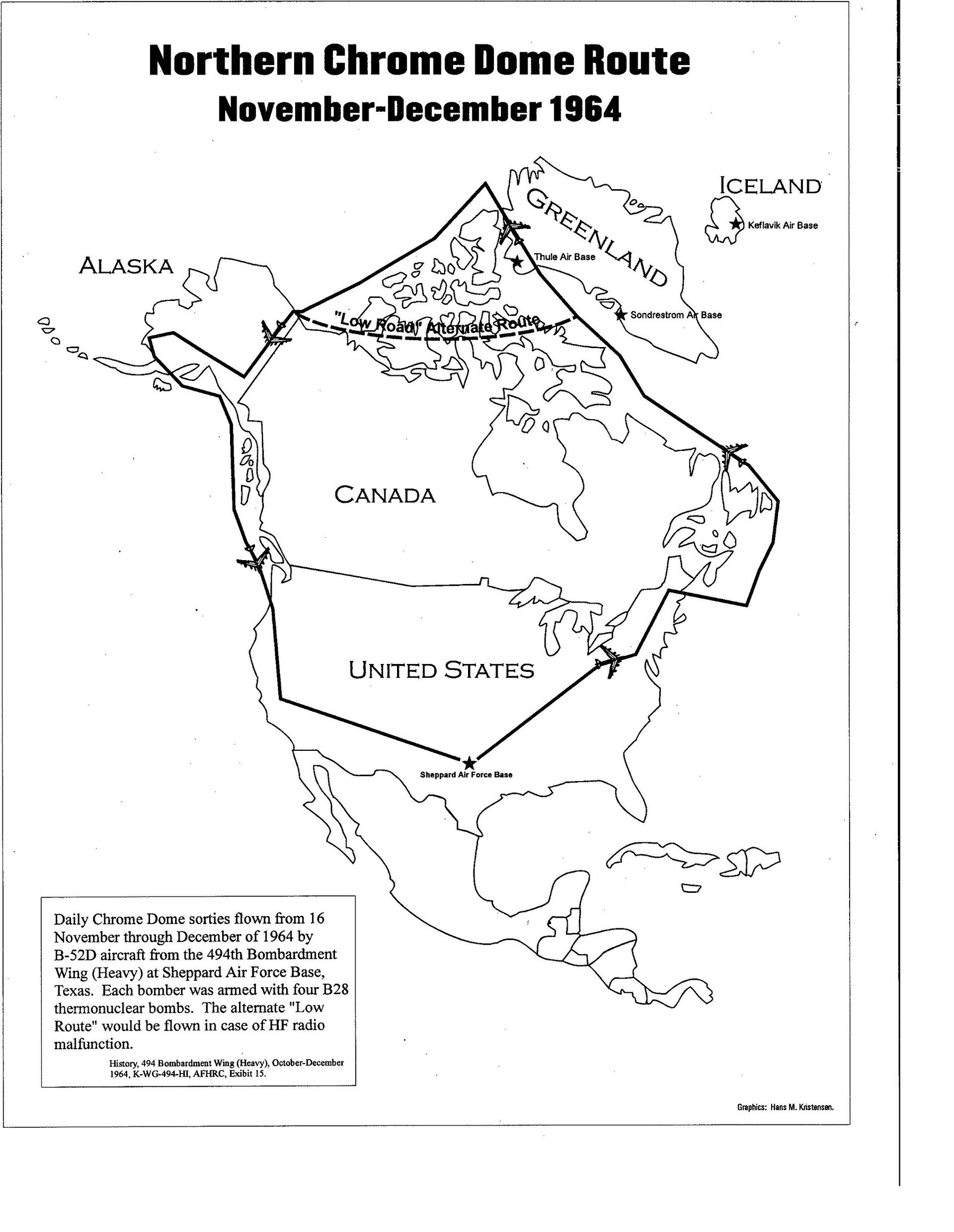
The requirement that followed from this is easy to state and hard to meet. The gun had to be light, because everything in a bail-out kit is carried by the person who survives. It had to be short when packed, because it lived in a seat pack or a cramped cockpit. It had to be simple enough to assemble with cold hands. It had to kill small game at short range without destroying the meat. And, for crews coming down in water, it had to float. Each of those demands shows up, almost line for line, in the shape of the rifle this dive is about.
1.3 What the Air Force Already Had: M4 and M6
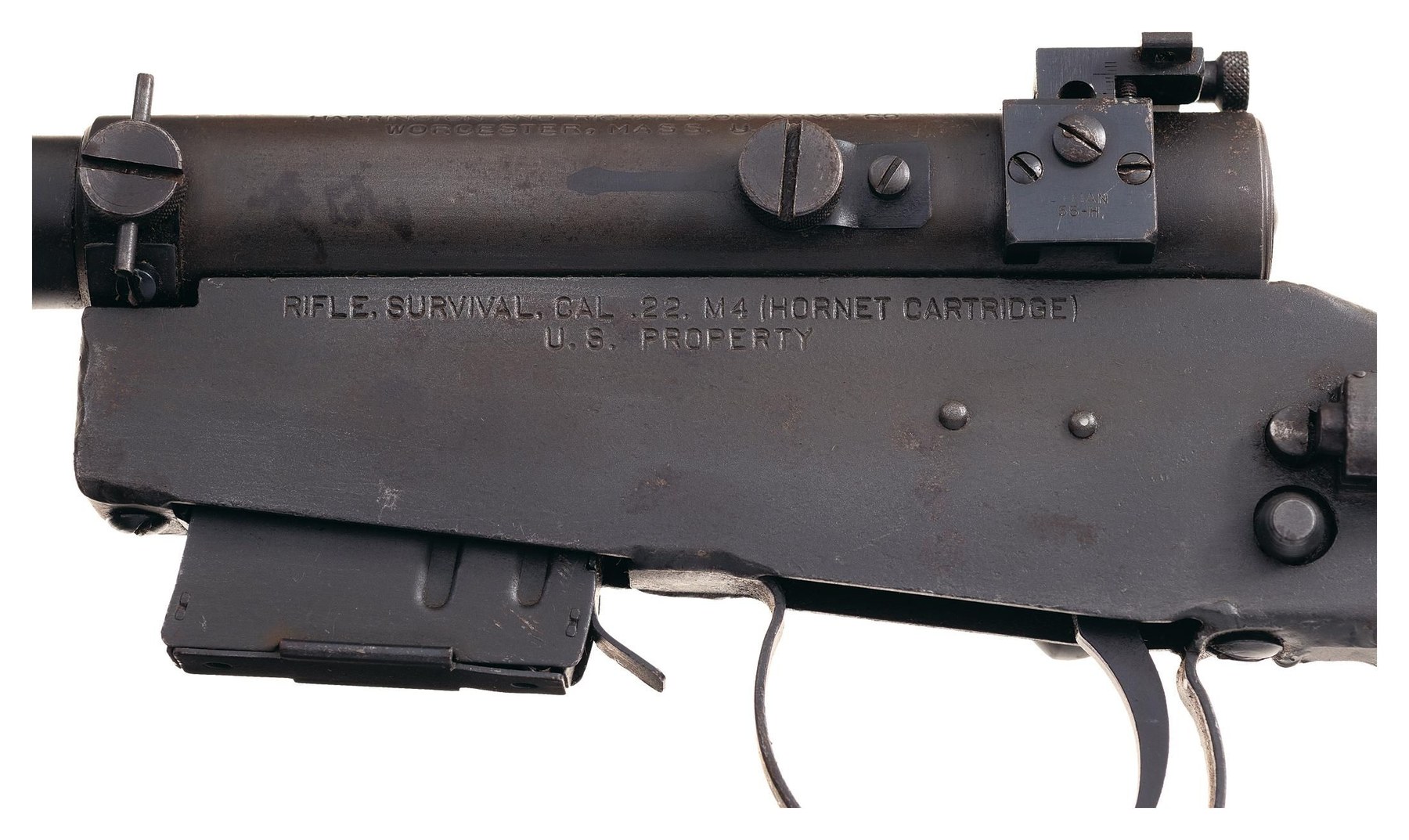
The Air Force’s first purpose-built survival rifle, according to Knupp, came in 1949: the M4, a bolt-action, magazine-fed rifle in .22 Hornet made by Harrington & Richardson. It had a sliding wire stock and a 13.5 in barrel (Knupp; Rock Island gives the original as 14 in) that screwed into the receiver at an index mark and was held by a thumbscrew; it weighed 4 lb and packed into a two-piece bundle the length of its barrel.1 Rock Island Auction’s catalogue for several M4s describes them as stored under aircraft seats, “not intended as a defensive weapon, but more for hunting and survival,” and in service “well into the late 1950s and early 1960s with B-52 bomber crews.”2
A few years later came the M6, made by Ithaca: an over-and-under with a .22 Hornet rifle barrel over a .410 shotgun barrel, 14 in long, folding at the breech to the length of its barrels, with a skeletal metal stock.1 The Wikipedia article on the AR-5, which is useful here only as a pointer, notes that the M6’s combination of rifle and shotgun was versatile but gave only one shot of each before reloading.3
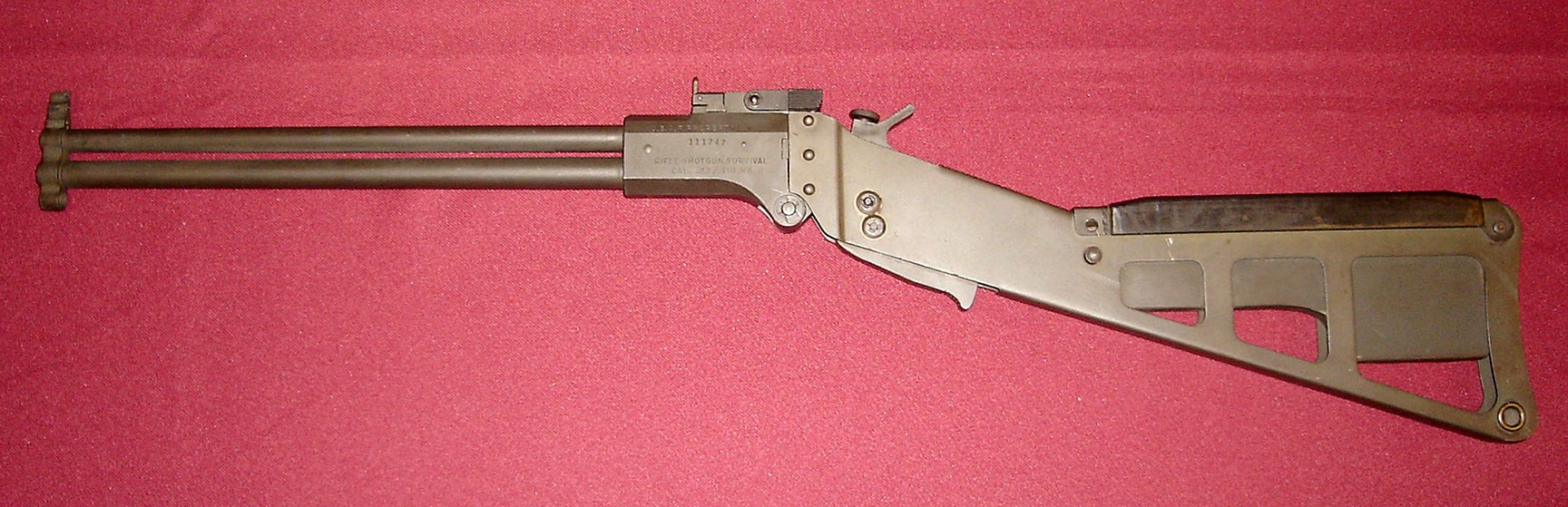
Two things about the M4 and M6 matter for the AR-7 story. First, both were made in quantity: Knupp gives the Air Force’s inventory of the two as “nearly 100,000.”1 That number is the reason the rifle ArmaLite designed next was bought in almost no quantity at all. Second, both are short-barrelled long guns. With barrels of 14 in, the military originals fall under the National Firearms Act in civilian hands; Rock Island’s catalogue describes several M4s on the civilian market whose barrels have been “professionally lengthened” or permanently extended, and original 14-in M6s selling as registered “Any Other Weapon” items.2 That legal line — barrel length — will turn out to matter to the AR-7 as well (Volume 2).
1.4 An Aircraft Company Goes Into Guns
ArmaLite’s own corporate history, first written as a company letter in March 1974 and revised in 1998 and 1999, is the closest thing to a primary source for how the company began.4 It says that the idea of building firearms from “the latest technical advances in plastics and alloys” belonged to George Sullivan, chief patent counsel of Lockheed, who had been working on it in his own garage shop since the Second World War. In 1953 Sullivan discussed the idea with Fairchild’s corporate secretary, Paul Cleaveland, at an aircraft-industry committee meeting; Cleaveland brought it to Fairchild’s president, Richard Boutelle, “a long-time gun enthusiast.” The ArmaLite Division of Fairchild Engine and Airplane Corporation was established on 1 October 1954, after “at least two years of privately funded development.”4
The same document states the business premise plainly: “ArmaLite believed that a ready market existed for firearms of advanced design featuring lightweight, modern alloys and plastics and economical production procedures.” The plan was to begin with fine sporting arms for the commercial market and expect the military to follow.4 Eugene Stoner, a former Marine with an ordnance background, became chief engineer in 1954; Charles Dorchester ran the programme as general manager. ArmaLite’s first project, before Fairchild’s involvement, was the AR-1 “Parasniper,” a lightweight bolt-action rifle begun in 1952 with a foam-filled fibreglass stock and “an anodized aluminum barrel with a thin steel liner.”4 That barrel construction — aluminium outside, a thin steel tube inside — is the one the AR-7 would carry into production.
1.5 The AR-5: A Rifle in Weeks
The plan to start with sporting rifles did not survive the first contact with the Air Force. ArmaLite’s history: “Shortly after Fairchild established the ArmaLite Division, ArmaLite was invited to submit a rifle to the U.S. Air Force as a replacement for the then-standard survival rifle. A few weeks after receiving information as to this requirement, ArmaLite submitted the AR-5, .22 Hornet Survival Rifle for Air Force evaluation.”4 Knupp puts the timing even tighter — the Air Force’s call came “within a month of establishment of the ArmaLite Division,” and “within a month the Air Force had a working prototype in its hands” — and adds that the requirement specified the rifle must float.1
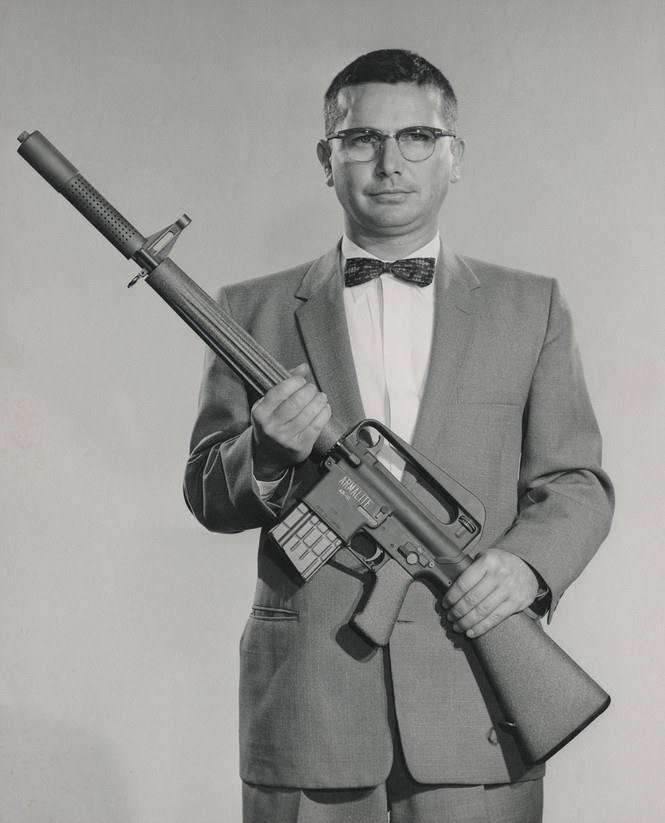
What ArmaLite delivered kept the M4’s cartridge and bolt action and changed everything else. Knupp describes an original ArmaLite photograph of Stoner at his bench with an M4 lying beside an AR-5 prototype. The AR-5’s centrepiece was a hollow fibreglass stock, building on Sullivan’s work with synthetic stocks, into which the action and barrel stowed to make a compact package that floated; ArmaLite called it the “pack-in-stock” concept. Its 14 in barrel attached to an aluminium-alloy receiver with a threaded collar, a knurled bolt held the receiver to the stock, and the whole assembled without tools. Knupp gives the weight as 2 lb 8 oz and the packed length as slightly more than 14 in.1 ArmaLite’s own history gives “a mere 2 ¾ pounds” and adds one detail no other source located mentions: “The government specification for the MA-1 called for a second, .22 long rifle barrel to be attached outside the stock.”4
The NRA Museum’s text on ArmaLite adds that the fibreglass buttstock “in addition to its ability to float, also provided a storage place for fish hooks, matches, and other supplies” — the survival kit and the rifle as one object.5
No licensed photograph of an AR-5 was located. One image on Wikimedia Commons is filed as an “AR-5A”; its source is given as a commercial blog page rather than the photographer’s own work, and it was not used. The identification key in Volume 3 describes the AR-5 in words for that reason.
1.6 The Adoption That Bought a Dozen
The Air Force adopted the AR-5 in 1956 and designated it the MA-1 Survival Rifle. Every source agrees on the adoption; they agree too on what followed, which was very little. ArmaLite’s history: “After adopting the AR-5 as the MA-1, the Air Force failed to follow through with a purchase. The main effect of the AR-5 was to whet ArmaLite’s appetite for government business.”4 Knupp gives the reason — the M4 and M6 already in inventory, nearly 100,000 of them, were judged adequate — and the result: “Only about a dozen MA-1s are believed to have been acquired.”1 The NRA Museum says the same in fewer words: expected sales “failed to materialize because the Air Force had already purchased a large inventory of Harrington & Richardson M4” and M6 rifles.5
The adoption nevertheless changed the company. ArmaLite’s history says the AR-5’s success “led Fairchild to reverse the strategy of focusing on the commercial market first”: with a quantity purchase “seemingly assured,” ArmaLite deferred commercial work and spent the next five years on military rifles.4 That is the road to the AR-10 and AR-15. The sporting-market plan returned only when the military market had failed — and the product it returned with was a civilian version of the AR-5.
1.7 The XB-70 Story, Tested
Several secondary accounts, including the Wikipedia article on the AR-5, say the Air Force wanted the new survival rifle for the crews of the XB-70 bomber, and that the rifle died when the XB-70 fleet was cancelled. The Wikipedia article attributes this to a 1971 Guns & Ammo Annual article by Harris Bierman.3
The claim sits awkwardly with the dates the other sources give: ArmaLite was founded in October 1954, the Air Force’s request came within weeks, and the MA-1 was adopted in 1956, years before any XB-70 flew.41 ArmaLite’s own history never mentions the aircraft: it describes the requirement only as “a replacement for the then-standard survival rifle,” and explains the lack of a purchase entirely by the existing M4 and M6 inventory. Knupp explains it the same way and frames the shift in strategy as one from long-range bombers to missiles, not as the cancellation of a particular aircraft.1 The 1971 annual could not be read for this dive. The XB-70 connection is therefore not repeated here as fact. The better-attested explanation is the one both ArmaLite and the NRA give: the Air Force already owned enough survival rifles.
1.8 What the AR-5 Left Behind
The AR-5 left three things that shaped the AR-7. The first was the concept: a rifle whose stock is also its case, which packs to little more than the length of its barrel and floats. The second was tooling and research — Wikipedia says ArmaLite “used the research and tooling for the AR-5/MA-1” to develop the AR-7, and Knupp confirms the AR-7 “used as much of the AR-5’s technology as possible.”31 The third was a reputation: ArmaLite’s history calls the AR-5 “ArmaLite’s first success,” and the company would sell the AR-7 as the “Air Force Survival Rifle” — a phrase that has done lasting damage to the record, because the Air Force never adopted the AR-7 (Volume 2).
1.9 The Brief Is Still Open
The problem the AR-5 answered has not gone away, and the Air Force’s current answer shows how the brief has moved from foraging to defence. Its current aircrew weapon is the GAU-5A, a short M4-type carbine packed, broken down, into the ejection-seat survival kit.
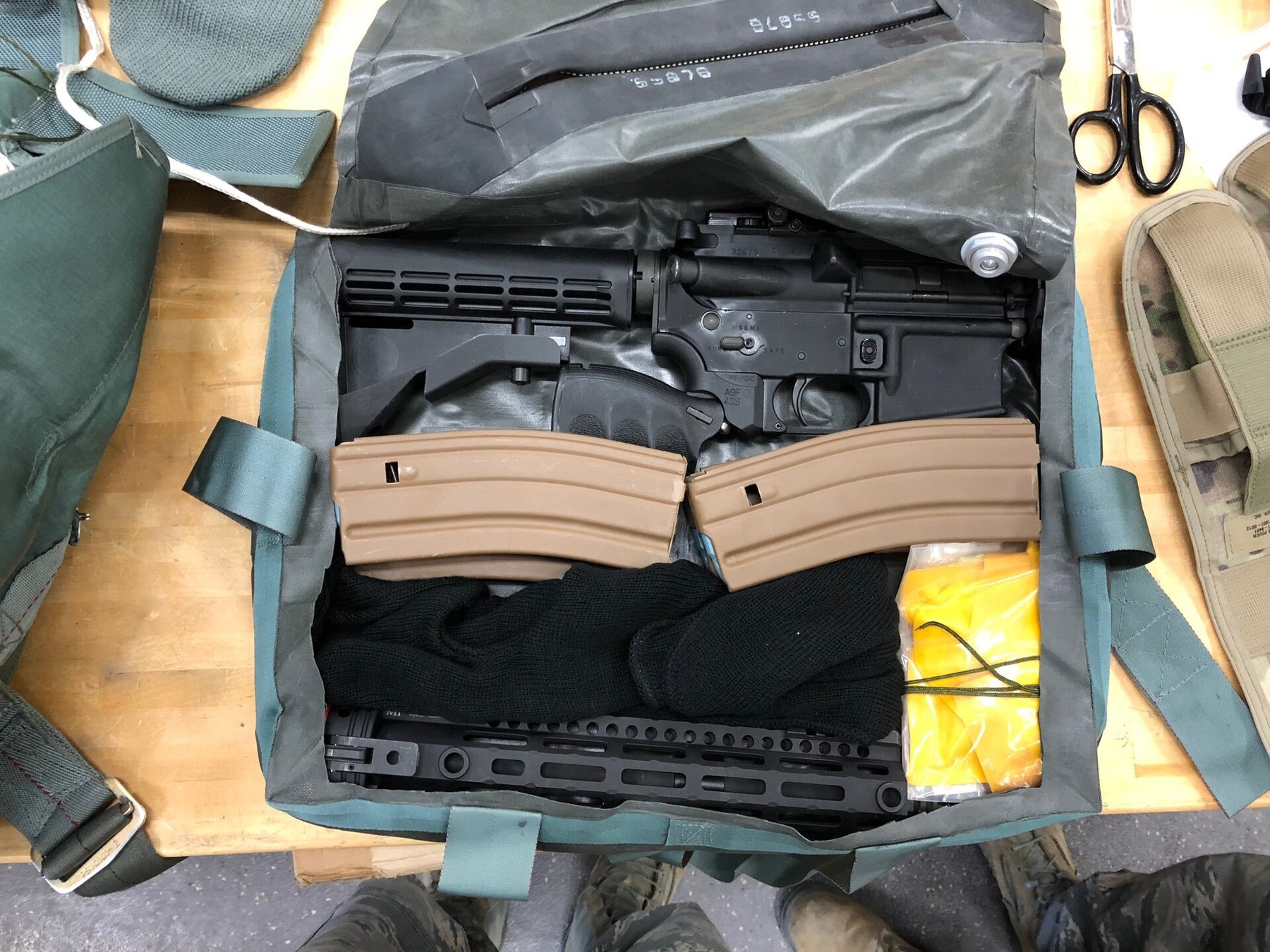
The contrast is instructive. The 1950s brief was about food, which is why every one of its answers — M4, M6, AR-5 — was a small-calibre sporting gun. The AR-7 inherited that brief, and with it the choice of the .22 Long Rifle: the most widely available cartridge in the country, light enough to carry by the hundred, and adequate for rabbits and birds at the ranges a survival rifle is used. Volume 2 follows that choice into the rifle ArmaLite actually sold.
1.10 The Makers at a Glance
The AR-7 has passed through more hands than most firearms, and the dates in circulation disagree. Volume 3 sets them out source by source. In outline:
References
Footnotes
-
Jeremiah Knupp, “The Unlikely Resilience of the AR-7 Survival Rifle”, American Rifleman, 27 December 2016, https://www.americanrifleman.org/content/the-unlikely-resilience-of-the-ar-7-survival-rifle/ , retrieved 2026-09-19. ↩ ↩2 ↩3 ↩4 ↩5 ↩6 ↩7 ↩8 ↩9 ↩10 ↩11
-
Rock Island Auction Company, lot descriptions for H&R M4 survival rifles (lots 80/426, 86/3322, 4093/3355, 1047/557) and Ithaca M6 (lots 80/3455, 88/376), https://www.rockislandauction.com/detail/80/426/ and siblings, retrieved 2026-09-19. ↩ ↩2
-
Wikipedia, “ArmaLite AR-5” (revision 1336947041, 6 February 2026), https://en.wikipedia.org/wiki/ArmaLite_AR-5 , consulted 2026-09-19 as a pointer only; it cites Harris Bierman, “Armalite AR5A”, Guns & Ammo Annual 1971, p. 298, which was not seen. ↩ ↩2 ↩3
-
ArmaLite, Inc., “A Historical Review of ArmaLite”, edition of 23 April 1999 (begun as a company letter of March 1974), Internet Archive copy of https://www.armalite.com/images/Library/AL%20HISTORY%20COPY%202.pdf captured 1 October 2008, https://web.archive.org/web/20081001234245/http://www.armalite.com/images/Library/AL%20HISTORY%20COPY%202.pdf , retrieved 2026-09-19. ↩ ↩2 ↩3 ↩4 ↩5 ↩6 ↩7 ↩8 ↩9
-
National Firearms Museum (NRA Museums), “ArmaLite AR-7 Explorer Rifle”, Case 22, https://www.nramuseum.org/guns/the-galleries/innovation,-oddities-and-competition/case-22-the-weird-and-the-wonderful/armalite-ar-7-explorer-rifle.aspx , retrieved 2026-09-19. ↩ ↩2
Comments (0)