.450 Bushmaster AR-15 · Volume 8
Keeping It Working — Field Strip, Detail Strip, Maintenance and Repair
Only what differs from a 5.56 AR-15: the bolt that is headspaced to its barrel, the big-bore extractor that wants no extra tension, the chamber step that is the headspace datum, and a malfunction table that reads ejection differently
8.1 What this volume covers, and what it links
A .450 Bushmaster AR-15 is stripped, cleaned and repaired like any AR-15, and the hub’s AR-15 (5.56) dive, Volume 7 covers that: field stripping, where cleaning matters, lubrication, wear points and reading a malfunction. This volume does not repeat it. It gives only what is different for the .450, and it takes the procedures from the US Army’s armorer-level manual for the M16A2, TM 9-1005-319-23&P, whose bolt and carrier procedures apply unchanged to the parts the .450 shares with a 5.56 rifle.1
No owner’s or armorer’s manual from a maker of .450 AR uppers could be found and read for this dive. Bear Creek Arsenal’s product pages point to videos for cleaning and barrel changes; Tromix’s guidance is its FAQ and its product listings; Ruger’s 2018 .450 MPR manual could not be located.23 Where this volume says something about the .450 specifically, it says whose statement it is.
8.2 Field strip
The procedure is the 5.56 one, with no .450 differences: magazine out, chamber cleared and checked, rear takedown pin out, upper pivoted on the front pin, charging handle and carrier group drawn out. Then the carrier group, per the TM:1
- Remove the firing pin retaining pin. (“Do not spread or close legs of firing pin retaining pin.”)
- Tilt the carrier and catch the firing pin as it drops out.
- Rotate the bolt cam pin a quarter turn and lift it straight out.
- Remove the bolt from the carrier.
Reassembly reverses it, and the TM’s two warnings apply word for word:
“Bolt cam pin must be Installed or rifle will blow up while firing the first round.” “Install firing pin retaining pin … from left side only … Check for proper installation by holding key and bolt carrier assembly with bolt assembly up, then attempt to shake out firing pin.”
🔴 The .450 adds one rule, and it is the TM’s other warning read with a .450 owner’s parts bin in mind: “Do not Interchange bolt assemblies from one rifle to another. Doing so may result In Injury, or death of, personnel.”1 An owner with several AR-15s has carrier groups that look identical from the side (Volume 7 §7.5, plate panels A and B). A .450/.458 bolt and a 5.56 bolt must never be swapped, and a .450 bolt should stay with the .450 barrel it was headspaced with. Keep the .450 carrier group marked.
8.3 Detail strip of the bolt
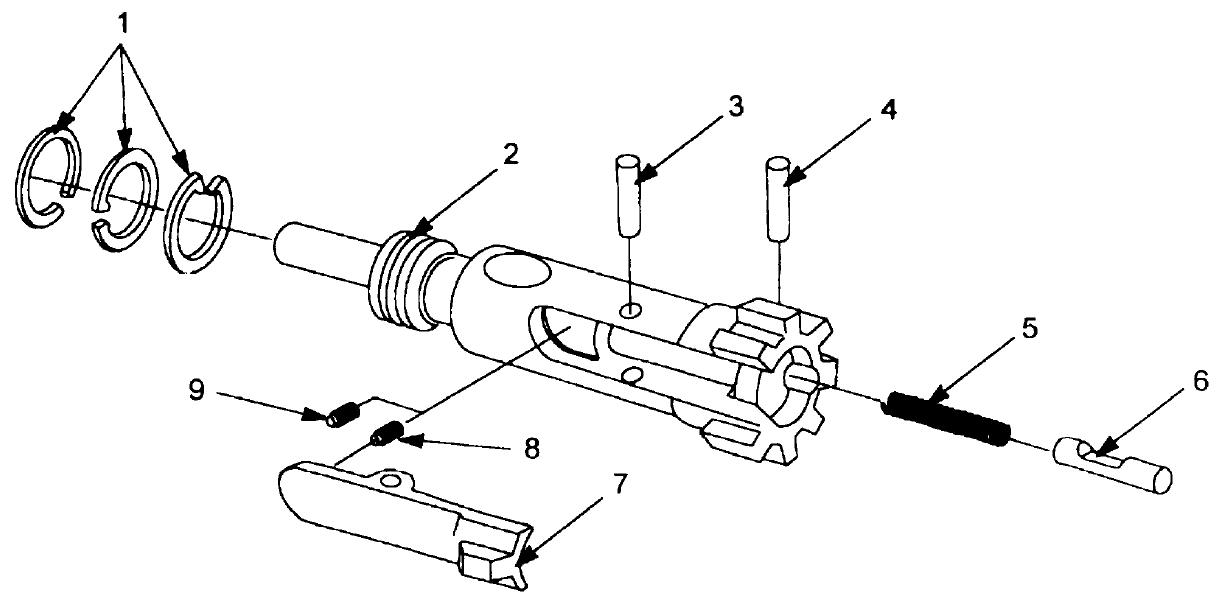
The TM’s sequence, which Tromix’s and Bear Creek’s .450 bolts follow because they use the same layout:1
Extractor.
- “Push out extractor pin and remove cartridge extractor and extractor spring assembly as a unit.”
- Separate the spring from the extractor only if one of them is being replaced: “Do not separate cartridge extractor and extractor spring assembly unless replacement of either or both is required. Do not remove the rubber Insert from the extractor spring assembly.” (That instruction is for the M16 extractor spring with its factory insert, and it does not license adding one; see below.)
Ejector.
- Hold the bolt body in a vise with protective jaw caps and drive out the ejector spring pin with a 1/16-inch punch.
- Catch the ejector and its spring as the punch comes out; they are under spring load.
- To reassemble, start the spring pin, insert the spring and ejector with the ejector’s groove aligned to the pin, hold them compressed with a 3/8-inch punch, and drive the pin flush with a 1/16-inch punch.
Gas rings. Three rings on the bolt tail, gaps staggered. The TM’s check is with the bolt assembled into the carrier (§8.4).
What is different on a .450 bolt:
- The extractor and ejector are big-bore parts. Tromix: “Extractor and Ejector are specific to the big bore calibers. They are not 5.56 parts.”4 A 5.56 extractor or ejector from a spares kit is the wrong part.
- Do not add extractor tension. On a 5.56 bolt a tired extractor spring is routinely helped with a stronger spring or an insert. Tromix’s FAQ says not to on its big-bore bolts: “Too much extractor tension will cause pieces of brass to be chipped off the rim of the case.”3 The fix for a weak extractor on a .450 is a correct replacement spring, not a booster.
8.4 Cleaning and lubrication
The 5.56 dive’s ranking of where cleaning matters (Volume 7 §7.2) holds: bolt tail, rings and carrier interior first, then the lugs and barrel extension, then the chamber, then the bore. The .450 changes the emphasis in two places.
The chamber step is the headspace datum. The .450 headspaces on its case mouth against the step at the front of the chamber, SAAMI 1.700 to 1.710 inches (Volume 7 §7.3). A ring of carbon or bullet lube built up against that step is sitting on the datum, and it can stop a round short of battery. Clean the chamber with a chamber brush, and pay attention to the step, not only the walls.
Fouling is heavier but easier to remove. A .45-calibre bore at moderate pressure leaves more carbon in absolute terms than a .223, but a .45 bore takes a large brush and patch easily.
Lubrication is the 5.56 dive’s (Volume 7 §7.3): the carrier rails, the cam pin and its slot, the bolt body and rings. One seasonal note: a hunting rifle used in a Michigan December should run a light oil, because a heavy one thickens in the cold, and a rifle that cycles on the bench at 70 °F can be sluggish at 10 °F.
The finishes on my rifle are the low-maintenance ones: a parkerized barrel and a black nitride carrier, both as recorded in my inventory. Neither is a substitute for wiping the rifle down after a wet day.
8.5 Inspection and the parts that wear
The TM’s inspections, applied to a .450 carrier group:1
Table 1 — 8.4 Inspection and the parts that wear
| What | TM test | .450 note |
|---|---|---|
| Gas rings | Gaps staggered; with the bolt in the carrier, “holding the key and bolt carrier assembly with the bolt assembly facing down. If bolt assembly falls out after firing pin retaining pin and bolt cam pin are removed, the rings are worn.” | Same rings as 5.56 (supplied with Tromix’s bolt).4 |
| Bolt body | ”Inspect for cracks or damage, especially around bolt cam pin hole and locking lugs.” | The big-bore face is cut close to the lug roots (Volume 7 §7.2). Look there. |
| Extractor | ”Inspect cartridge extractor, extractor spring assembly, and extractor pin for cracks, breaks, chips … Pay close attention to cartridge extractor lip.” | Big-bore part. Chipped brass on case rims means too much tension (§8.2). |
| Ejector and spring | ”Inspect … for cracks, breaks, and chips.” | Big-bore part. |
| Carrier key | ”Inspect carrier key for dents, distortion, or looseness.” Staking checked. | Same as 5.56. Bear Creek states its .450 carrier key is “staked from the side”.5 |
| Firing pin, cam pin, retaining pin | Cracks, chipped tip, wear. | Standard 5.56 parts (Tromix).4 |
Replacement intervals. No maker of .450 parts publishes a round-count interval for any of them, and the 5.56 dive found none for 5.56 parts either. None is given here. A hunting rifle in this calibre fires a few boxes a year (Volume 6 §6.3); it will be retired by its owner long before its bolt is worn out. The risk for this rifle is corrosion and neglect, not wear.
8.6 Malfunctions and their diagnosis
Read with the 5.56 dive’s §7.8, with one correction for this calibre: that section reads brass thrown forward as a sign of overgassing. On a .450 it is not. Tromix states that forward ejection, around 1 to 2 o’clock, is normal for the rebated-rim case in a big-bore bolt (Volume 7 §7.1).3 Judge gas on a .450 by how hard the brass is thrown and by the bolt’s lock-back, not by direction.
Table 2 — 8.5 Malfunctions and their diagnosis
| Symptom | Most likely, in order | Source |
|---|---|---|
| Failure to feed: nosedive, tip, bolt rides over the round | Follower (not single-column), magazine (Magpul P-Mag divider; Lancer date code 2021 or newer), the bolt, then the ramp | Tromix FAQ and barrel listing; Volume 4 §4.6 |
| Random failure to eject | Port too small at the rear; then extractor, dirty chamber | Tromix FAQ |
| Failure to extract | Dirty chamber (step and walls); extractor spring; then overpressure ammunition | TM; 5.56 dive §7.8 |
| Chipped case rims | Extractor tension too high (booster or insert added) | Tromix FAQ |
| Bolt does not lock back on empty | Follower; undergassed (gas block alignment); buffer too heavy | Tromix FAQ; 5.56 dive §7.8 |
| Short-stroking with a suppressor fitted (or harsh cycling) | Overgassed with the can on; Tromix recommends an adjustable block for supersonic suppressed use | Tromix FAQ |
| Round will not chamber, or bolt will not close | Case too long (mouth headspace), bullet seated long for the chamber, carbon on the chamber step | Volume 7 §7.3 |
| Light primer strikes | Carbon in the firing pin recess; firing pin chipped | TM troubleshooting |
| Groups open suddenly | Optic mount, barrel nut, handguard: torque check | 5.56 dive |
The TM’s own troubleshooting table names “Carbon buildup in firing pin recess inside bolt assembly”, “Burred locking lugs on bolt assembly”, “Defective extractor pin, cartridge extractor, and or extractor spring”, “Broken cartridge ejector”, “Cartridge ejector stuck in bolt body” and “Weak or broken ejector spring” among its causes; they apply to a .450 bolt as written, with big-bore replacement parts.1
🔴 The two big-bore makers both put feeding trouble on the bolt first (Volume 4 §4.2): Tromix says 90 per cent of .458 SOCOM feeding problems trace to “an incorrectly machined bolt”. If a .450 rifle will not feed reliably with a known-good single-column magazine, a different maker’s bolt is a cheaper experiment than any work on the barrel.
8.7 What the bench can fix, what it cannot, and parts
At the bench, with ordinary AR tools:
- Gas rings, extractor, extractor spring, ejector and spring, firing pin, cam pin, retaining pin (§8.2). Bear Creek sells the whole .450/.458 bolt assembly, with extractor, ejector, pins and springs, for $52.99, and a complete .450/.458 carrier group for $74.99; Tromix sells a bolt with rings, extractor and ejector (prices on their pages, read 19 October 2026).456
- The magazine follower and spring. (The follower in my magazines is a Tromix part that Tromix’s shop no longer lists; Volume 4 §4.6.)
- Gas block alignment and a gas tube, if the handguard comes off. Bear Creek sells a carbine gas tube for $19.99.7
- Muzzle devices, after the thread is gauged and the device is confirmed for a .45-calibre bore (Volume 4 §4.7b).
At the bench, with the right fixtures:
- Barrel replacement. A standard AR barrel change: barrel nut, gas block, handguard. Tromix’s warnings for its receivers are general good practice: hold the receiver in a clamshell fixture, “NEVER HOLD THE RECEIVER BY THE TAKEDOWN PIN LUGS WHEN TORQUING THE BARREL NUT”, and do not use a reaction rod on its uppers, which “can damage the barrel extension index pin as well as the receiver itself.”8 Bear Creek points to a video for the procedure rather than publishing one.7
- Headspace check after a barrel or bolt change. The .450 needs gauges for its mouth datum (1.700 GO side, 1.710 maximum), which are different from any 5.56 gauge. Tromix sells a cartridge case gauge for its calibres and says a correct round must drop “BELOW flush” with the top.3 See the Headspace dive.
Gunsmith or maker:
- A cracked bolt lug, a cracked barrel extension, or a damaged chamber.
- Any headspace reading outside the gauges.
- Feed-ramp blending into the receiver (Volume 4 §4.7): Tromix publishes it as a tip; it removes metal permanently.
Parts availability, as of 19 October 2026: bolts, carrier groups and the bolt kit are listed by both Bear Creek and Tromix (stock status was not recorded for them); Bear Creek’s 16-inch parkerized heavy barrel, the one matching mine, was shown “Out of stock”, with an 18-inch parkerized and a 16-inch stainless barrel among Bear Creek’s other .450 listings.7 Because the .450 shares its bolt with the .458 SOCOM, the bolt market is the deeper one; barrels are the part to buy before they are needed.
8.8 A maintenance cycle for a hunting rifle
A hunting .450 fires a box to confirm zero, a box or two of practice, and one or two rounds at a deer. That is a corrosion problem, not a wear problem.
- After every outing in wet or cold: wipe down, dry, re-oil lightly. Condensation on a cold rifle brought into a warm house is the classic way to rust a bore.
- After every range session: field strip; clean the chamber (step included), the bolt face recess and the bolt tail; lubricate the carrier.
- Before every season: detail-inspect the bolt per §8.4, ring-collapse test, function check with the hunting load and the hunting magazines, confirm zero (Volume 5 §5.10).
- Every time a magazine is loaded for the field: count it against Michigan’s six-shell rule (Volume 3 §3.4).
8.9 References (Vol 8)
Footnotes
-
Departments of the Army and Air Force, TM 9-1005-319-23&P / TO 11W3-5-5-42, Unit and Direct Support Maintenance Manual (Including Repair Parts and Special Tools List), Rifle, 5.56mm, M16A2, May 1991, with Change 5 of 9 April 1997: §2-13 Bolt carrier assembly; §2-14 Bolt assembly; troubleshooting table; Figure C-3. “Approved for public release; distribution is unlimited.” Read from the Internet Archive copy (item milmanual-tm-9-1005-319-23-m16a2-maintenance—repair-manual), 19 October 2026. URL: https://archive.org/details/milmanual-tm-9-1005-319-23-m16a2-maintenance—repair-manual. ↩ ↩2 ↩3 ↩4 ↩5 ↩6
-
Sturm, Ruger & Co., news release “AR-556 MPR Now Chambered in .450 Bushmaster”, 26 September 2018, read 19 October 2026; Ruger’s manuals page is script-driven and no .450 MPR manual was retrieved. URL: https://ruger.com/news/2018-09-26a.html. ↩
-
Tromix Corporation, “FAQs”, read 19 October 2026 (written about the .458 SOCOM, which shares the .450’s bolt). URL: https://tromix.com/faqs/. ↩ ↩2 ↩3 ↩4
-
Tromix Corporation, “Bolt – 458 SOCOM, 375 SOCOM, 450 Bushmaster”, read 19 October 2026. URL: https://tromix.com/product/bolt-458-socom-375-socom-450-bushmaster/. ↩ ↩2 ↩3 ↩4
-
Bear Creek Arsenal, “BCA .458 SOCOM / .450 Bushmaster Bolt Carrier Group”, SKU BCG-450-458, $74.99, read 19 October 2026. URL: https://www.bearcreekarsenal.com/bca-458-socom-450-bushmaster-bolt-carrier-group.html. ↩ ↩2
-
Bear Creek Arsenal, “BCA 450 Bushmaster / 458 SOCOM Bolt Assembly”, SKU BA-450-458, $52.99, read 19 October 2026. URL: https://www.bearcreekarsenal.com/bca-450-458-bolt-assembly.html. ↩
-
Bear Creek Arsenal, “BC-15 .450 Bushmaster, Parkerized 16” Heavy Barrel …”, SKU 1817-B450CHB16124(P).875, with its related-products block (carbine gas tube $19.99) and FAQ links, and the “.450 Bushmaster Barrels” category page, read 19 October 2026. URLs: https://www.bearcreekarsenal.com/450-bushmaster-16-parkerized-hb-1-24-twist-carbine.html; https://www.bearcreekarsenal.com/calibers/450-bushmaster/450-bushmaster-barrels.html. ↩ ↩2 ↩3
-
Tromix Corporation, “M4 Style Standard Big Bore Upper Receiver – Right Handed” and “Tromix Big Bore Billet Upper Receiver 7075”, read 19 October 2026. URLs: https://tromix.com/product/upper-receiver/; https://tromix.com/product/big-bore-billet-upper-receiver/. ↩
Comments (0)