.450 Bushmaster AR-15 · Volume 3
The Michigan Question — The Rule This Cartridge Was Bought For No Longer Exists
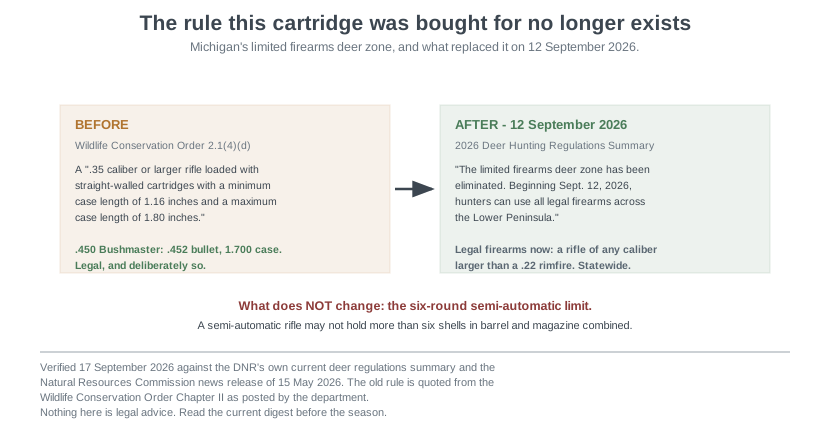
This is the volume to read first.
The .450 Bushmaster became a common rifle in Michigan for one reason, and it was not ballistic. It was a hunting regulation that made most conventional rifle cartridges illegal for deer across the southern part of the state and admitted straight-walled cartridges instead. The .450 Bushmaster fits that rule almost as though it had been written for it.
That rule was eliminated on 12 September 2026.
Nearly every article, forum post, buyer’s guide and cartridge comparison about the .450 Bushmaster on the internet was written while the old rule was in force, and a great many of them recommend the cartridge because of it. They are now stale on exactly the point they rest on, and that is why this volume exists.
Everything below is quoted from the Michigan Department of Natural Resources’ own current regulations, the Natural Resources Commission’s own announcement, or the Wildlife Conservation Order itself. Nothing here is taken from an article, and nothing here is legal advice. All sources were read on 17 September 2026.
3.1 What the Rule Was
Michigan’s Wildlife Conservation Order, Chapter II, section 2.1, lists things a person shall not do. Subsection (4) is the one that built a cartridge market. Quoted verbatim:1
“(4) Use in hunting, or, subject to section 43510, 1994 PA 451, MCL 324.43510, possess afield in an area inhabited by wild birds and animals within the ‘limited firearms deer zone’ from November 15 to November 30, or use to take a deer during any firearm deer season in the ‘limited firearms deer zone,’ a firearm other than:
(a) A shotgun with a smooth or rifled barrel.
(b) A .35 caliber or larger pistol capable of holding no more than nine shells at one time in the barrel and magazine combined and loaded with straight-walled cartridges.
(c) A muzzle-loading rifle or black-powder pistol loaded with black-powder or a commercially manufactured blackpowder substitute.
(d) A .35 caliber or larger rifle loaded with straight-walled cartridges with a minimum case length of 1.16 inches and a maximum case length of 1.80 inches.
(e) A .35 caliber or larger air rifle or pistol charged only from an external high-compression power source such as an external hand pump, air tank, or air compressor.”
Subsection (d) is the rifle rule, and it has three tests. A cartridge had to be:
- .35 calibre or larger
- straight-walled
- between 1.16 and 1.80 inches of case length
3.1.1 How the .450 Bushmaster scored
Table 1 — How the .450 Bushmaster scored
| Test | Requirement | .450 Bushmaster | |
|---|---|---|---|
| Calibre | ≥ .35 | .4525 bullet | ✅ comfortably |
| Case shape | straight-walled | straight, rebated rim | ✅ |
| Case length | 1.16 to 1.80 in | 1.700 in | ✅ with room at both ends |
It passes all three, and it passes the length test with 0.10 inch of margin at the top — which is the constraint that excludes the .45-70 Government, whose case is 2.105 inches and therefore too long for the zone that the .450 Bushmaster was legal in.
⭐ That is the single most useful thing to understand about why this cartridge existed commercially. The .450 Bushmaster is, to a good approximation, a .45-70 shortened until it was legal in southern Michigan and would fit an AR-15. Both constraints push the same way, and the 1.700-inch case satisfies both.
3.1.2 The zone was a line on a map, not a vibe
“Limited firearms deer zone” is a defined term, and the definition is geographic and specific. Chapter I of the order defines it as the area south of a line that runs, in part:2
“that area south of a line beginning at a point on the Wisconsin-Michigan boundry line directly west of the west end of highway M-46; then east to M-46 and east along M-46 to its junction with freeway US-131; then south along freeway US-131 to M-57; then east along M-57 to its intersection with Montcalm road on the Kent-Montcalm county line…”
The definition continues in that vein for some length. It is worth quoting because of how often the zone is described loosely as “the southern Lower Peninsula.” It was a specific boundary defined by named highways and county lines, and whether a particular parcel fell inside it was a question with an exact answer.
3.2 What the Rule Is Now
From the DNR’s current deer hunting regulations, in the summary of changes at the top of the page, quoted verbatim:3
“The limited firearms deer zone has been eliminated. Beginning Sept. 12, 2026, hunters can use all legal firearms across the Lower Peninsula.”
And from the same source, the list of what is legal during a firearm deer season:3
“Legal firearms include:
• A shotgun.
• A rifle of any caliber larger than a .22-caliber rimfire.
• A muzzleloading firearm, including black powder handguns, loaded with black powder or a commercially manufactured black powder substitute.
• A handgun of any caliber larger than a .22-caliber rimfire.”
The Natural Resources Commission’s own announcement of the decision, from 15 May 2026:4
“Elimination of the Limited Firearms Deer Zone in the Lower Peninsula, allowing the use of all legal firearms, including bottleneck cartridges, throughout the Lower Peninsula. Firearms larger than .22 rimfire are now permitted statewide.”
The change was one item in a larger package the commission approved for the 2026 and 2027 seasons, which also shortened the muzzleloader season to three days and renamed it the December Firearm Deer Season, eliminated the Upper Peninsula antlerless access drawing, and scheduled the early antlerless firearm season to run with the Liberty Hunt on 12–13 September.4
The straight-walled cartridge requirement is gone from the Lower Peninsula. A .30-06, a .308, a 6.5 Creedmoor or a .243 is now legal for deer in Jackson County in the same way it always was in Marquette County.
3.3 ⚠ The Order as Posted Still Contains the Old Text
One honest complication, recorded because a reader who goes looking will find it.
The Wildlife Conservation Order chapters as published on michigan.gov on 17 September 2026 still contain the old rule. Chapter II §2.1(4) is quoted verbatim in §3.1 above from the currently posted PDF, and Chapter I still carries the geographic definition of the “limited firearms deer zone.”
Meanwhile the department’s own current deer regulations say the zone “has been eliminated,” and the commission that issues wildlife orders announced the elimination in May.
The most likely explanation is a documentation lag — the posted chapter PDFs not yet reflecting an amendment the commission adopted. An attempt to locate a specific 2026 amendment document covering this change was unsuccessful; the commission’s page lists an Interim Order of the Director and “Amendment No. 1 of 2026” concerning Canada geese, and no deer-firearms amendment was found in the material that could be read.
This dive does not treat that as evidence the zone survives. The DNR’s current regulations summary is the department’s own operative statement of what the rules are for this season, the commission’s release is the issuing body’s own account of its decision, and the two agree with each other. A hunter should follow the current digest. The discrepancy is recorded because an unexplained conflict between two state documents is exactly the sort of thing that gets discovered mid-season by somebody who then has no idea which to believe.
⚠ Verify against the current digest before the season. Regulations change annually, this one changed inside the last four months, and the check date on everything in this volume is 17 September 2026.
3.4 🔴 What the Change Does Not Do
Four things, and the second is the one most likely to catch somebody.
3.4.1 It does not make the rifle illegal
Obviously, but worth stating plainly because the framing “Michigan banned the straight-wall zone” reads backwards to some people. The zone was a restriction; removing it widens what is legal. A .450 Bushmaster is a rifle of a calibre larger than a .22 rimfire, and it is legal for deer in Michigan exactly as it was before.
3.4.2 🔴 It does not touch the six-round semi-automatic limit
This is the rule that actually constrains an AR-15, and it is untouched. From the current digest:3
“You cannot hunt deer with a semi-automatic shotgun or semi-automatic rifle that can hold more than six shells in the barrel and magazine combined.”
The Wildlife Conservation Order says the same thing in Chapter II §2.1(2), and its version is broader — it prohibits not only hunting with such a firearm but having one “in the persons possession in an area frequented by animals.”1
For the rifle documented here this is a non-issue, and pleasantly so. A four-round Lancer magazine plus one in the chamber is five. The rifle is compliant as configured, with a round to spare.
⚠ But it is a live trap for the .450 Bushmaster generally, because the cartridge is also sold in larger magazine bodies. A nine-round magazine on a thirty-round body (Volume 1 §1.7) holds nine, plus one chambered, which is ten — comfortably over the limit. The magazine is where an AR owner fails this rule, and the cartridge’s single-stack geometry is the only reason most .450 Bushmaster magazines happen to be legal.
3.4.3 It does not change the archery-season prohibition
The digest’s rules on carrying a firearm while bow hunting are unchanged, and a rifle is not a pistol for this purpose. The Remington XP-100 dive covers the handgun side of Michigan’s hunting rules in detail and should be read for that; this volume does not restate it.
3.4.4 It does not change anything outside Michigan
Straight-walled cartridge requirements still exist in other states. The .450 Bushmaster was designed into a multi-state market, and Michigan is one state leaving it.
⚠ This dive deliberately does not list which other states restrict deer hunting to straight-walled cartridges, or what their case-length limits are. Those rules differ from each other in their details — calibre floors, case-length windows and which counties are covered are all state-specific — and none of them was read from a primary source for this dive. A hunter travelling with this rifle must check the destination state’s own current regulations. Reproducing a half-remembered list here is exactly how the stale-article problem this volume is about gets perpetuated.
3.5 3.4a The Michigan Rules That Still Apply to This Rifle
The zone is gone; a good deal else is not. These are the provisions in the current digest that bear directly on carrying and using a .450 Bushmaster AR-15 in Michigan, quoted verbatim.3
3.5.1 The quiet period
“The ‘quiet period’ is Nov. 10–14. During this time, you cannot carry afield or transport any rifle (including rimfire) or shotgun if you have buckshot, slug, ball loads or cut shells.”
The digest lists exceptions: transporting a firearm to deer camp or to a target range during the period if it is properly transported, and target shooting on one’s own property “provided there is no attempt to take game.”
This one catches people, because it bites in the five days immediately before the opener — exactly when a hunter is most likely to be moving rifles around. The Wildlife Conservation Order carries the same restriction at Chapter II §2.1(3).1
3.5.2 Transport in a vehicle
“These rules apply whether your vehicle is parked, stopped or moving. At all times when carried in or on a motor vehicle, including snowmobiles: Rifles, shotguns, muzzleloaders and all other firearms must be unloaded in both barrel and magazine and enclosed in a case or carried in the trunk of a vehicle on private or public property.”
🔴 A concealed pistol licence does not help here. The digest’s easier vehicle rules apply to pistols carried under a CPL. A .450 Bushmaster AR-15 is a rifle, and it travels unloaded and cased, full stop. The Remington XP-100 dive covers the pistol side of this contrast in detail; the asymmetry is real and it runs against the rifle.
3.5.3 Afield outside legal hunting hours
“Firearms must be unloaded in the barrel and all arrows must be in a quiver when you are afield outside the legal hunting hours.”
3.5.4 Lead-free ammunition
“While not required by law, it is recommended that you use lead-free ammunition when hunting a deer. Some national wildlife refuges require the use of lead-free ammunition.”
Not a requirement, and worth knowing anyway — a hunter on a national wildlife refuge may face a rule the state does not impose. No lead-free .450 Bushmaster factory load is named in this dive, because none was confirmed on a maker’s site (Volume 2 §2.7).
3.5.5 Pneumatic guns, and what the phrasing reveals
“You can use a pneumatic gun to hunt deer if it meets the firearm requirements for the season, species hunted and zone you are hunting in.”
A small point with a useful implication: the digest still speaks of “the zone you are hunting in.” Zones 1, 2 and 3 continue to exist and continue to govern seasons — what has been eliminated is the separate limited firearms deer zone and its equipment restriction, not Michigan’s three-zone structure. Conflating the two is an easy mistake to make when reading about the change.
3.6 3.4b What Else the Commission Changed
The elimination of the zone was one item in a package, and the rest of it affects when a .450 Bushmaster can be used even though it says nothing about cartridges.4
- The statewide muzzleloader season is cut from ten days to three, beginning the first Friday in December, and in the Lower Peninsula it is renamed the December Firearm Deer Season — during which any legal firearm may be used. ⭐ That is a second, quieter win for this rifle: a season that previously excluded it now admits it.
- The Liberty Hunt and the Early Antlerless Firearm season run together on the second weekend in September — 12–13 September 2026, the same date the zone elimination took effect.
- The Late Antlerless season opens earlier, on the Monday after the December firearm season, running through 1 January.
- The Extended Late Antlerless and January Archery seasons are eliminated, so all deer hunting now ends after 1 January.
- From 2027, in the Lower Peninsula only, buck harvest is limited to one buck per hunter, with a single deer licence valid for a buck with at least three antler points on one side or an antlerless deer.
- A pilot “earn a second buck” programme begins in Zone 3 in 2027, requiring an antlerless deer first before a second buck with a four-point restriction.
⚠ The 2027 changes were approved in May 2026 and are not in force for the 2026 season. They are recorded here because a rifle bought for 2026 will be hunted in 2027, and because a one-buck rule changes how many shots a season is likely to offer rather more than a cartridge choice does.
3.7 ⚠ An Ambiguity in the New Wording
The replacement rule contains a wording problem worth knowing about, and it is the same one the Remington XP-100 dive flagged for handguns.
“A rifle of any caliber larger than a .22-caliber rimfire” is ambiguous on its face. Read strictly, “larger than a .22 calibre” would exclude every .224-inch bullet and therefore outlaw the .223 Remington for deer. Read the other way — and this is plainly the drafter’s intent — the qualifier “rimfire” carries the sentence, and the clause excludes .22 rimfire specifically while admitting any centrefire.
The second reading is almost certainly correct, since no one believes Michigan has quietly banned the .223 Remington for deer. It has no bearing whatever on a .450 Bushmaster, which is not close to the line in any reading. It is noted only so that a reader who spots the same oddity knows it has been seen and is not a transcription error in this dive.
3.8 What This Means for a .450 Owner
Stated directly, because hedging here would be useless.
The cartridge has lost its exclusive claim and kept everything else.
Before 12 September 2026, a hunter with land in the limited firearms deer zone had a short list of legal rifle cartridges, and the .450 Bushmaster was near the top of it. The rifle was bought because it was allowed where a .308 was not.
After 12 September 2026, that hunter may use the .308. The .450 Bushmaster now has to justify itself on merit against the whole catalogue — and against cartridges that shoot flatter, cost less to feed and reach further.
Three things it still has:
- It is what the rifle is chambered in. A rifle already built, already zeroed, already fed, with magazines and a known load, has a large practical advantage over a hypothetical better rifle that would have to be bought.
- Inside 200 yards it does the job as well as anything. Volume 2’s numbers do not get worse because the law changed. A 250-grain .452 bullet at 1,800 fps at 100 yards is an excellent deer proposition, and the terrain most southern Michigan deer are shot in does not offer 300-yard shots.
- The AR platform advantages are unchanged — a fast second shot, a familiar manual of arms, a light-recoiling big bore, and modularity.
Two things it has lost:
- The legal argument, entirely.
- A slice of its resale market. Michigan was one of the larger straight-wall states, and a meaningful part of demand for .450 Bushmaster rifles and ammunition there was regulation-driven. What happens to Michigan prices and shelf stock over the next few seasons is a genuine unknown, and Volume 6 treats it as one rather than predicting it.
⭐ The honest summary: the change is a real loss to the cartridge’s case, and no loss at all to the cartridge’s performance. An owner who bought it for the zone has a rifle that is now one option among many. An owner who likes shooting it has exactly what he had before.
3.9 References (Vol 3)
Footnotes
-
Michigan Department of Natural Resources / Natural Resources Commission, Wildlife Conservation Order, Chapter II — General Hunting and Trapping Regulations, section 2.1(2) and 2.1(4), as published at michigan.gov and read 17 September 2026. ↩ ↩2 ↩3
-
Wildlife Conservation Order, Chapter I, definitions, subsection (17), “Limited firearms deer zone,” as published at michigan.gov and read 17 September 2026. ↩
-
Michigan Department of Natural Resources, 2026 Deer Hunting Regulations Summary (deer regulations page, michigan.gov), read 17 September 2026. Source of the elimination statement, the legal firearms list, and the semi-automatic capacity restriction. ↩ ↩2 ↩3 ↩4
-
Michigan Department of Natural Resources, “Natural Resources Commission approves deer regulation changes for 2026 and 2027,” news release, 15 May 2026. ↩ ↩2 ↩3
Comments (0)