.450 Bushmaster AR-15 · Volume 4
Building and Feeding One — The Bolt, the Barrel, and the Magazine Problem
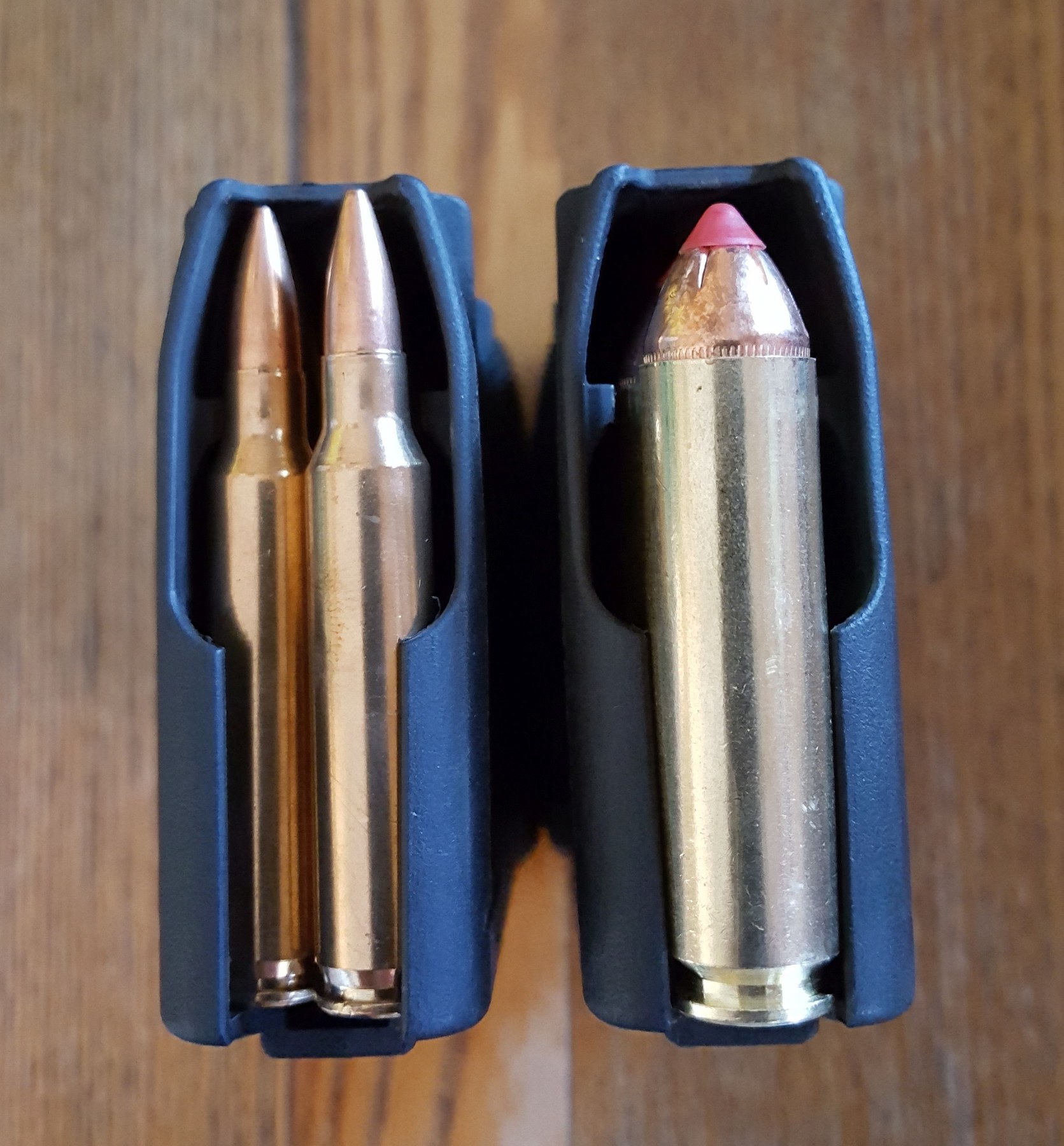
A .450 Bushmaster AR-15 is a caliber conversion of an existing rifle, not a different rifle. That is the cartridge’s commercial advantage and the source of every mistake made building one.
The rifle documented in these volumes was assembled at home on a Black Rain Ordnance lower, and the parts list in Volume 1 §1.8 is the worked example throughout.
4.1 What Carries Over, and What Does Not
The clean way to think about a .450 build is to sort the rifle into parts that do not care about the cartridge and parts that do.
Table 1 — 4.1 What Carries Over, and What Does Not
| Component | Carries over from a 5.56 AR-15? |
|---|---|
| Lower receiver | Yes, entirely. No modification of any kind. |
| Trigger, safety, grip, stock, buffer tube | Yes |
| Upper receiver | Yes — a standard AR-15 upper |
| Charging handle | Yes |
| Handguard | Yes, subject to barrel profile and gas system clearance |
| Barrel | No — .450 Bushmaster specific |
| Bolt | No — .473 rim, not .378 |
| Magazine | No — single-column body |
| Magazine follower | No — and this is the one people skip |
| Bolt carrier | Usually yes, but commonly supplied as a matched group |
| Buffer and spring | Sometimes — see §4.5 |
The lower receiver carrying over completely is the whole point. In the United States the lower is the serialised, regulated part; everything above it is ordinary commerce. A .450 Bushmaster upper on an existing lower is a legal non-event — the same rifle, a different barrel and bolt. Volume 1 §1.7 explains why the cartridge was shaped to make this possible.
4.2 🔴 The Bolt Is the Non-Negotiable Part
A 5.56 bolt will not work and cannot be made to work.
The numbers, from Volume 2 §2.1: a 5.56×45 has a .378-inch case head. A .450 Bushmaster has a .473-inch rim. The bolt face must be cut for the larger dimension, and the extractor and ejector must suit it.
The rifle documented here uses a black nitride .450/.458 bolt carrier group with an MPI-marked bolt, which is the conventional answer. Two details in that description are worth unpacking:
“450/458” is not a compromise. The .458 SOCOM shares the .473 rim dimension, so a single bolt serves both cartridges. A bolt sold for one is correct for the other, which is why they are catalogued together and why the pool of available bolts is larger than a .450-only market would support.
“MPI” means magnetic particle inspection, a non-destructive test for surface and near-surface cracks. On an AR bolt it is a meaningful quality marker rather than marketing: the bolt lugs are the most highly stressed small part in the rifle, and the failure mode is a lug shearing. On a big-bore conversion it is worth paying for, and a builder choosing between an MPI-marked bolt and an unmarked one at a similar price has an easy decision.
4.3 The Barrel, and the Twist That Is Already Right
The barrel documented here is a Bear Creek Arsenal .450 Bushmaster, 4150 chrome-moly vanadium, parkerized, heavy profile, 1:24 twist.
Volume 2 §2.6 established that 1:24 matches SAAMI’s own reference barrel exactly, and that the standard marks twist OPTIONAL. There is nothing to second-guess here: the twist is right, and it is right for the same reason across essentially every .450 Bushmaster barrel on the market.
4150 chrome-moly vanadium is the ordinary quality steel for AR barrels and is a sound choice for a cartridge at this pressure. At 38,500 psi maximum average pressure (Volume 2 §2.4), the .450 Bushmaster is not stressing a barrel the way a magnum bottleneck cartridge does. Barrel life is not a practical concern for a hunting rifle in this chambering; round counts that would matter are not round counts a hunter will fire, and the cost of the ammunition (Volume 6) enforces that by itself.
⭐ The barrel is 16 inches (confirmed 17 September 2026; Volume 1 §1.8). That is shorter than every barrel any published .450 Bushmaster velocity was measured in, which is why Volume 5 treats the published figures as an upper bound for this rifle rather than as its performance.
4.4 The Gas System
This is the part of a .450 Bushmaster build where confident advice is easy to find and hard to source.
The mechanism is straightforward. The rifle is a direct-impingement autoloader. Gas is tapped from the bore through a port, travels down a tube, and drives the carrier back. Whether it cycles correctly depends on how much gas arrives and when — which depends on port size, port position along the barrel, barrel length, and the pressure curve of the cartridge.
The .450 Bushmaster has a very different pressure curve from a 5.56. It is a large-bore, low-pressure cartridge burning a fast powder in a big case. Pressure peaks and falls away quickly. A gas system positioned and sized for 5.56 behaviour is not automatically correct.
⚠ This dive publishes no port diameter, no gas length recommendation and no buffer weight, and the reason is a sourcing one. The owner’s record does not state the gas system length of the rifle documented here, and no manufacturer documentation specifying port sizes or gas lengths for .450 Bushmaster barrels was read for this dive. The figures that circulate in builder discussion are plausible and may well be right; they are not sourced, and a wrong gas port dimension published as fact would be worse than the gap.
What can be said without a source is diagnostic, and it is what a builder actually needs:
- Short-stroking — the carrier not travelling far enough to pick up the next round, or the bolt not locking back on an empty magazine — indicates undergassing.
- Brass thrown far forward, violent ejection, and heavy recoil impulse indicate overgassing, which on this cartridge also accelerates extraction while the case is still gripping the chamber.
- Both are tuned at the gas block or the buffer, and an adjustable gas block turns a guess into an afternoon’s work.
A complete factory upper sidesteps the entire question, which is a real argument for buying one rather than assembling from components on a first big-bore build.
4.5 The Buffer
Related and equally under-documented.
The reasoning is sound and general: a heavier bolt carrier group and a heavier cartridge impulse mean the reciprocating mass is being driven harder than in a 5.56 rifle, and a heavier buffer slows the carrier, delays unlocking slightly, and softens the impulse at the rear of the travel. Heavier buffers are commonly fitted to big-bore AR conversions for exactly these reasons.
⚠ No specific buffer weight is recommended here, for the same sourcing reason as the gas system. The owner’s record does not state the buffer fitted to the rifle documented here. A builder experiencing cycling trouble should treat buffer weight as one of the two variables to adjust, alongside gas.
4.6 🔴 The Magazine Problem, in Full
This is the part of the rifle that is genuinely peculiar, and the part the owner’s own record flags in capital letters.
4.6.1 Why standard AR magazines do not work
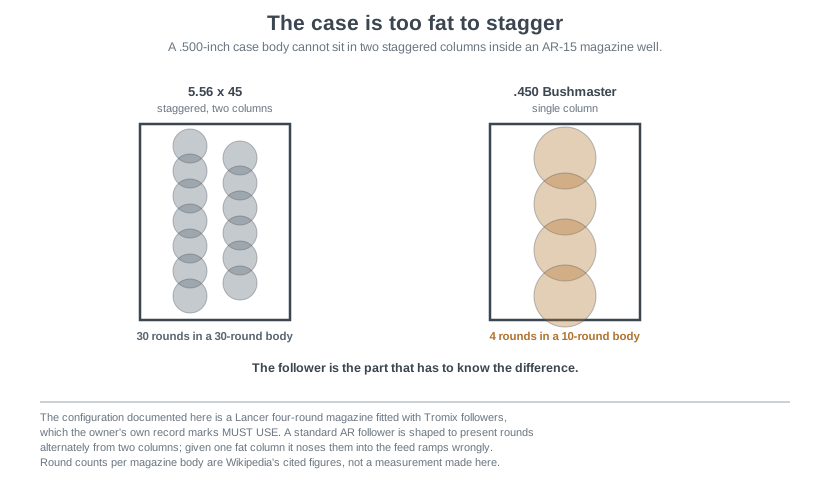
A 5.56 AR-15 magazine is an engineered solution to a specific problem: take two staggered columns of cartridges and deliver them, one at a time, into a single feed path. The follower is the part that does this. Its geometry is asymmetric, shaped to present rounds alternately from the left and right columns at the correct angle and height for the feed ramps.
Put .450 Bushmaster into that magazine and every assumption breaks. The case body is .500 inch across (Volume 2 §2.1) and cannot stagger — the rounds stack in one vertical column. The follower, still shaped to feed two columns into one, is now presenting a single fat column, and it does so at the wrong angle and with the wrong support.
The results are the classic .450 Bushmaster feeding complaints: rounds nosediving into the front of the magazine well, rounds tipping, the bolt riding over the top of the stack, and failures to lock back.
4.6.2 The configuration documented here
The rifle uses Lancer four-round magazines fitted with Tromix followers, and the owner’s record marks the follower “must use.”
The follower is not an accessory. It is the component that makes a single-column cartridge feed correctly out of an AR-pattern magazine body, and it is the difference between a rifle that works and a rifle that jams. That the owner’s own notes flag it in mandatory terms is consistent with everything the geometry predicts.
⚠ The Lancer product page could not be read for this dive. The manufacturer’s site returned HTTP 403 to every automated request made for it, including after deliberate pacing, and the failure is recorded in the shared fetch engine’s log. No Lancer specification, material claim or capacity figure is therefore quoted here from the maker. The four-round capacity is the owner’s own record, and it agrees with the independently published figure that a ten-round AR magazine body yields four rounds of .450 Bushmaster.1
Tromix is a real and long-established source for large-bore AR components — the company’s own site describes founder Tony Rumore as a pioneer in large-bore AR-15 platforms from 1999 and the originator of the .458 SOCOM in 2001, and states that Tromix has built AR-15 barrels and uppers in more than a dozen large-bore calibres.2 That is the company’s own account of itself, and it is quoted as such. The site’s current catalogue is dominated by .458 and .375 SOCOM products.
4.6.3 Capacity, and the Michigan rule
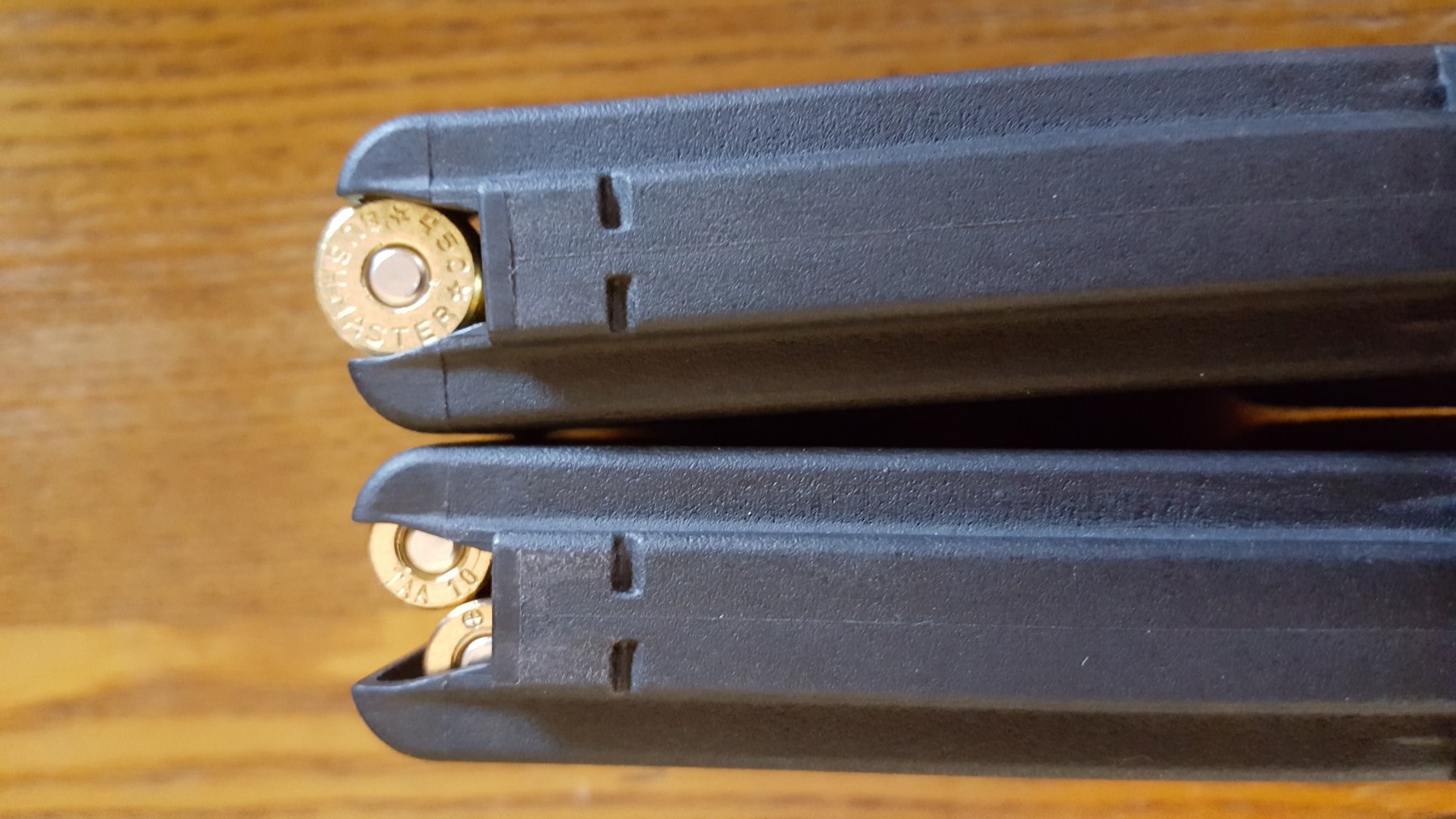
Magazine bodies yield roughly:1
Table 2 — Capacity, and the Michigan rule
| AR magazine body | .450 Bushmaster rounds |
|---|---|
| 10-round | 4 |
| 20-round | 5 to 7 |
| 30-round | 9 |
🔴 Volume 3 §3.4 is the reason to care. Michigan prohibits hunting deer with a semi-automatic rifle holding more than six shells in barrel and magazine combined. A four-round magazine plus a chambered round is five — legal. A nine-round magazine plus a chambered round is ten — not legal to hunt with, and the Wildlife Conservation Order’s wording extends beyond hunting to possession afield.
The four-round magazine is therefore the correct magazine for this rifle’s actual job, and the fact that it is also the smallest is a coincidence that happens to resolve in the owner’s favour.
4.7 Feeding and Reliability
Beyond the magazine, three cartridge-specific things affect whether the rifle runs.
The round is short and fat and has almost no neck. There is very little case mouth gripping the bullet compared with a bottleneck cartridge. This matters for bullet setback — a round chambered repeatedly can have its bullet pushed deeper by the feed cycle, which raises pressure. Rounds that have been chambered and ejected repeatedly should not simply be cycled back through the rifle indefinitely, and a handloader must pay attention to crimp.
It headspaces on the case mouth (Volume 2 §2.3), which is unusual in a rifle and has direct consequences for a builder:
- Trim length is a headspace dimension, not a tidiness question. Over-trimmed brass headspaces long.
- A heavy roll crimp deforms the datum surface. A taper crimp, or a light crimp into a cannelure, is the conventional answer.
- The full method for measuring headspace rather than inferring it from gauges is in the Headspace dive, which is also where the argument about where different makers place their FIELD gauges lives.
Feed ramp geometry matters more than on a 5.56. A large blunt bullet has less margin to find its way into the chamber than a pointed small one.
4.8 4.7a The Parts Pool, and Why It Is Bigger Than It Looks
A cartridge with a brand name in it raises a reasonable worry about parts. In this case the worry is misplaced, and the reason is a dimension.
The .458 SOCOM shares the .450 Bushmaster’s .473-inch rim.3 That is why bolts are catalogued as “.450/.458” (§4.2), and it means the two cartridges — from different designers, different decades and different parent cases — draw on one bolt market rather than two. Add the .458 SOCOM’s own installed base to the .450 Bushmaster’s and the pool of makers with a reason to tool for that bolt face is substantially larger than either cartridge would justify alone.
The .50 Beowulf does not share it. Its rim is .445, matched to the 6.5mm Grendel.4 A .50 Beowulf builder is in a separate and smaller parts market — which is worth knowing when comparing the three (Volume 6 §6.4).
Everything below the upper receiver is an AR-15 parts market of essentially unlimited depth, which is the whole benefit of the platform.
4.9 4.7b Muzzle Devices, Threads and Suppressors
⚠ This dive publishes no muzzle thread specification for the .450 Bushmaster, and the omission is deliberate.
Thread pitch on .450 Bushmaster barrels is not standardised by SAAMI — the standard specifies the cartridge and the chamber, and marks even the rifling OPTIONAL (Volume 2 §2.6). Barrel makers choose their own muzzle threads, and more than one pattern is in circulation for this cartridge. No manufacturer documentation stating the thread on the barrel fitted to the rifle documented here was read, and the owner’s record does not state it.
🔴 A wrong thread specification is the kind of error that destroys a suppressor and possibly a shooter, so the only correct advice is the boring one: measure the barrel’s threads, or get the specification from the barrel maker in writing, before ordering anything that screws onto the muzzle. Do not infer it from a forum post about a different maker’s barrel.
On suppressors generally, three of this hub’s dives own the subject and this volume defers to them rather than summarising badly:
- How Suppressors Work for the mechanism.
- Suppressor Law for the NFA framework.
- Suppressors by Caliber for how a given bore rates.
What can be said here is that a suppressor must be rated for the bore diameter and the pressure, that a .452 bullet through an undersized can is a baffle strike, and that the .450 Bushmaster’s low pressure and large bore are, in principle, favourable characteristics — the same reasoning the .45-70 Government dive develops at length for a cartridge of similar shape.
4.10 4.7c Troubleshooting
The failures a .450 Bushmaster build actually produces, and where to look first. Change one thing at a time — the commonest way to make a cycling problem unsolvable is to alter gas and buffer together.
Table 3 — 4.7c Troubleshooting
| Symptom | First suspect | Then |
|---|---|---|
| Bolt does not lock back on empty | Undergassed, or follower not lifting correctly | Gas port / block; then the magazine follower |
| Failure to feed, round nosed into the ramp | Magazine follower (§4.6) | Magazine body, then feed ramp geometry |
| Round tips or jams sideways | Follower or feed lips | Magazine body |
| Brass thrown far forward, harsh impulse | Overgassed | Adjustable gas block, then heavier buffer |
| Failure to extract, case left in chamber | Dirty chamber, or extraction while pressure is high | Clean chamber; then check gas |
| Case mouth damage on ejection | Overgassed, violent ejection | Gas first — and note the mouth is the headspace datum (§4.7) |
| Bolt will not close on a handload | Case too long — mouth headspacing | Trim length, then crimp |
| Groups open up suddenly | Loose optic mount or barrel nut | Torque check before anything else |
⭐ Two entries in that table are cartridge-specific rather than generic AR problems, and both trace to the same fact: this cartridge stops on its case mouth. A long case will not chamber, and a damaged mouth is a damaged datum. Neither has an equivalent on a 5.56 build.
4.11 4.7d First Range Trip
A deliberate first outing is worth more on a big-bore build than on a 5.56, because the failure modes are less familiar and the ammunition costs $2.00 to $4.00 a round (Volume 6 §6.3).
- Check torque on everything before firing — barrel nut, gas block, optic mount, stock.
- Verify headspace, or have it verified. See the Headspace dive.
- Single-load the first rounds rather than feeding from the magazine, to separate a chambering problem from a feeding problem.
- Then feed from the magazine, one round at a time, then a full magazine.
- Watch the brass — where it lands and how hard it is thrown is the cheapest gas diagnostic available.
- Inspect fired cases for mouth damage, head marks and extractor marks.
- Only then zero (Volume 5 §5.10).
4.12 What a Builder Must Check
The short list, in order of consequence:
- The bolt is a .450/.458 bolt. Not a 5.56 bolt. This is the one that cannot be discovered later.
- Headspace. It is a mouth-headspacing cartridge in a self-loading action; check it, and see the Headspace dive for how to get a number rather than a pass/fail.
- The magazine has the correct follower. A .450 magazine body with a standard AR follower is a rifle that will jam.
- The magazine capacity suits the intended use — five in the rifle for Michigan deer hunting, and the magazine is what decides it.
- Function-fire before hunting with it, across the full magazine, from a cold rifle, with the ammunition intended for use.
- Confirm cycling behaviour and adjust gas or buffer, not both at once.
- Chronograph the rifle and write the numbers down. The barrel is confirmed at 16 inches (Volume 1 §1.8), which is shorter than every barrel the published figures were measured in, and no velocity-loss-per-inch figure for this cartridge exists — so what this rifle actually does cannot be derived from print.
4.13 References (Vol 4)
Footnotes
-
Magazine capacity per magazine-body size as cited in .450 Bushmaster, Wikipedia. Not measured for this dive. The four-round figure agrees with the owner’s own record of the magazines in use. ↩ ↩2
-
Tromix Lead Delivery Systems, company site, “About Us,” read 17 September 2026. The company’s own account of its history and of Tony Rumore’s role in large-bore AR-15 development. ↩
-
.458 SOCOM, Wikipedia, for the .473 rim dimension shared with the .450 Bushmaster. ↩
-
.50 Beowulf, Wikipedia, for the .445 rim matched to the 6.5mm Grendel. ↩
Comments (0)