.450 Bushmaster AR-15 · Volume 1
Why the .450 Bushmaster Exists
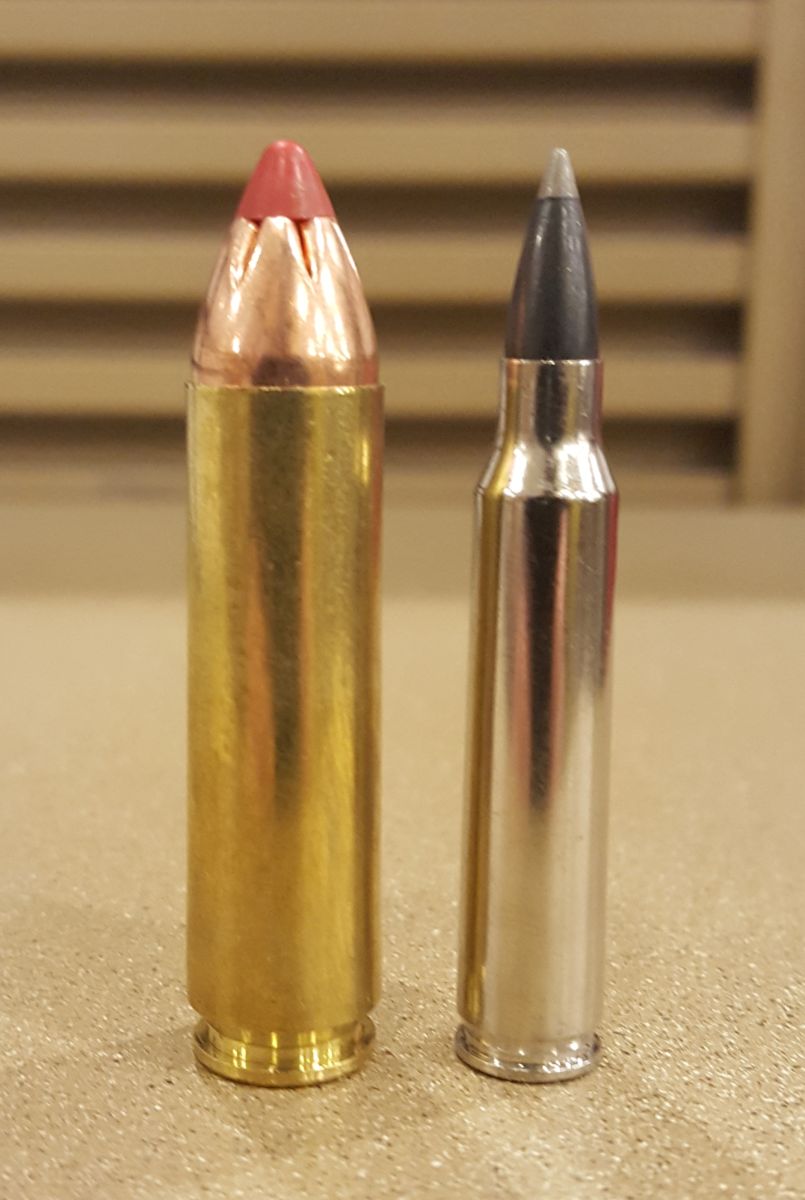
The .450 Bushmaster is the answer to a question a retired Marine lieutenant colonel asked in the 1980s, engineered by a small Michigan shop in the early 2000s, shortened by an ammunition company in 2007 to fit a bullet it already made, and then sold three times in fifteen years as its owners went bankrupt around it.
None of that is why most of them were bought. The great majority of .450 Bushmaster rifles in the United States were bought because of a state hunting regulation, and in Michigan — where the rifle documented in these volumes lives — that regulation no longer exists. Volume 3 is about that, and it is the most consequential thing in this dive.
This volume is about where the cartridge came from and what problem it was actually built to solve, because the popular version of the story is compressed to the point of being wrong in three separate places.
1.1 What These Six Volumes Argue
Six volumes, and four claims run through all of them.
The cartridge is a good engineering answer to a genuinely hard problem. Putting a half-inch-diameter case into an AR-15 without redesigning the AR-15 is not trivial, and the solution — a rebated rim and a single-column magazine — is elegant rather than crude. Volume 2 has the geometry.
It is a 200-yard cartridge, and the dive shows the arithmetic rather than asserting it. Every trajectory and energy figure in these volumes comes from a ballistic model fitted to a manufacturer’s own published table, and the fit is stated so it can be checked. Volume 5.
🔴 The regulatory reason it became popular has been repealed in Michigan, and nearly every article online is stale on exactly this point. Volume 3 quotes both the old rule and the new one from primary sources.
What the change does not do is make the rifle useless, and the reasoning there is more interesting than either the enthusiast or the sceptic position. Also Volume 3, and Volume 6.
1.2 The Thumper Idea
The lineage starts with Jeff Cooper, and specifically with his dissatisfaction with the 5.56×45mm cartridge in the AR-15.
Cooper’s objection was not that the 5.56 did not work. It was that it was the wrong tool for a particular job: a fast, small-diameter bullet optimised for a military requirement, being asked to do the work of a hunting cartridge. What he proposed instead was what he called the Thumper — a large-bore cartridge, .44 calibre or greater, in a semi-automatic rifle, intended to produce one-shot kills on big game out to roughly 250 yards.1
Three parts of that specification matter, and they are all constraints rather than aspirations:
- Large bore. A wide bullet makes a wide hole, and a wide hole does not depend on velocity to be effective.
- Semi-automatic. This is the part that makes it hard. A rimmed, straight-walled big-bore cartridge is easy to build; making one cycle reliably through a magazine-fed autoloader is not.
- 250 yards. A modest distance, deliberately. Cooper was not asking for a flat-shooting cartridge, and the concept does not pretend to be one.
The Thumper was a concept, not a product. Cooper did not design the .450 Bushmaster and never made a cartridge himself. What he did was describe a specification clearly enough that other people built to it — and several did. The .458 SOCOM and the .50 Beowulf come out of the same intellectual territory, and none of the three is a descendant of the others.
1.3 Tim LeGendre and the .45 Professional
The cartridge that became the .450 Bushmaster was designed by Tim LeGendre of LeMag Firearms, and its original name was the .45 Professional.1
LeGendre built to Cooper’s brief directly. In the early 2000s he developed the .45 Professional and — this is the detail that ties the lineage together rather than merely asserting it — built an AR-10 chambered in .45 Professional and delivered it to Cooper.2
The choice of platform is the thing to notice. The .45 Professional in its original form was an AR-10 cartridge, not an AR-15 cartridge. Its case was 1.772 inches long with an overall length of 2.362 inches — dimensions that suit the larger receiver.1
That single fact reframes the whole history. The cartridge was not originally designed to fit an AR-15. It was designed to do the job properly, in whatever rifle would hold it, and the AR-15 compatibility that defines it today was a later compromise made by somebody else for a commercial reason.
1.4 The 2007 Shortening, and Who Actually Decided It
In 2007 Bushmaster Firearms International acquired the .45 Professional concept from LeGendre and approached Hornady to manufacture the ammunition.1
Hornady then asked for a change, and the reason is refreshingly unromantic. Hornady wanted the case and overall length shortened to suit a bullet it already made — its .452-inch, 250-grain pointed SST flex-tip. The .452 diameter was attractive because it was already in wide use across the .45 Colt, .45 ACP, .454 Casull and .460 S&W Magnum, and the 250-grain SST was already selling into the .454 and .460.1
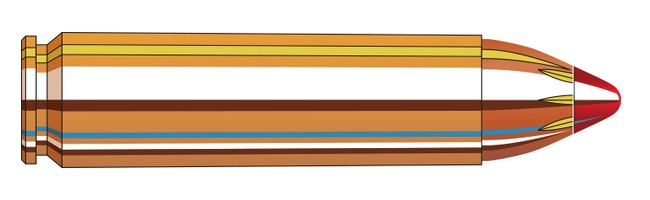
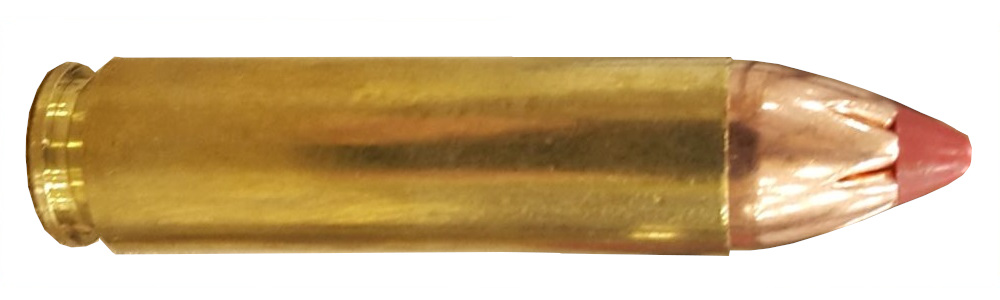
Bushmaster and LeGendre approved the change. The case went from 1.772 inches to 1.700, the overall length from 2.362 inches to 2.260, and the name from .45 Professional to .450 Bushmaster.3
⭐ The consequence of that shortening is the entire commercial history of the cartridge. The shorter round fits the AR-15, which is the abundant and popular platform, rather than the AR-10, which is neither. A cartridge designed for the larger rifle became a cartridge for the smaller one because an ammunition maker wanted to use an existing bullet — and that accident of component inventory is why there are hundreds of thousands of .450 Bushmaster AR-15s and essentially no .45 Professional AR-10s.
The bullet chose the cartridge, not the other way round. It is worth keeping in mind through Volume 2, because several of the cartridge’s characteristics that get explained as deliberate design decisions are better explained as consequences of that one commercial constraint.
1.5 ⚠ Two Dates That Do Not Agree
The standard account of the ownership history contains an internal contradiction, and this dive prints it rather than smoothing it over.
The same reference source states that Bushmaster was “sold the .45 Professional concept in 2007,” and also that “in 2006 the rights to the .450 Bushmaster were sold to Cerberus Capital Management.”1 Those two statements cannot both be straightforwardly true as written, since the second describes the sale of rights to a cartridge that the first says was not acquired, renamed or standardised until the following year.
The likely reconciliation is that the 2006 transaction was Cerberus acquiring Bushmaster the company — Bushmaster was folded into what became the Freedom Group, alongside Remington, Marlin and Advanced Armament Corporation — rather than a separate sale of cartridge rights. That reading is an inference and it is not what the source says. No primary document establishing either date was located for this dive, and the question is left open.
What is better supported is the later chain. Following Remington’s 2020 bankruptcy, the company’s assets were broken up and sold, and the .450 Bushmaster along with its parent company was purchased by Franklin Armory, of Nevada, in 2021.1 Bushmaster Firearms was again manufacturing rifles chambered in .450 as of 2022.1
⭐ A useful corrective sits in that paragraph. The cartridge has outlived the bankruptcy of the company it is named after. A buyer does not depend on Bushmaster for ammunition and never really did — Hornady made it from the beginning, and Volume 6 shows a factory field that now includes Federal, Remington and Winchester. The brand on the headstamp is not the supply chain.
1.6 ⚠ The Dates SAAMI Implies
One more chronological wrinkle, and this one comes from a primary document.
The commonly published production date for the .450 Bushmaster is 2009–present.4 But the SAAMI standard velocity and pressure test barrel drawing for the cartridge is marked “Issued: 09/09/2007, Revised: 02/01/2008,” and the cartridge and chamber drawing is marked “ISSUED 02/01/2008.”5
An industry standards body does not issue a test barrel drawing for a cartridge that does not exist. The cartridge was therefore standardised in 2007–2008, a year or more before the commonly cited production date. Both figures can be correct if “2009” refers to volume commercial production rather than to the cartridge’s existence, but the dive uses the SAAMI dates where a date matters, because they are printed on a dated engineering document rather than reported.
1.7 1.6a What Else the Thumper Idea Produced
The .450 Bushmaster is not the only answer to Cooper’s brief, and placing it beside its siblings explains what is distinctive about it.
The .458 SOCOM came out of the same dissatisfaction with the 5.56 and arrived earlier — Tromix’s own account dates its launch to 2001, and the company describes its founder Tony Rumore as working on large-bore AR-15 platforms from 1999.6 It is a rebated bottleneck case taking a .458-inch bullet.
The .50 Beowulf was developed by Bill Alexander of Alexander Arms, also in 2001: a rebated straight case with a .500-inch bullet.7
⭐ All three use a rebated rim, and that is not a coincidence — it is the only way to solve the problem. A large-diameter case has to present a bolt-sized rim to an AR-15, so every successful big-bore AR cartridge rebates. What differs is which standard rim they rebate to: the .450 Bushmaster and .458 SOCOM both use .473, the .308 family rim, and therefore share bolts; the .50 Beowulf uses .445, matched to the 6.5mm Grendel, and does not.
The .450 Bushmaster arrived last of the three and is the one that went mainstream. Volume 6 §6.4 argues why: the .452 bullet diameter it inherited from Hornady’s parts bin gives it the deepest component pool of any of them, and four major manufacturers now load it.
1.8 1.6b Who Makes Rifles and Ammunition For It
A cartridge’s health is measured in catalogue entries, and the .450 Bushmaster’s are unusually broad for a proprietary-origin round.
Rifles. Beyond AR-15 uppers, the cartridge is chambered in bolt-action rifles by Ruger, Savage, Mossberg and Remington; in the Ruger No. 1 single shot; in Ruger’s AR-556 MPR; and in Franklin Armory’s XO-26 with its binary trigger.8 Bushmaster itself resumed making .450 rifles as of 2022.
Ammunition. As of 2025, Ammo Inc., Federal, Hornady, Remington and Winchester all manufacture .450 Bushmaster, and Starline makes empty brass for handloaders.8 Volume 2 §2.7 has the loads and Volume 6 §6.3 has the prices.
⭐ That breadth is the practical answer to the most common worry about a cartridge with a brand name in it — that it will be orphaned when its owner changes hands. It has now changed hands at least twice, through one bankruptcy, and the catalogue has grown rather than shrunk.
⚠ The parent case is usually given as the .284 Winchester.8 This is the standard attribution and it is repeated here as such, but it was not confirmed against any primary document, and the relationship is in any case ancestral rather than practical — no one forms .450 Bushmaster brass from .284 Winchester cases.
1.9 The Problem It Had To Solve
Strip the history away and one engineering problem defines the cartridge. Volume 2 works it in detail; it is stated here because it is the reason the design looks the way it does.
An AR-15 is built around the 5.56×45mm. The magazine well, the magazine, the bolt, the barrel extension and the receiver were dimensioned for a cartridge with a .378-inch case head that sits in two staggered columns.
A cartridge that will kill a deer at 200 yards with a .452-inch bullet needs a case around .500 inch across the body. That is a third again as wide.
Two things therefore have to give, and the design gives on both:
The rim is rebated. The case body is .500, but the rim is turned down to .473 — which is not an arbitrary number. It is the rim diameter of the .308 Winchester and the .30-06. The rebate exists so that the bolt face, while not a standard AR-15 bolt face, is at least a standard size that the industry already tools for. Volume 2 has the dimensions off the SAAMI drawing, and Volume 4 covers what this means for a builder — beginning with the fact that the rifle needs its own bolt, and a 5.56 bolt will not do.
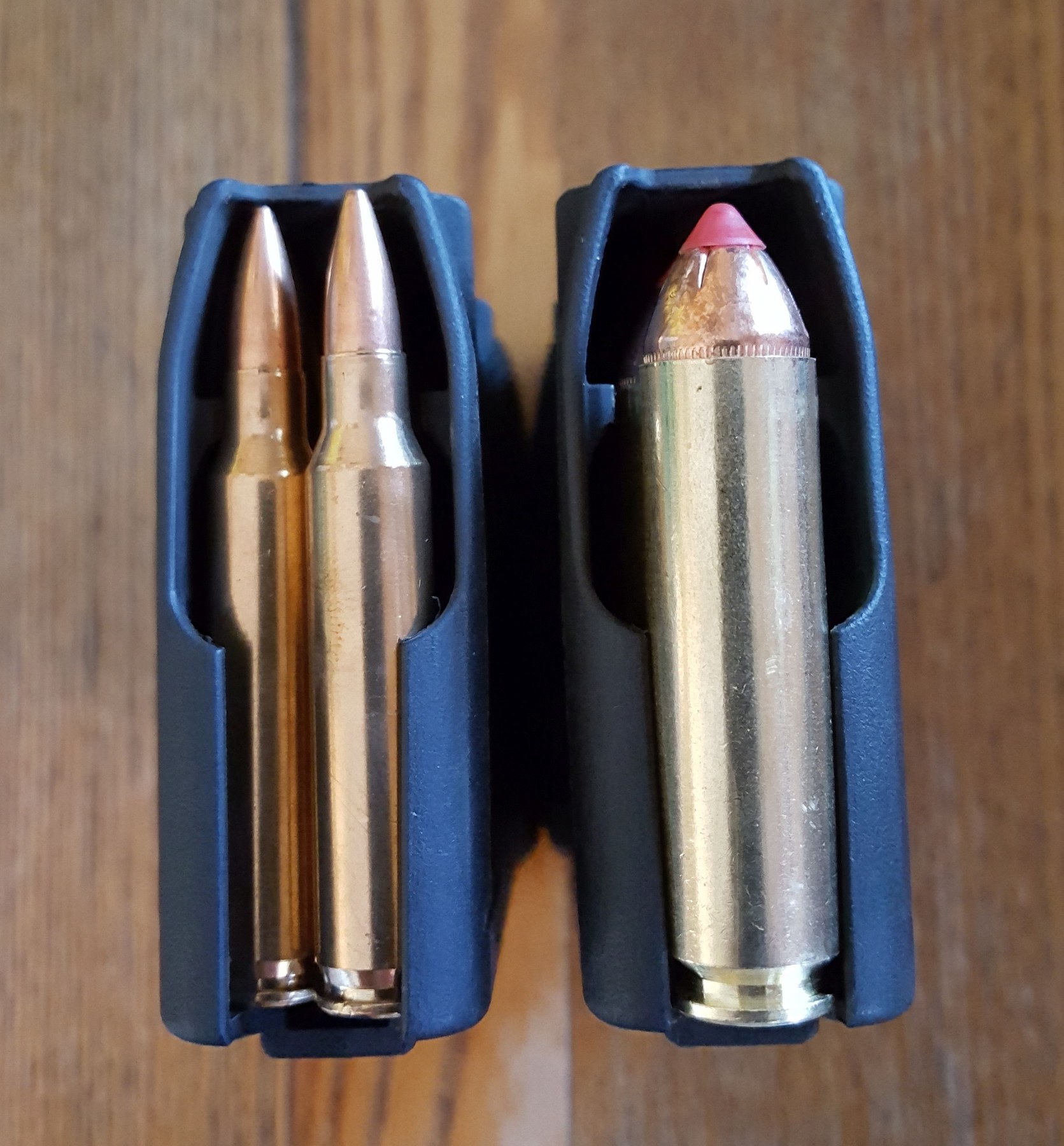
The magazine goes to a single column. A .500-inch case body will not stagger inside an AR-15 magazine well. The rounds stack in one vertical column, which is why a magazine body that holds thirty rounds of 5.56 holds roughly nine rounds of .450, a twenty-round body holds five to seven, and a ten-round body holds four.9 The rifle documented here runs Lancer four-round magazines fitted with Tromix followers, and Volume 4 explains why the follower is not an optional refinement.
1.10 The Rifle Documented Here
These volumes are written against a specific rifle: a home-built AR-15 in .450 Bushmaster assembled on a Black Rain Ordnance lower.
Its configuration, as recorded by its owner:
Table 1 — Its configuration, as recorded by its owner
| Lower | Black Rain Ordnance |
| Upper | Aero |
| Barrel | Bear Creek Arsenal .450 Bushmaster, 4150 chrome-moly vanadium, parkerized, heavy profile, 1:24 twist |
| Bolt carrier group | Black nitride .450/.458 BCG, MPI-marked bolt |
| Handguard | 15-inch M-LOK free-float rail |
| Stock | Luth-AR MBA-3 with cheek riser |
| Recoil pad | Luth-AR 3-axis, soft 35 durometer |
| Trigger | RISE Armament RAVE 140 drop-in |
| Bipod | Harris, M-LOK |
| Optic | Vector Optics Paragon 3-15×50, 30 mm tube |
| Optic mount | Primary Arms offset mount |
| Magazines | Lancer four-round |
| Followers | Tromix — recorded as “must use” |
| Ammunition | Hornady .450 Bushmaster 250 gr FTX |
⭐ The barrel is 16 inches, confirmed by the owner on 17 September 2026. An earlier record listed the rifle as an 18-inch build while the barrel line in the same notes named a 16-inch Bear Creek Arsenal barrel; the barrel line was correct. 🔴 The consequence is worth stating plainly: 16 inches is four inches shorter than the 20-inch barrel Hornady publish their figures from, and eight shorter than SAAMI’s 24-inch test barrel. Every published velocity for this cartridge therefore overstates what this rifle does, and by how much is not recorded anywhere — no velocity-loss-per-inch figure for .450 Bushmaster could be verified (Volume 5 §5.5).
1.11 The Twist Rate Is Not an Accident
One detail of that configuration is worth flagging in Volume 1 because it is a point where the owner’s rifle and the published standard agree exactly.
The barrel is 1:24. SAAMI’s own velocity and pressure test barrel for the .450 Bushmaster specifies a twist rate of 24 inches, right hand.5 The commercial barrel and the standard’s reference barrel are the same.
That is a very slow twist by modern rifle standards, and Volume 2 explains why it is correct here rather than lazy: a short, wide, heavy bullet needs far less rotational speed to stabilise than a long thin one, and the governing relationship depends on bullet length relative to diameter, not on weight.
On the SAAMI drawing the twist is marked OPTIONAL, which is a distinction Volume 2 takes seriously — the standard specifies the chamber and the cartridge, and treats rifling as the barrel maker’s business.
1.12 What This Dive Is Not
Two boundaries, stated so that later volumes do not have to keep apologising.
It is not a reloading manual. Volume 6 covers brass, component availability and the economics of handloading the cartridge, and it names no powder charges. Published load data belongs to the people who pressure-tested it.
It does not re-derive the .45-70. The comparison in Volume 6 is real and the .450 Bushmaster comes off well in parts of it, but the .45-70 Government dive owns that cartridge — its pressure tiers, its 24-inch barrel problem and its terminal behaviour — and this dive links to it rather than restating it.
1.13 Reading Order
Volume 2 is the cartridge: the SAAMI drawing read off the page, the rebated rim, the twist, the factory field and the ballistics, computed and checked against a manufacturer’s published table.
Volume 3 is the Michigan question, and it is the volume to read first if only one gets read. It is also the volume most likely to contradict something the reader already believes.
Volume 4 is building and feeding one — bolt, barrel, buffer, and the magazine problem in full.
Volume 5 is shooting it — recoil, optics, zero, and the honest limits of the accuracy claims available.
Volume 6 is owning one — maintenance, brass, what ammunition costs, and how it compares with the .350 Legend, the .400 Legend, a slug gun and a .45-70.
1.14 References (Vol 1)
Footnotes
-
.450 Bushmaster, Wikipedia, citing Philip Massaro, “Behind the Bullet: .450 Bushmaster,” American Hunter, National Rifle Association, 16 November 2022. Source of the Thumper lineage, the LeGendre attribution, the 2007 Bushmaster/Hornady sequence, the Cerberus and Franklin Armory transactions, and the .452-bullet rationale. ↩ ↩2 ↩3 ↩4 ↩5 ↩6 ↩7 ↩8
-
The delivery of an AR-10 in .45 Professional to Cooper is attributed in the same article. No primary correspondence was located for this dive. ↩
-
The 1.772 in / 2.362 in original dimensions and the change to 1.700 in / 2.260 in are as reported in the sources at 1. The post-change figures agree exactly with the SAAMI drawing at 5; the pre-change figures could not be checked against any standards document, since the .45 Professional was never SAAMI-standardised. ↩
-
“Bushmaster firearms reintroduces the 450 bushmaster Rifle,” GUNSweek.com, 30 October 2021, cited for the 2009–present production date. ↩
-
ANSI/SAAMI Z299.4, Centerfire Rifle — Voluntary Performance Standards. Cartridge and chamber drawing, 450 Bushmaster, printed page 147, issued 02/01/2008; standard velocity and pressure test barrel, 450 Bushmaster, printed page 343, issued 09/09/2007, revised 02/01/2008. Read from the page images, not from the PDF text layer. ↩ ↩2 ↩3
-
Tromix Lead Delivery Systems, company site, “About Us,” read 17 September 2026, for the 1999 and 2001 dates and the company’s own account of its role in large-bore AR-15 development. ↩
-
.50 Beowulf, Wikipedia. Designer, 2001 date, rebated straight case, .500 bullet and the .445 rim matched to the 6.5mm Grendel. ↩
-
.450 Bushmaster, Wikipedia, for the list of rifles chambered, the 2025 list of ammunition manufacturers, the Starline brass attribution, and the .284 Winchester parent-case attribution. ↩ ↩2 ↩3
-
Magazine capacity figures per magazine-body size are as cited in the source at 1. They were not measured for this dive. The four-round figure for a ten-round body matches the Lancer magazines the rifle documented here uses. ↩
Comments (0)