.450 Bushmaster AR-15 · Volume 2
The Cartridge — What SAAMI Specifies, and How Far It Actually Reaches
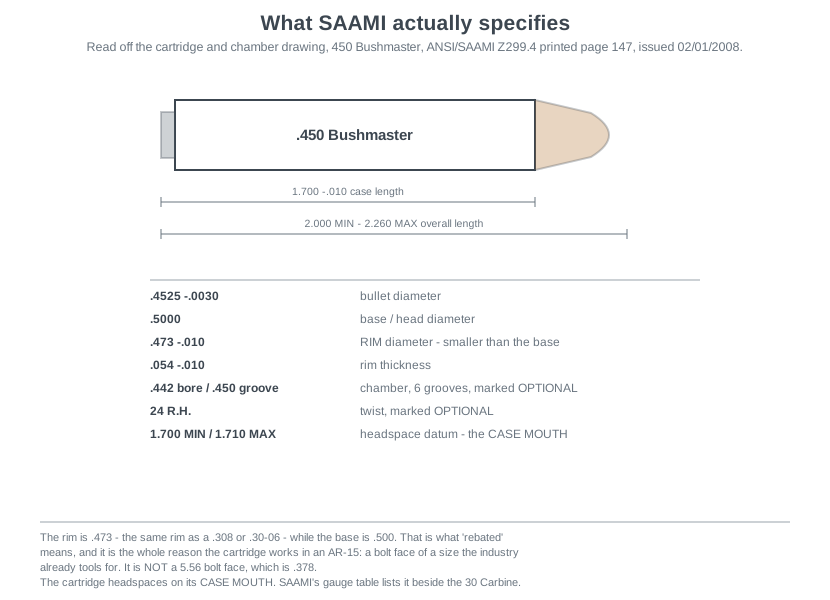
Most of what circulates about the .450 Bushmaster is downstream of somebody else’s summary, and two of the most-repeated numbers in those summaries do not match the standard. The specification is a published engineering document, and this volume reads the numbers off the drawing.
The dive holds a copy of ANSI/SAAMI Z299.4, the centerfire rifle voluntary performance standard. The .450 Bushmaster cartridge and chamber drawing is printed page 147; its velocity and pressure test barrel is printed page 343. Both were read from the page images, not from the PDF text layer — a scanned or vector drawing’s text layer routinely mangles decimals, and every figure below was taken off the picture.
2.1 The Dimensions
From the cartridge and chamber drawing, issued 02/01/2008:
Table 1 — From the cartridge and chamber drawing, issued 02/01/2008
| Dimension | Value (in / mm) |
|---|---|
| Bullet diameter | .4525 −.0030 (11.494 −0.076) |
| Case mouth | .4820 (12.243); .4800 △ (12.192) |
| Base / head diameter | .5000 (12.700) |
| Rim diameter | .473 −.010 (12.01 −0.25) |
| Rim thickness | .054 −.010 (1.37 −0.25) |
| Extractor groove diameter | .409 −.010 (10.39 −0.25) |
| Rim bevel | 45° ±10′ |
| Case length | 1.700 −.010 (43.18 −0.25) |
| Cartridge overall length | 2.000 MIN / 2.260 MAX (50.80 / 57.40) |
| Bore diameter | .442 (11.23) |
| Groove diameter | .450 (11.43) |
| Leade angle | 2° 30′ |
| Chamber headspace | 1.700 MIN / 1.710 MAX |
| Grooves (marked OPTIONAL) | 6, .1480 +.0020 wide |
| Twist (marked OPTIONAL) | 24 (609.6) R.H. |
| Minimum bore and groove area | .1570 sq in (101.290 mm²) |
Two of those are worth stopping on.
The bullet is .4525, and the groove is .450. That is the usual two-and-a-half thousandths of interference that makes a gas seal. It also means the cartridge uses the .452-inch handgun bullet family — the same diameter as the .45 Colt, .45 ACP, .454 Casull and .460 S&W Magnum — which is exactly why Hornady wanted the case shortened around it (Volume 1 §1.4). It is not a .458 cartridge, and this is the most common confusion in the big-bore AR space: the .458 SOCOM and the .45-70 use .458 bullets, the .450 Bushmaster does not.
⭐ The reason for that choice is a terminal-performance argument, not a manufacturing one. The heavier-jacketed .458-inch bullets are built for cartridges that drive them faster; at the .450 Bushmaster’s impact velocities they would not expand adequately.1 The cartridge picked the smaller bullet because the smaller bullet opens up at the speeds this cartridge actually produces.
The overall length minimum is 2.000 inches, and the maximum 2.260. Published summaries almost always quote only the 2.260 figure. The minimum matters to anyone seating bullets, and the 260-inch span between them is generous by rifle standards because the case has very little neck.
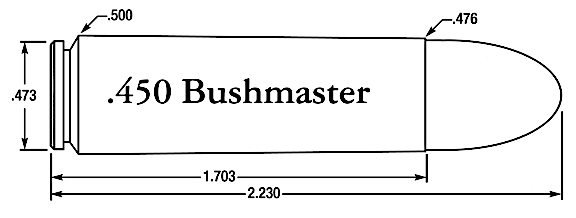
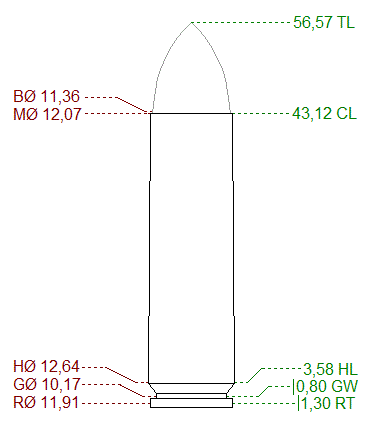
⚠ Two drawings in wide circulation disagree with the standard. The dimensioned illustrations reproduced below — both of which circulate freely and both of which are used in this dive — give a case length of 1.703 and an overall length of 2.230. SAAMI specify 1.700 −.010 and 2.000 MIN / 2.260 MAX. The circulating drawings are loading-manual and reference-site illustrations, not the standard, and where they differ the standard is what a chamber is cut to.
2.2 The Rebated Rim, and Why It Is the Whole Design
The case body is .500. The rim is .473. A rim smaller than the body is a rebated rim, and it is the single decision that makes the cartridge possible.
The number .473 is not arbitrary. It is the rim diameter of the .308 Winchester and the .30-06 Springfield — the most common large-rifle case head in the world. Turning the rim down to a dimension the industry already tools for means the bolt, while not an AR-15 bolt, is at least a conventional size rather than a bespoke one.
🔴 What this does not mean is that a .450 Bushmaster drops into an existing AR-15. A standard AR-15 bolt is cut for the 5.56×45’s .378 case head. The .450’s .473 rim is nearly a tenth of an inch larger. The rifle needs its own bolt — the rifle documented here uses a .450/.458 bolt carrier group with an MPI-marked bolt — and Volume 4 treats this as the first hard requirement of a build, because it is the one that a parts-bin assembly gets wrong.
The rebate does one more thing that is easy to miss: it preserves the extractor and ejector geometry. The extractor claw grips a rim of a size the AR’s extractor design already understands. A straight .500 case head would have needed a larger bolt body than the AR-15’s barrel extension and upper receiver comfortably allow.
2.3 It Headspaces on the Case Mouth
The ⊗ symbol on a SAAMI drawing marks the headspace dimension. On the .450 Bushmaster it sits on the chamber length: 1.700 MIN / 1.710 MAX.
That is the case mouth. The cartridge is not rimmed, so it cannot headspace on the rim like a .45-70; it has no shoulder, so it cannot headspace on a shoulder like a .308; and it has no belt. What stops it going further into the chamber is the front edge of the case against a step in the chamber.
⭐ A detail from the standard that settles the point. SAAMI’s headspace gauge table lists the .450 Bushmaster in the same block as the .30 Carbine, with the same .2000 basic datum construction and an F dimension of 1.7000 MIN / 1.7100 MAX.2 The .30 Carbine is the other mouth-headspacing straight-wall in the centerfire rifle standard. The two cartridges have almost nothing else in common and share a headspacing principle.
Three practical consequences follow, and Volume 4 acts on all three:
- Case length is the headspace dimension. Unlike a bottleneck cartridge, where trimming affects chambering and crimp but not headspace, trimming a .450 Bushmaster case changes where it stops. Over-trimmed brass headspaces long.
- A heavy roll crimp into a cannelure is not free. Anything that deforms the mouth is deforming the datum surface.
- The full treatment of what a headspace number means, and how to measure one rather than infer it from gauges, is in the Headspace dive. This is only where the .450’s datum lives.
2.4 Pressure
From the transducer velocity and pressure table:3
Table 2 — 2.4 Pressure
| 250 gr | 260 gr | |
|---|---|---|
| Maximum average pressure (MAP) | 38,500 psi | 38,500 psi |
| Maximum probable lot mean (MPLM) | 39,500 psi | 39,500 psi |
| Maximum probable sample mean (MPSM) | 41,000 psi | 41,000 psi |
| Nominal velocity, instrumental at 15 ft | 2,250 fps | 2,150 fps |
Crusher pressures are not established for this cartridge — the standard says so explicitly, in place of a number. It is a transducer-only cartridge, which is unsurprising for one standardised in 2007.
For scale: 38,500 psi is a modest working pressure. The .350 Legend runs 55,000 psi and the .400 Legend 45,000 psi, both from the same kind of straight-walled case in the same rifle.4 The .450 Bushmaster gets its effect from bullet diameter and mass, not from pressure — which is a large part of why the cartridge is pleasant to a bolt, an extractor and a barrel, and why brass life is generally good (Volume 6).
2.5 🔴 The Test Barrel Is 24 Inches, and Almost Nobody’s Box Is
SAAMI’s standard velocity and pressure test barrel for the .450 Bushmaster is 24.000 ± .010 inches, six grooves, 1:24 right hand, issued 09/09/2007 and revised 02/01/2008.5 The nominal velocities in §2.4 are 24-inch numbers.
Hornady publish item 82246 from a 20-inch barrel, and say so plainly on the product page.6
Federal and Remington publish .450 Bushmaster velocities without stating a barrel length at all.78
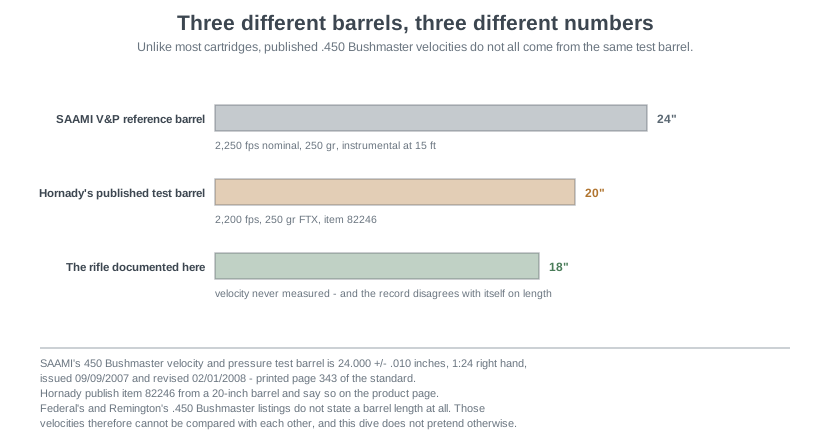
🔴 This is the correction that matters most for reading any .450 Bushmaster comparison. For a cartridge like the .45-70, every published velocity traces to SAAMI’s 24-inch reference barrel, so box figures are at least comparable with each other even when they are optimistic for a carbine. For the .450 Bushmaster they are not comparable, because the makers are not all measuring the same way and two of them do not say what they did.
⚠ What could not be verified, and it is not trivial: no primary or well-controlled source was located giving a velocity loss per inch for the .450 Bushmaster. The figure is widely asserted in the 20-to-30 fps per inch range in forum and vendor writing; none of it traces to a documented test. This dive therefore publishes no fps-per-inch number, and Volume 5 handles the rifle’s real barrel by showing what a range of muzzle velocities does to the answer rather than by pretending to know the velocity.
2.6 The Twist Is Slow, and That Is Correct
1:24 is a very slow twist. A .223 runs 1:7 to 1:9; a .308 typically 1:10 to 1:12. The .450 Bushmaster turns the bullet once in two feet, and the rifle documented here has exactly that twist in a Bear Creek Arsenal barrel.
The reason is that gyroscopic stability depends on the bullet’s length in calibres, not on its weight. A 250-grain .452 bullet is short and fat. A 250-grain .224 bullet would be enormously long relative to its diameter and would need a fast twist to stabilise. The .450’s bullet is roughly two calibres long; it needs very little spin.
On the SAAMI drawing the twist and the groove count are both marked OPTIONAL, under a heading that groups them with the rifling dimensions. The standard specifies the chamber and the cartridge; rifling is the barrel maker’s business. This is the same posture the standard takes with the .45-70, where the .45-70 dive makes the same observation. In practice the industry has converged on 1:24 anyway.
2.7 The Factory Field
Every load available at the time of writing, as published by its own maker:
Table 3 — Every load available at the time of writing, as published by its own maker
| Load | Bullet | MV (fps) | BC (G1) | Muzzle energy | Price/20 |
|---|---|---|---|---|---|
| Hornady BLACK #82246 | 250 gr FTX | 2,200 (20 in) | — | 2,687 | — |
| Winchester Deer Season XP X450DS | 250 gr Extreme Point | 2,200 | .210 | 2,686 | — |
| Federal Fusion F450BMFS1 | 260 gr Fusion SP | 2,200 | .180 | 2,795 | $79.99 |
| Federal Power-Shok 450BMB | 300 gr SP | 1,900 | .225 | 2,405 | $71.99 |
| Federal American Eagle AE450BM | 260 gr FMJ-RN | 2,040 | .186 | 2,403 | $41.99 |
| Remington Premier AccuTip 27943 | 260 gr AccuTip | 2,180 | .144 | 2,744 | $69.99 |
| Remington Core-Lokt 27941 | 260 gr PSP Core-Lokt | 2,040 | .171 | 2,403 | $69.99 |
| Remington UMC 23661 | 260 gr FMJ | 2,040 | .186 | 2,403 | $41.99 |
Prices are the makers’ own listed prices as read on 17 September 2026 and are not a market survey.
⚠ One published figure in that table looks wrong and is printed as published. Remington’s AccuTip, a polymer-tipped hunting bullet, is listed at BC .144 — the lowest of every 260-grain load in the field, and lower than Remington’s own flat-based full metal jacket at .186. A tipped bullet having a worse ballistic coefficient than a plain FMJ of the same weight and diameter is not impossible, but it is unexpected enough to be worth flagging. It was not independently verified and may be a catalogue error. It is reproduced here because inventing a plausible number would be worse.
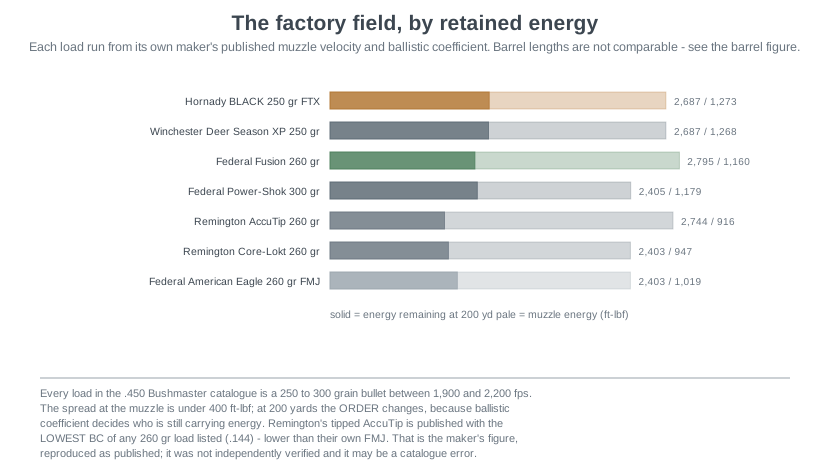
⚠ Hornady’s wider .450 Bushmaster range could not be confirmed. Only the BLACK 250 gr FTX product page (item 82246) could be read; the company’s ammunition listing is script-driven and other product URLs returned 404. No other Hornady .450 Bushmaster load is named in this dive, which is not the same as saying none exists.
⚠ No Barnes .450 Bushmaster load was located. A search of the maker’s own site returned no .450 Bushmaster product. The widely referenced “Barnes VOR-TX .450 Bushmaster 250 gr TSX” is not claimed here, because it could not be confirmed on the maker’s site.
2.8 The Ballistics, and How They Were Computed
Every trajectory and energy figure in this dive comes from a G1 drag model, and the calibration is stated so that it can be checked.
Hornady publish a four-point table for item 82246 from a 20-inch barrel: 2,200 / 1,835 / 1,515 / 1,255 fps at 0 / 100 / 200 / 300 yards, with energies of 2,687 / 1,868 / 1,274 / 874 ft-lbf.6
A G1 ballistic coefficient was fitted to that table. The best fit is BC = 0.2112, which reproduces Hornady’s three downrange velocities to 1.5 fps RMS:
Table 4 — A G1 ballistic coefficient was fitted to that table. The best fit is BC = 0.2112, which reproduces Hornady's three downrange velocities to 1.5 fps RMS
| Range | Hornady published | Model | Model energy | Hornady energy |
|---|---|---|---|---|
| 100 yd | 1,835 fps | 1,833 | 1,865 | 1,868 |
| 200 yd | 1,515 fps | 1,515 | 1,273 | 1,274 |
| 300 yd | 1,255 fps | 1,256 | 876 | 874 |
That agreement is close enough that the model can be trusted to interpolate between Hornady’s points and to re-zero their trajectory — which is what Volume 5 does. It is not evidence that the model predicts any other load, or this load from any other barrel. It reproduces one manufacturer’s published table for one product.
The fitted 0.2112 also sits sensibly beside Winchester’s published .210 for its own 250-grain Extreme Point at the same 2,200 fps, which is a mild independent check.
2.9 What the Numbers Say About Range
With the 250-grain FTX at its published 2,200 fps:
Table 5 — With the 250-grain FTX at its published 2,200 fps
| Range | Velocity | Energy |
|---|---|---|
| Muzzle | 2,199 | 2,685 |
| 50 yd | 2,010 | 2,244 |
| 100 yd | 1,833 | 1,865 |
| 150 yd | 1,667 | 1,543 |
| 200 yd | 1,514 | 1,273 |
| 250 yd | 1,377 | 1,052 |
| 300 yd | 1,256 | 876 |
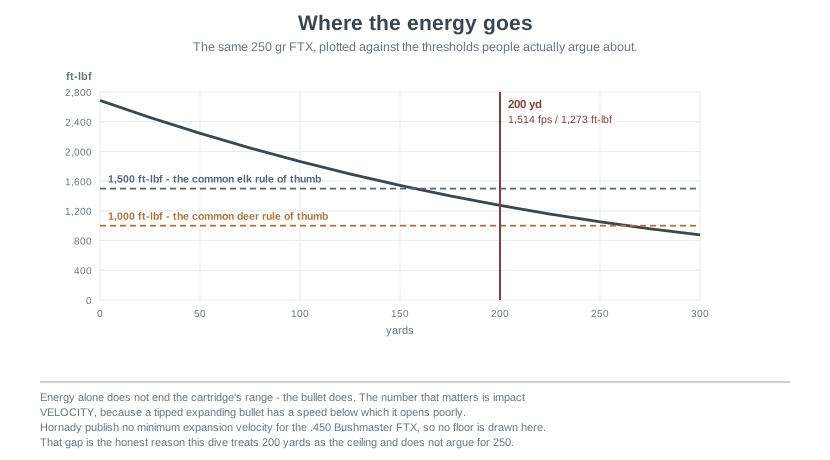
On the energy rules of thumb alone, this cartridge looks good well past 200 yards. It holds more than the commonly cited 1,000 ft-lbf deer threshold to about 260 yards, and it is still carrying 876 ft-lbf at 300.
🔴 Energy is the wrong test, and this is the most important analytical point in the volume. What ends a hunting cartridge’s useful range is not a number of foot-pounds; it is the impact velocity below which the bullet stops expanding reliably. A .452 bullet that fails to open is a .452 hole, which is not nothing — but it is not what the bullet was designed to do, and the terminal performance the cartridge is chosen for disappears.
⚠ Hornady publish no minimum expansion velocity for the .450 Bushmaster FTX, and none was located for the Winchester, Federal or Remington bullets either. No expansion floor is drawn on the energy figure and none is asserted in the prose. This is a real gap in the published record, not an omission of convenience.
What can be said honestly:
- Inside 200 yards the bullet arrives above 1,500 fps, which is comfortably within the working range of a tipped expanding hunting bullet.
- Past 250 yards it is under 1,400 fps and falling, and at 300 it is at 1,256 — approaching the speeds at which expansion becomes bullet-specific rather than assured.
- The trajectory argument in Volume 5 lands in the same place, independently. Past about 200 yards the drop steepens enough that a ranging error, not a terminal-performance question, becomes the thing that misses the deer.
⭐ Two unrelated limits agreeing at roughly the same distance is the strongest available argument for treating 200 yards as the working ceiling — and it is very close to the 250 yards Jeff Cooper specified for the Thumper concept in the first place (Volume 1 §1.2). The cartridge does what it was asked to do, and the honest version of the claim stops a little short of the brief.
2.10 Terminal Behaviour on Deer-Sized Game
What a .452-inch, 250-grain expanding bullet arriving at 1,800 to 2,000 fps does to a whitetail is not controversial, and the dive will not pretend to a precision the evidence does not support.
The mechanism is diameter and mass rather than velocity. The bullet starts wider than most rifle bullets end up after expansion, and it carries enough weight to keep going after it opens. At the ranges this cartridge is used at, the result is a large wound channel and, characteristically, good penetration with a high rate of pass-through.
That last point has a practical consequence worth stating: a bullet that exits takes its remaining energy with it, and leaves two holes. Hunters argue both sides of this — an exit wound is a better blood trail; retained energy is energy delivered. The .450 Bushmaster tends strongly toward the exit, and on deer-sized game inside 150 yards that is generally regarded as a feature.
⚠ No independent terminal-performance testing — gelatin, recovered-bullet weights, or measured expansion diameters — was located for any .450 Bushmaster factory load during this dive. Every terminal claim above is mechanism and general principle, not measurement. Anyone wanting numbers should treat that as an open question rather than assume the internet’s confident answers are sourced.
2.11 References (Vol 2)
Footnotes
-
.450 Bushmaster, Wikipedia, citing Philip Massaro, “Behind the Bullet: .450 Bushmaster,” American Hunter, 16 November 2022, for the .452-versus-.458 expansion rationale. ↩
-
ANSI/SAAMI Z299.4, Section II, headspace gauge dimension table. The .450 Bushmaster row: A .473, B .054, C .409, D .2000 basic, E1 .5009, E2 .4810, F 1.7000 MIN / 1.7100 MAX, listed beside the 30 Carbine. ↩
-
ANSI/SAAMI Z299.4, centerfire rifle velocity and pressure data — transducer, and velocity and pressure data — crusher. The crusher table prints “Crusher Pressures Not Established” for this cartridge. Transducer calibration range 20,000–45,000 psi in 5,000 psi increments. ↩
-
.350 Legend and .400 Legend, Wikipedia, both citing SAAMI, for the 55,000 psi and 45,000 psi maximum average pressures. ↩
-
ANSI/SAAMI Z299.4, standard velocity and pressure test barrel, 450 Bushmaster, printed page 343. Issued 09/09/2007, revised 02/01/2008. 24.000 ± .010 in; 6 grooves; .148 +.002 wide; twist 24 (609.6) R.H.; transducer diameter .250. ↩
-
Hornady Manufacturing, product page for 450 Bushmaster 250 gr FTX Hornady BLACK, item #82246, read 17 September 2026. Test barrel stated as 20 in; four-point velocity, energy and trajectory table. ↩ ↩2
-
Federal Ammunition, product search results for 450 Bushmaster (Power-Shok 450BMB, American Eagle AE450BM, Fusion F450BMFS1), read 17 September 2026. No test barrel length stated. ↩
-
Remington Ammunition, product search results for 450 Bushmaster (Core-Lokt 27941, UMC 23661, Premier AccuTip 27943), read 17 September 2026. No test barrel length stated. ↩
Comments (0)