.450 Bushmaster AR-15 · Volume 5
Shooting It — Recoil, Optics, Zero, and What the Accuracy Claims Are Worth
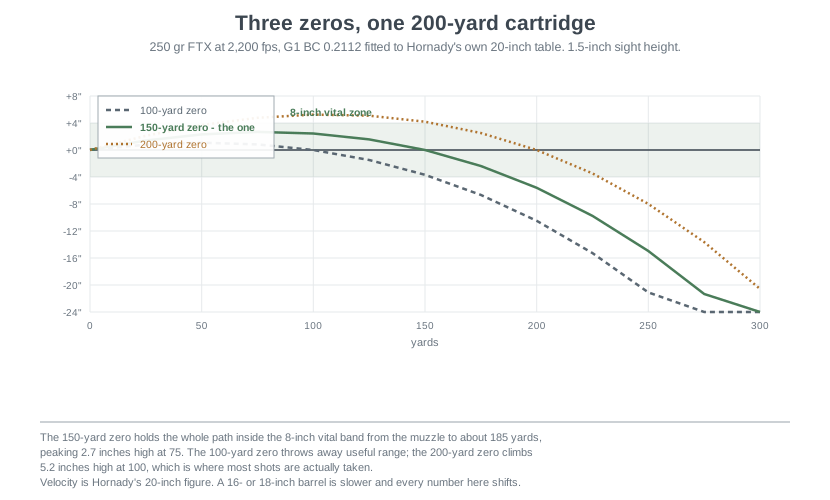
Volume 2 established that the .450 Bushmaster is a 200-yard cartridge. This volume is about hitting things inside that, and it contains one firm recommendation and one large honest gap.
5.1 🔴 Zero at 150
The reflex on a big slow cartridge is a 100-yard zero. For this load it wastes range, and the three tables show why. All figures come from the model described in Volume 2 §2.8, at Hornady’s published 2,200 fps, 1.5-inch sight height.
100-yard zero:
Table 1 — 100-yard zero:
| Range | Velocity | Energy | Path |
|---|---|---|---|
| 25 | 2,103 | 2,456 | +0.8” |
| 50 | 2,010 | 2,244 | +1.1” |
| 100 | 1,833 | 1,865 | 0.0 |
| 150 | 1,667 | 1,543 | −3.7” |
| 200 | 1,514 | 1,273 | −10.5” |
| 250 | 1,377 | 1,052 | −21.1” |
150-yard zero:
Table 2 — 150-yard zero:
| Range | Velocity | Energy | Path |
|---|---|---|---|
| 25 | 2,103 | 2,456 | +1.4” |
| 50 | 2,010 | 2,244 | +2.3” |
| 75 | 1,920 | 2,046 | +2.7” (highest point) |
| 100 | 1,833 | 1,865 | +2.5” |
| 125 | 1,748 | 1,697 | +1.6” |
| 150 | 1,667 | 1,543 | 0.0 |
| 175 | 1,589 | 1,402 | −2.4” |
| 200 | 1,514 | 1,273 | −5.6” |
| 250 | 1,377 | 1,052 | −15.0” |
200-yard zero:
Table 3 — 200-yard zero:
| Range | Velocity | Energy | Path |
|---|---|---|---|
| 50 | 2,010 | 2,244 | +3.7” |
| 100 | 1,833 | 1,865 | +5.2” |
| 150 | 1,667 | 1,543 | +4.2” |
| 200 | 1,514 | 1,273 | 0.0 |
| 250 | 1,377 | 1,052 | −8.0” |
The 150-yard zero never leaves an 8-inch vital zone between the muzzle and about 185 yards. Its maximum ordinate is +2.7 inches at 75 yards — well inside the vitals of any deer — and it is only 5.6 inches low at 200. Across the cartridge’s entire useful range the correct hold is dead on.
The 100-yard zero gives that up for nothing. It is 10.5 inches low at 200 yards, which converts the cartridge’s outer useful range into a holdover problem for no benefit at any distance anyone actually shoots.
The 200-yard zero is the interesting wrong answer. It reaches furthest before needing holdover, but it sits 5.2 inches high at 100 yards — and 100 yards is where most shots at deer are actually taken. A hold that is five inches high on a close broadside deer is a spine shot or a miss over the back.
⭐ Point-blank range, stated formally: with a 150-yard zero and an 8-inch vital zone, the load stays inside the window from the muzzle to roughly 185 yards. That figure and the terminal-performance ceiling from Volume 2 §2.9 land in the same place from completely independent directions, which is the strongest argument available for treating 200 yards as the hard limit.
5.2 Recoil
The .450 Bushmaster has a reputation for being a hard-kicking cartridge. Against a .223 it certainly is. Against the things it actually replaces, it is not.
Free recoil energy, computed for a 9 to 10 pound rifle — which is roughly where the rifle documented here lands with a heavy barrel, a 15-inch rail, a 3-15×50 scope and a bipod:
Table 4 — Free recoil energy, computed for a 9 to 10 pound rifle — which is roughly where the rifle documented here lands with a heavy barrel, a 15-inch rail, a 3-15×50 scope and a bipod
| Rifle weight | Free recoil |
|---|---|
| 9 lb | 16.2 – 17.8 ft-lbf |
| 10 lb | 14.6 – 16.0 ft-lbf |
⚠ The range comes from an assumed powder charge, because this dive publishes no load data (Volume 1 §1.10). The calculation spans 32 to 40 grains of propellant; the bullet and velocity are Hornady’s published figures. The charge weight is the only guessed input, and it moves the answer by under 2 ft-lbf, so the conclusion is not sensitive to it.
In context, all at a common weight:
Table 5 — In context, all at a common weight
| Cartridge | Free recoil | Muzzle energy |
|---|---|---|
| .223 Remington, 55 gr | 2.9 ft-lbf | 1,282 ft-lbf |
| .308 Winchester, 150 gr | 13.6 ft-lbf | 2,649 ft-lbf |
| .450 Bushmaster, 250 gr | 18.0 ft-lbf | 2,687 ft-lbf |
| .45-70, 300 gr standard pressure | 21.8 ft-lbf | 2,355 ft-lbf |
| 12 ga 438 gr rifled slug | 28.3 ft-lbf | 2,522 ft-lbf |
| 12 ga 383 gr rifled slug | 27.3 ft-lbf | 2,756 ft-lbf |
⭐ The .450 Bushmaster recoils about a third less than the 12-gauge slug gun it was bought to replace, and delivers more energy than either slug load. For a hunter coming from a slug gun — which, in the old limited firearms deer zone, was very often the alternative — the .450 Bushmaster is the softer rifle. That is the opposite of its reputation and it is the single most useful thing in this section.
It is also meaningfully softer than a standard-pressure .45-70, and only about a third harsher than a .308 while carrying similar energy.
Three things about this particular rifle reduce the felt impulse further, and felt recoil is not free recoil:
- A gas-operated action spreads the impulse in time. An autoloader’s recoil is a push rather than a slap, because the bolt carrier’s travel absorbs and delays part of it. This is a real advantage of the AR platform for a big bore and it does not show up in the free-recoil arithmetic at all.
- The rifle is heavy, deliberately. A heavy-profile barrel and a 3-15×50 scope are recoil-reduction components whether or not they were chosen as such.
- The stock is doing work. The Luth-AR MBA-3 with a 3-axis soft 35-durometer recoil pad is a substantial pad on an adjustable stock — and an adjustable comb matters more here than on a light-recoiling rifle, because a scope this size on a flat-top AR sits high.
5.3 Optics
The rifle carries a Vector Optics Paragon 3-15×50 on a 30 mm tube, on a Primary Arms offset mount.
The important number is the bottom of the range, not the top. On a cartridge whose useful life ends at 200 yards, 3× is the setting that matters. A deer at 80 yards in Michigan cover is a 3× or 4× proposition; 15× is for load development off a bench and for confirming zero, not for hunting.
That is not a criticism of the scope — a wide zoom range costs nothing to have — but it does reframe what to look for in an optic for this cartridge:
- A genuinely low bottom end. A 1-6×, 2-7× or 3-9× is the natural fit for a 200-yard big bore, and a wide field of view at the low end is worth more than resolution at the top.
- Eye relief matters more than on a .223. At 18 ft-lbf of recoil in a rifle that sits high, generous and consistent eye relief is a safety feature.
- Elevation travel is a non-issue. A cartridge that drops 5.6 inches at 200 yards off a 150-yard zero does not need a tall turret or a Christmas-tree reticle. The cartridge does not reach far enough to need dialling.
- A simple duplex or a lightly holdover-marked reticle is sufficient, because §5.1 established the correct hold across the whole useful range is “dead on.”
⚠ The offset mount is the one component in the optic arrangement whose purpose is not clear from the record. An offset mount normally exists to carry a secondary sight — commonly a red dot for close, fast shots — alongside the primary optic, which is a sensible arrangement on a hunting AR. The owner’s record lists an offset mount for this rifle and for others, but does not record a secondary optic on this rifle, so what is mounted where cannot be stated. It is noted rather than guessed at.
5.4 ⚠ Practical Accuracy — the Honest Position
No measured accuracy data for this rifle exists, and this dive will not manufacture any.
What can be said about the configuration, as mechanism rather than measurement:
- The heavy-profile barrel is the right choice for a rifle that will be shot from a bipod and zeroed carefully.
- The RISE Armament RAVE 140 drop-in trigger is a meaningful accuracy component. A good trigger is worth more on a hunting rifle than most barrel upgrades.
- The 1:24 twist is correct and matches SAAMI’s reference barrel (Volume 2 §2.6), so stabilisation is not a variable to worry about with factory ammunition.
- The bipod and adjustable-comb stock are a setup that will produce repeatable results if the shooter does.
⚠ Published accuracy expectations for the .450 Bushmaster generally could not be verified from any controlled source. Figures in the 1.5 to 2 MOA region circulate widely for factory ammunition in AR-pattern rifles; none of the sources examined for this dive documented a test protocol, a sample size, or a rifle. No accuracy figure is asserted here, and a reader should be suspicious of any .450 Bushmaster accuracy claim that does not say how it was measured.
What is worth knowing regardless of the number is that accuracy is not this cartridge’s binding constraint. At 200 yards, even 2 MOA is a 4-inch group, comfortably inside the vital zone the trajectory argument is built around. The cartridge runs out of trajectory and terminal velocity long before it runs out of precision.
5.5 🔴 The Measurement Nobody Has Made
The largest uncertainty in this entire dive is a single number that one afternoon would settle.
Every velocity figure in these six volumes is a manufacturer’s number from a barrel that is not this rifle’s barrel. Hornady’s 2,200 fps is from 20 inches (Volume 2 §2.5). SAAMI’s 2,250 fps is from 24 inches. The rifle documented here is 16 inches (confirmed 17 September 2026; Volume 1 §1.8) — shorter than both. That fixes the direction of the error even though it does not fix its size: every velocity quoted in these six volumes is an upper bound for this rifle, not an estimate that might fall either way.
And, as Volume 2 §2.5 recorded, no primary source giving a velocity loss per inch for the .450 Bushmaster could be located. So the shortfall cannot even be estimated responsibly.
What that uncertainty does to the answers, using the model to show the sensitivity rather than pretending to know the velocity:
Table 6 — What that uncertainty does to the answers, using the model to show the sensitivity rather than pretending to know the velocity
| Muzzle velocity | Energy at 100 yd | Energy at 200 yd | Path at 200 yd, 150-yd zero |
|---|---|---|---|
| 2,200 fps (Hornady, 20 in) | 1,865 ft-lbf | 1,273 ft-lbf | −5.6” |
| 2,100 fps | 1,691 ft-lbf | 1,152 ft-lbf | −6.2” |
| 2,000 fps | 1,526 ft-lbf | 1,041 ft-lbf | −6.8” |
⭐ The reassuring part: the trajectory barely cares. A 200 fps error moves the 200-yard impact by 1.2 inches — irrelevant against an 8-inch vital zone. A hunter can zero at 150 and hold dead on to 200 yards without knowing the muzzle velocity at all, which is a genuine practical result and not a dodge.
The part that does care is the terminal end. Two hundred feet per second is 230 ft-lbf at 200 yards, about 18 per cent of the retained energy, and it shifts where the bullet’s expansion window closes — the limit Volume 2 §2.9 could not pin down because no maker publishes an expansion floor.
5.6 Hunting Use
Pulling the practical points together.
Set the zero at 150 and forget about holdover. §5.1 is the whole of the field procedure.
Treat 200 yards as the limit and mean it. Not because the bullet stops carrying energy — it does not, on paper, until well past 250 — but because past 200 the drop steepens into ranging-error territory and the bullet’s expansion behaviour becomes an open question nobody has published an answer to.
🔴 Check the magazine against the six-round rule. Michigan prohibits hunting deer with a semi-automatic rifle that can hold more than six shells in barrel and magazine combined (Volume 3 §3.4). The four-round magazines this rifle uses are compliant with one chambered; a larger .450 magazine body is not. The rule is about what the rifle can hold, not what is loaded into it.
The fast second shot is a real advantage and a real temptation. A semi-automatic big bore offers a follow-up that a slug gun or a single-shot does not. It is worth having and it is not a licence to take the first shot less carefully.
The cartridge is well matched to the terrain it was bought for. Southern Michigan deer hunting is largely a woodlot, field-edge and blind proposition at ranges well inside 200 yards. Volume 3 established that the legal reason for the cartridge has gone; the terrain reason has not, and it was always the better argument.
5.7 Wind, and the Number Nobody Mentions
Trajectory gets all the attention on this cartridge and wind is the larger practical problem. The figures below are computed with the same model, for a full-value 10 mph crosswind.
Table 7 — 5.7 Wind, and the Number Nobody Mentions
| Range | Time of flight | Drift, 10 mph |
|---|---|---|
| 50 yd | 0.071 s | 0.6” |
| 100 yd | 0.150 s | 2.3” |
| 150 yd | 0.235 s | 5.4” |
| 200 yd | 0.330 s | 10.0” |
| 250 yd | 0.434 s | 16.3” |
| 300 yd | 0.548 s | 24.4” |
🔴 Ten inches of drift at 200 yards in a 10 mph crosswind is more than the vital zone is wide. Compare it with the cartridges a hunter is likely to have a feel for, all at 200 yards in the same wind:
Table 8 — 🔴 Ten inches of drift at 200 yards in a 10 mph crosswind is more than the vital zone is wide. Compare it with the cartridges a hunter is likely to have a feel for, all at 200 yards in the same wind
| Cartridge | Drift at 200 yd |
|---|---|
| .308 Winchester, 150 gr | 3.5” |
| .223 Remington, 55 gr | 5.1” |
| .450 Bushmaster, 250 gr FTX | 10.0” |
⭐ The .450 Bushmaster drifts roughly three times as much as a .308 and twice as much as a .223. This is the price of a ballistic coefficient of 0.21: the bullet is in the air for 0.33 seconds to reach 200 yards, against roughly 0.21 for a .308, and drift grows with the lag behind an unretarded bullet, not simply with time.
The practical consequence is a genuine correction to how this cartridge gets discussed. The usual framing is that the .450 Bushmaster is limited by drop. It is not, particularly — Volume 5 §5.1 showed a 150-yard zero holds the whole path inside the vitals to 185 yards with no holdover at all. What actually limits it in the field is wind, and unlike drop, wind cannot be zeroed out. It has to be read, every shot.
At the ranges the cartridge is used at, this is manageable and worth knowing. Inside 100 yards a 10 mph wind moves the bullet 2.3 inches, which is inside the vitals and can be ignored. Between 100 and 200 it becomes a real hold. Past 200 it compounds with everything else — which is the third independent argument, after trajectory and terminal velocity, for treating 200 yards as the ceiling.
5.8 Temperature, and a Problem This Cartridge Does Not Have
Supersonic cartridges that slow toward the speed of sound can become unpredictable in the transonic region, and cold air lowers the speed of sound, which makes the problem worse.
The .450 Bushmaster never gets near it. The speed of sound runs from about 1,062 fps at 10 °F to 1,139 fps at 80 °F. The bullet is still doing 1,256 fps at 300 yards — comfortably supersonic across the whole temperature range a Michigan November can produce, and far beyond any distance the cartridge should be used at.
So transonic instability is not a .450 Bushmaster concern, which is worth stating plainly because it is a concern for the subsonic and near-subsonic loads discussed in the .45-70 Government dive, and the two cartridges are often discussed together.
⚠ What temperature does still affect is muzzle velocity, through propellant temperature sensitivity. No temperature-sensitivity data for any .450 Bushmaster factory load was located, and none is asserted here. A rifle zeroed in August may not shoot to exactly the same point in a Michigan December, and the only way to know is to check it.
5.9 Mounting the Optic, and Why Comb Height Matters Here
An AR-15 puts the bore well below the sight line — the flat-top rail sits high above the barrel axis, and a 50 mm objective in 30 mm rings sits higher still.
Two consequences follow, and both are addressed by components already on this rifle:
The cheek weld has to be built up to meet the scope. This is what the Luth-AR MBA-3’s adjustable cheek riser is for, and on a rifle with a 3-15×50 it is not a luxury. A shooter craning to find the scope will get inconsistent eye position, and inconsistent eye position on a rifle with 18 ft-lbf of recoil is how people get hit by scopes.
Sight height changes the near trajectory. Every path figure in §5.1 assumes a 1.5-inch sight height, which is a reasonable figure for an AR flat-top with a low mount. A taller mount raises the launch angle needed for a given zero and slightly changes the close-range numbers. It does not change the recommendation — the 150-yard zero remains correct — but a shooter mounting a scope notably higher should re-check the near path rather than assume the table.
The bipod and the bench are not the field. A Harris bipod on an M-LOK rail is the right tool for zeroing and for a blind with a rail. Most shots at deer are not taken from it.
5.10 A Zero Procedure That Suits This Cartridge
Ammunition at $2.00 to $4.00 a round (Volume 6 §6.3) rewards a deliberate process.
- Bore-sight first. On an AR this is easy — remove the bolt carrier and look through the barrel at a target at 50 yards. It costs nothing and it saves a box.
- Start at 25 yards and get on paper. Do not start at 150.
- Move to 100 yards and adjust to +2.5 inches high. From the 150-yard-zero table in §5.1, a rifle 2.5 inches high at 100 is zeroed at 150. This is the whole trick — it means the 150-yard zero can be set on a 100-yard range, which is what most people have access to.
- Confirm at 150 or 200 if a range allows it, but the 100-yard setting is the one that matters.
- Shoot the confirmation group from a cold barrel, in the position and with the load intended for hunting.
- Write the zero down — range, load, barrel length, date, and the conditions.
⭐ Step 3 is the practical payoff of the whole volume. A hunter with access only to a 100-yard range can set the optimum zero for a 200-yard cartridge by holding 2.5 inches high at 100, and then hold dead on at everything out to 185 yards.
5.11 References (Vol 5)
- Trajectory, velocity, energy and point-blank figures: the G1 model described in Volume 2 §2.8, fitted to Hornady’s published 20-inch table for item 82246 and reproducing it to 1.5 fps RMS.
- Free recoil: standard free-recoil formulation, with bullet weight and velocity from the makers’ published figures and an assumed 32–40 grain propellant charge, stated as an assumption in §5.2. Comparison shotgun slug figures (Federal Power-Shok 438 gr at 1,610 fps; Remington Slugger High Velocity 383 gr at 1,800 fps) are from the owner’s own equipment record.
- Wind drift computed with the same model by the lag-time method; crosswind figures are full-value 10 mph. Comparison BCs for .308 (0.400) and .223 (0.243) are representative published values for common hunting bullets, used for scale rather than as a specific product claim.
- Michigan semi-automatic capacity restriction: 2026 Deer Hunting Regulations Summary, Michigan DNR, read 17 September 2026. See Volume 3 §3.4.
- Rifle configuration: the owner’s own record, reproduced in Volume 1 §1.8.
- No accuracy figure, no chronograph data and no velocity-loss-per-inch rate is cited, because none could be verified. See §5.4 and §5.5.
Comments (0)