.450 Bushmaster AR-15 · Volume 6
Owning One — Brass, Cost, and the Alternatives Now That the Rule Is Gone
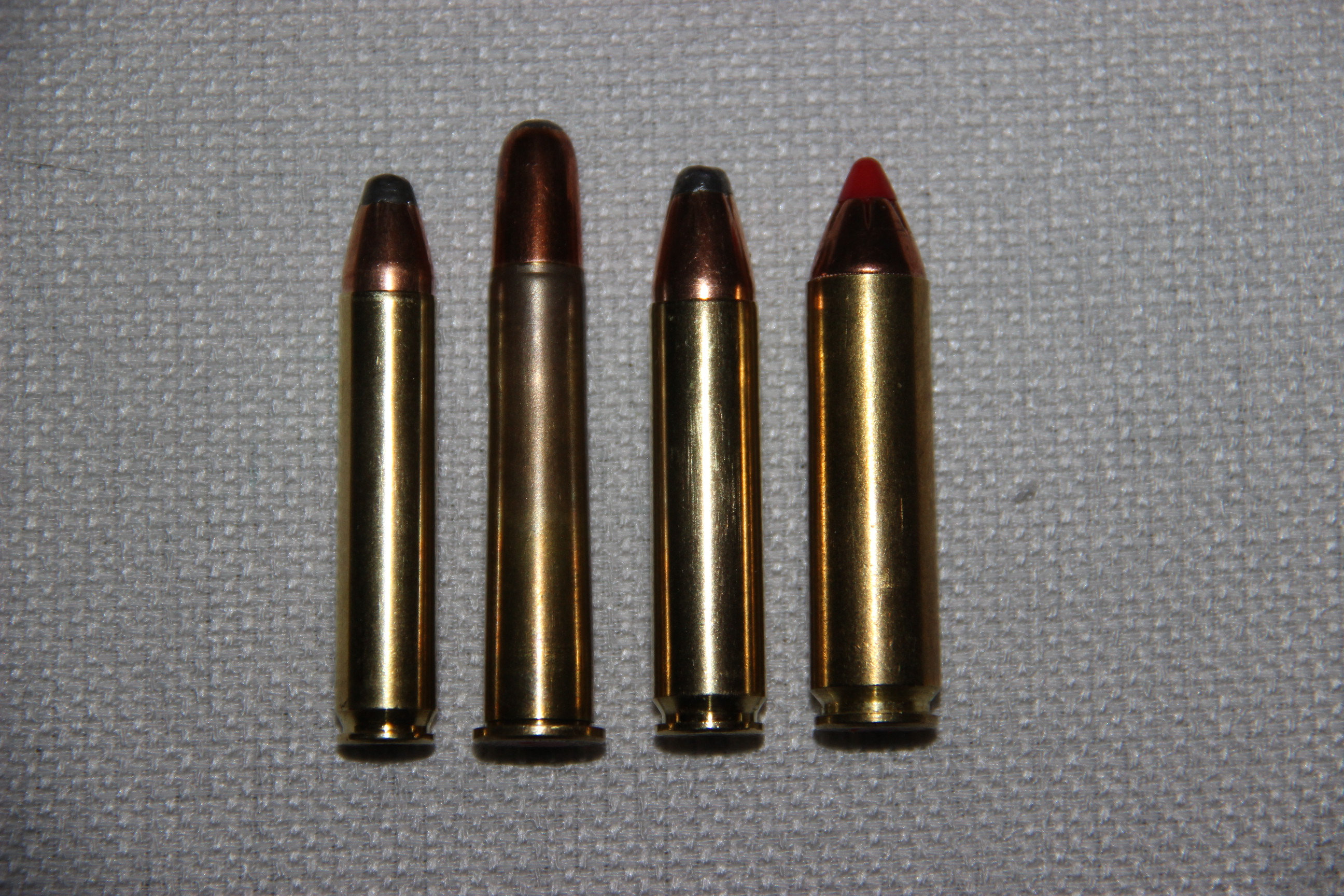
Volume 3 removed the .450 Bushmaster’s legal argument in Michigan. This volume asks what is left, and the answer is more favourable than the framing suggests — but it is not unconditional.
6.1 Maintenance
There is very little that is special here, which is itself the point.
The action is an ordinary direct-impingement AR-15 and is cleaned and lubricated like one. Nothing about the .450 Bushmaster changes the manual of arms, the field strip, or the parts that wear.
Fouling is heavier than a .223 and easier to remove. A large-diameter bore at modest pressure with a fast powder leaves more carbon in absolute terms, but a .45-calibre bore is a great deal easier to get a brush and a patch down than a .224.
The finishes on this rifle are the durable ones. A parkerized barrel and a black nitride bolt carrier group are both corrosion-resistant, low-maintenance choices. Nitride in particular is slick enough that carbon tends to wipe rather than scrape off the carrier.
Two things deserve more attention than on a 5.56 rifle:
- The bolt lugs and the extractor. The cartridge is working a bolt harder than a .223 does, and the bolt is the part whose failure matters. The MPI marking (Volume 4 §4.2) is a manufacturing check, not a substitute for looking at the lugs periodically.
- The chamber, because of how it headspaces. The cartridge stops on its case mouth (Volume 2 §2.3). A ring of carbon built up at the chamber step is sitting exactly on the headspace datum. Keeping the chamber clean is not cosmetic on this cartridge.
6.1.1 A maintenance interval that suits the round count
A hunting rifle in this chambering will fire very few rounds a year — a box to confirm zero, a box or two of practice, and one or two at a deer. That is a different maintenance problem from a .223 carbine that sees 500 rounds in a weekend.
The risk is corrosion and neglect, not wear. A rifle that sits in a safe for eleven months, gets carried in the wet for two weekends, and goes back in the safe is a rifle that rusts rather than one that wears out. The parkerized barrel and nitride carrier on this build are the right answer to that, but they are not a substitute for wiping it down after a wet day.
A sensible cycle for a rifle used this way:
- After every outing in wet or cold, wipe down, dry, and re-oil lightly. Condensation on a cold rifle brought into a warm house is the classic way to rust a bore.
- After every range session, clean the chamber and bore and re-lubricate the carrier.
- Before every season, function-check with the hunting load, confirm zero, and look at the bolt lugs and extractor.
- Do not over-oil. In a Michigan December, heavy oil thickens, and a rifle that cycles on the bench at 70 °F can be sluggish at 10 °F.
6.2 Brass and Reloading
The .450 Bushmaster is a good handloading proposition, for one reason above all others.
⭐ The bullet is a .452, and that is the most abundant large-diameter bullet in North America. It is shared with the .45 Colt, .45 ACP, .454 Casull and .460 S&W Magnum (Volume 2 §2.1). A handloader is buying into a component pool that a cartridge-specific diameter like the .458 SOCOM’s cannot match — more makers, more weights, more constructions, better prices, and no risk of the supply disappearing with the cartridge.
Brass is available. Starline is reported to manufacture .450 Bushmaster cases for handloading.1
⚠ The Starline product page could not be read for this dive — the URLs attempted returned 404 — so no price, case weight or availability claim is made from the maker. The existence of Starline .450 Bushmaster brass rests on the cited secondary source.
Brass life should be good, and the reason is structural. At 38,500 psi maximum average pressure (Volume 2 §2.4) the case is not being worked hard. A straight-walled case also has no shoulder to move, so the annual bottleneck-cartridge chores — shoulder bump, headspace creep from repeated full-length sizing — do not arise.
🔴 What does arise, and it is the one thing a .450 Bushmaster handloader must understand:
- Case length IS headspace. Trim length is not housekeeping on this cartridge; it is the dimension the round stops on. Over-trimmed brass headspaces long. Volume 2 §2.3 and the Headspace dive have the full treatment.
- Crimp carefully. A heavy roll crimp deforms the case mouth, which is the datum surface. A taper crimp or a light crimp into a cannelure is the conventional answer.
- Watch for setback. The case has very little neck gripping the bullet, and a round chambered repeatedly in an autoloader can have its bullet driven deeper, raising pressure (Volume 4 §4.7).
⚠ This dive publishes no load data — no powders, no charge weights, no primers. Published load data belongs to the organisations that pressure-tested it. The SAAMI drawing does not specify a primer size and none is asserted here.
6.3 What It Costs to Feed
Makers’ own listed prices, read 17 September 2026:
Table 1 — Makers' own listed prices, read 17 September 2026
| Load | Price / 20 | Per round |
|---|---|---|
| Federal American Eagle 260 gr FMJ | $41.99 | $2.10 |
| Remington UMC 260 gr FMJ | $41.99 | $2.10 |
| Remington Core-Lokt 260 gr | $69.99 | $3.50 |
| Remington Premier AccuTip 260 gr | $69.99 | $3.50 |
| Federal Power-Shok 300 gr | $71.99 | $3.60 |
| Federal Fusion 260 gr | $79.99 | $4.00 |
The owner’s own record notes the Hornady 250 gr FTX — the load this rifle is set up for — at a local shelf price of $39.99 per box, or $2.00 per round, which is the best figure in the whole table and worth knowing about.
Two conclusions:
Practice ammunition exists and is affordable by big-bore standards. Full metal jacket loads at $2.10 a round make it possible to actually shoot the rifle rather than only zero it. Compared with the .458 SOCOM or the .50 Beowulf, where the component pool is narrower and factory ammunition scarcer and dearer, this is a real advantage.
It is still four to eight times the cost of .223. Nobody plinks with a .450 Bushmaster. A realistic annual budget for a hunting rifle is a box to confirm zero and a box or two of practice — which the cartridge supports comfortably, and which is the honest use case.
Availability is good and no longer depends on one company. Federal, Remington, Winchester and Hornady all currently catalogue .450 Bushmaster (Volume 2 §2.7). The cartridge survived the bankruptcy of the company it is named after (Volume 1 §1.5), and its supply chain is now four large manufacturers deep.
⚠ What Michigan’s rule change does to .450 Bushmaster supply and price in Michigan specifically is a genuine unknown. Michigan was a significant straight-wall market and a meaningful share of demand there was regulation-driven. Whether shelf stock thins, prices soften on used rifles, or nothing much happens is not predicted here. Anyone reading a confident forecast on this point should ask what it is based on.
6.4 The Alternatives, Honestly
The comparison an AR owner would actually make. All muzzle energies computed from the makers’ own published bullet weights and velocities.
Table 2 — 6.4 The Alternatives, Honestly
| Cartridge / load | Muzzle energy | Free recoil | Platform |
|---|---|---|---|
| .350 Legend, 160 gr Fusion | 1,880 ft-lbf | lowest here | AR-15 |
| .350 Legend, 180 gr | 1,763 ft-lbf | AR-15 | |
| .400 Legend, 215 gr Power Point | 2,417 ft-lbf | AR-15 | |
| .450 Bushmaster, 250 gr FTX | 2,687 ft-lbf | 18.0 ft-lbf | AR-15 |
| .450 Bushmaster, 300 gr Power-Shok | 2,405 ft-lbf | AR-15 | |
| .45-70, 300 gr standard pressure | 2,355 ft-lbf | 21.8 ft-lbf | lever / single shot |
| 12 ga, 438 gr rifled slug | 2,522 ft-lbf | 28.3 ft-lbf | shotgun |
| 12 ga, 383 gr rifled slug | 2,756 ft-lbf | 27.3 ft-lbf | shotgun |
6.4.1 .350 Legend
Winchester’s 2019 cartridge, SAAMI-standardised on 31 January 2019, built explicitly for straight-walled-cartridge deer states.2
What it does better: less recoil, flatter trajectory, cheaper ammunition, and more rounds in a magazine — a .357-inch bullet in a .390 case stacks far better than a .500 case does. It runs at 55,000 psi, which is how a smaller bullet reaches similar velocity.
What it does worse: it carries roughly 1,880 ft-lbf against the .450’s 2,687 — about 30 per cent less — with a much smaller frontal area.
The honest verdict: for deer inside 200 yards the .350 Legend is entirely sufficient and is the more pleasant rifle to shoot and own. If the choice were being made from scratch today, with Michigan’s zone gone, the .350 Legend would be the more sensible straight-wall pick for most hunters.
6.4.2 .400 Legend
Winchester’s 2023 cartridge, SAAMI-standardised 15 January 2023, aimed squarely between the other two.3 2,417 ft-lbf at 45,000 psi with a .4005-inch bullet.
It splits the difference almost exactly, and it is the newest and therefore the least-supported of the three. As a reason to sell an existing .450 Bushmaster it is not persuasive.
6.4.3 gauge slug
This is the comparison that matters most historically, because in the old limited firearms deer zone the slug gun was what most hunters actually used.
The slug loads in the owner’s own record produce 2,522 and 2,756 ft-lbf — genuinely comparable to the .450 Bushmaster at the muzzle.
⭐ And they recoil about 55 per cent harder — 27 to 28 ft-lbf against 18 (Volume 5 §5.2). They also shed velocity far faster, shoot markedly worse trajectories, and are generally less accurate.
The .450 Bushmaster beats the slug gun on every axis except cost. For anyone who owns both, that is the cleanest argument the cartridge has, and it is untouched by the rule change.
6.4.4 .45-70 Government
The ancestor in spirit, and the cartridge the .450 Bushmaster is most often compared with.
It is not an AR-15 cartridge. Its case is 2.105 inches against the .450’s 1.700, and it lives in lever actions and single shots. ⭐ That length is also exactly why it was never legal in Michigan’s old limited firearms deer zone — the rule capped case length at 1.80 inches (Volume 3 §3.1). The .450 Bushmaster is, functionally, the .45-70 idea shortened until it was both AR-legal and zone-legal.
At standard pressure with a 300-grain bullet the .45-70 produces about 2,355 ft-lbf and recoils harder. Its real advantage is range of application: it is loaded from mild cowboy ammunition to loads that will stop a brown bear, and it takes bullets up to 500 grains.
⚠ The .45-70’s higher-pressure tiers are platform-specific and genuinely dangerous in the wrong rifle. That is not a caveat this dive can do justice to; the .45-70 Government dive owns the pressure-tier question, the 24-inch barrel problem and the terminal analysis, and should be read before anyone acts on the comparison above.
The verdict: the two are not really competitors. The .45-70 is more versatile and more powerful at the top end; the .450 Bushmaster is softer, faster to shoot, semi-automatic, and fits a rifle most American shooters already own.
6.4.5 The other big-bore AR cartridges
The .450 Bushmaster is one of three well-established ways to put a large bullet through an AR-15, and the comparison is instructive because the three solve the same problem differently.
.458 SOCOM. Designed by Teppo Jutsu LLC, a rebated bottleneck case with a .458-inch bullet on a 1.575-inch case, 2.260 overall, at 35,000 psi.4 A 300-grain load produces about 2,405 ft-lbf.
⭐ Its rim is .473 — exactly the same as the .450 Bushmaster’s. That is why bolts are sold as “.450/.458” (Volume 4 §4.2) and it is a real practical benefit to both cartridges: a shared bolt means a larger, cheaper and more durable parts pool than either would support alone.
Against the .450 Bushmaster, the .458 SOCOM takes heavier bullets — up to 600 grains — and is the better choice for anyone wanting a subsonic suppressed big bore. Against it, its .458-inch bullets are a smaller and dearer component pool than the .452 handgun-bullet family (§6.2), and factory ammunition is scarcer and costs more.
.50 Beowulf. Bill Alexander’s 2001 cartridge for Alexander Arms: a rebated straight case, .500-inch bullet, 1.65-inch case, 33,000 psi, and — unusually and helpfully — published from a 16-inch test barrel, which is an actual rifle length rather than a laboratory one.5 A 400-grain load gives about 2,878 ft-lbf.
⭐ Its rim is .445, matched to the 6.5mm Grendel, not to the .308 family. So it needs a different bolt again — and its parts pool is separate from the .450/.458 one.
The comparison in one line: the .450 Bushmaster is the one with the best factory ammunition support, the cheapest components, and the mildest recoil of the three; the .458 SOCOM is the most versatile, particularly suppressed; the .50 Beowulf hits hardest and is the most proprietary.
None of this is a reason to change. All three do the same job inside 200 yards, and the .450 Bushmaster is the one with four major manufacturers currently loading for it.
6.4.6 And now, the bottleneck cartridges
The comparison that did not exist in Michigan before 12 September 2026. A .308 Winchester produces 2,649 ft-lbf — essentially identical to the .450 Bushmaster at the muzzle — while recoiling less (13.6 against 18.0 ft-lbf), shooting very much flatter, reaching several times further, and costing far less to feed.
On the merits, for a hunter with no rifle and no constraint, a .308 is the better general-purpose choice, and pretending otherwise would be dishonest. What the .450 Bushmaster has against it is a larger hole, an AR-15 platform, and the fact that it is already in the safe.
6.5 6.4a Storage, Travel and Resale
Storage is unremarkable and that is the point. A parkerized barrel and a nitride carrier tolerate a safe with a dehumidifier and an annual wipe-down. The ammunition stores indefinitely in a cool dry place; there is nothing temperature-critical about it.
Travel out of Michigan needs two checks, not one. The first is the destination’s hunting regulation — whether it restricts deer hunting to straight-walled cartridges, and if so with what calibre floor and case-length window (Volume 3 §3.4). The second is its possession and transport law, which is a separate question with separate answers and which this dive does not address for any state. Both change, and both are the traveller’s responsibility to check against the state’s own current publication.
Resale is the one genuinely uncertain variable, and Volume 3 §3.6 flagged why. Michigan was a significant straight-wall market, and a meaningful share of demand for .450 Bushmaster rifles there was created by a regulation that no longer exists. Whether that shows up as softer used prices, thinner shelf stock, or nothing much at all is not predicted here.
⭐ What is worth saying is that the rifle is not the cartridge. A .450 Bushmaster AR-15 is a complete lower plus a caliber-specific upper. If the cartridge ever became genuinely inconvenient, the lower — the serialised, regulated, expensive-to-replace part — carries over unchanged to any other AR-15 chambering, including the .350 Legend and the .400 Legend discussed above. The platform is the hedge, and it is a considerably better one than a bolt-action owner has.
6.6 The Verdict
Keep it, and stop justifying it on the law.
The rifle documented here is a well-specified build: a correct 1:24 barrel, an MPI-marked big-bore bolt, a good drop-in trigger, a substantial recoil pad, an adjustable comb, and — the part most .450 Bushmaster owners get wrong — the right magazines with the right followers. It is set up for a load the cartridge is at its best with, and it is compliant with Michigan’s six-round rule as configured.
What changed on 12 September 2026 is the argument, not the rifle. The cartridge no longer has a legal monopoly in southern Michigan. Inside 200 yards, on deer, from a blind or a field edge, it does exactly what it did before — and it does it with a third less recoil than the slug gun that used to be the alternative.
Three things would improve the dive more than any new component would:
- Chronograph it. The barrel is 16 inches (Volume 1 §1.8) — shorter than every barrel the published figures were measured in. Nobody publishes .450 Bushmaster velocity from a 16-inch barrel, and no velocity-loss-per-inch figure for this cartridge could be verified anywhere (Volume 5 §5.5), so there is no way to derive what this rifle does from what is in print.
- Shoot a group and keep the target. Every accuracy claim available for this cartridge is unsourced (Volume 5 §5.4).
⭐ All three are an afternoon’s work, and all three would produce numbers that do not currently exist in the public record.
6.7 References (Vol 6)
- Muzzle energies computed from the makers’ published bullet weights and velocities; free recoil per the method and assumptions stated in Volume 5 §5.2.
- Shotgun slug figures (Federal Power-Shok 438 gr at 1,610 fps; Remington Slugger High Velocity 383 gr at 1,800 fps) are from the owner’s own equipment record.
- Ammunition prices are the makers’ own listed prices read 17 September 2026 and are not a market survey. The Hornady shelf price is the owner’s own note.
Footnotes
-
Starline brass manufacture for the .450 Bushmaster as cited in .450 Bushmaster, Wikipedia. The Starline product page itself could not be read; no figure from the maker is quoted. ↩
-
.350 Legend, Wikipedia, citing SAAMI. Bullet and case dimensions, 55,000 psi maximum average pressure, 1:16 twist, 20-inch test barrel, the 31 January 2019 SAAMI acceptance date, and the straight-walled-state design intent. ↩
-
.400 Legend, Wikipedia, citing SAAMI. Bullet and case dimensions, 45,000 psi maximum average pressure, 1:16 twist, the 15 January 2023 SAAMI acceptance date, and the 215 gr Power Point figures. ↩
-
.458 SOCOM, Wikipedia. Case type, bullet and rim dimensions, 35,000 psi maximum pressure, twist, designer, and the 300 gr ballistic figures. The .473 rim shared with the .450 Bushmaster is the basis for the shared-bolt observation. ↩
-
.50 Beowulf, Wikipedia, citing Alexander Arms’ published Beowulf ballistics. Case type, bullet and rim dimensions, 33,000 psi maximum pressure, the 16-inch test barrel, and the 400 gr figures. The .445 rim is matched to the 6.5mm Grendel. ↩
Comments (0)