Smith & Wesson M&P Shield · Volume 5
The DeltaPoint Micro — A Dot in the Rear-Sight Dovetail, and Carrying It
How Leupold's smallest dot mounts, why it is specific to the slide, what a 9 mm window means against a slide-cut optic, and what changes in the holster
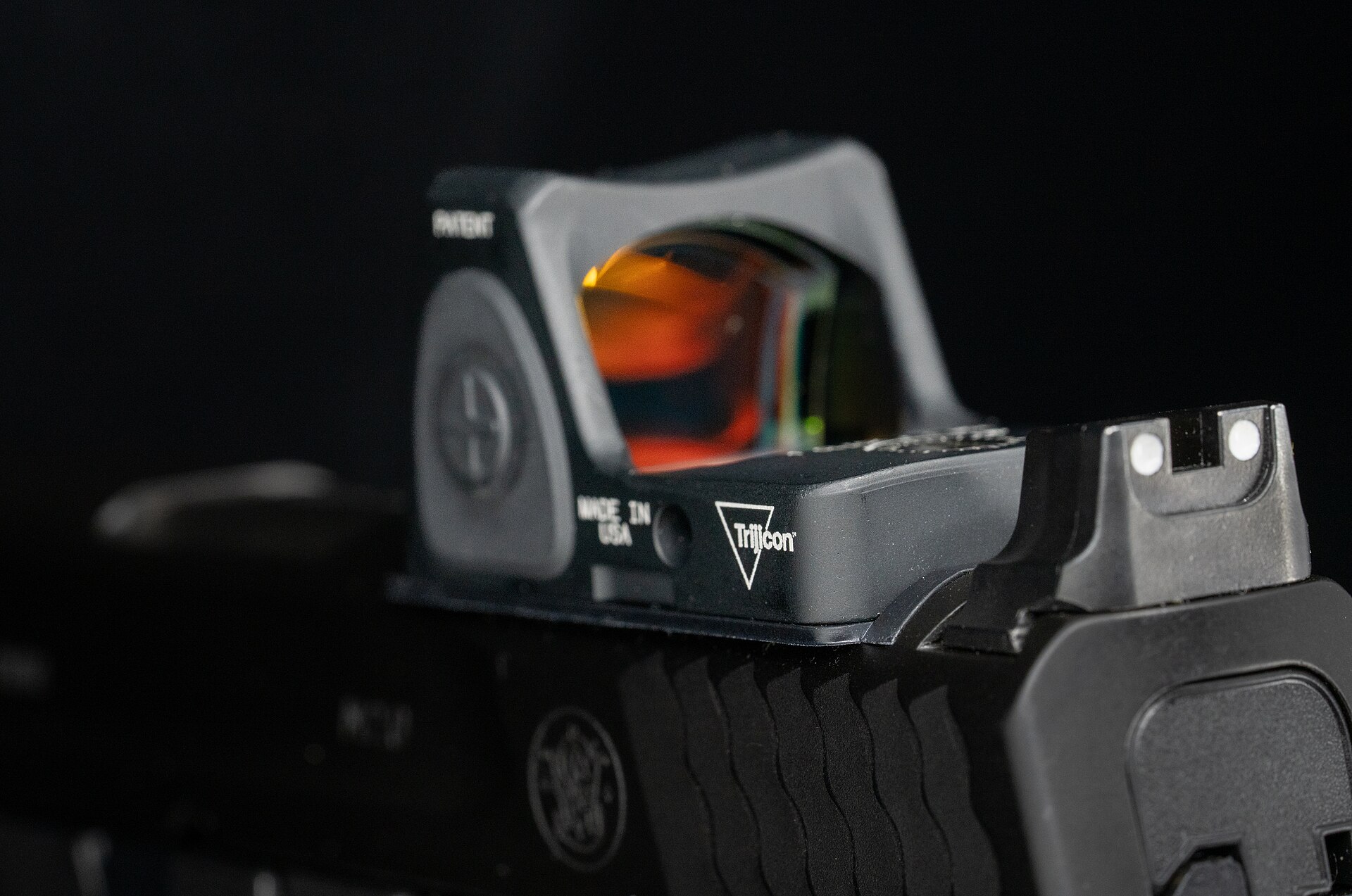
The optic theory — how a collimated dot works, parallax, astigmatism, open and enclosed emitters, and the pistol footprint standards — is covered in the Scopes dive, Volume 5, and the arithmetic of minutes of angle in its Volume 3. Neither is repeated here. This volume covers what is specific to one optic on one pistol: a reflex sight that replaces the rear iron sight in the slide’s dovetail rather than sitting in a pocket cut into the slide.
5.1 The configuration, as documented
As recorded in the owner’s inventory in September 2026, the pistol documented here carries a Leupold DeltaPoint Micro with a 3 MOA dot, described as “low profile”, and the entry is marked done — that is, installed. Nothing else about the installation is recorded: not the date, not who pressed the rear sight out, not the sight’s part number, and not which Shield generation the slide belongs to.
One inference is safe and is labelled as one. Leupold’s current DeltaPoint Micro is made in a Glock pattern and an S&W M&P pattern, and its own page for the S&W version gives the part as 179570.1 A DeltaPoint Micro fitted to a Shield is therefore, in all probability, the S&W M&P pattern. The owner’s sheet does not say so.
“Low profile” on the sheet reads as a description of the sight rather than a separate part: Leupold’s own copy calls it “the low-profile, concealable design that really makes it stand out” and says it is “mounted at the same height as factory iron sights.”1
5.2 What the DeltaPoint Micro is
Leupold’s figures, from its manual and its product page for the S&W version:21
Table 1 — What the DeltaPoint Micro is
| Leupold’s figure | |
|---|---|
| Part | 179570 (S&W M&P); the manual lists “SKU 178745 or 179570” |
| Dot | 3.0 MOA |
| Magnification | 1.0× |
| Sight window | 9.0 mm (0.35 in) |
| Size (L × W × H) | 2.25 × 0.9 × 1.25 in |
| Weight | 1.1 oz with battery |
| Battery | one CR1632, 3 V |
| Battery life (product page) | 100,000 h low · 30,000 h medium · 500 h high |
| Illumination settings | 8 |
| Adjustment | 18 MOA per revolution elevation, 36 MOA per revolution windage (“1” and 2” @ 5 yards, respectively”); 100 MOA total elevation, 180 MOA total windage |
| Sealing | ”Waterproof rated at IPX7” |
| Operating temperature | −20 °F to +120 °F |
| Housing | aluminium; enclosed |
Adjustment is by revolution, not by click. Leupold specifies the Micro’s adjusters by the amount of movement per full turn of a hex screw — the “U” and “R” screws on the left side of the sight, turned with a 1/16 hex key, with “limit stops at both ends” — and does not give a per-click value.2 An owner zeroing it is turning a screw by fractions of a turn: at 18 MOA a turn, a quarter turn of the elevation screw moves the point of impact about 4.5 MOA, which is about a third of an inch at 7 yards (4.5 × 1.047 in × 7/100).
5.3 How it mounts
Leupold’s manual gives the whole procedure in four sentences, and the first is a recommendation to hand it to someone else:
Leupold recommends utilizing a qualified gunsmith to press/remove the rear sight from your handgun. Once the rear sight has been removed, the appropriate dovetail replaces the rear sight. Once the dovetail has been placed on the slide, place the DeltaPoint Micro on top of the dovetail. The two holes in the bottom of the DeltaPoint Micro engage into the dovetail using the two included M4x.7x5.7mm Torx screws.2
and:
Secure the screws by applying 25 inch-pounds of torque. Securing these screws creates a press-fit and will hold the DeltaPoint Micro firmly in place.2
A T-15 Torx wrench is in the box.2
Smith & Wesson says the same thing from the other side. Its manuals, from the 2012 Shield to the 2025 Shield Plus and Shield X, state: “The rear sight is not adjustable. No attempt should be made to move the rear sight on this model. Removal of the rear sight and its replacement should only be performed by a gunsmith who is familiar with Smith & Wesson® products.”34 The two makers, writing about opposite halves of the same job, both put the rear-sight press in a gunsmith’s hands.
For the lab this hub is written for, that is a statement about tooling rather than skill: a rear sight on a polymer-framed striker pistol is an interference fit in a steel dovetail, and a sight pusher made for the slide is the tool that moves it without marring the dovetail or bending the slide. What neither maker gives is the dovetail’s dimensions, and none are given here.
The screws are the retention. Smith & Wesson’s warning for optics on its optics-ready slides applies with equal force to this one: “A sight which is not mounted securely may become detached upon recoil of the firearm … Observe the condition of the mounting screws before and after firing.”4 The Micro’s 25 in-lb figure is the maker’s; no thread-locker instruction was found in Leupold’s manual and none is added here.
5.4 Why it is specific to the slide
The DeltaPoint Micro does not mount to a footprint. It mounts to a dovetail insert that takes the place of the rear sight, and the insert is made for one maker’s dovetail. That is why the sight exists in a Glock version and an S&W M&P version, and why Leupold’s compatibility statement reads as a list of slides:
Current models fit Glock® and Smith & Wesson® M&P® centerfire semiautomatic handguns only. (Does not fit Rimfire Glock and M&P models, Glock MOS, Smith and Wesson M&P CORE, Smith and Wesson Shield EZ, nor Smith and Wesson M&P 5.7 models)1
Four consequences follow.
The Shield is included by the absence of an exclusion. Leupold names the M&P models the sight does not fit; the Shield is not among them and the Shield EZ is. That the Shield’s rear dovetail is the same as the full-size M&P’s is implied by that statement. It is not stated in terms by Leupold or by Smith & Wesson, and no dovetail drawing was found for either.
The exclusions are slides, not calibres. The M&P CORE and the Glock MOS are optics-ready slides — the two platforms’ own slide-cut systems — and they are excluded; the Micro is a sight for an iron-sighted slide.
An optics-ready Shield slide is an open question. Smith & Wesson’s optics-ready Shield Plus and Shield X slides keep a rear sight in a dovetail behind the optic pocket, with a cover plate over the pocket.4 Whether the Micro’s insert fits that rear dovetail, and whether it clears the cover plate if so, is not addressed by Leupold’s list, and is not asserted either way here. An owner with an optics-ready slide has a slide cut for a different kind of sight in any case.
Moving it to another pistol means moving the insert. A DeltaPoint Micro set up for an M&P goes onto another M&P-pattern slide with the same dovetail, with its insert, after that slide’s rear sight has been pressed out. It does not go onto a Glock. This hub’s standing practice of treating optics as moving between guns (Scopes) applies to this sight only within one maker’s dovetail.
5.5 Two ways to put a dot on a Shield
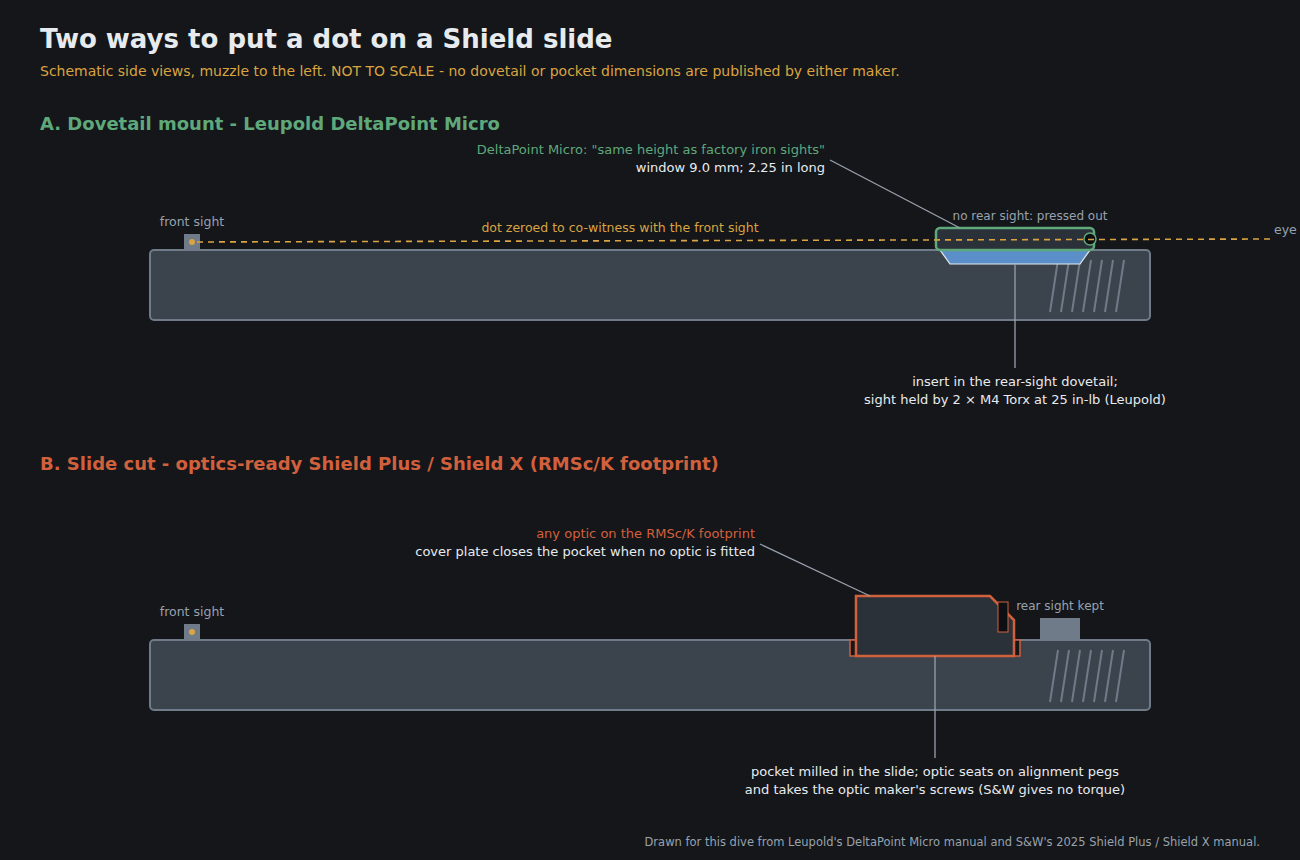
Table 2 — Two ways to put a dot on a Shield
| Dovetail (DeltaPoint Micro) | Slide cut (optics-ready Shield Plus / Shield X) | |
|---|---|---|
| Slide machining | none; uses the existing rear-sight dovetail | pocket milled at the factory; Smith & Wesson calls its footprint “RMSc/K”5 |
| Rear sight | removed; the sight replaces it | kept, behind the pocket4 |
| Front sight | kept; dot zeroed to co-witness with it2 | kept |
| Reversible | yes — press the rear sight back in | the pocket is permanent; a cover plate closes it |
| Optic choice | the one sight made for that dovetail | any optic on the footprint |
| Height | ”the same height as factory iron sights”1 | set by the pocket depth and the optic; not published by Smith & Wesson |
| Retention | two M4 screws into the insert, 25 in-lb2 | the optic maker’s screws into the slide; Smith & Wesson publishes no torque4 |
The slide-cut route is now available as a factory part for the pistol documented here, whichever generation it is. Smith & Wesson sells an optics-ready slide for the 3.1-inch Shield described as “Drop-in Fit - Change the slide on your M&P® Shield 1.0, 2.0 or SHIELD PLUS”, at $299 on 19 September 2026.6 Its Performance Center Carry Comp slides are listed as “Optic Ready - RMSc/K footprint.”7 That was not true when the dovetail sight was designed, and it is the most important change in the choice since.
5.6 A 9 mm window
The DeltaPoint Micro’s window is 9.0 mm across — 0.35 inch — and its objective and eyepiece are both given as 0.35 inch.21 That is the number that distinguishes it from every slide-cut pistol dot.
For scale: the DeltaPoint Pro, the other Leupold dot in this collection, has a window Leupold gives as 25.7 × 17.5 mm (P320-M17 dive, Volume 7). Treated as a rectangle, that is about 450 mm² against about 64 mm² for the Micro’s 9 mm circle — roughly seven times the area. The Pro’s window is not a perfect rectangle, so the ratio is approximate; it is not close.
What a small window does is the reason for the design. With a large window the eye can find the dot anywhere within a generous field and follow it back to centre; with a 9 mm aperture held at arm’s length, the eye and the sight must be close to aligned before the dot appears at all. The Micro keeps “unlimited eye relief” — the dot is collimated and the distance from eye to sight does not matter — but the lateral and vertical latitude is small, because the tube is short and narrow.2
Leupold’s own framing is consistent with that reading: a sight “mounted at the same height as factory iron sights” that “aligns the red dot with the front sight”, “perfect for anyone transitioning to a red dot sight for the first time.”1 A shooter who presents the pistol with an iron-sight index — front sight up, eye behind the slide — finds the dot where the rear notch used to be. A shooter trained on large-window dots, who expects to find the dot anywhere in the glass, may not. This is reasoning from Leupold’s published geometry, not a measured result, and no published test of dot-acquisition time for the Micro against a slide-cut optic was found.
5.7 MOA
The Micro’s dot is 3.0 MOA.1 The arithmetic of what 3 MOA and 6 MOA cover at pistol distances — 0.22 inch against 0.44 inch at 7 yards, 0.79 against 1.57 at 25 — is worked in the P320-M17 dive, Volume 7, which carries the 6 MOA DeltaPoint Pro in this collection, and is not repeated here.
What is specific to the Micro is how the two numbers interact. In a 9 mm window a 3 MOA dot is a small point in a small aperture, which suits a sight meant to be used like an iron sight — precise placement with the eye already aligned — and suits less well a sight meant to be found quickly from an imperfect index. Whether a larger dot was offered in the Micro was not established from Leupold’s pages; the current manual and product page list only the 3.0 MOA dot.21
5.8 Zeroing, and the front sight
Leupold’s boresighting instruction is specific to this sight: “Place the DP Micro close to your eye. Using the hex key, position the red dot so it co-witnesses with your factory front iron sight. Move the pistol to a normal firing position and check the position of the red dot in relation to your front iron sight … Complete your sight-in process with live fire, verifying the final location of the red dot.”2
The zero is therefore set in two stages: mechanically, to the front sight, and then by live fire. The front sight stays on the slide, and Smith & Wesson’s manual still governs it — “The front sight can be drifted left or right to adjust windage … Use a brass drift or punch to prevent marring the sight.”4 With the Micro fitted, drifting the front sight moves the reference the dot was co-witnessed to; once the dot is zeroed by live fire, the front sight is best left alone.
The front sight is not a documented backup. Leupold describes co-witnessing the dot with the front sight for zeroing. Nothing in its manual or product page describes aiming with the front sight through a dark sight, and none is claimed here.
5.9 Power, the motion sensor, and the battery
The manual’s operating details matter more on a carry pistol than on a range gun, because a carry pistol spends almost all its life still.2
- On, off and brightness. Press to switch on; press repeatedly to step through eight levels; at the end of the range “the LED will flash 5 times”; hold for two seconds to reverse direction; hold about three seconds to switch off. It returns to the last setting when switched on.
- The motion sensor. “After the optic has been completely at rest for several minutes, the sight transfers to sleep mode … Upon movement of the optic, the system powers up the LED to the last known setting.”
- 🔴 The motion sensor does not act at low settings. “Please note that the motion sensor will not turn off the sight if the sight is running levels 1, 2, 3 or 4.” At levels 1–4 the sight stays on continuously; at 5–8 it sleeps and wakes. Leupold presents this as maximising run time, and its product page’s figure of 100,000 hours at low intensity is consistent with it.
- Manual off defeats the sensor. “The motion sensor will NOT reactivate the DeltaPoint Micro if it has been turned off manually.” A carry sight switched off by hand is off until someone switches it on.
- Low battery. Illumination dims as the battery runs down; “when level 8 illumination appears only as bright as level 7 appeared with a fresh battery, it is time to replace the battery”; on start-up a low battery shows as ten quick flashes, after which there are “several days of operating time.”
⚠ Battery access has not been confirmed. The manual says to open the battery cover “by unscrewing module from bottom of sight”. On a sight that sits on its dovetail insert with its bottom against the insert, that wording suggests the sight must come off the insert to change the battery — which would put the 25 in-lb screws and the zero back in play at every change. The manual does not say so in terms, and it is not asserted here. It is a question for the owner, whose pistol can answer it.
5.10 Carrying it: what the optic changes in the holster
A holster moulded for an iron-sighted Shield is moulded around a rear sight. The DeltaPoint Micro replaces that sight with a housing 2.25 inches long and 0.9 inch wide that extends forward over the top of the slide.2 Leupold’s point that it sits “at the same height as factory iron sights” is about height; it says nothing about length or width, and it is length and width that decide whether a holster’s sight channel clears the housing or bears on it.
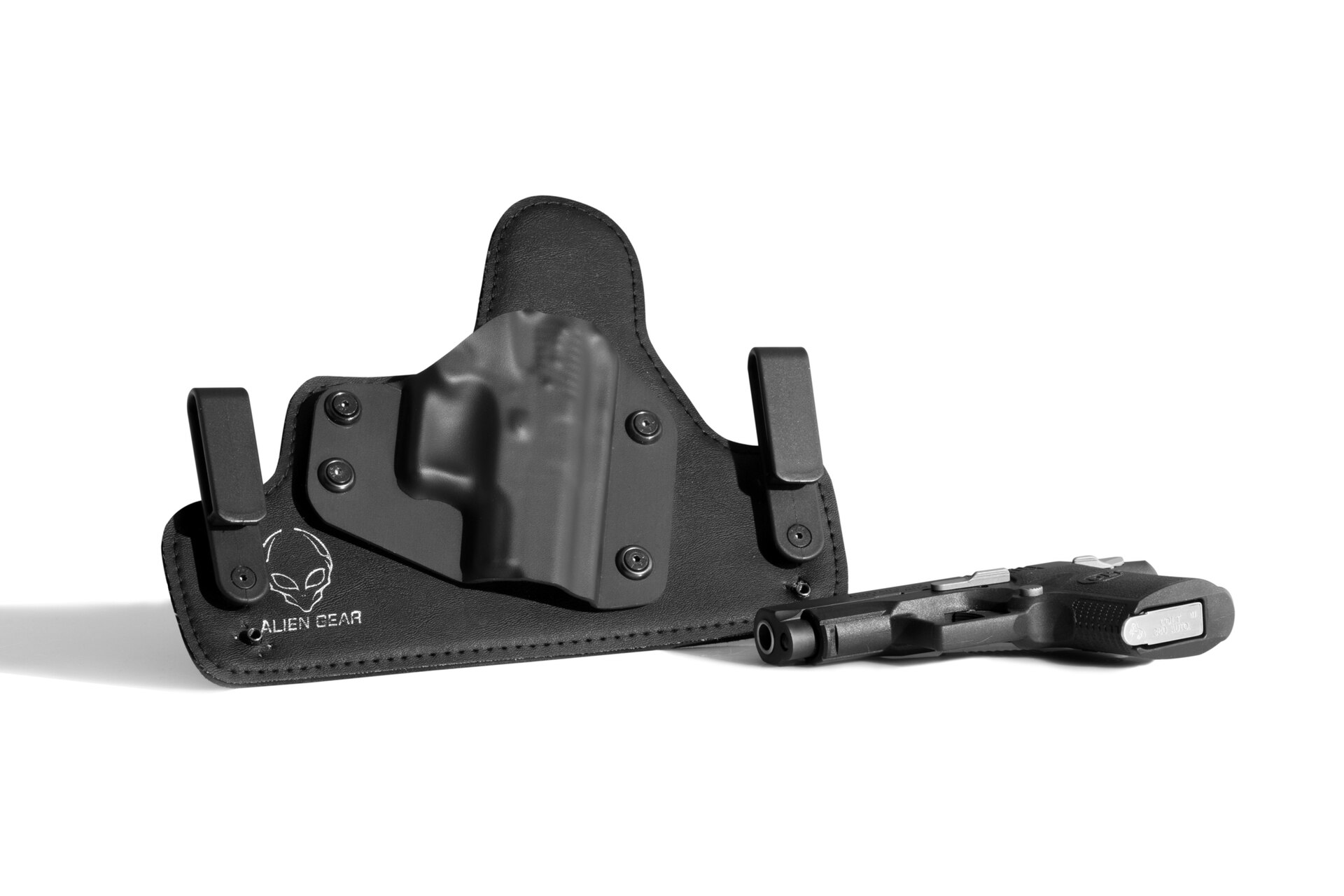
Three things change when a Shield goes from iron sights to the Micro, and each is a holster question rather than a pistol one.
Clearance. A shell whose sight channel is cut for a rear sight may bear on the optic body, on the window, or on the adjusters on its left side. Contact there is pressure on the one component the pistol cannot zero without.
Retention. Many moulded holsters retain on the trigger guard and ejection port; a housing that holds the pistol off its seat changes the retention the holster was set for.
Draw. A draw that snags the optic on the holster mouth is a draw that fails in the hand. A holster made for the combination should let the pistol clear with the grip it will be drawn with.
No holster maker’s statement naming the DeltaPoint Micro on a Shield was surveyed for this dive, and none is recommended. The owner’s records name no holster for this pistol, and the question of which one is carried with the optic fitted is among the questions for the owner.
5.11 A discontinued sight
⚠ Leupold’s page for the S&W DeltaPoint Micro, part 179570, is marked “This product has been discontinued and is no longer available for purchase”, with a last list price of $399.99, as read on 19 September 2026.1 When it was discontinued is not stated on the page and was not established.
Three practical consequences, none of them urgent:
- Replacement is not a catalogue order. A lost or damaged Micro is replaced from remaining stock or the used market, or not at all. Leupold’s “Lifetime Guarantee” is set out in the manual as repair or replacement “for free, whether you’re the original owner or not – forever”, and what Leupold does when the model to replace is discontinued is a question for Leupold.2
- The factory slide-cut route has overtaken it for anyone buying new, as above.
- Nothing about the sight on the pistol changes. A discontinued sight that is zeroed, tight, and powered is exactly as good as it was the day it was fitted.
5.12 Bibliography
Footnotes
-
Leupold & Stevens, “DeltaPoint Micro (S&W M&P)”, part 179570, https://www.leupold.com/deltapoint-micro-s-w-m-p (accessed 2026-09-19). Description, compatibility statement, discontinued notice, list price, specifications table (battery life, adjustment ranges, dimensions). ↩ ↩2 ↩3 ↩4 ↩5 ↩6 ↩7 ↩8 ↩9 ↩10
-
Leupold & Stevens, DeltaPoint Micro™ Red Dot Sight Mounting & Operation Instructions — GLOCK® / S&W M&P®, artwork 180678E, © 2024, linked from the product page as “DeltaPoint Micro Manual + French”: https://www.leupold.com/media/manuals/DeltaPoint_Micro_Manual_French_180678E.pdf (accessed 2026-09-19). Specifications, installation, torque, boresighting, illumination, motion sensor, low-battery indication, battery installation, package contents, lifetime guarantee. ↩ ↩2 ↩3 ↩4 ↩5 ↩6 ↩7 ↩8 ↩9 ↩10 ↩11 ↩12 ↩13 ↩14
-
Smith & Wesson, Safety & Instruction Manual, M&P SHIELD™ Pistols, © 2012 — “Sight Adjustment”. Copy hosted at https://savannaharsenal.files.wordpress.com/2014/05/mp_shield_manual_04-02-2012.pdf (accessed 2026-09-19). ↩
-
Smith & Wesson, Safety & Instruction Manual for SHIELD® PLUS and SHIELD X™ pistols, 07/08/25, part 3017716, https://smith-wesson.canto.com/direct/document/64u457llr51g7db5vqethvi635/gY5JDnG1Bq08wv-8wMzkvdugsCU/original?content-type=application/pdf&name=SHIELD_PLUS&X_Manual_070825_3017716.pdf (accessed 2026-09-19). “Sight Adjustment”, “Optical Sight Instructions” (Figures 94–101), “Model & Features Identification” (Figures 4–5). ↩ ↩2 ↩3 ↩4 ↩5 ↩6
-
Smith & Wesson, “M&P® SHIELD X™ NO THUMB SAFETY”, item 14263 — “flat-plane RMSc/K optic cut” (accessed 2026-09-19). ↩
-
Smith & Wesson, “M&P®9 SHIELD OR SHIELD PLUS FDE OPTIC READY SLIDE FOR 3.1IN BARREL”, item 14482, $299 (accessed 2026-09-19). ↩
-
Smith & Wesson, Performance Center Shield Plus Carry Comp slide kits, “Optic Ready - RMSc/K footprint”, listed on https://www.smith-wesson.com/products/compatible-with-shield (accessed 2026-09-19). ↩
Comments (0)