Smith & Wesson M&P Shield · Volume 1
The Single-Stack Decade — What the Shield Was, and the Pistol That Ended Its Era
From the 2012 launch to the Shield X, the category the Shield helped define, and the 2018 SIG P365 that changed the arithmetic
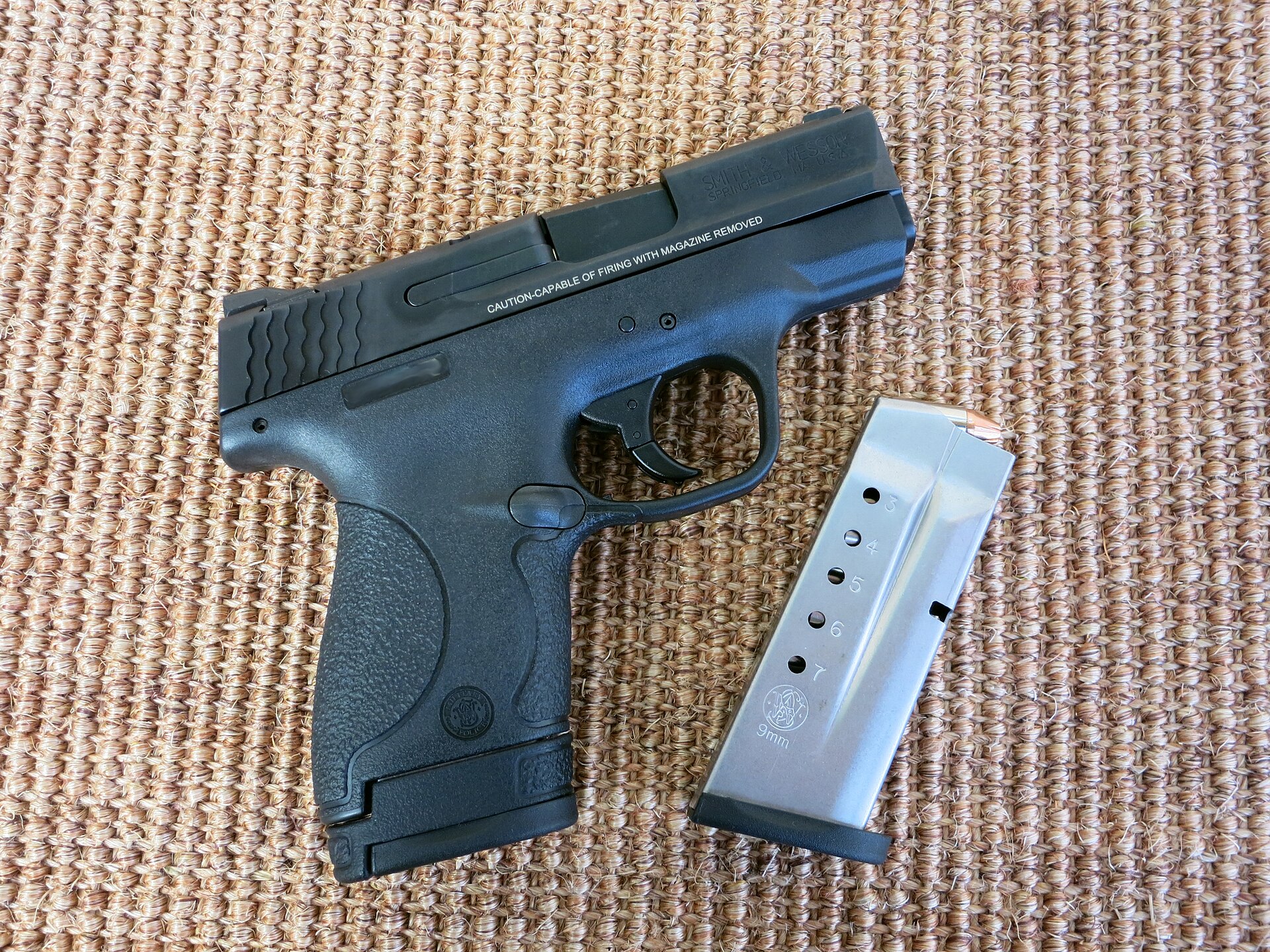
The Smith & Wesson M&P Shield is a small, polymer-framed, striker-fired 9×19 pistol built for concealed carry. That sentence describes a great many pistols now, and it describes them because of the Shield. When it was unveiled in April 2012 it was not the first slim single-stack nine — Walther and Ruger had both been there first — but it was the one that sold in numbers large enough to make the configuration the default American carry pistol for most of a decade. Smith & Wesson put the figure at more than three million Shields sold by March 2021.1
It is also a name that now covers at least four different pistols, only some of which share magazines, and one that is not the same mechanism at all. The volumes that follow are organised around that fact. This one sets out the history: what the Shield was built from, what it answered, what the 2018 SIG Sauer P365 did to the single-stack category, and how Smith & Wesson responded — first with a pistol it called “the next evolution of the Smith & Wesson M&P Shield”, and then in 2025 with a longer one.
1.1 The pistol in one table
The original-pattern Shield in 9×19, as published at its launch, beside the two later 9×19 Shields that Smith & Wesson catalogued in September 2026. Figures are as each source gives them.
Table 1 — The pistol in one table
| M&P Shield (2012) | M&P Shield Plus (2021) | M&P Shield X (2025) | |
|---|---|---|---|
| Barrel | 3.1 in | 3.1 in (standard); 4 in on some models | 3.6 in, 1:10 twist |
| Length | 6.1 in | 6.1 in | 6.7 in |
| Height | 4.6 in | 4.6 in | 4.9 in |
| Width | 0.95 in “at its thickest” | 1.1 in | 0.9 in |
| Weight, unloaded | 19 oz | 17.9 oz (standard, S&W listing); 20.2 oz (S&W comparison table) | 20.8 oz |
| Magazines at launch | 7 flush, 8 extended | 10 flush, 13 extended | 13, 15 |
| Optic cut | none | on “optics ready” models (RMSc/K on the Carry Comp slide) | RMSc/K on all standard models |
| Launch price | $449 MSRP | from $553 MSRP | $599 |
| Source | American Rifleman, 12 April 20122 | S&W press release 15 March 2021; S&W product data13 | S&W product data, 20254 |
Two cautions attach to that table.
The Shield X width is the odd one out. The original’s 0.95 in and the Shield Plus’s 1.1 in are both widest-point figures, and American Rifleman compared them directly.25 Smith & Wesson then lists the longer, higher-capacity Shield X at 0.9 in.4 The maker does not say what that figure measures, and a pistol whose grip holds fifteen rounds is not narrower than one that holds thirteen by any measure a holster notices. The Shield X figure is reproduced as published and is not used for comparison anywhere in this dive.
The two weights for the Shield Plus are both Smith & Wesson’s. The product listing for the standard model gives 17.9 oz; Smith & Wesson’s own comparison article against the Shield X gives 20.2 oz.36 Neither page says whether a magazine is included. Both are given; neither is preferred.
1.2 Where it came from: the M&P, 2005
The Shield is a derivative of the full-size M&P, a polymer-framed, short-recoil, locked-breech striker pistol that Smith & Wesson introduced in the summer of 2005.7 The name reuses the company’s Military & Police revolver name.
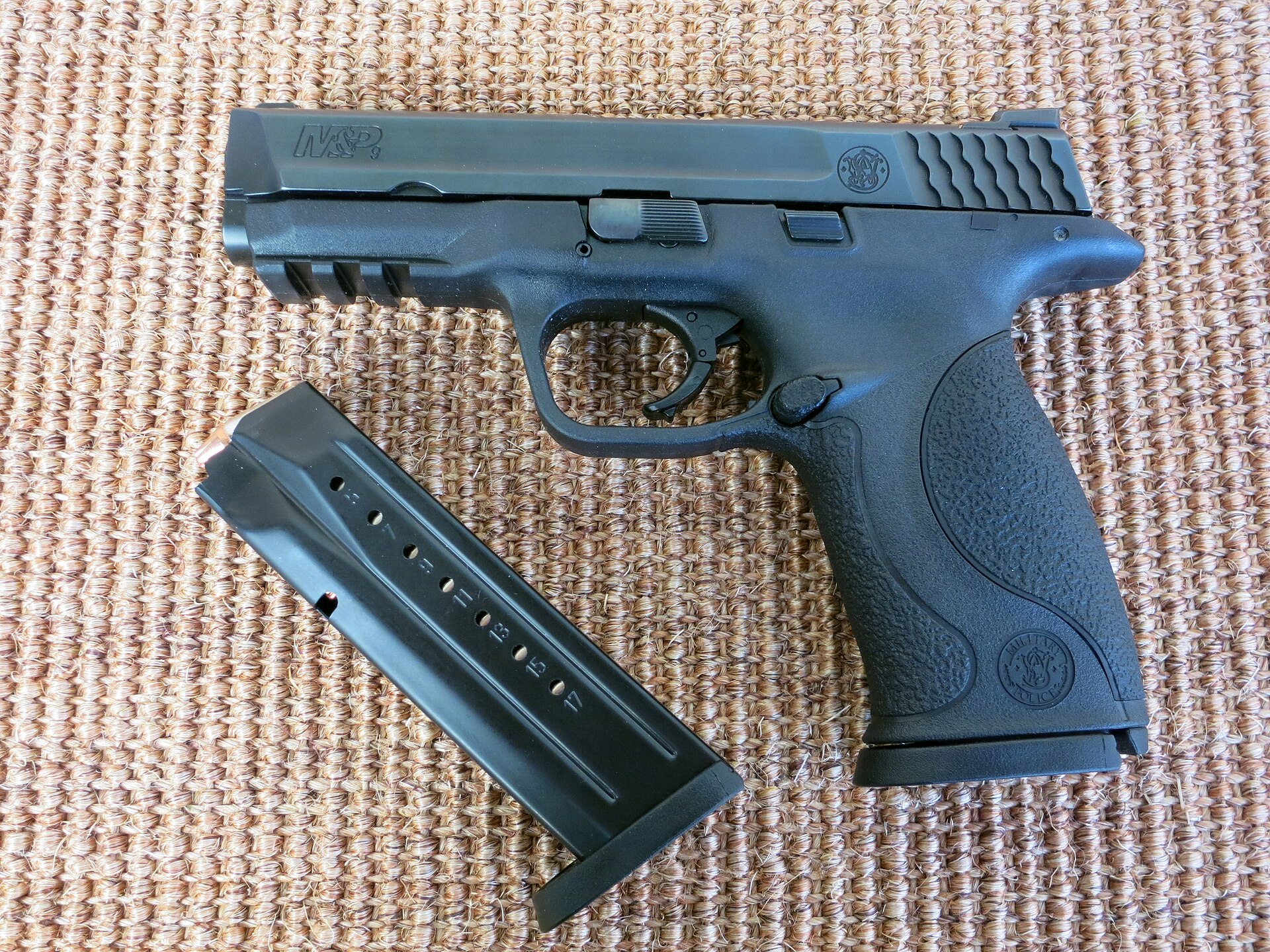
What the Shield inherits is visible in the patents Smith & Wesson prints in the back of its manuals: a striker-type firing pin released by a pivoting sear carried in a separate sear housing, a striker block cammed out of the way by the trigger bar, and a sear deactivation lever that allows the slide to be removed without pulling the trigger. Volume 4 works through them. What it inherits in the hand is the M&P’s grip angle, which Smith & Wesson describes in its Shield Plus material as “the hallmark 18-degree grip angle of the M&P pistol series”.1
1.3 April 2012: a Shield, and what it was answering
The M&P Shield was unveiled at the NRA Annual Meetings & Exhibits in St. Louis in April 2012, in 9×19 and .40 S&W.2 The launch description is specific: 6.1 inches long, 4.6 inches tall, 19 ounces unloaded, a frame 0.95 inch “at its thickest”, a 3.1-inch barrel, two single-stack magazines — one flush-fitting and holding seven rounds of 9 mm or six of .40, and one extended by one round — and a trigger “re-engineered to provide a very clear reset with audible and tactile cues.” The suggested retail price was $449.2
It launched with a thumb safety. The 2012 description lists a “thumb safety switch” among the controls.2 Versions without one followed; a 9 mm Shield photographed in January 2015 and reproduced at the head of this volume has none. The thumb safety is therefore not a generation marker. It is a configuration option that exists across generations, and Volume 2 treats it that way.
It was not first. The slim, polymer-framed, single-stack nine already existed: the Walther PPS, a striker pistol, was first shown at IWA in 2007, and the Ruger LC9 appeared at the 2011 SHOT Show.89
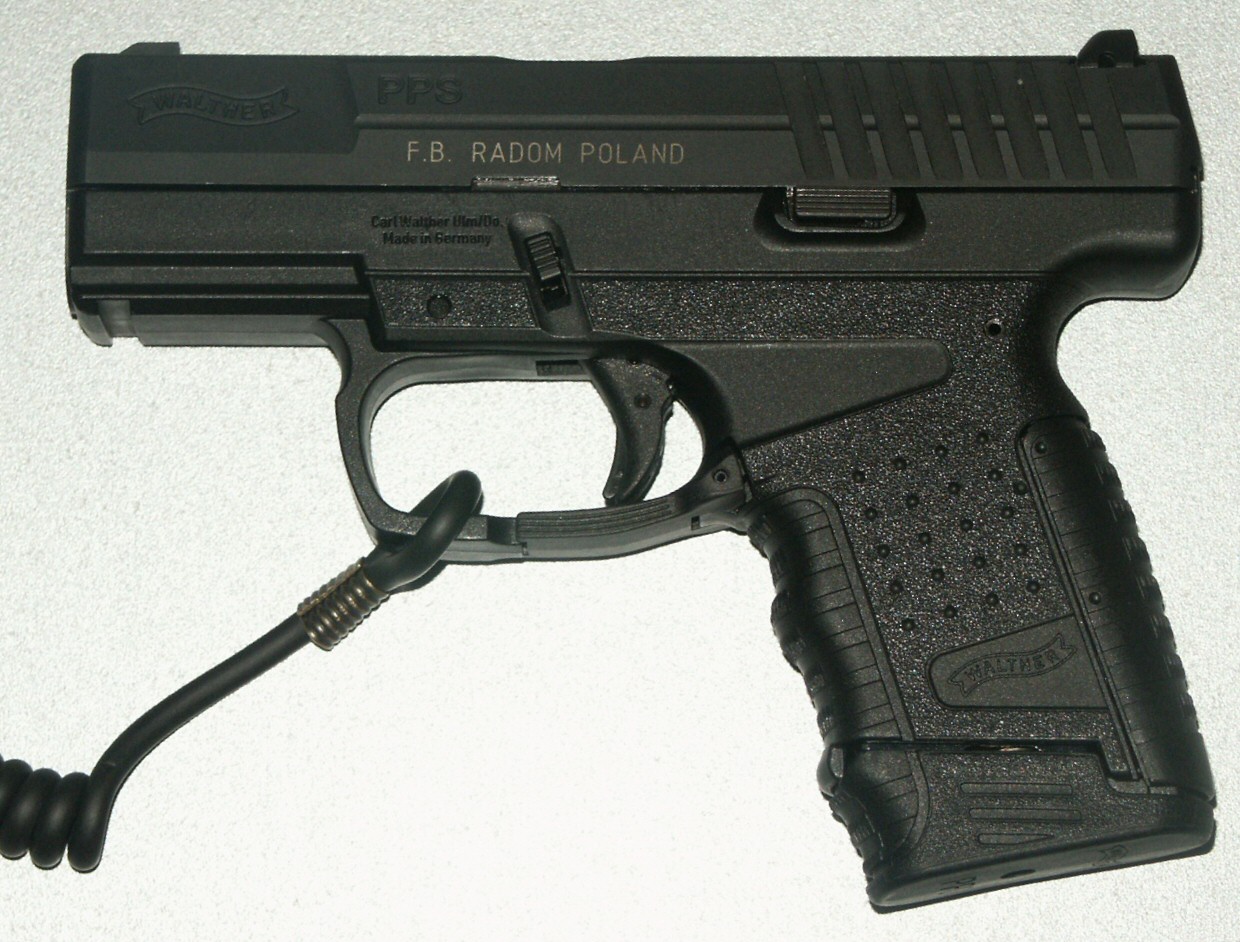
What the Shield added was the full-size service pistol’s controls and grip in a pistol thin enough for inside-the-waistband carry, at a price below $450, from a maker with a police-service pistol line behind it. That is a commercial achievement rather than a technical first, and it is worth saying plainly, because “the Shield created the single-stack micro-nine” is a common sentence and it is not true. The Shield made the category the default. It did not invent it.
1.4 Why single-stack was the answer in 2012
A single-column magazine stacks cartridges one directly above another. A double-column magazine staggers them, so it holds roughly twice as many rounds in the same length at the cost of roughly half a cartridge diameter more width. For a carry pistol the width is the whole problem: the grip is the part of the pistol that prints through clothing, and a grip thick enough to hold a staggered column of 9×19 was, in 2012, a compact service pistol rather than a carry pistol.
The single-stack answer traded capacity for width. The original Shield carried 7+1 flush or 8+1 extended.2 That was the price of a grip under an inch, and for most of the following decade the market judged it a price worth paying.
1.5 Three million in a decade
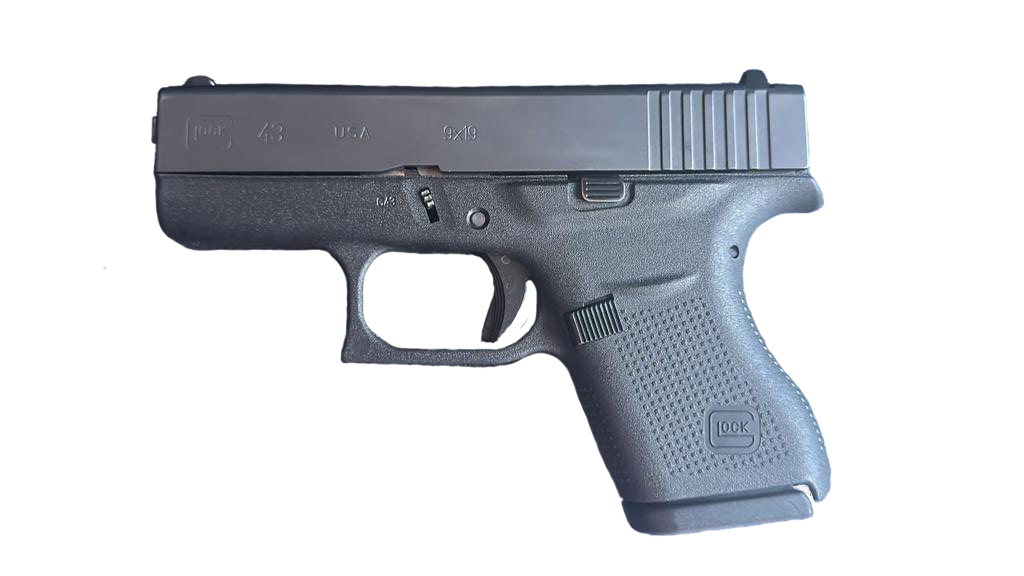
The measure of the Shield’s success is Smith & Wesson’s own. Announcing its successor on 15 March 2021, the company’s vice president of marketing said: “With over three million M&P Shield pistols sold in the past decade, the Smith & Wesson M&P Shield is a proven, reliable platform.”1 That is a company figure in a product launch and it is quoted as such; no independent production total was located. It is, on its face, a figure for all Shields — 9 mm, .40 and .45, original and M2.0 — and not for the 9 mm alone.
The Shield M2.0. Smith & Wesson announced the M2.0 version of the Shield in October 2017, in 9 mm and .40 S&W, carrying over the M2.0 trigger and grip texture from the full-size M&P M2.0, with Crimson Trace laser versions.10 The M2.0 Shield kept the single-stack magazine. Smith & Wesson’s current listing for the .40 M2.0 describes “aggressive grip texture”, the “M2.0 Trigger”, a 3.1-inch stainless barrel with a 1:16 twist, and a 7-round magazine.11
⚠ The 9 mm M2.0 Shield is not in Smith & Wesson’s September 2026 catalogue. The company’s Shield M2.0 page lists only .40 S&W and .45 ACP models, with and without a thumb safety.12 The 9 mm single-stack Shield has, in practice, been replaced by the Shield Plus. Smith & Wesson still sells 9 mm single-stack Shield magazines (below and in Volume 3), which is the expected support for a very large installed base.
1.6 January 2018: the P365
In January 2018 SIG Sauer introduced the P365, a striker-fired 9×19 micro-compact whose flush magazine held ten rounds.13 The Firearm Blog’s account from SHOT Show that year put the point in one line: “Sig Sauer brought a double stack 9mm magazine smaller than most of the single stack 9mm.” It shipped with two ten-round magazines, one with a pinky extension, with a 12-round magazine available separately, at an MSRP of $599.13 SIG’s own description of the magazine, as widely reproduced from its release, is a “narrow-neck, modified double-stack” design; SIG’s site refused automated access for this work and that phrase is therefore attributed to the reproductions rather than to a page read directly.
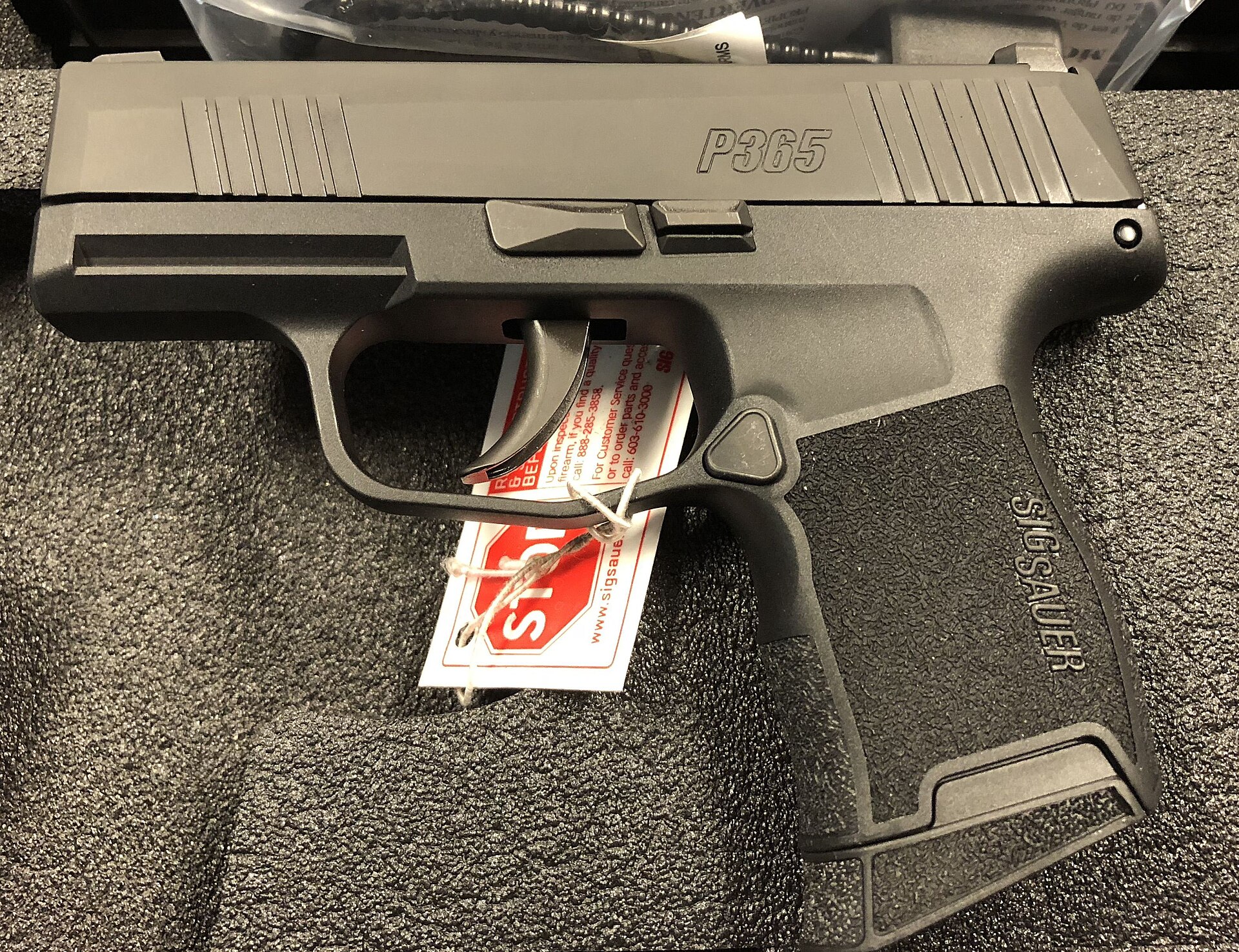
The significance is arithmetic. The original Shield’s grip bought its width by giving up capacity: seven flush, eight extended. The P365 matched the width and gave back the capacity: ten flush. Once one maker had shown that a staggered column could be narrowed at the top enough to fit a carry-width grip, the premise of the single-stack carry pistol — that thinness required seven rounds — no longer held. Springfield Armory’s Hellcat followed in September 2019.14
This is the event that ended single-stack dominance, not a change in taste. A single-stack nine is still easier to make thin, and still a perfectly serviceable carry pistol. What changed is that it stopped being the only way to be thin, and a buyer offered the same width with three more rounds took them.
1.7 “Shield is Back”: the Shield Plus
Smith & Wesson’s answer came on 15 March 2021, under the headline “Shield is Back: Introducing the New M&P Shield® Plus”. The press release calls it “the next evolution of the Smith & Wesson M&P Shield pistol” and “the most advanced M&P Shield pistol to date, featuring a magazine capacity up to 13 rounds in a slim, micro-compact frame.” Standard models came with “a flat-face trigger, a new, optimized grip texture designed for concealed carry, and two-magazines: an extended 13+1 round magazine and a flush fit 10+1 round magazine.” Performance Center models added “porting, fiber optic sights, longer slides, and optics cuts.” The MSRP started at $553.1
Two things in that release matter for the rest of this dive.
It kept the name. The Shield Plus is marketed as a Shield and shares much of the Shield’s upper — Smith & Wesson sells a 3.1-inch barrel that “fits any Shield or Shield Plus with 3.1” Barrel” and an optics-ready slide it describes as “Drop-in Fit - Change the slide on your M&P® Shield 1.0, 2.0 or SHIELD PLUS.”1516 The frame and magazine are what changed. A pistol whose upper interchanges and whose magazine does not is exactly the pistol on which magazine errors are made, which is why Volume 3 exists.
It is not a single-stack pistol. Smith & Wesson’s release and product pages call the Shield Plus “large capacity” and “micro-compact” and do not describe the column arrangement. American Rifleman’s April 2021 review reports that Smith & Wesson terms it a “stack-and-a-half” design, “evidenced by the wider body dimensions of the Shield Plus magazine versus that of the original Shield”, and gives the pistol’s widest point as 1.1 inches against the original’s 0.95 — 0.15 inch bought back for three more rounds.5 The same review notes that “due to the entirely new nature of the trigger, aftermarket options designed for use in the original M&P Shield will not work in the Shield Plus.” The practical fact is ten rounds flush where the original carried seven, in a grip Smith & Wesson lists at the same 4.6-inch height.
1.8 The Shield X, and a name that now covers four pistols
In July 2025 Smith & Wesson added the Shield X. Its product page gives a “3.6” 1:10” twist stainless steel barrel”, a “longer grip to maximize capacity”, a “reversible magazine catch”, a “flat-plane RMSc/K optic cut and front rail”, Smith & Wesson’s “ClearSight™ Cut” to divert gas away from an optic, and “(one) 13-round and (one) 15-round magazines”, at $599.4 Smith & Wesson’s combined Shield Plus and Shield X manual adds the point that matters most to an owner of either: “The grip length of a SHIELD® Plus pistol is shorter than the grip length of the SHIELD X™ pistol … The magazines are not directly interchangeable.”17
The result is a family name that, in September 2026, covers:
Table 2 — The result is a family name that, in September 2026, covers
| Pistol | Introduced | Magazine family | Mechanism |
|---|---|---|---|
| M&P Shield | 2012 | Shield single-stack (7 / 8 in 9 mm) | striker |
| M&P Shield M2.0 | 2017 | Shield M2.0 single-stack (8 in 9 mm) | striker |
| M&P Shield Plus | 2021 | Shield Plus (10 / 13 / 15) | striker |
| M&P Shield X | 2025 | Shield X (13 / 15) | striker |
| M&P Shield EZ | (.380 and 9 mm models) | Shield EZ | hammer-fired, grip safety |
The Shield EZ shares the name and not the design. It is covered in Volume 2 only so that it is not confused with the rest, and its recall — the only Shield-family recall on Smith & Wesson’s current recalls page — is set out in Volume 4.
1.9 The pistol documented here
The pistol documented here is a Smith & Wesson M&P Shield in 9×19 with a 3.1-inch barrel. The owner’s records do not say which generation it is, and nothing in this dive assumes one. A 3.1-inch barrel is consistent with the original Shield, the Shield M2.0 and the standard Shield Plus, and it rules out the 3.6-inch Shield X and the 4-inch variants. Beyond that the barrel says nothing, and Volume 2 sets out how to tell the rest apart from the pistol itself.
As documented in September 2026 it carries a Leupold DeltaPoint Micro with a 3 MOA dot, a reflex sight that replaces the rear iron sight in the slide’s dovetail. That choice bears on which slides it fits and on how the pistol carries, and is the subject of Volume 5.
1.10 How the rest of this dive is organised
Table 3 — How the rest of this dive is organised
| Vol | Subject |
|---|---|
| 1 | This volume — history and the category |
| 2 | Reading a Shield — generations, variants, and how to tell them apart |
| 3 | Magazines — what Smith & Wesson says fits, and why the common answer is wrong |
| 4 | How it works — the cycle, striker, sear, safeties, and the 2013 safety alert |
| 5 | The DeltaPoint Micro — a dot in the rear-sight dovetail, and carrying it |
| 6 | Owning and carrying one in Michigan |
| 7 | Keeping it working — field strip, detail strip, maintenance and repair |
1.11 Bibliography
Footnotes
-
Smith & Wesson Inc., press release “Shield is Back: Introducing the New M&P Shield® Plus”, Springfield, Mass., 15 March 2021, hosted on Smith & Wesson’s asset server: https://assets.contentstack.io/v3/assets/bltb61dcb3c40854cd9/blt7f3b7e95c220c2b7/636d1f048d4c7b7d089925ac/PR_ShieldPlus_Final.pdf (accessed 2026-09-19). All quotations in this volume are verbatim from it. ↩ ↩2 ↩3 ↩4 ↩5
-
“The Smith & Wesson M&P Shield”, American Rifleman, 12 April 2012, https://www.americanrifleman.org/articles/2012/4/12/the-smith-wesson-mp-shield/ (accessed 2026-09-19). Launch at the NRA Annual Meetings, St. Louis; dimensions, weight, frame width “0.95 inches at its thickest”, barrel, magazines, “thumb safety switch”, trigger reset, MSRP $449. Smith & Wesson’s own investor-relations release for the launch timed out on every request made for this work and could not be read. ↩ ↩2 ↩3 ↩4 ↩5 ↩6
-
Smith & Wesson, product listing “M&P 9 SHIELD PLUS”, item 13248, $499, read from the page’s structured product data at https://www.smith-wesson.com/product/m-p-9-shield-plus (accessed 2026-09-19): 3.1 in stainless barrel, capacity 10 and 13, 17.9 oz, width 1.1 in, height 4.6 in. ↩ ↩2
-
Smith & Wesson, product listing “M&P® SHIELD X™ NO THUMB SAFETY”, item 14263, $599, listed 28 July 2025, https://www.smith-wesson.com/product/m-p-shield-x-no-thumb-safety (accessed 2026-09-19). ↩ ↩2 ↩3
-
“Review: Smith & Wesson M&P Shield Plus”, American Rifleman, 19 April 2021, https://www.americanrifleman.org/content/review-smith-wesson-m-p-shield-plus/ (accessed 2026-09-19): widest-point widths, the “stack-and-a-half” term attributed to Smith & Wesson, and aftermarket trigger incompatibility. ↩ ↩2
-
Smith & Wesson, “Smith & Wesson M&P Shield X vs. Shield Plus: A Detailed Comparison”, article embedded in smith-wesson.com product pages (accessed 2026-09-19): comparison table giving barrel, length, width and weight for both pistols. ↩
-
“Smith & Wesson M&P”, English Wikipedia, consulted 2026-09-19 — introduction in the summer of 2005. ↩
-
“Walther PPS”, English Wikipedia, consulted 2026-09-19 — first shown in 2007 at IWA & OutdoorClassics. ↩
-
“Ruger LC9”, English Wikipedia, consulted 2026-09-19 — introduced at the 2011 SHOT Show. ↩
-
“First Look: Smith & Wesson M&P Shield M2.0 Pistol Series”, American Rifleman, 16 October 2017, and “First Look: Smith & Wesson M&P Shield M2.0”, Shooting Illustrated, 17 October 2017 (consulted 2026-09-19 through search listings; Smith & Wesson’s own 2017 release was not retrieved). Announcement date, calibres and Crimson Trace variants. ↩
-
Smith & Wesson, product listing “M&P®40 SHIELD M2.0® NO THUMB SAFETY”, item 14657, $399, https://www.smith-wesson.com/product/m-p-40-shield-m2-0-no-thumb-safety (accessed 2026-09-19). ↩
-
Smith & Wesson product category pages https://www.smith-wesson.com/products/shield-m2-0,
/shield-plusand/shield-x, read 2026-09-19. ↩ -
“Sig Sauer Launches the New P365 and More”, The Firearm Blog, 26 February 2018, https://www.thefirearmblog.com/blog/2018/02/26/new-sig-sauer-p365/ (accessed 2026-09-19). SIG Sauer’s own pages returned HTTP 403 to every automated request made for this work, and no Wayback Machine capture of its 2018 release page exists. ↩ ↩2
-
“Springfield Armory Hellcat”, English Wikipedia, consulted 2026-09-19 — introduced September 2019. ↩
-
Smith & Wesson, “SHIELD AND SHIELD PLUS 3.1IN 9MM BARREL”, item 14471, $119: “Barrel fits any Shield or Shield Plus with 3.1” Barrel.” (accessed 2026-09-19). ↩
-
Smith & Wesson, “M&P®9 SHIELD OR SHIELD PLUS FDE OPTIC READY SLIDE FOR 3.1IN BARREL”, item 14482, $299: “Optic Ready, Drop-in Fit - Change the slide on your M&P® Shield 1.0, 2.0 or SHIELD PLUS.” (accessed 2026-09-19). ↩
-
Smith & Wesson, Safety & Instruction Manual for SHIELD® PLUS and SHIELD X™ pistols, dated 07/08/25, part 3017716, https://smith-wesson.canto.com/direct/document/64u457llr51g7db5vqethvi635/gY5JDnG1Bq08wv-8wMzkvdugsCU/original?content-type=application/pdf&name=SHIELD_PLUS&X_Manual_070825_3017716.pdf (accessed 2026-09-19). “Note about magazines and interchangeability”. ↩
Comments (0)