Smith & Wesson M&P Shield · Volume 4
How It Works — The Cycle, Striker, Sear, Safeties, and the 2013 Safety Alert
The M&P fire control shrunk into a carry pistol, read from Smith & Wesson's own patents and manuals, and the two safety notices that bear the Shield name
Smith & Wesson publishes no exploded diagram of the Shield’s fire control, and the manual forbids disassembly beyond the field strip. What it does publish is a list of the patents that “may” cover the pistol, printed in the back of the 2012 manual, and a set of manual descriptions of what each control does.1 Four of those patents describe, in the company’s own words, the mechanism the Shield inherits from the full-size M&P. This volume reads the mechanism from them and from the manuals, and says where the one is not proof of the other.
4.1 What the sources are, and what they are not
The patents below all name Smith & Wesson as assignee and all appear in the 2012 Shield manual’s patent list. The list is introduced with the words “This product may be covered by one or more of the following patents”, which is a statement that each patent may read on the product, not that every embodiment described in each patent is built into the Shield.1
Table 1 — What the sources are, and what they are not
| Patent | Title | Inventors | Filed / granted |
|---|---|---|---|
| US 7,617,628 | Fire Control Mechanism for a Firearm | Brett Curry | 22 Dec 2005 / 17 Nov 2009 |
| US 7,703,230 | Positive Striker Lock Safety for Use with a Firearm | Brett Curry, Gary Zukowski | 22 Dec 2005 / 27 Apr 2010 |
| US 7,472,507 | Firearm with Modular Sear and Trigger Mechanism Housings | Brett Curry, Michael Poulin | 22 Dec 2005 / 6 Jan 2009 |
| US 7,194,833 | Firing Mechanism for Semi-Automatic Pistols | Brett Curry | 10 Feb 2004 / 27 Mar 2007 |
The three December 2005 filings share a set of December 2004 provisional applications and date from the development of the full-size M&P, which reached the market in 2005.2345 Where the text below says “the patent describes”, that is exactly what is meant.
4.2 The action: short recoil, locked breech
The M&P family is a short-recoil, locked-breech design.5 The manual’s field-strip and assembly instructions describe the parts of it an owner handles: a barrel with a lug beneath the chamber, removed “by grasping the barrel lug and lifting it up and back”; a captive recoil spring assembly whose rear end must be tipped “into the notch on the barrel lug” and “properly seated against the barrel lug”; and a slide stop that engages a notch in the slide.6 Smith & Wesson’s manuals do not describe the locking geometry, and none is described here.
4.3 The cycle of operation, step by step
Smith & Wesson’s own description of a shot is one paragraph: “As the trigger is drawn fully to the rear, the striker assembly is released, striking the cartridge primer and firing the round. Upon firing, the slide moves rearward thereby extracting and ejecting the spent cartridge case. The slide then returns forward feeding the next cartridge from the magazine into the barrel chamber.” Then: “After firing you must allow the trigger to move fully forward to reset before you can fire another shot,” and, on the last round, “the magazine follower exerts upward pressure on the slide stop causing it to engage the slide and to hold it in the ‘open’ position.”6
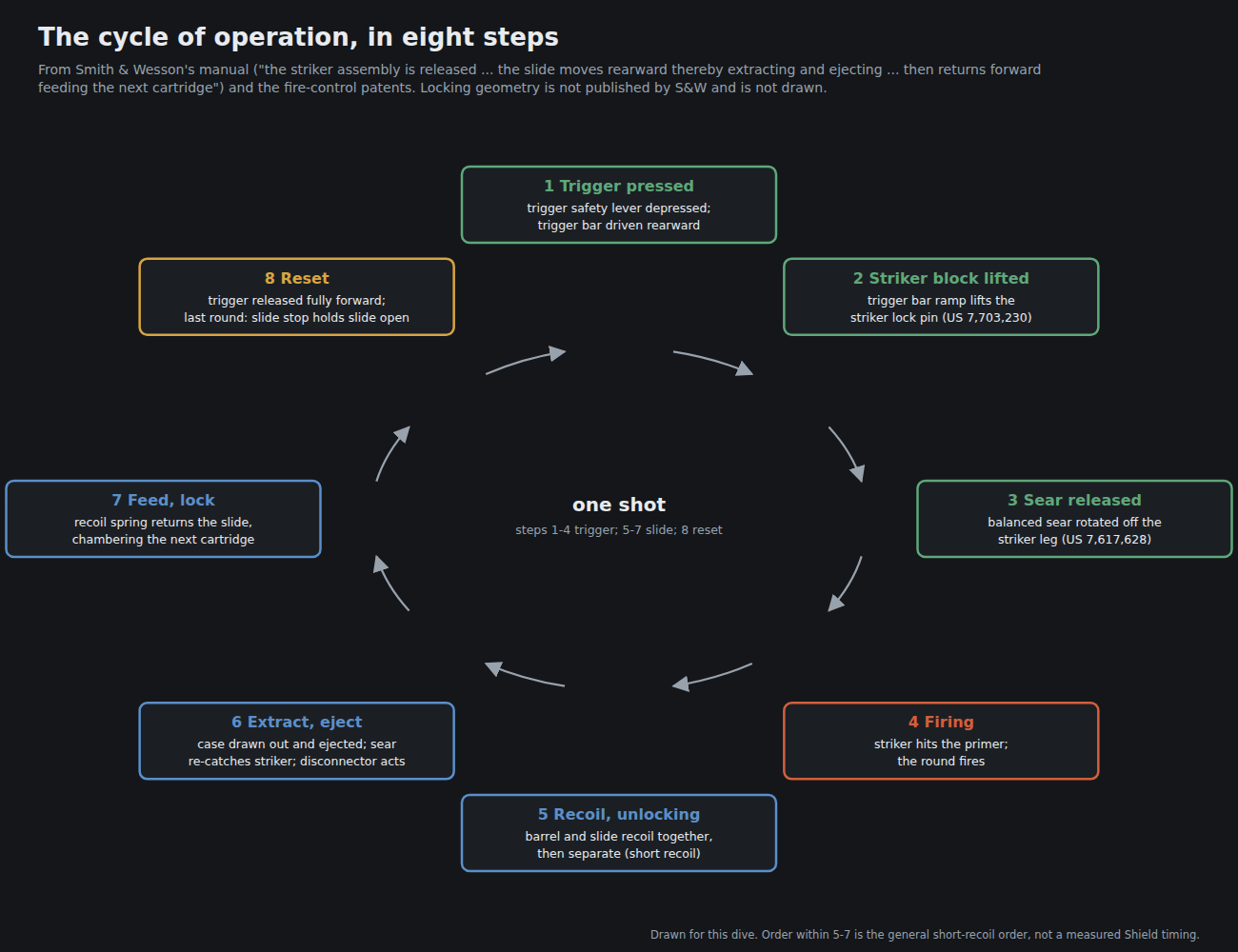
Laid out as a cycle, with each step attributed:
Table 2 — Laid out as a cycle, with each step attributed
| Step | What happens | Source |
|---|---|---|
| 1. Trigger pressed | the trigger safety lever is depressed and the trigger moves rearward, driving the trigger bar | manual; US 7,617,628 |
| 2. Striker block lifted | the trigger bar’s sloped surface lifts the striker lock pin at the end of the stroke | US 7,703,230 |
| 3. Sear released | the trigger bar rotates the balanced sear off the striker’s leg; “the striker assembly is released” | US 7,617,628; manual |
| 4. Firing | the striker hits the primer and the round fires | manual |
| 5. Recoil and unlocking | barrel and slide recoil together and separate; “the slide moves rearward” | short recoil: see above; manual |
| 6. Extraction and ejection | the slide draws the case from the chamber and ejects it; the striker is re-caught by the sear; the disconnector holds the trigger bar off the sear while the slide is out of battery | manual; US 7,617,628 |
| 7. Feeding and locking | the recoil spring drives the slide forward, “feeding the next cartridge from the magazine into the barrel chamber” | manual |
| 8. Reset | the trigger must “move fully forward to reset” before the next shot; on the last round the follower raises the slide stop instead | manual |
Two cautions. The order within steps 5–7 is the general order for any short-recoil, locked-breech pistol, not a timing measured on a Shield; no source consulted gives the Shield’s timing. And step 6’s “re-caught by the sear” is the manual’s “lockwork” returning to its starting state, which the manual describes only by its consequence — that the trigger must be released for the next shot. How much the slide’s travel cocks the striker is the open question set out below.
4.4 The striker and the sear
Patent 7,617,628 describes a striker-type firing pin with “a depending leg” held by a sear, and a sear that is unusual in one respect: it “is pivotally balanced about a central fulcrum, and is biased in a first pivotal direction by a spring. In this position, a rear portion of the sear engages the firing pin.” Rearward movement of the trigger bar engages “a forward portion of the sear” and “pivots the sear in a second pivotal direction, against the spring, which releases the firing pin.”2
A sear balanced about its middle is a sear that an inertial shock tends not to rotate: a blow along the bore axis pushes both ends of it equally. The patent does not make a drop-safety argument in those words, and none is attributed to it here; it is the geometric property of a centrally pivoted, balanced part, and it is the reason the arrangement is worth noticing.
Patent 7,472,507 puts the sear in its own sear housing and the trigger mechanism in a separate trigger mechanism housing, each carrying slide rails that “fully or partially replace the rails previously integrally formed as part of the frame.”4 The polymer frame of an M&P-pattern pistol is, on this description, a grip and a magazine well into which separate housings carrying the rails and the fire control are fitted. The patent does not tie the housings to a material, and none is asserted.
4.5 Part-cocked or fully cocked?
The usual question about any striker pistol is how far the slide cocks the striker and how much of the job is left to the trigger. Smith & Wesson’s Shield manuals do not say. They describe firing only in these terms: “As the trigger is drawn fully to the rear, the striker assembly is released.”1
One patent on the Shield’s list does address it. Patent 7,194,833, the earliest of the four, describes a sear whose engagement with the firing pin’s leg is deep enough “to enable the sear to move the firing pin rearwardly to its fully cocked position before the sear is moved so that its sear surface disengages the leg” — that is, the trigger stroke carries the striker the last part of the way back before releasing it.7
⚠ This is not confirmed for the Shield. The 7,194,833 mechanism uses a pivot-arm assembly that differs from the balanced sear of 7,617,628, the two patents describe different embodiments, and the manual’s patent list does not say which reads on which model. The claim that a Shield’s trigger finishes cocking its striker is therefore attributed to one patent on a list, and is not stated as a fact about the pistol documented here.
4.6 The articulated trigger
The M&P-pattern trigger is hinged. Patent 7,617,628 allows that the trigger “may be of unitary construction, as shown, or of a multiple-piece articulated construction.”2 Smith & Wesson’s current manual labels the lower part the “trigger safety lever” on both the Shield Plus and the Shield X.6 Smith & Wesson’s 2013 safety alert refers to the “lower trigger” and ties it in terms to “the drop safety feature of the firearm” (below).8
The principle is that of any blade-in-trigger or hinged-trigger design: the trigger cannot move rearward as a unit unless the lower part is first pressed, which a finger does and an inertial load on the trigger alone does not. The storage warning in the manual — never use a lock “that continually or prolongedly depresses the trigger or trigger safety” — confirms that Smith & Wesson treats the trigger safety as a working part that can be damaged by sustained pressure.6
4.7 The striker block
Patent 7,703,230 describes “an automatic positive striker lock safety” consisting of “a pin-like safety element biased downwards to normally block the striker. The bottom of the pin is rounded, and cooperates with a rearwards facing, sloped surface on the trigger bar.” Only “full rearwards movement of the trigger automatically causes the safety pin to unblock the striker”.3
This is the second, independent barrier: even if the sear released the striker by some other means — a broken sear, a severe impact — the striker would meet the block unless the trigger bar had been driven fully back to lift it.
4.8 The disconnector
Patent 7,617,628’s abstract states that “movement of the slide to a retired position causes the trigger bar to disengage from the sear (preventing discharge of the firearm) until the slide returns to a battery position.”2 This is the disconnector function: a slide out of battery takes the trigger bar out of engagement, and the trigger must be allowed forward to reset. The manual states the consequence for the shooter: “After firing you must allow the trigger to move forward fully before you can fire another shot.”1
4.9 The sear deactivation lever: takedown without a trigger pull
The feature M&P-pattern pistols are best known for is that the slide comes off without pulling the trigger, a point Smith & Wesson makes in its own product copy. Smith & Wesson’s Shield Plus listing names it: “M&P’s patented take-down lever and sear deactivation systems allow for disassembly without pulling the trigger.”9 Patent 7,617,628 figures a “sear deactivation lever of the present invention”.2
In use: with the slide locked open and the chamber confirmed empty, the owner uses “a small screwdriver (or a similar device) to gently push the yellow(ish) sear deactivation lever down (rotate forward) into the magazine well”, and the 2025 manual adds, against its figure, “Do not force lever down beyond this position.”6 Reassembly ends with the instruction to insert an empty magazine: “this returns the sear deactivation lever to normal operation mode.”6
That last step is the design’s own safeguard. The lever is lowered into the magazine well; a magazine pushes it back. A pistol reassembled without that step is not in its normal state until a magazine has been inserted, and the manual makes the insertion part of the procedure rather than leaving it to chance. The full sequence is in Volume 7.
4.10 The optional safeties
Two further safeties are fitted to some Shields and not others (Volume 2).
The manual thumb safety is a trigger block. The 2012 manual: “This feature prevents the trigger from moving rearward when the thumb safety lever is in the ‘SAFE’ position.” Up is safe, down is fire, and “the slide can still be opened and closed”, the magazine removed and installed, and the pistol loaded and unloaded “regardless of the position of the safety lever.”1 The 2025 manual repeats this for the Shield Plus and Shield X.6 The 2012 manual opens that section with “Your M&P SHIELD™ pistol is equipped with a manual thumb safety lever”, consistent with the launch pistol having one as standard.1
The magazine disconnect prevents firing with the magazine removed. The manual’s test for its presence is physical: with the slide locked open and the magazine out, a small lever is visible in the magazine well; if there is none, the pistol has no magazine disconnect. Its warning is blunt: if the pistol “is not equipped with a magazine disconnect safety, the pistol can be fired even when the magazine is removed.”6 The original-pattern pistol pictured in Volume 1, which has none, carries the frame warning “CAUTION-CAPABLE OF FIRING WITH MAGAZINE REMOVED”; whether every Shield without a magazine disconnect is so marked was not established.
4.11 Everything that must be true before the striker moves
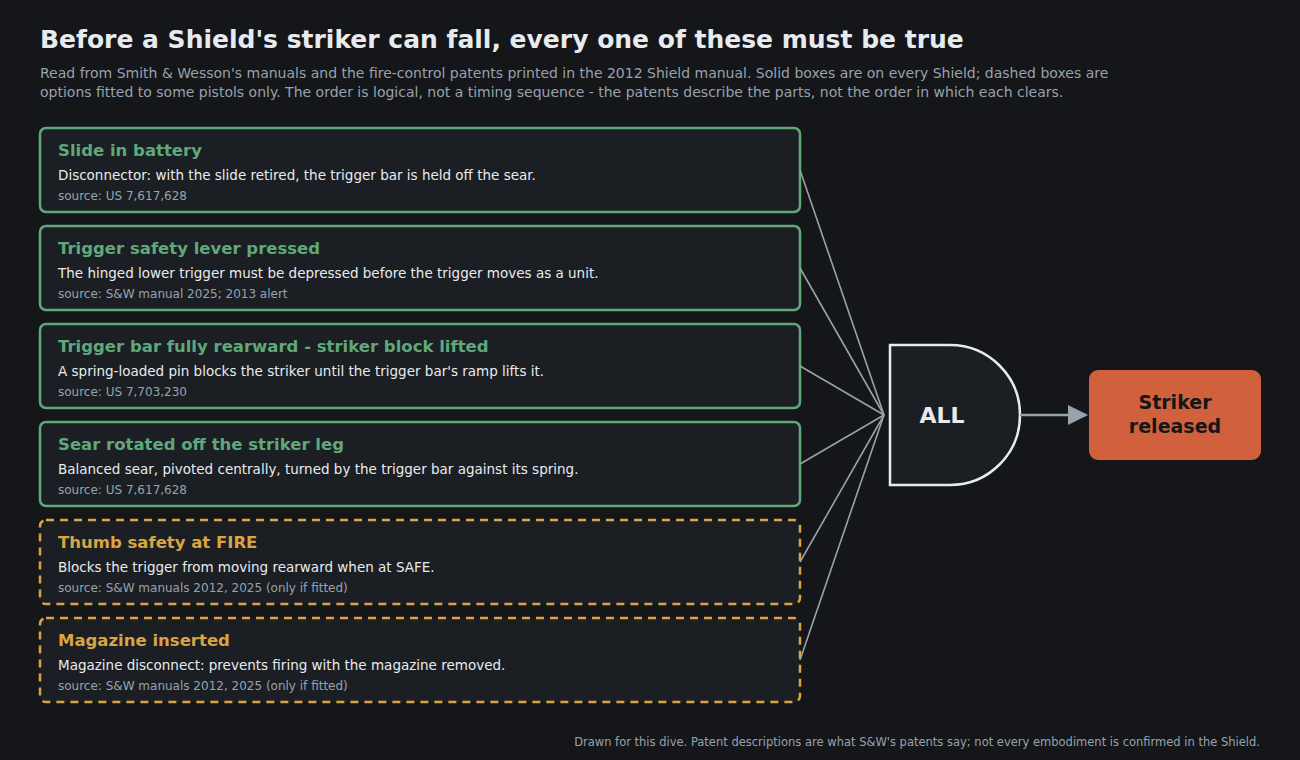
Put together, the patents and manuals describe a striker that can fall only when all of the following are true — the sequence drawn in the figure at the head of this volume:
Table 3 — Put together, the patents and manuals describe a striker that can fall only when all of the following are true — the sequence drawn in the figure at the head of this volume
| Condition | What satisfies it | Every Shield? |
|---|---|---|
| Trigger safety lever pressed | the finger on the lower trigger | yes |
| Striker block lifted | trigger bar at full rearward travel | yes (per 7,703,230) |
| Sear rotated off the striker leg | trigger bar on the sear’s forward portion | yes |
| Slide in battery | disconnector re-engaged | yes |
| Thumb safety off | lever down to “FIRE” | only if fitted |
| Magazine inserted | magazine disconnect lever displaced | only if fitted |
The order in the table is logical, not a timing claim. The patents describe the parts; they do not give the sequence in which each is cleared during the stroke, and none is asserted.
4.12 The 2013 safety alert
On 22 August 2013 Smith & Wesson announced that it had “identified a condition where the trigger bar pin could damage the lower trigger in certain M&P Shields in a way that may affect the functionality of the drop safety feature of the firearm, potentially allowing the pistol to discharge if it is dropped.”8 The notice’s scope, in Smith & Wesson’s words:
This Safety Alert applies to all M&P Shield pistols manufactured before August 19, 2013. We believe this condition is largely limited to recently manufactured M&P Shield pistols. However, out of an abundance of caution, we are asking all consumers of all M&P Shields manufactured before August 19, 2013 to immediately inspect their pistols for this condition.
Owners were told to “STOP USING YOUR PISTOL IMMEDIATELY UNTIL IT HAS BEEN INSPECTED AND, IF THE CONDITION IS FOUND, REPAIRED”, to use video inspection instructions at MPShieldSafetyAlert.com, or to take the pistol to an M&P Certified Armorer or send it to Smith & Wesson; affected pistols were repaired free, with shipping paid, and returned “within 5 to 7 business days.”8
Three things about it are worth recording accurately.
It was a safety alert, not labelled a recall. Smith & Wesson called it a “Safety Alert” and an “inspection procedure”; the press reported it as a recall.8
It concerned the lower trigger and the drop safety — the articulated trigger described above — and not the sear or the striker block.
It is no longer on Smith & Wesson’s recalls page. As read on 19 September 2026, Smith & Wesson’s consumer recalls page lists no notice for the striker-fired Shield at all.10 The microsite named in the alert survives in the Internet Archive only as an empty redirect page. The text quoted above is Smith & Wesson’s release as reproduced verbatim at the time by The Firearm Blog.8 An owner of an original Shield made before 19 August 2013 who does not know whether the pistol was inspected should ask Smith & Wesson, with the serial number; nothing on Smith & Wesson’s current pages says the alert has been closed.
4.13 The Shield EZ recall, and why it is not a Shield recall
The only notice with “Shield” in its name on Smith & Wesson’s current recalls page concerns the Shield EZ, a different, hammer-fired pistol (Volume 2). It covers EZ pistols “manufactured between March 1, 2020 and October 31, 2020”, in which a supplier hammer could crack so that “the hammer failed to fully engage the sear, causing the round to fire, cycling the slide, and potentially resulting in multiple discharges without depressing the trigger”. Smith & Wesson states: “In all cases, the firearm will NOT fire unless the grip safety is depressed”, and, in capitals, that the notice “does NOT apply to all SHIELD™ pistols.” The date of manufacture is read from “the label on the box.”11
It is recorded here for one reason: a search for “Shield recall” returns it first, and it does not apply to the pistol this dive documents.
4.14 Two warnings in the manual that are about the mechanism
Staging the trigger. The 2012 manual carries a specific warning: “It has come to our attention that some users of Smith & Wesson handguns may stage the trigger in anticipation of firing a shot … if the user decides not to fire, release of the trigger from a position close to the firing point in the staging process could result in an unintentional discharge.”1 On a striker pistol with a short reset, this is a warning about the mechanism as much as about technique.
Locks on the trigger. “Do not use any lock, cable, or device that continually or prolongedly depresses the trigger or trigger safety … Any lock or storage device that applies continuous pressure to the trigger or trigger safety can damage components, resulting in the malfunction of the safety and creating an unsafe condition.”6 This bears directly on storage under Michigan’s 2024 safe-storage law, and Volume 6 returns to it.
4.15 Bibliography
Footnotes
-
Smith & Wesson, Safety & Instruction Manual, M&P SHIELD™ Pistols, © 2012 — firing, staging warning, thumb safety, magazine disconnect, loaded chamber indicator, patent information page. Copy hosted at https://savannaharsenal.files.wordpress.com/2014/05/mp_shield_manual_04-02-2012.pdf (accessed 2026-09-19); Smith & Wesson’s own manual portal is script-only. ↩ ↩2 ↩3 ↩4 ↩5 ↩6 ↩7
-
US Patent 7,617,628 B2, “Fire Control Mechanism for a Firearm”, B. Curry, assignee Smith & Wesson Corp., filed 22 December 2005, granted 17 November 2009. Abstract and detailed description, including Figures 10–13 (sear deactivation lever). Text read from the USPTO image PDF at https://patentimages.storage.googleapis.com/pdfs/US7617628.pdf (accessed 2026-09-19). ↩ ↩2 ↩3 ↩4 ↩5
-
US Patent 7,703,230 B2, “Positive Striker Lock Safety for Use with a Firearm”, B. Curry and G. Zukowski, assignee Smith & Wesson Corp., filed 22 December 2005, granted 27 April 2010, https://patentimages.storage.googleapis.com/pdfs/US7703230.pdf (accessed 2026-09-19). ↩ ↩2
-
US Patent 7,472,507 B2, “Firearm with Modular Sear and Trigger Mechanism Housings”, B. Curry and M. J. Poulin, assignee Smith & Wesson Corp., filed 22 December 2005, granted 6 January 2009, https://patentimages.storage.googleapis.com/pdfs/US7472507.pdf (accessed 2026-09-19). ↩ ↩2
-
“Smith & Wesson M&P”, English Wikipedia, consulted 2026-09-19 — “a polymer-framed, short recoil operated, locked breech semi-automatic pistol introduced in the summer of 2005”. ↩ ↩2
-
Smith & Wesson, Safety & Instruction Manual for SHIELD® PLUS and SHIELD X™ pistols, 07/08/25, part 3017716, https://smith-wesson.canto.com/direct/document/64u457llr51g7db5vqethvi635/gY5JDnG1Bq08wv-8wMzkvdugsCU/original?content-type=application/pdf&name=SHIELD_PLUS&X_Manual_070825_3017716.pdf (accessed 2026-09-19). ↩ ↩2 ↩3 ↩4 ↩5 ↩6 ↩7 ↩8 ↩9
-
US Patent 7,194,833 B1, “Firing Mechanism for Semi-Automatic Pistols”, B. Curry, assignee Smith & Wesson Corp., filed 10 February 2004, granted 27 March 2007, https://patentimages.storage.googleapis.com/pdfs/US7194833.pdf (accessed 2026-09-19). ↩
-
Smith & Wesson Corp., safety alert release, Springfield, Mass., 22 August 2013, reproduced verbatim in “SAFETY RECALL: Alert and Inspection Procedure for M&P Shield Pistols”, The Firearm Blog, 22 August 2013, https://www.thefirearmblog.com/blog/2013/08/22/safety-alert/ (accessed 2026-09-19). The alert’s microsite, mpshieldsafetyalert.com, is captured by the Internet Archive between 2014 and 2018 only as a script redirect with no content. ↩ ↩2 ↩3 ↩4 ↩5
-
Smith & Wesson, “M&P 9 SHIELD PLUS”, item 13248, https://www.smith-wesson.com/product/m-p-9-shield-plus (accessed 2026-09-19). ↩
-
Smith & Wesson, “Consumer Firearm Recalls”, https://www.smith-wesson.com/safety/recalls, read 2026-09-19. ↩
-
Smith & Wesson, “M&P® Shield™ EZ™ Recall Notice for Pistols”, https://www.smith-wesson.com/safety/recall/recall-notice-for-pistols (accessed 2026-09-19). ↩
Comments (0)