Smith & Wesson M&P Shield · Volume 2
Reading a Shield — Generations, Variants, and How to Tell Them Apart
Original, M2.0, Shield Plus, Shield X, Performance Center and the unrelated Shield EZ — and why the name on the slide does not settle the question
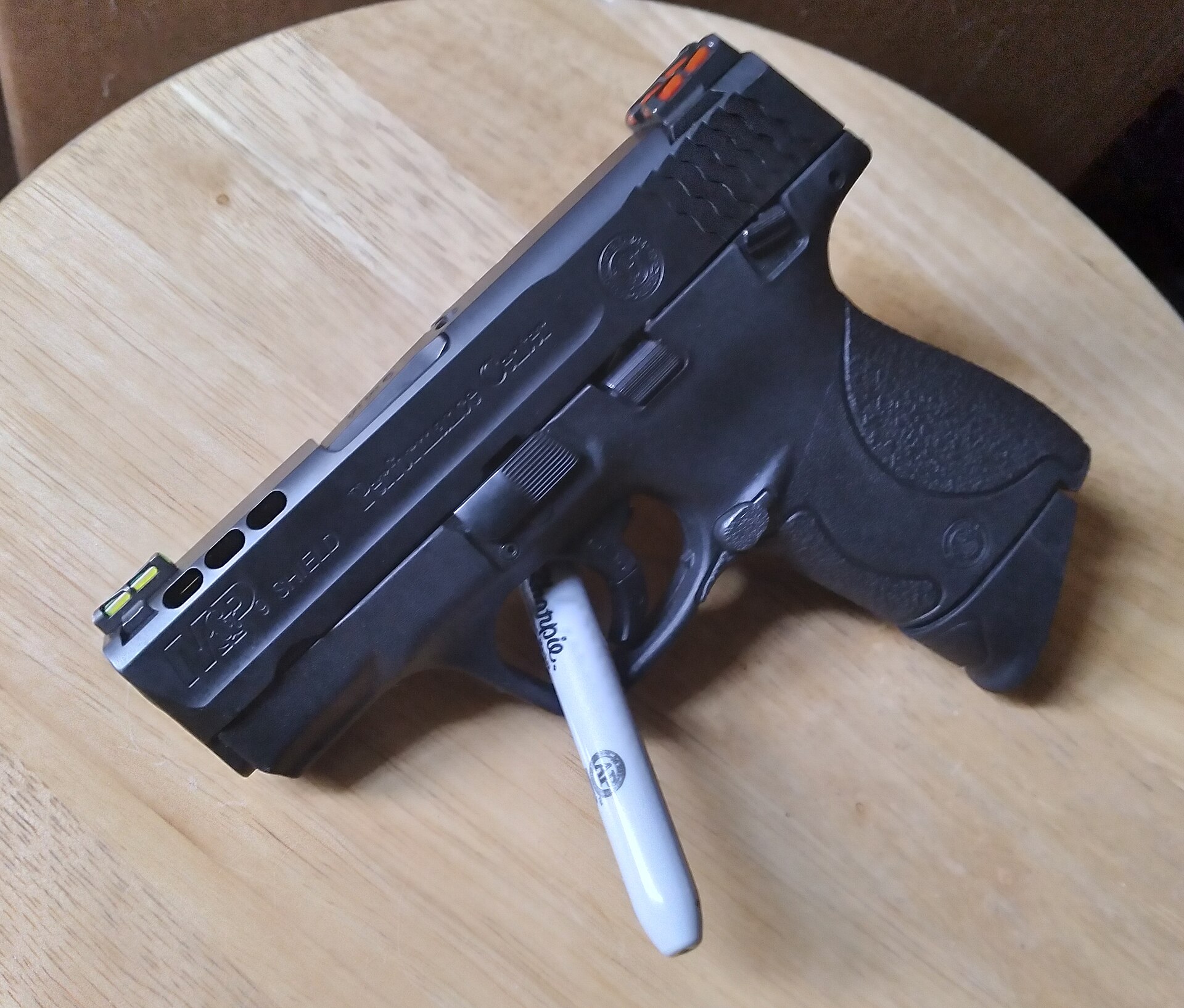
A Shield is identified by what it is built on, not by what it is called. Smith & Wesson has sold five pistols under the name since 2012, in three calibres, with and without a thumb safety, with and without a magazine disconnect, with and without an optic cut, and with standard and Performance Center slides. Several of those options are independent of the generation, and the most visible marking on the pistol — the model name — is on the one major part that Smith & Wesson itself sells as interchangeable between generations.
This volume sets out what changed at each step, which features are generation markers and which are options, and a procedure for identifying a given pistol that does not depend on any one marking.
2.1 The family at a glance
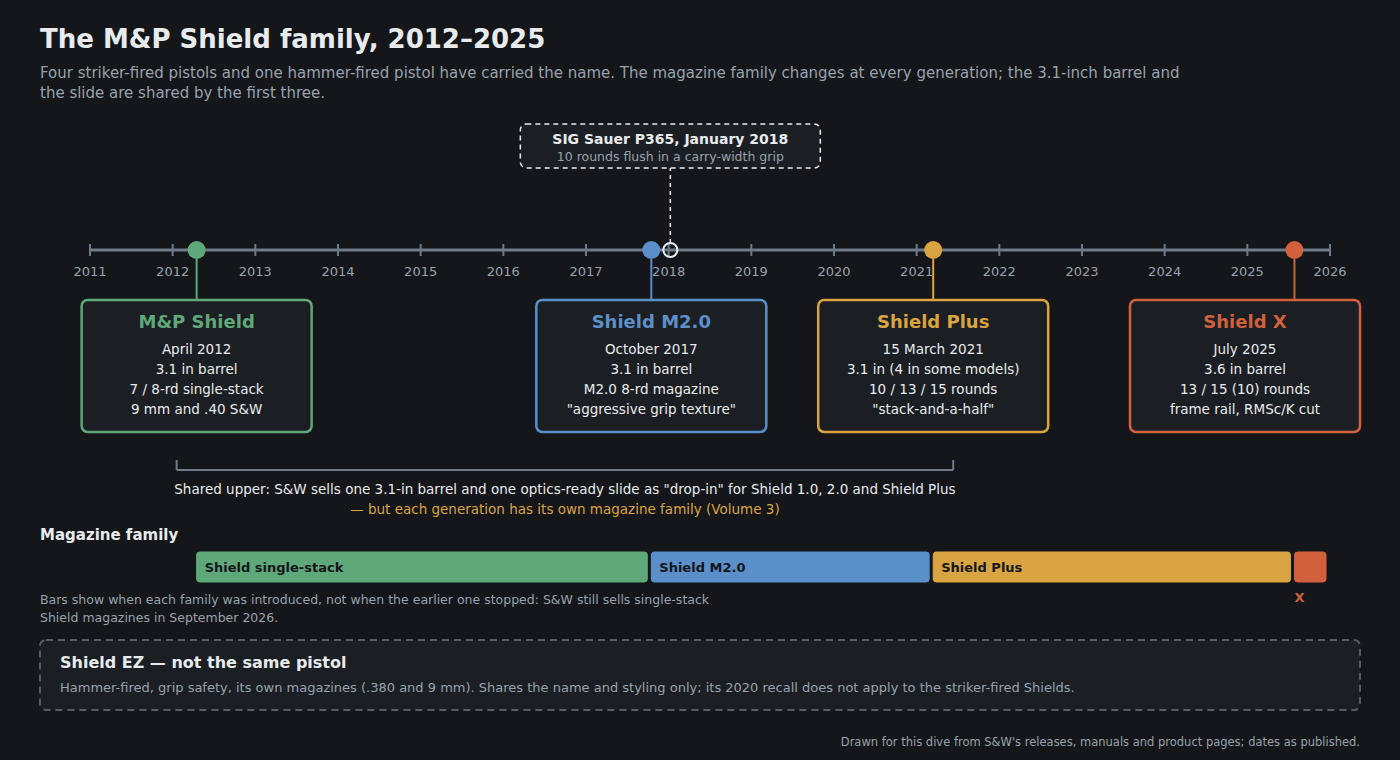
Table 1 — The family at a glance
| Introduced | 9 mm magazines (flush / extended) | Barrel | Trigger | Optic cut | |
|---|---|---|---|---|---|
| M&P Shield | April 2012 | 7 / 8 | 3.1 in | hinged, curved blade | no |
| M&P Shield M2.0 | October 2017 | 8 (M2.0 magazine “with finger rest”) | 3.1 in | ”M2.0 Trigger” | none found on standard models in the sources consulted |
| M&P Shield Plus | March 2021 | 10 / 13, and 15 | 3.1 in; 4 in on some models | flat-face | on “optics ready” and Performance Center models |
| M&P Shield X | July 2025 | 13 / 15 | 3.6 in | flat-face | RMSc/K on standard models |
| M&P Shield EZ | — | its own | — | hammer-fired, grip safety | — |
Sources: the 2012 launch description, Smith & Wesson’s 2021 release, and Smith & Wesson’s product and parts listings as of September 2026.12345 Calibres beyond 9 mm are left out of the table: the original and M2.0 Shields were also made in .40 S&W and the M2.0 in .45 ACP, and Smith & Wesson lists a Shield Plus in 30 Super Carry, so “Shield Plus” is not by itself a statement that the pistol is a 9 mm.6
2.2 The trap: the model name is on the part that interchanges
Smith & Wesson’s own manual shows where to look. Its “Model & Features Identification” page has two photographs: the model name, rolled on the left side of the slide (“M&P 9 SHIELD PLUS” in the example), and the serial number, on the frame.7
Smith & Wesson also sells, as a factory part, an optics-ready slide described as “Drop-in Fit - Change the slide on your M&P® Shield 1.0, 2.0 or SHIELD PLUS”, and a 3.1-inch barrel that “fits any Shield or Shield Plus with 3.1” Barrel.”89
Put those two facts together and the difficulty is plain. A slide marking identifies the slide. A Shield Plus frame can carry a Shield 1.0 slide and the reverse, by the maker’s own design, and the result is a pistol whose most prominent marking names a generation that its frame — the serialised part, the part that sets the magazine, the grip and the trigger — is not. The magazine goes into the frame. So does the owner’s hand. A generation identification made from the slide is an identification of the wrong part.
⚠ This is not a claim that any particular pistol has had its slide changed. It is the reason that a slide marking alone is not treated as settling the question in this dive, and that the procedure at the end of this volume starts with the frame.
2.3 The original Shield, 2012
The pistol described at the April 2012 launch: 9 mm or .40 S&W, 3.1-inch barrel, frame 0.95 inch at its thickest, seven- and eight-round single-stack magazines in 9 mm, a thumb safety, and a trigger “re-engineered to provide a very clear reset with audible and tactile cues.”1
What it looks like. The photographs in Commons that can be dated to before October 2017 — and therefore cannot be M2.0 pistols — show a consistent set of features: slide serrations at the rear only; a hinged trigger with a curved blade; a moderately textured grip with the M&P’s palm-swell panels; and, on pistols without a magazine disconnect, the frame warning “CAUTION-CAPABLE OF FIRING WITH MAGAZINE REMOVED”.
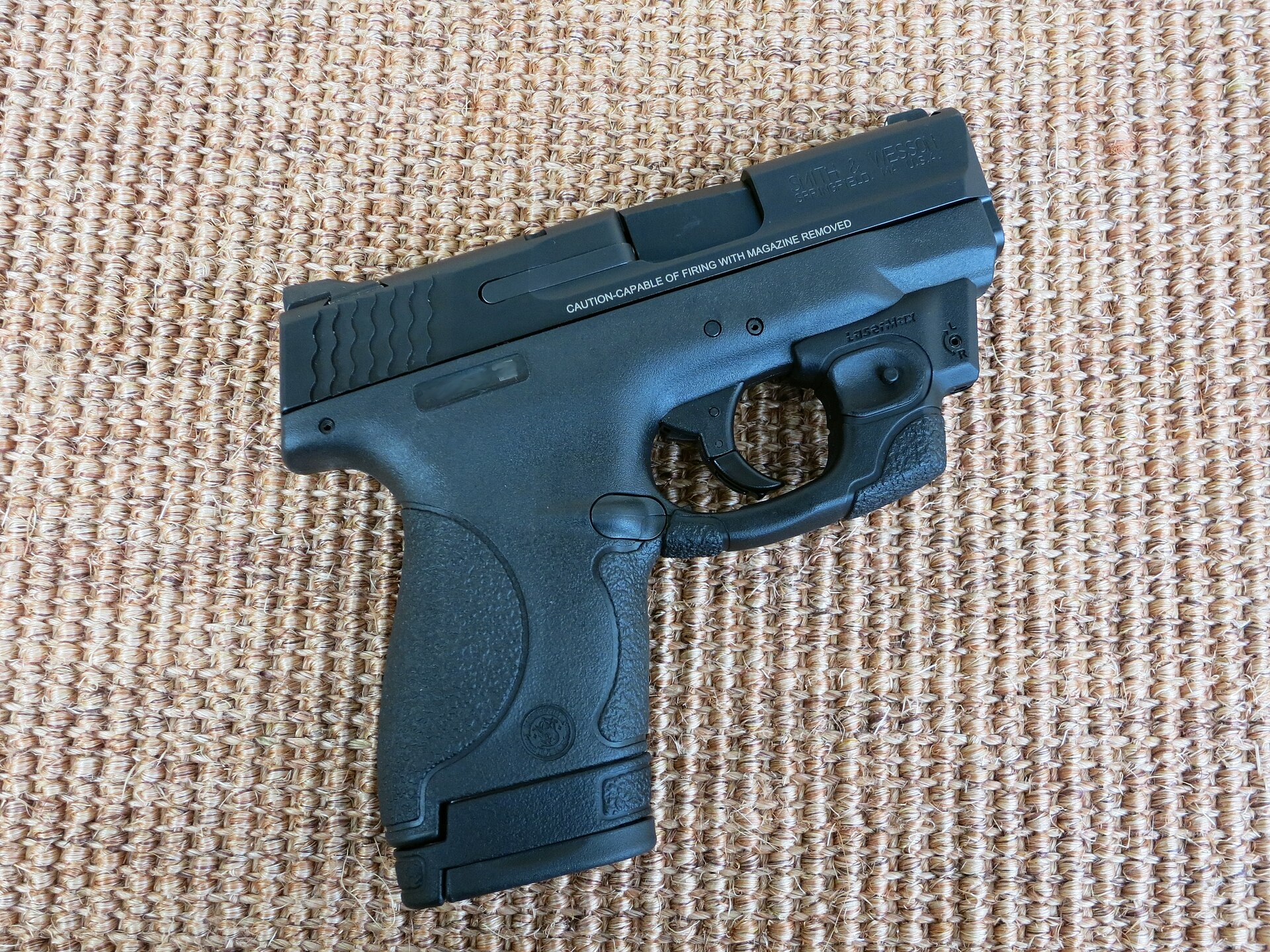
Loaded chamber indicator. The 2012 manual describes two types: Type 1, an opening at the rear of the barrel hood through which the cartridge rim can be seen, and Type 2, a tactile indicator on the top of the slide that protrudes when the chamber is loaded. “Some M&P Shield™ model pistols are equipped with” the tactile type.10 The indicator type therefore varies within the generation and is not a generation marker.
2.4 The Shield M2.0, 2017
Announced in October 2017, in 9 mm and .40 S&W, with Crimson Trace laser versions.11 Smith & Wesson’s current description of the .40 M2.0 gives its distinguishing features in the maker’s own words: “aggressive grip texture”, “Enhanced Grip Texture - The perfect blend between traction and comfort”, and “M2.0 Trigger - Striker-fired for short, consistent trigger pull”. Its listed width is 0.95 in and its height 4.6 in — the same figures as the 2012 pistol — with a 3.1-inch, 1:16-twist stainless barrel and a 7-round .40 magazine.3
The M2.0 has its own 9 mm magazine. Smith & Wesson sells an “M&P®9 Shield M2.0 Magazine with Finger Rest”, eight rounds, as a separate part from the original Shield’s eight-round 9 mm magazine, and lists both under “compatible with Shield”.5 Volume 3 takes up what that listing does and does not say.
What changed is in the frame. Grip texture and trigger are both frame-side features. The M2.0 is therefore the generation most easily confused with an original when only the slide is looked at.
⚠ The 9 mm M2.0 Shield is not in Smith & Wesson’s September 2026 catalogue; the M2.0 page lists only .40 and .45 models.6 No discontinuation date was found on Smith & Wesson’s pages and none is given here.
2.5 The Shield Plus, 2021
“The next evolution of the Smith & Wesson M&P Shield pistol”, announced 15 March 2021: a flat-face trigger, “a new, optimized grip texture designed for concealed carry”, an extended 13+1 and a flush 10+1 magazine, and the M&P’s 18-degree grip angle.2 Smith & Wesson’s current listing for the standard model adds a “tactile and audible trigger reset”, 3.1-inch stainless barrel, 1.1-inch width and 4.6-inch height, and states that “M&P’s patented take-down lever and sear deactivation systems all[ow] for disassembly without pulling the trigger.”12
The Shield Plus is where Smith & Wesson’s catalogue now has its 9 mm Shields, and the one generation with a long list of factory variants: standard, optics ready (a slide cut closed by a cover plate), thumb safety and no thumb safety, 10-round-limited “compliant” versions, a threaded barrel, the Performance Center Carry Comp, and the 30 Super Carry model.6
Identifying marks. Flat-face trigger; a 10-, 13- or 15-round magazine (the capacity witness holes run past eight); on optics-ready pistols, a cover plate held by two screws ahead of the rear sight. Smith & Wesson’s manual instructs that the pistol not be fired “without the slide cap or an optic in place.”7
2.6 The Shield X, 2025
Listed from July 2025: a 3.6-inch, 1:10-twist barrel, a longer grip, an accessory rail, a reversible magazine catch, aggressive front and rear serrations, an RMSc/K optic cut on standard models, and 13- and 15-round magazines.4 It is the easiest Shield to identify: the only one with a 3.6-inch barrel and the only one with a frame rail. Smith & Wesson’s manual says in terms that its magazines “are not directly interchangeable” with the Shield Plus.7
2.7 Performance Center Shields
Performance Center is Smith & Wesson’s in-house custom shop label, and it has been applied across Shield generations. On the Shield Plus the release lists “porting, fiber optic sights, longer slides, and optics cuts”.2 The Performance Center Carry Comp Shield Plus slide kit is described as “Optic Ready - RMSc/K footprint” with a barrel that “is only compatible with Shield Plus Carry Comp Slides”.13
Two consequences follow for identification. A Performance Center slide can be longer than 3.1 inches, so barrel length is not constant within the Shield Plus; and porting and fibre-optic sights are slide features, so a ported slide tells nothing about the frame it sits on. The photograph at the head of this volume shows a ported Performance Center Shield with a thumb safety; its grip texture is consistent with an earlier-pattern frame, but the photograph cannot establish the generation on its own and it is not captioned with one.
2.8 Options that cross generations
Four features appear on some pistols of more than one generation. None of them is a generation marker.
Table 2 — Options that cross generations
| Feature | Where it shows | What it tells |
|---|---|---|
| Manual thumb safety | frame, above the grip at the rear | configuration only; the 2012 launch pistol had one, the January 2015 pistol in Volume 1 has none, and current Shield Plus and Shield X models are sold both ways16 |
| Magazine disconnect | ”a small lever present in the magazine well” | configuration only; where it is absent, “there will be no small lever”7 |
| Loaded chamber indicator type | witness opening in the barrel hood, or tactile pin on the slide | varies within a generation10 |
| Laser | trigger-guard unit (factory Crimson Trace versions were sold — an earlier Shield manual is titled “M&P Shield Std & CTC” — and aftermarket units fit too) | nothing about generation |
The frame warning “CAUTION-CAPABLE OF FIRING WITH MAGAZINE REMOVED” belongs to the second row. It says what it says — that the pistol has no magazine disconnect — and nothing about the generation.
2.9 The Shield EZ is a different pistol
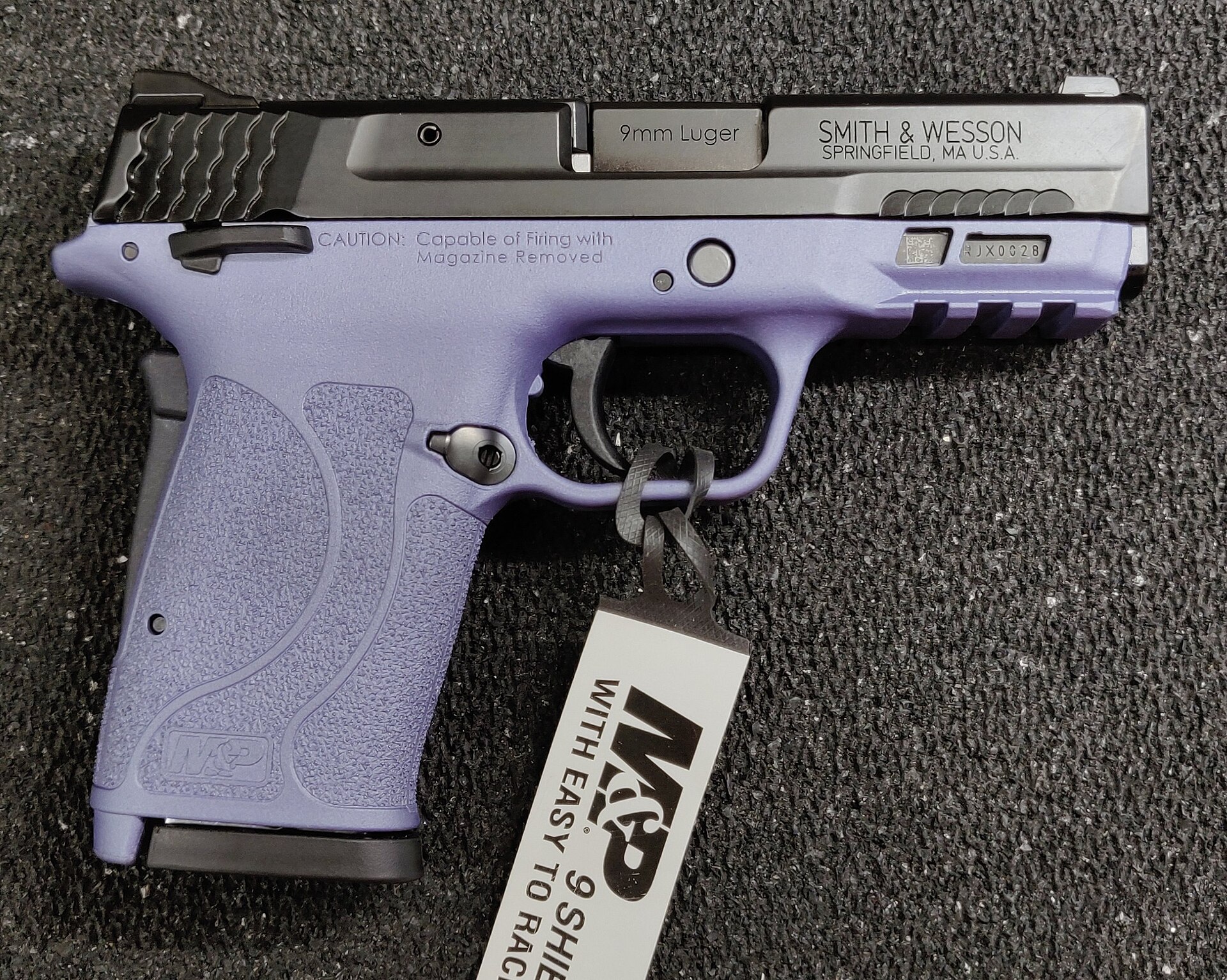
The Shield EZ, in .380 and 9 mm, is a hammer-fired pistol with a grip safety. Smith & Wesson’s own recall notice establishes both points: its 2020 recall concerns supplier hammers that could crack and fail “to fully engage the sear”, and states that “In all cases, the firearm will NOT fire unless the grip safety is depressed.”14 Leupold’s compatibility statement for the DeltaPoint Micro excludes it by name.15 Nothing in this dive about magazines, fire control, field stripping or optics applies to the EZ.
2.10 An identification procedure
Start with the frame, because the frame is the part that is the firearm, carries the serial number, and sets the magazine.
- Barrel length and frame rail. A 3.6-inch barrel and an accessory rail: Shield X. A 3.1-inch barrel: original, M2.0 or standard Shield Plus. Anything longer on a non-X Shield: a 4-inch model or a Performance Center slide, which is a slide question, not a frame one.
- The magazine the frame was sold with, and what the frame accepts. Witness holes that stop at seven or eight: single-stack Shield. Ten, thirteen or fifteen: Shield Plus or Shield X. A magazine is not conclusive on its own because magazines move between pistols; the frame’s magazine well is, and Volume 3 explains why a single-stack magazine is not a test of a Shield Plus frame.
- Trigger shape. A flat-face trigger is standard on the Shield Plus and Shield X; the original shipped with a curved hinged blade. Aftermarket triggers exist for all of them, so this is supporting evidence, not proof.
- Grip texture. Smith & Wesson describes the M2.0’s as “aggressive grip texture” and the Shield Plus’s as “a new, optimized grip texture designed for concealed carry”; both were introduced as changes from what came before. This is the least objective test and the one that most needs a known example beside it.
- The slide marking — last, and only as confirmation. If the slide marking agrees with steps 1–4, the identification stands. If it disagrees, the slide has probably been changed.
- The box and the maker. Smith & Wesson’s EZ recall directs owners to “the label on the box to determine date of manufacture”.14 The box end label and a call to Smith & Wesson with the serial number are the two sources that answer the question outright.
2.11 Applied to the pistol documented here
The pistol documented here is a 9×19 Shield with a 3.1-inch barrel, as recorded in September 2026. Step 1 is the only step the owner’s records answer, and it narrows the field to three: the original Shield, the Shield M2.0, or a standard Shield Plus. It is not a Shield X. It is not a Shield EZ — the DeltaPoint Micro fitted to it does not fit an EZ.15
Which of the three it is has not been recorded, and it matters for two practical reasons: the magazines (Volume 3) and the slide the DeltaPoint Micro sits on (Volume 5). It is listed among the questions for the owner.
2.12 Bibliography
Footnotes
-
“The Smith & Wesson M&P Shield”, American Rifleman, 12 April 2012, https://www.americanrifleman.org/articles/2012/4/12/the-smith-wesson-mp-shield/ (accessed 2026-09-19). ↩ ↩2 ↩3
-
Smith & Wesson Inc., press release “Shield is Back: Introducing the New M&P Shield® Plus”, 15 March 2021, https://assets.contentstack.io/v3/assets/bltb61dcb3c40854cd9/blt7f3b7e95c220c2b7/636d1f048d4c7b7d089925ac/PR_ShieldPlus_Final.pdf (accessed 2026-09-19). ↩ ↩2 ↩3
-
Smith & Wesson, “M&P®40 SHIELD M2.0® NO THUMB SAFETY”, item 14657, https://www.smith-wesson.com/product/m-p-40-shield-m2-0-no-thumb-safety (accessed 2026-09-19). ↩ ↩2
-
Smith & Wesson, “M&P® SHIELD X™ NO THUMB SAFETY”, item 14263, https://www.smith-wesson.com/product/m-p-shield-x-no-thumb-safety (accessed 2026-09-19). ↩ ↩2
-
Smith & Wesson, “M&P SHIELD M2.0 MAGAZINE 9MM 8RD”, item 3009876, $38, listed as “M&P®9 Shield M2.0 Magazine with Finger Rest” on the Smith & Wesson store, and “M&P SHIELD MAGAZINE 9MM 8RD”, item 199360000, $38; both on https://www.smith-wesson.com/products/compatible-with-shield (accessed 2026-09-19). ↩ ↩2
-
Smith & Wesson product category pages
/products/shield-m2-0,/products/shield-plusand/products/shield-xon smith-wesson.com, read 2026-09-19. ↩ ↩2 ↩3 ↩4 -
Smith & Wesson, Safety & Instruction Manual for SHIELD® PLUS and SHIELD X™ pistols, 07/08/25, part 3017716, https://smith-wesson.canto.com/direct/document/64u457llr51g7db5vqethvi635/gY5JDnG1Bq08wv-8wMzkvdugsCU/original?content-type=application/pdf&name=SHIELD_PLUS&X_Manual_070825_3017716.pdf (accessed 2026-09-19). Model & features identification (Figures 2–5), magazine disconnect safety, optical sight instructions, magazine interchangeability note. ↩ ↩2 ↩3 ↩4
-
Smith & Wesson, “M&P®9 SHIELD OR SHIELD PLUS FDE OPTIC READY SLIDE FOR 3.1IN BARREL”, item 14482, $299 (accessed 2026-09-19). ↩
-
Smith & Wesson, “SHIELD AND SHIELD PLUS 3.1IN 9MM BARREL”, item 14471, $119 (accessed 2026-09-19). ↩
-
Smith & Wesson, Safety & Instruction Manual, M&P SHIELD™ Pistols, © 2012 — loaded chamber indicator types 1 and 2. Smith & Wesson’s current manual portal is script-only; the copy consulted is hosted at https://savannaharsenal.files.wordpress.com/2014/05/mp_shield_manual_04-02-2012.pdf (accessed 2026-09-19). ↩ ↩2
-
“First Look: Smith & Wesson M&P Shield M2.0 Pistol Series”, American Rifleman, 16 October 2017 (consulted through search listings 2026-09-19). ↩
-
Smith & Wesson, “M&P 9 SHIELD PLUS”, item 13248, https://www.smith-wesson.com/product/m-p-9-shield-plus (accessed 2026-09-19). ↩
-
Smith & Wesson, Performance Center Shield Plus Carry Comp slide kits, as listed on https://www.smith-wesson.com/products/compatible-with-shield (accessed 2026-09-19). ↩
-
Smith & Wesson, “M&P® Shield™ EZ™ Recall Notice for Pistols”, https://www.smith-wesson.com/safety/recall/recall-notice-for-pistols (accessed 2026-09-19). ↩ ↩2
-
Leupold & Stevens, “DeltaPoint Micro (S&W M&P)”, part 179570, https://www.leupold.com/deltapoint-micro-s-w-m-p (accessed 2026-09-19): “Does not fit Rimfire Glock and M&P models, Glock MOS, Smith and Wesson M&P CORE, Smith and Wesson Shield EZ, nor Smith and Wesson M&P 5.7 models”. ↩ ↩2
Comments (0)