The Rifle Shoppe Ketland Blunderbuss · Volume 7
Feeding & Firing a .75 Coaching Buss
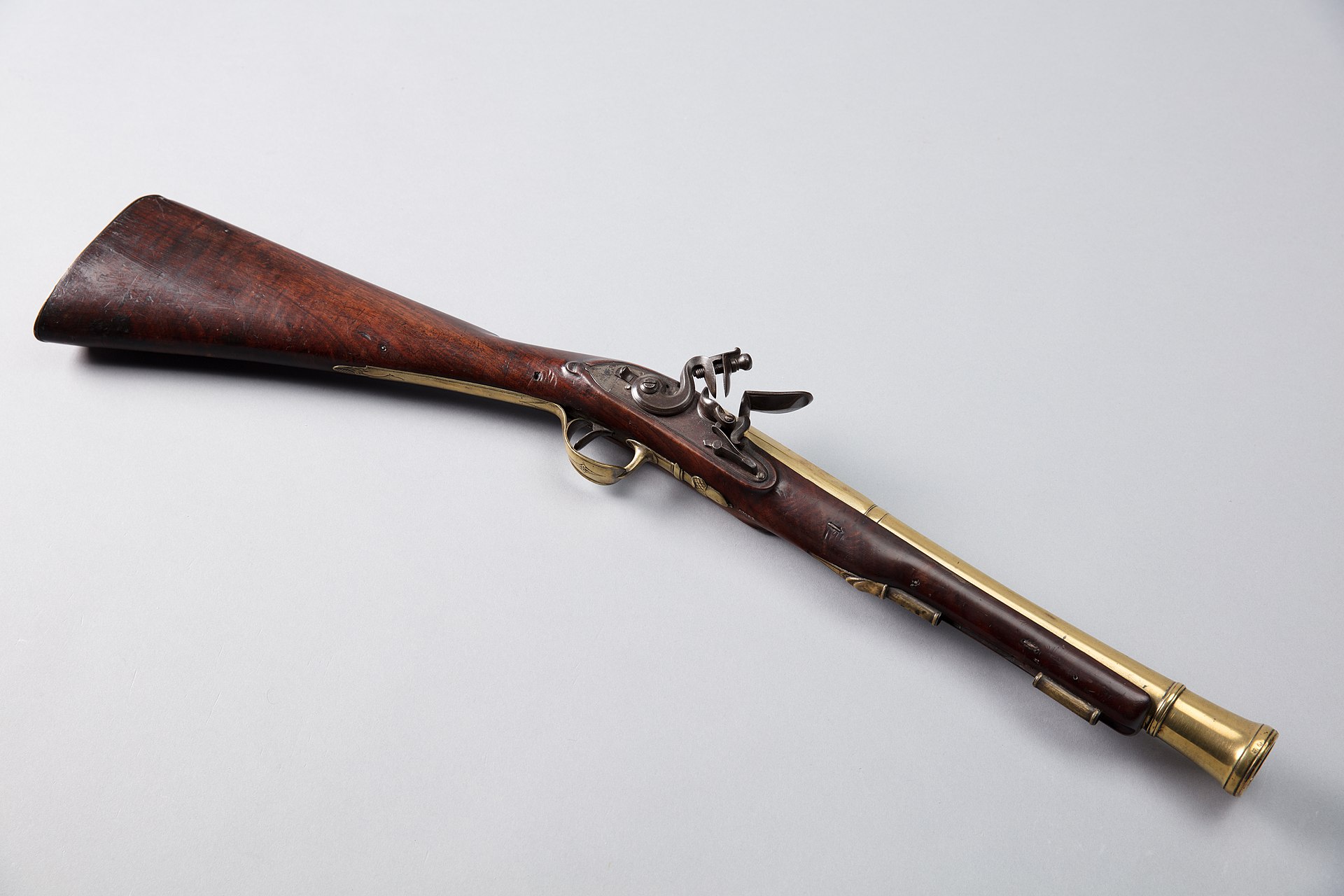
You have built a real .75 English coaching blunderbuss. This volume covers what to feed it and how to fire it safely. The 821 is a genuine, serious black-powder firearm — a three-quarter-inch smoothbore — and it is loaded and shot like the historical gun it copies. The fundamental black-powder mechanics, the flintlock firing cycle, the misfire drill, and the range-safety rules apply identically to every muzzleloader, so this volume cross-references the Traditions Blunderbuss dive for the full loading sequence, misfire procedure, and safety rules rather than repeating all of them, and concentrates on what is specific to a .75 coaching buss.
7.1 What a .75 smoothbore eats
Three-quarter-inch bore is the classic English coaching size, and it gives you the same menu the original coach guard had:
- Patched round ball. A .75 bore takes a round ball of roughly .735-inch diameter, run down over a cloth patch that engages the smooth bore and seals the gases. A patched ball is the single-projectile load — a heavy lead ball for a deliberate, close shot. Size the ball and patch so the combination loads snugly with firm ramrod pressure but does not require pounding; the patch’s thickness makes up the small difference between ball and bore.
- Shot. Loaded with a charge of shot, the buss becomes what it historically was for most of its life — a short, crude single-barrel shotgun for close work. Over powder you seat an over-powder wad, pour the shot, and hold it with an over-shot wad. Pattern-test on paper at the short range you actually intend to shoot; a smoothbore’s pattern opens quickly and effective range is genuinely short.
- Buck-and-ball / coach load. The historical coaching load was often a mix — a ball plus several buckshot, or a heavy charge of large buck — the “scatter of lead into a close press” that made the buss a defensive gun. This is the load that gives the type its character.
A myth to keep dispelling at the range: the flared bell muzzle does not spread the shot into a wide cone. The pattern is set by the powder charge, the shot size, and the bore — not by the last inch of flare. The bell is for fast loading and intimidation. Load and expect patterns accordingly.
7.2 Powder: start low and work up
Use only real black powder (or an appropriate black-powder substitute rated for flintlock ignition — a true flintlock needs a powder that ignites reliably from the pan, which is a reason many buss shooters stay with genuine black powder). Use an FFg grade for a bore this size; the finer FFFg is a pistol/small-bore powder.
The cardinal rule for a hand-built gun with no factory load data: start low and work up. Begin with a modest charge, fire, inspect, and increase in small increments while watching for a clean, comfortable report and no sign of over-pressure. There is no published cartridge for a .75 you built from castings, so you establish a sane working load by careful increment. Never guess high. A .75 coaching buss is not a magnum — it is a close-range gun, and modest charges do everything the gun is for. Work up a ball load and a shot load separately, and keep a written record of what shot well.
Two hard rules that never bend, both detailed in the Traditions dive’s loading volume: measure every charge from a separate powder measure, never poured directly from the horn, flask, or can into the muzzle — a lingering ember loading straight from a powder source is how people lose hands and eyes; and seat every load firmly and consistently against the powder with no air gap between powder and projectile, which is both a safety and an accuracy requirement in a muzzleloader.
7.3 Firing the flintlock
The 613 is an English flintlock, and it fires on the same cycle as any flint gun — a sharp flint scraping the frizzen, sparks into a primed pan, flash through the touch-hole to the main charge. The full firing cycle, priming, and the essential misfire and hangfire drill — what to do when the pan flashes but the gun does not fire, and the discipline of keeping the muzzle downrange and waiting before you ever look down the barrel — are covered step by step in the Traditions Blunderbuss dive and apply identically here. The one point worth stating plainly: with a flintlock, treat every apparent misfire as a potential slow hangfire. Keep it pointed downrange, count out a full wait, and never break that rule to peek.
7.4 Safety specific to this gun
Beyond the universal muzzleloader safety rules (eye and ear protection, a clear range, no smoking near powder, one load at a time, verify the bore is empty before loading) — all in the Traditions dive — a few points are specific to a hand-built .75 buss:
- This is a firearm, fully. A hand-built appearance changes nothing about that. Store, transport, and handle it as the firearm it is, and know your state and local law on muzzleloaders (many, not all, treat them differently from modern firearms — verify locally).
- Trust your own work — and verify it. You built the lock (or bought it), inletted the breech and tang, and set the touch-hole. Before the first live round, confirm the breech is sound and tight, the tang and lock are properly bedded and pinned, and the barrel is clear. Fire the first several rounds with reduced charges as a proof-and-familiarization step before working up.
- Short range, close targets. The gun has no sights and a 15½-inch smoothbore barrel. It is a point-and-shoot, close-range arm by design. Shoot it as what it is.
- Clean it same-day. Black powder is corrosive. Scrub the bore, lock, and pan with hot soapy water, dry thoroughly, and oil — every time you shoot, without exception.
Fed sensibly and respected as the real firearm it is, the 821 does exactly what a Ketland coaching buss did two and a half centuries ago: throws a heavy, close charge with a satisfying roar from a gun you built by hand. For the deep loading detail, the misfire drill, and the full safety code, keep the Traditions Blunderbuss dive open alongside this one — and remember the Stonewall Creek 4-Gauge dive for the far larger bore above this tier.
Sources
General black-powder loading and flintlock safety practice for a .75 smoothbore (patched round ball sizing, shot and buck-and-ball coach loads, start-low-work-up charge development, misfire/hangfire discipline); shared loading sequence, misfire drill, and safety rules cross-referenced from the Traditions Blunderbuss dive.
Comments (0)