The Rifle Shoppe Ketland Blunderbuss · Volume 6
Finishing: Stock Stain/Oil and a Period Rust-Brown Barrel
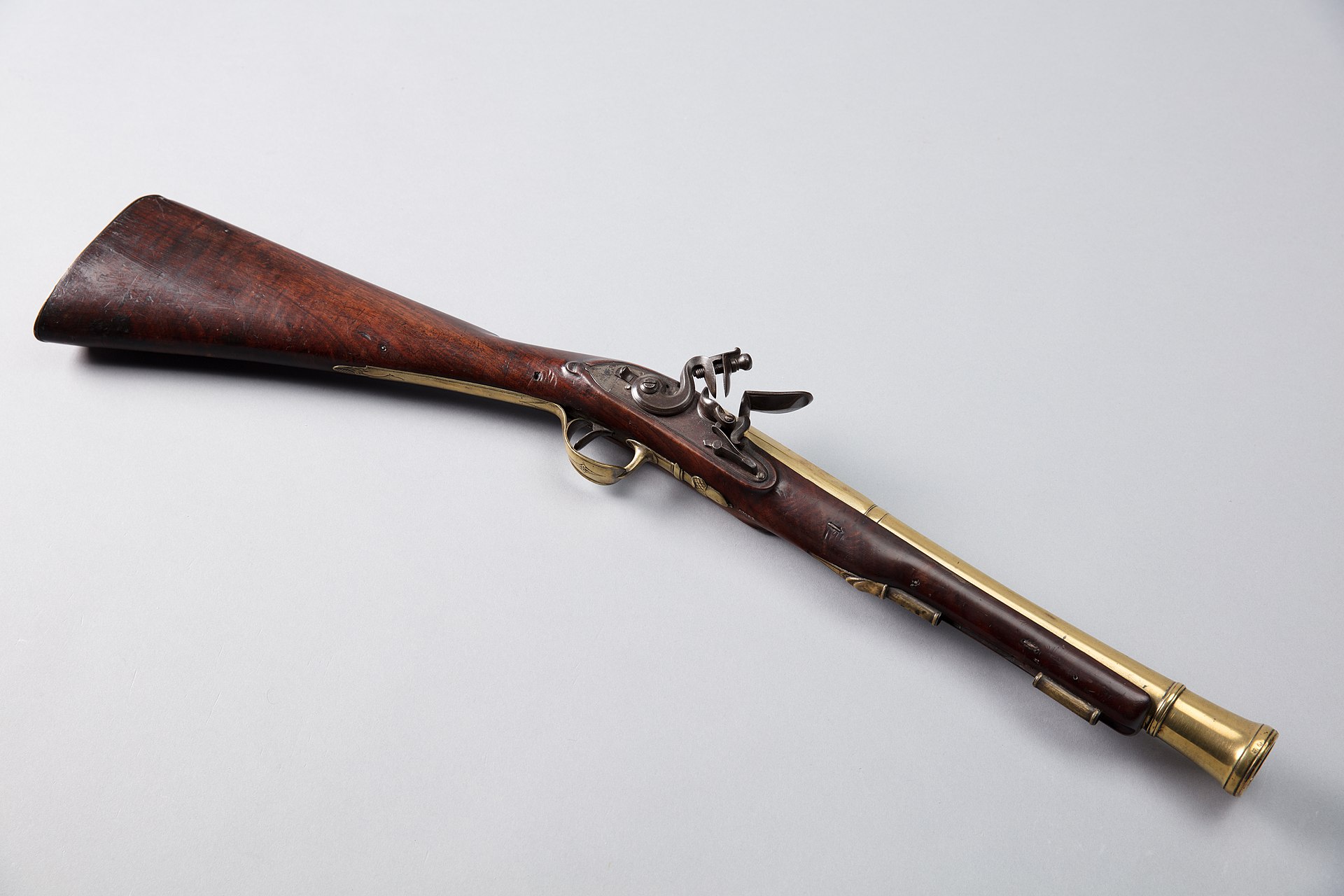
With every part cleaned up, fitted, and inletted, the gun is mechanically finished but visually raw — bare walnut and grey steel. Finishing is what makes it a Ketland rather than a project, and on a faithful copy it should be a period finish, not a modern one. This volume covers finishing the English walnut and putting a period rust-brown on the barrel. The base methods for both are covered at length in the Traditions Blunderbuss dive — its stock-finishing volume and its browning volume — so this volume adapts those methods to this specific build rather than repeating every step; read them alongside this one.
6.1 Finishing the walnut
The 821’s walnut wants the classic English oil finish: a stained ground brought up under many thin coats of oil to a deep, warm, close-grained glow — nothing glossy, nothing plastic. The sequence, adapted from the Traditions dive’s stock volume:
- Final scrape and sand. After shaping (Volume 5), take the wood to its final surface by scraping and then sanding through descending grits. Do not over-sand into the metal or round the crisp wood-to-metal lines you worked for; finish the wood flush to each part.
- Whisker the grain. Wet the wood to raise the grain, let it dry, and knock back the raised fibers with fine paper or a burnisher. Repeat until wetting no longer raises a whisker. Skipping this is why a finish feels rough after the first coat.
- Stain to an English walnut tone. A period English buss reads as a warm-to-dark brown walnut. Aqua fortis (ferric nitrate) blushed with heat is the traditional, most authentic route on walnut and gives a rich, slightly reddish-brown ground with depth; an alcohol or oil stain in a walnut tone is the simpler path. Test on scrap or a hidden area first, and build color in controlled steps rather than one heavy application.
- Oil finish, many thin coats. Build the finish with a traditional stock oil — a linseed- or tung-based finish — applied in very thin coats, each rubbed in and allowed to cure hard before the next. The grain fills over many coats; rushing thick coats gives a gummy, streaky surface. Rub back between coats and finish with a hand-rubbed sheen, not a high gloss. A period buss was a working gun; the finish should look like hand-rubbed oil, which is exactly what it is.
Leave the brass furniture bright or let it take a mellow patina to taste — an original coaching buss would show honest wear on brightwork, and softly patinated brass looks more right than a hard modern polish. That is a preference call; either is defensible.
6.2 A period rust-brown on the barrel
If the 821 barrel is steel, the correct period finish is a rust brown, not blue and certainly not bright. Rust browning is the authentic eighteenth/early-nineteenth-century barrel finish: a controlled, even coat of fine red rust converted to a hard, protective brown surface. It is also, done well, beautiful — a soft, deep brown that suits a coaching buss far better than any modern finish. The Traditions dive’s browning volume gives the full step-by-step; the method, adapted here:
- Degrease absolutely. The barrel must be chemically clean — no oil, no fingerprints. Handle it with gloves or by plugs in the bore and muzzle from this point on. Any oil spot will refuse to brown and leave a blemish.
- Apply the browning solution. Wipe on a thin, even coat of a rust-browning solution and set the barrel in a warm, humid place to rust. A damp box or “sweat box” gives the even, controlled humidity that makes for uniform browning.
- Card and repeat. After each rusting cycle, card the barrel — knock the loose red rust back to a hard brown film with fine steel wool, a card, or a wheel, without stripping it to bare metal. Then re-apply, re-rust, and re-card. Each cycle deepens and evens the color. Expect several cycles over a few days to build a rich, uniform brown.
- Stop the rust and oil. When the color is right, neutralize/stop the rusting action (a baking-soda water rinse or boiling to convert, per your solution’s directions), let it dry, and oil the surface to protect it. The result is a stable, period-correct brown that will only look better with honest use.
A note on the barrel material: many English coaching and naval busses wore brass barrels, which need no browning at all — brass is finished by polishing and then allowing or forcing a patina, and does not rust. Confirm the 821 barrel’s material when you inspect the set (Volume 3) and finish accordingly: rust-brown for steel, polish-and-patina for brass. Either is period-correct for the type.
6.3 Assembly and the finished gun
With the wood finished and the barrel browned, do the final assembly: bed the finished barrel, hang the lock, set the furniture, pin and screw everything home, and fit the brass-tipped ramrod through its pipes. Wipe an oiled cloth over the steel, and the build is done — a hand-built copy of a real Ketland coaching blunderbuss, finished the way its original was. Volume 7 takes it to the range.
Sources
Traditional muzzleloader stock finishing (whiskering, aqua fortis / walnut stains, hand-rubbed oil) and rust-browning practice (sweat-box rusting, carding cycles, stopping and oiling); adapted from the Traditions Blunderbuss dive’s stock-finishing and barrel-browning volumes. Barrel material per the Rifle Shoppe 821 set as received.
Comments (0)