The Rifle Shoppe Ketland Blunderbuss · Volume 1
Overview: The Ketland, and What a 'Parts Set from Castings' Really Means
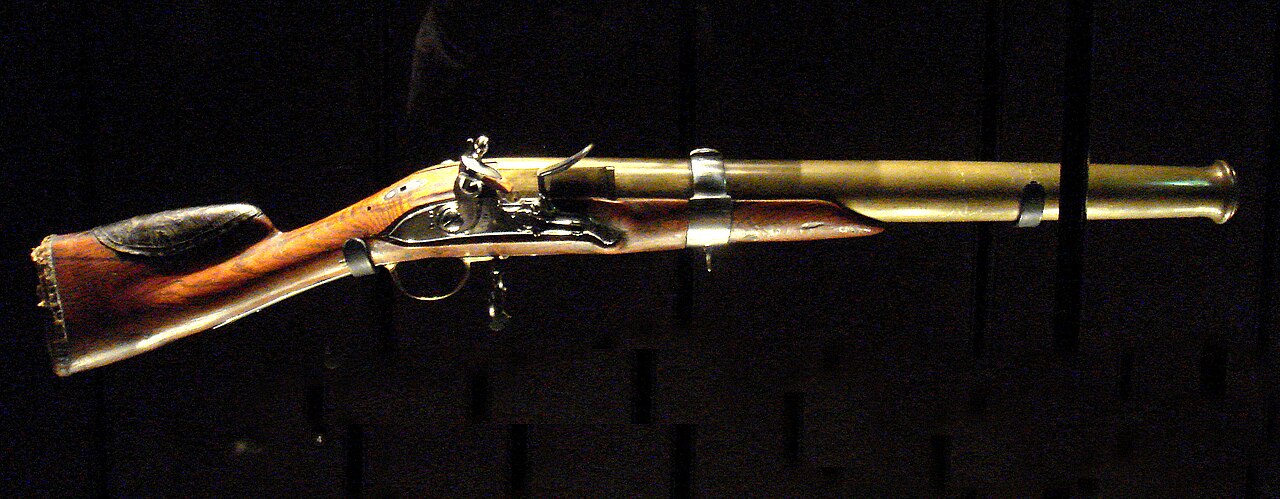
This dive is about building one specific gun: The Rifle Shoppe’s British Ketland Blunderbuss, catalog number 821 — a .75-caliber coaching buss with a 15½-inch barrel, sold not as a kit but as a set of raw investment castings and a plank of walnut. It is the currently-orderable, high-fidelity answer to a builder who wants a museum-accurate English blunderbuss and is willing to earn it at the bench. Where the companion Stonewall Creek 4-Gauge dive covers the unobtainable brass-barreled grail — a semi-custom build gated for years on Ed Rayl 4-bore barrels — this is the premium build you can actually pick up the phone and order. The trade is explicit and it is the spine of everything that follows: maximum fidelity for maximum handwork.
1.1 What “parts set” actually means here
The word “kit” does a lot of dishonest work in the muzzleloader trade. A Traditions blunderbuss is a kit in the truest sense — the barrel channel is cut, the lock mortise is milled, the holes are drilled, and you are essentially finishing and screwing together a gun that was ninety percent built in Spain. A Pecatonica River order is a precarve: a machine-shaped walnut stock with the major inletting roughed in, plus components you fit. The Rifle Shoppe sells neither of those things. What arrives is a box of investment castings — the lockplate and its internals, the buttplate, the trigger guard, the ramrod pipes, the barrel — together with a stock that is closer to a shaped plank than a precarve, and a bag of small parts. Nothing is inletted. The castings wear sprue stubs and mold flash. There are no drilled pin holes waiting for you. You are not assembling a gun; you are building one, and the set simply guarantees that every part you build with is the correct shape copied from a real Ketland.
That is the whole proposition. You are buying fidelity and correct raw stock, and you are supplying the gunsmithing.
1.2 Why the Ketland set, specifically
The Rifle Shoppe (Enid, Oklahoma) specializes in exactly this: correct investment-cast parts sets copied part-for-part from surviving originals, for arms that no one mass-produces. Their 821 buss is copied from an original Ketland blunderbuss in the Kit Ravenshear collection. That provenance is the reason this set exists and the reason it earns a premium-build dive of its own. It is not a generic “blunderbuss shape” cast from a modeler’s guess; it is a reproduction of a documented eighteenth-century English coaching gun, and Volume 2 lays out who the Ketlands were and why that pattern matters.
The specifications, as the catalog gives them: .75 caliber bore, 15½-inch barrel — a genuinely short, stout coaching-buss profile, the length a guard could swing around on a moving coach box. Ignition is The Rifle Shoppe’s series 613 English lock, which — and this is the pivotal choice of the whole build — is offered either as raw castings you assemble and tune yourself, or fully assembled.
1.3 The $1,195 vs $1,495 decision, up front
The set is sold two ways, and the difference is one component:
Table 1 — The set is sold two ways, and the difference is one component
| Parts set, lock as castings | Parts set, assembled lock | |
|---|---|---|
| Price | $1,195 | $1,495 |
| The 613 English lock | Cast parts — you fit, harden, and tune it | Built and functioning |
| Everything else | Identical castings + plank stock | Identical castings + plank stock |
| Who it suits | Confident lock-builders | Everyone else |
The $300 spread buys you a working lock instead of a pile of lock castings. Building a flintlock from castings — fitting the sear and tumbler, timing the half- and full-cock notches, setting the frizzen and its spring, and getting the hardening right — is a real skill, and Volume 4 is honest about it. If you are not already comfortable that you can heat-treat a sear and a frizzen correctly, the assembled lock is the cheap insurance in this whole project. Individually, the set’s parts price out at roughly: barrel $395, stock $325, assembled lock $495, buttplate $39.95, trigger guard $39.95, and a brass-tipped tapered ramrod $39.95. Volume 3 walks the full contents.
One standing caveat for every price and spec in this series: The Rifle Shoppe’s catalog page for the 821 is dated 2010, and the shop updates slowly and works largely to order. Treat every figure here as the 2010 catalog number and confirm current price, contents, and lead time by phone — 405-356-2583 — before you send money. Expect to be told stock must be confirmed and that lead time runs roughly one to two months. This is a call-first purchase, not a shopping-cart one.
1.4 Who this build is for
The Rifle Shoppe grades this set advanced to expert, and that grade is not marketing caution — it is accurate. This dive is written for a maker who is comfortable draw-filing a casting true, cutting a barrel channel and an octagon-to-round breech into bare wood with inletting black and a scraper, fitting brass to shaped walnut, and finishing steel with a period process. If you have built a longrifle or a fowler from a blank, you have the skills. If your muzzleloader experience is a drop-together kit, read Volume 4 and Volume 5 carefully and decide honestly whether this is your next project or your third.
The reward, for the right builder, is a piece that no assembly kit can touch: a faithful copy of a real Ketland coaching buss, built by hand, for roughly a third the cost of commissioning a fine custom.
1.5 Where this dive goes
- Volume 2 — the Ketlands as gunmakers, and the English coaching/naval blunderbuss the 821 reproduces.
- Volume 3 — the full contents of the set, the 613 lock, the plank stock, and the $1,195/$1,495 choice in detail.
- Volume 4 — cleaning up investment castings, and building or buying the lock.
- Volume 5 — inletting from scratch: barrel, tang, lock, and furniture into a plank.
- Volume 6 — finishing the walnut and a period rust-brown on the barrel.
- Volume 7 — feeding and firing a .75 coaching buss.
For the shared black-powder fundamentals — how a flintlock actually works, the misfire drill, and the range-safety rules that apply to any muzzleloader — this dive cross-references the Traditions Blunderbuss dive rather than repeating them, and points to the Stonewall Creek 4-Gauge dive as the rarer, bigger-bore tier above this one.
Sources
The Rifle Shoppe catalog (2010, cat. 821 British Ketland Blunderbuss); the project blunderbuss-kit research file; Kit Ravenshear collection provenance as cited by The Rifle Shoppe.
Comments (0)